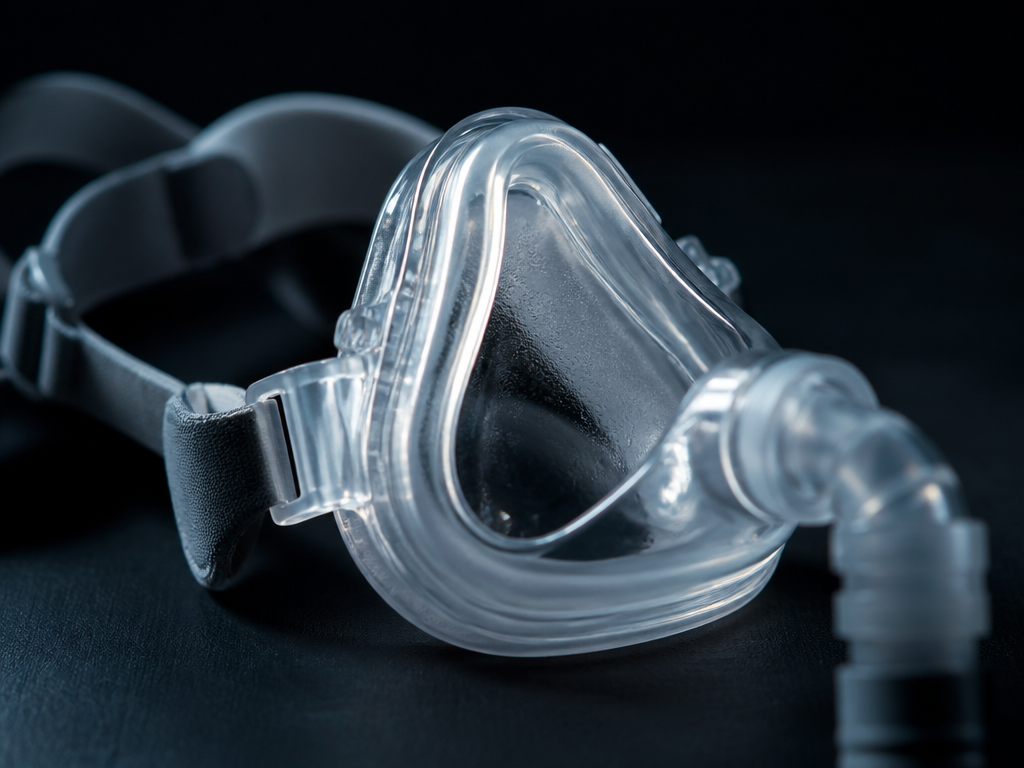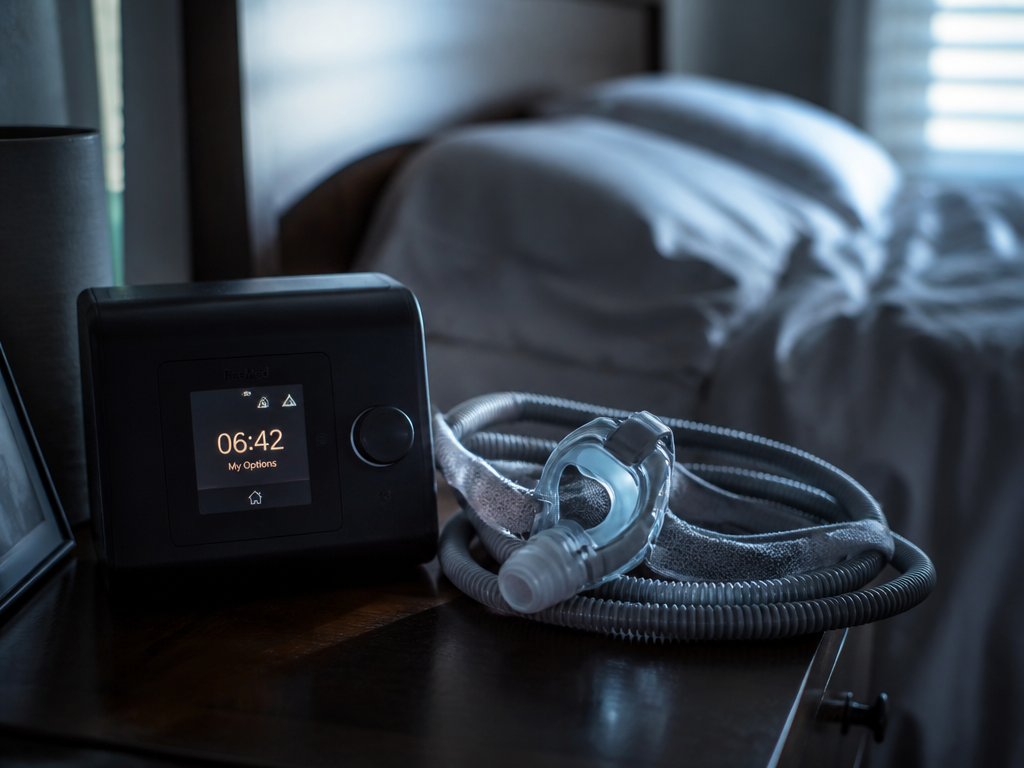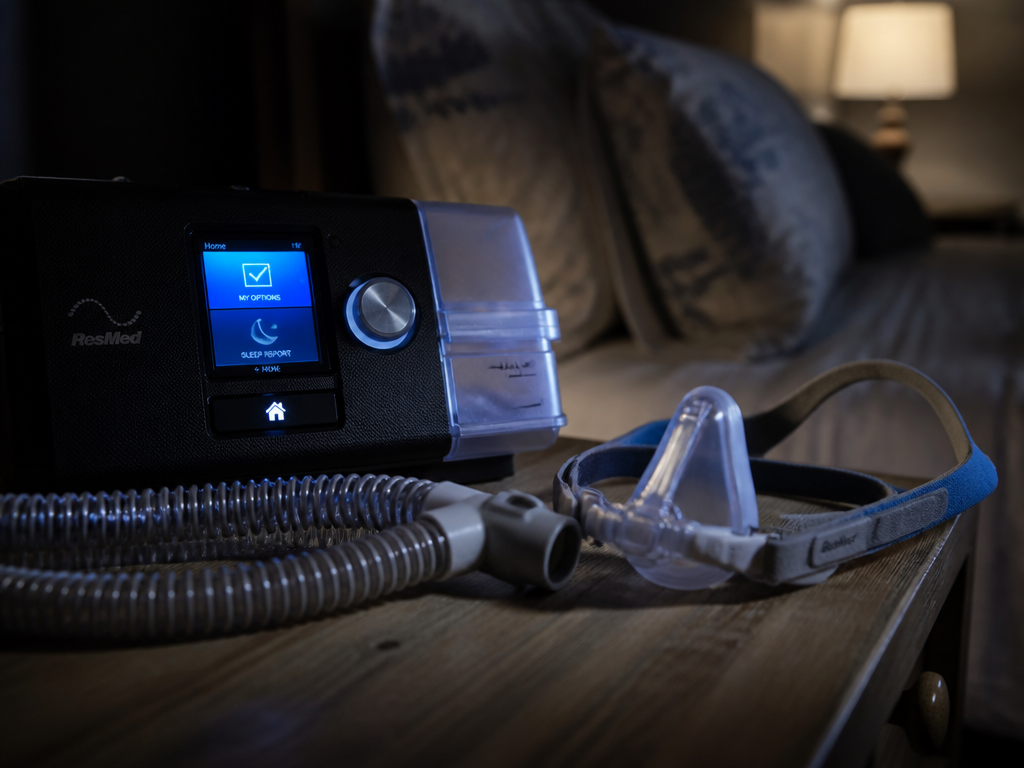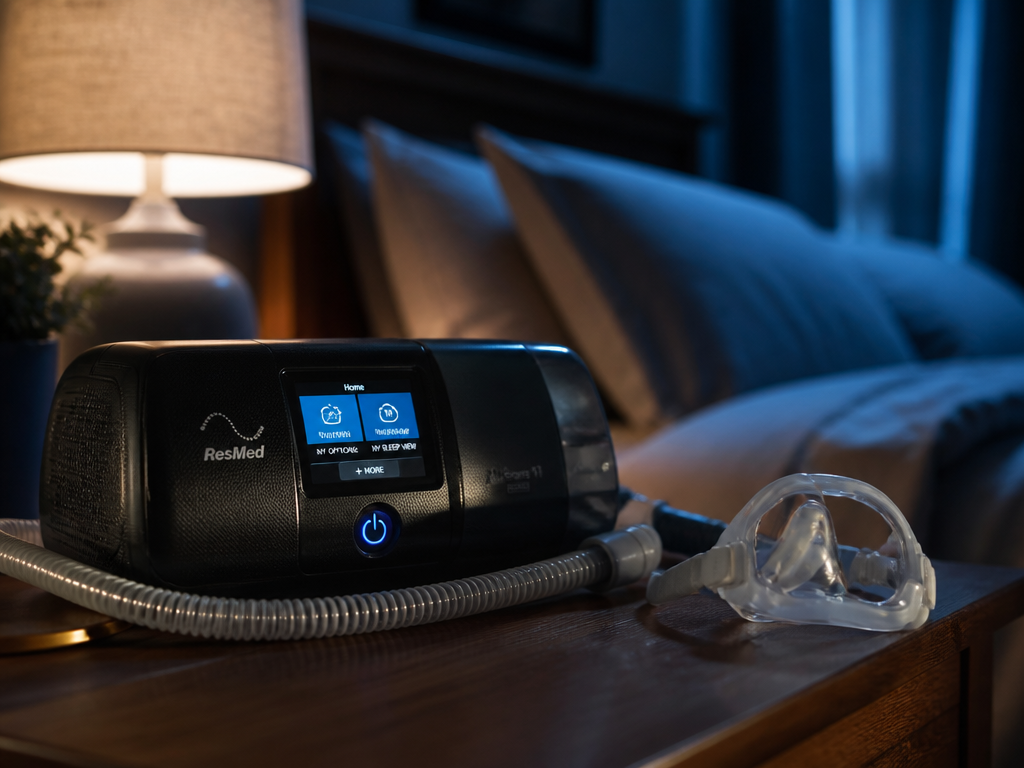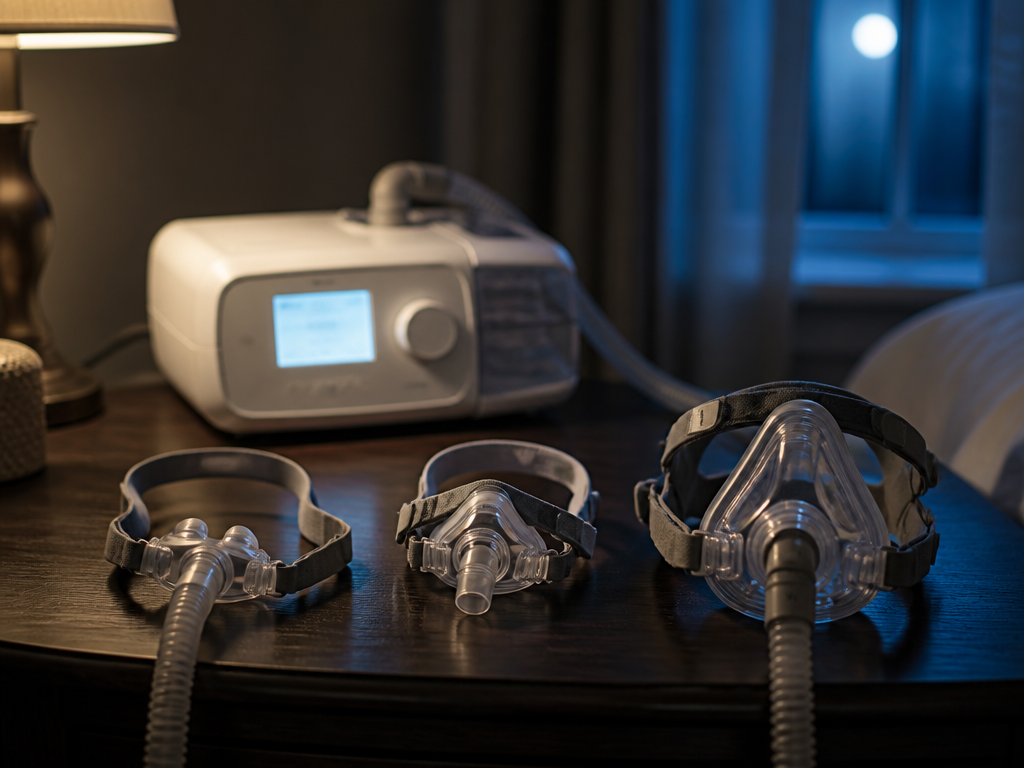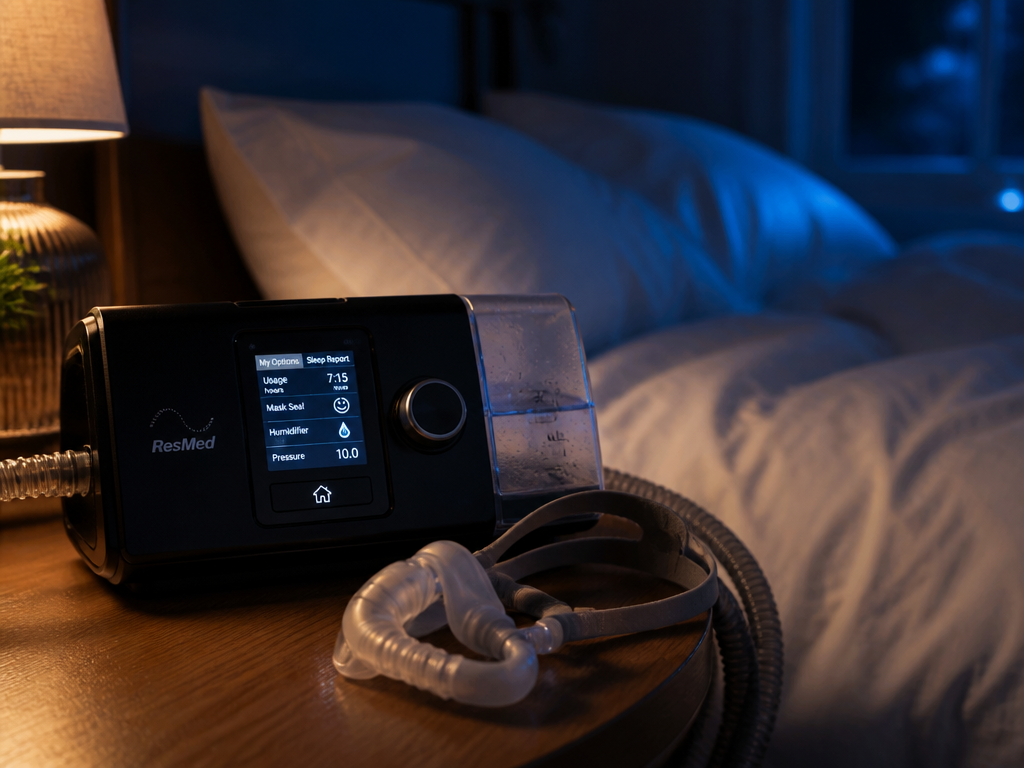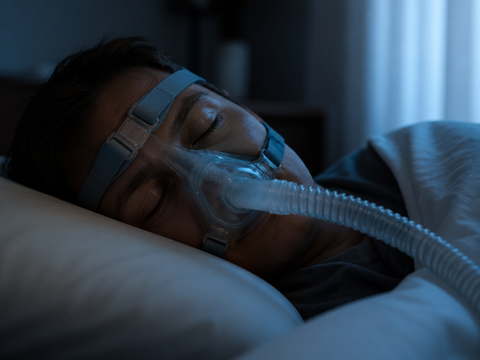
For three weeks I swapped my fixed-pressure CPAP for a VPAP — variable, or bilevel, positive airway pressure — and tracked what changed breath by breath. The verdict: a VPAP did not make me sleep more, but it made the act of exhaling against the machine roughly 40% less of a fight, and that was enough to move me from grudging tolerance to actual use. The device delivers two pressures instead of one — a higher pressure when you breathe in, a lower one when you breathe out — and that single architectural difference is the whole story.
I'm not a naive subject. I've used CPAP for four years at a titrated 11 cmH₂O, with an AHI that sits reliably under 3. My problem was never efficacy. It was the nightly sensation of pushing my breath out against a wall. So this is a review of comfort and mechanism, not a rescue story. What follows tracks the air itself — in, the moment between, and out — because that's the order in which the machine and your body actually negotiate.
The inhale: where the higher number lives
When you breathe in, the VPAP delivers what's labeled IPAP — inspiratory positive airway pressure. On my loaner unit, set by the sleep tech, IPAP was 13 cmH₂O. That's two above my old CPAP number, and it's doing the same job CPAP always did: splinting the soft tissue of the upper airway open so it doesn't collapse on the inhale. This is the part that treats the apnea.
Subjectively, the inhale felt more assisted than CPAP, not less. There's a faint sense of being handed the breath. For the first three nights I found this mildly alarming and woke twice convinced the machine was over-delivering. By night five it had become invisible, which is the only acceptable state for any sensation a PAP device produces.
The number that mattered to me here: my morning leak rate dropped from a CPAP average of 7 L/min to 4 L/min on the bilevel. I suspect the lower exhale pressure (below) meant I clenched my jaw less and broke the mask seal less. I can't prove the mechanism — that's a guess from one mouth.
The pause: the moment the machine decides
Here is where a VPAP earns its complexity. Between inhale and exhale, the device has to detect that you've finished breathing in and switch pressures. This is the trigger and cycle behavior, and it's the single thing a fixed CPAP never has to do.
My unit let the tech set trigger sensitivity to "medium." When it worked, the switch from 13 down to exhale pressure was seamless — I never caught it happening. When it didn't, on perhaps one breath in forty, the drop came a half-beat late and I felt like I was exhaling into a brief headwind. That mistimed breath is, as far as I can tell, the characteristic failure mode of bilevel therapy: not too much pressure or too little, but pressure arriving at the wrong instant in your respiratory cycle.
I have no instrument to measure trigger latency at home. The clinic's report flagged zero "patient-ventilator asynchrony" events, which either means my forty-to-one estimate is wrong or the events were too brief to register. I'll note the discrepancy and not resolve it.
The exhale: the reason anyone switches
Breathing out, the device drops to EPAP — expiratory positive airway pressure. Mine was set at 9 cmH₂O, four below the inhale number. That four-point gap is the entire pitch of bilevel therapy for someone like me.
This is what I came for, and it delivered. Exhaling against 9 instead of against a flat 11 is, in the body, a meaningfully easier task. I'd estimated the relief as "about 40% less of a fight" above; that's a felt number, not a measured one, but it tracks with the physics — less back-pressure to overcome, less work per breath, fewer micro-arousals from the effort.

CPAP machines offer their own exhale relief (ResMed's EPR, Philips's Flex), which briefly dips pressure at the start of exhale and ramps it back. I've used EPR at setting 3. The difference is that EPR returns you to full pressure mid-exhale; a true VPAP holds the lower EPAP across the whole expiratory phase. The distinction is small on paper and large at 2 a.m.
CPAP vs APAP vs VPAP
| Criterion | CPAP | APAP | VPAP (bilevel) |
|---|---|---|---|
| Pressure delivery | One fixed level | One auto-adjusting level | Two levels: higher in, lower out |
| What it adapts to | Nothing | Breath-to-breath obstruction | Your inhale/exhale phase |
| Exhale comfort | Lowest (relief features help) | Moderate | Highest |
| Typical first prescription | Yes | Often | Rarely |
| Relative device cost | $ | $$ | $$$ |
| Best served patient | Straightforward OSA | Variable nightly pressure need | Exhale-intolerant; high-pressure; some complex cases |
The honest summary of that table: APAP varies pressure across the night; a VPAP varies it across the breath. They solve different problems and are not competitors so much as answers to different complaints.
What I could and couldn't measure
I tracked, with reasonable confidence:
- AHI: CPAP 2.8 average, VPAP 2.6 average. No meaningful difference. Both control my apnea.
- Leak: dropped, as noted, from 7 to 4 L/min.
- Self-reported nightly use: rose from 5h 40m to 6h 55m. This is the result I actually care about.
I could not measure:
- Whether the longer use produced any daytime benefit. Three weeks and one subject is no sample. My Epworth score didn't budge, but it was already low.
- Trigger latency, as discussed.
- Anything about long-term adherence. Three weeks is the honeymoon window for any new device. I've abandoned gear I loved in week one by week six.
Who this is for — and who it isn't
Consider asking your clinician about bilevel if: you tolerate CPAP's therapy but hate the exhale; your titrated pressure is high (mid-teens and up), where the work of breathing out becomes genuinely tiring; or you have a documented reason you can't sustain CPAP and your doctor has ruled out the simpler fixes — mask refit, ramp settings, exhale-relief features — first.
This is probably not your device if: you were diagnosed last week and haven't tried anything yet. Bilevel is rarely a first prescription, and for good reason — it's costlier, more complex to titrate, and most people with straightforward obstructive sleep apnea do fine on a single pressure. It's also the wrong place to start shopping on your own; the inhale, exhale, and trigger settings on these units are not numbers to guess at.
If you take one line from this: a VPAP is the best PAP device I've used for the specific problem of exhaling against pressure, and a waste of money for almost any other problem.
The question I can't close
Here's what nagged at me by week three. My nightly use went up by more than an hour — clearly, measurably, on a device that was easier to breathe out of. But my AHI was already controlled on CPAP. So the extra hour of more-comfortable, equally-effective therapy: did it buy me anything?
The field assumes that comfort drives adherence and adherence drives outcomes, and the first half of that chain is well supported. The second half — whether the marginal hour of PAP use, in someone already well-controlled, changes cardiovascular or cognitive risk — is genuinely unsettled. The large trials that tried to link PAP adherence to hard outcomes have been frustratingly equivocal. I made my nights easier. Whether I made my life longer, I don't know, and neither, honestly, does anyone yet.