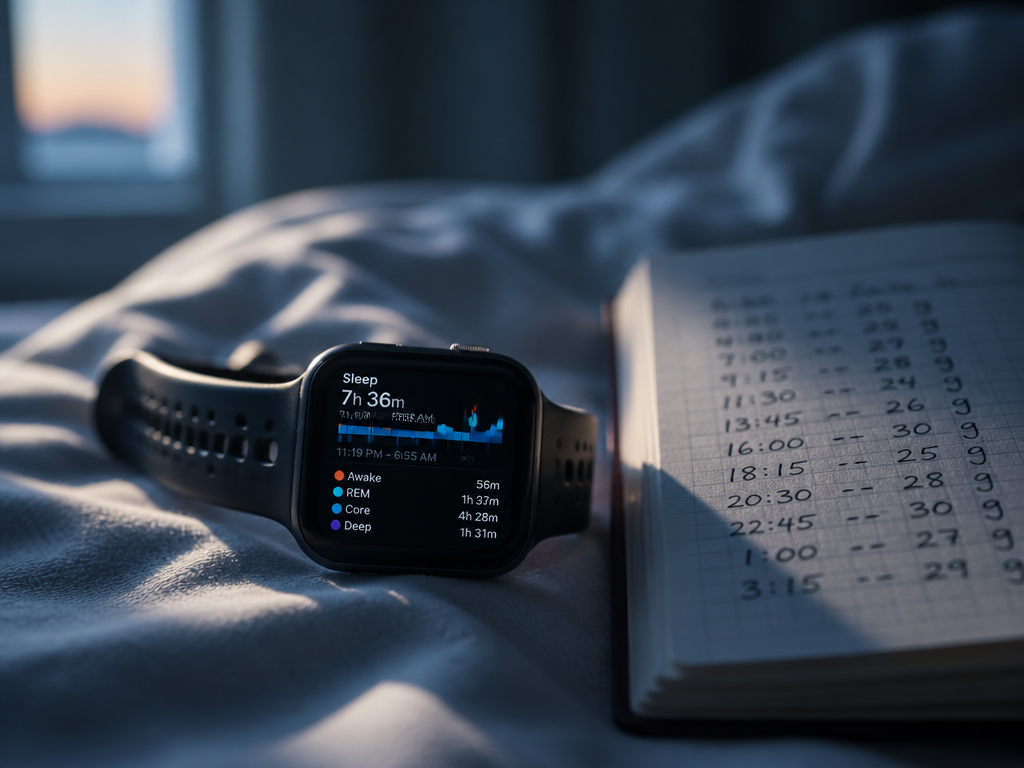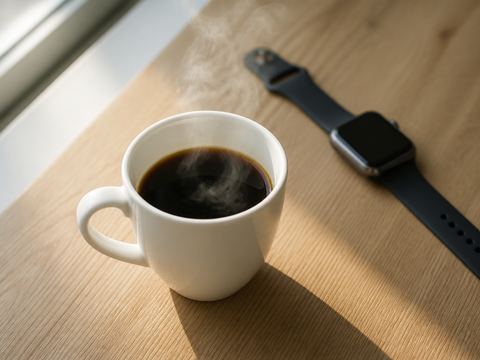
For nine weeks I wore a Google Pixel Watch 5 on one wrist and an over-the-counter continuous glucose monitor on the opposite arm, drinking between two and five cups of coffee a day while both devices quietly formed an opinion about my metabolism. The watch's Insulin Resistance Trends card updates once a month. The sensor on my arm updated every five minutes. Living between those two clocks turned out to be the actual experiment.
The verdict: Insulin Resistance Trends is the most restrained metabolic feature a mainstream wearable has shipped, and it still rests on a research base far thinner than the confidence it will produce in the people wearing it.
I should say plainly that I am not diabetic and have never been told I'm prediabetic. Everything below is discretionary — someone with a coffee habit paying money to be told things about their own blood. Hold onto that; I'll come back to it.
What the watch is actually doing
Nothing on this device touches your blood. Insulin Resistance Trends is a statistical model sitting on top of sensors the watch already had: overnight skin temperature, resting heart rate, heart rate variability, sleep duration and regularity, movement volume, plus the age and weight you typed in at setup. It infers a direction from those and reports it as a band — mine read typical for you — once a month. There is no per-meal graph. There is no score out of a hundred. There is no daily number to check, which is the single most important sentence in this review.
What Google has not published, at least not at the level a reviewer wants, is the validation detail: which cohort, against which reference standard, with what error distribution across body composition and skin tone. That reticence is normal for consumer health features and it is still the thing that determines how much weight the band deserves. A monthly cadence is a real product decision made against engagement metrics. Somebody argued for it internally and won, and the feature is better for it.
A short history of a belief
Almost everything people currently believe about coffee, sleep, and blood sugar traces back to a handful of papers. Not a literature. A handful.
1999: eleven men
The Van Cauter lab in Chicago put eleven healthy young men on four hours in bed for six consecutive nights and published the result in The Lancet. Glucose clearance ran roughly 40 percent slower; the acute insulin response to glucose fell about 30 percent. The authors noted the profile resembled impaired glucose tolerance.
It is a genuinely important study, and the direction has held up in later work. It is also eleven men in one sleep lab. When you read "sleep deprivation wrecks your blood sugar" in a wellness newsletter twenty-seven years later, that is the taproot.
2004: capsules, not coffee
James Lane and colleagues at Duke gave people with type 2 diabetes about 500 mg of caffeine in capsule form — roughly four strong cups — and watched postprandial glucose rise sharply. A 2008 follow-up using continuous monitoring, ten participants, same population, found average daytime glucose about 8 percent higher on caffeine days.
Real findings. Then note the three compressions that happen on the way to the internet: capsules are not coffee, ten people with diabetes are not the general population, and an acute challenge is not a lifelong habit. "Coffee spikes your blood sugar" is what survives the trip.
The epidemiology pointing the other way
Large cohorts have consistently found that coffee drinkers develop less type 2 diabetes. A 2005 JAMA meta-analysis, then a much bigger pooled dose-response analysis in Diabetes Care in 2014, landed somewhere around 6 to 9 percent lower risk per additional daily cup. Decaf trends the same direction, which is the tell: whatever is protective is probably not the caffeine. Chlorogenic acids are the usual suspect. Nobody has closed the case.
2018: fifty-seven people
A Stanford group published "glucotypes" in PLOS Biology — 57 mostly nondiabetic people wearing CGMs, showing that variability patterns differ even among people with normal labs. Good science, honestly framed by its authors. It is also the intellectual permission slip for the entire consumer glucose-monitoring market.
Eleven. Ten. Fifty-seven. That is the foundation now shipping on a watch that will sell in the millions.
Nine weeks, three blocks
I ran three three-week blocks, changing only when the caffeine landed. Same roasts, same grinder, same 18 g dose, same breakfast rotation.

| Metric | Block A: cutoff at 2 p.m. | Block B: last cup at 5 p.m. | Block C: decaf after noon |
|---|---|---|---|
| Caffeine, est. mg/day | 410 | 415 | 240 |
| Mean glucose | 98 mg/dL | 103 mg/dL | 99 mg/dL |
| Time above 140 mg/dL | 24 min/day | 51 min/day | 27 min/day |
| Sleep onset latency | 14 min | 26 min | 16 min |
| Sleep duration | 7 h 12 m | 6 h 31 m | 7 h 04 m |
| Monthly trend band | Typical | Elevated for you | Typical |
Separately, I tested the direct question fourteen mornings each way: black coffee fasted, then breakfast, versus breakfast alone. Peak postprandial glucose came in at 121 mg/dL with coffee and 118 without — a gap comfortably inside sensor noise, given that consumer CGMs run around 10 percent mean absolute relative difference and I changed sensors twice mid-experiment.
So the coffee did approximately nothing to my glucose. The 5 p.m. coffee did something to my sleep, and my sleep did something to my glucose the next day. The watch caught that. It caught it a month late and in one word, but it caught it, and it caught it through a pathway it never advertises.
Limitations, and they're not small. One person. Blocks run in order, not counterbalanced or randomized, so drift and seasonality confound everything — three months spanning a real change in ambient temperature, which is an input to the model. No blinding; I always knew which block I was in. And I never got a fasting insulin and glucose panel to establish ground truth, which is the omission I regret most, because it means I can tell you the watch agreed with my sleep tracker and not that either of them agreed with my pancreas.
The part I'm worried about
In 2023 I wore a CGM for six weeks with no medical reason. Here is what that did to me: I stopped ordering rice. I ate the same three-egg omelet eleven mornings running because it produced a curve I liked looking at. Twice I walked laps of my kitchen after dinner, at eleven at night, to pull a line down before it peaked. Nothing was at stake. That is the point.
Monthly banding is a real guardrail against that, and I want to give the feature full credit for it. But a band that reads elevated generates exactly one question — why — and the answer to that question is a food log, a walk-after-meals rule, and a third-party app that will very happily sell you the per-meal graph the watch declined to show you. The watch is restrained. Everything downstream of the watch is not.
Clinicians who treat eating disorders have been flagging consumer glucose tracking for a couple of years now on straightforward grounds: a metabolic number in a healthy person's hand is a new axis to restrict along. I can't hand you a randomized trial proving harm. Neither can anyone shipping the feature hand you one proving benefit in this population.
Who this is for, and who it isn't
It's for people with an actual reason to care — prediabetes, PCOS, a strong family history — who were never going to wear a sensor on their arm. A monthly directional check for the price of a watch you already wanted is a good trade. It's for bad sleepers who need a downstream consequence to make bedtime feel concrete; this is the most effective argument for an earlier caffeine cutoff anyone has ever handed me, and it worked on me in three weeks after a decade of ignoring the advice in prose form. It's for anyone who can read a monthly trend without going looking for a daily one.
It isn't for anyone with a history of restrictive eating or compulsive exercise. If you have ever changed a meal to make a number look better, turn this off during setup and don't revisit the decision. It isn't for anyone who wants to know what a specific meal did — it cannot tell you, and to its credit it doesn't pretend otherwise. It isn't for anyone treating it as a substitute for a blood draw that costs about sixty dollars cash and answers the question properly.
If you want one number about your metabolism, pay for the blood test. If you want one habit, move your last coffee three hours earlier. The Google Pixel Watch 5 is very good at telling you to do the second thing.
Eleven men. Six short nights. Chicago, 1999. That's the floor under the number on your wrist.