The number was 38 minutes.
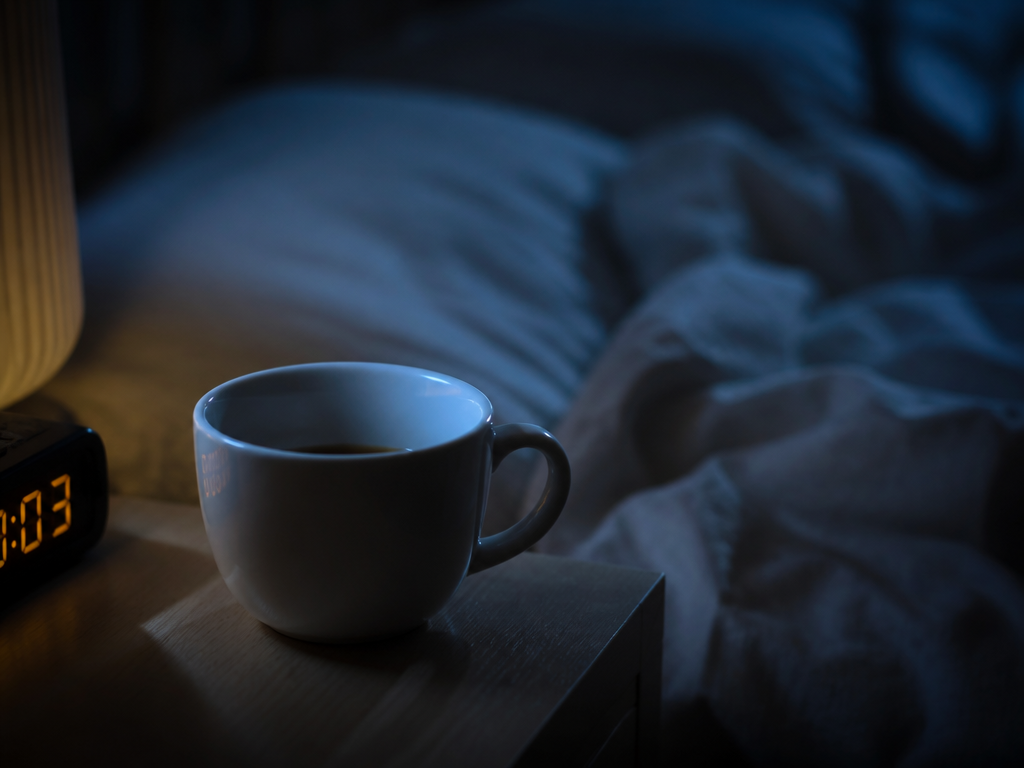
That is what my wrist reported for deep sleep on a Tuesday in March, down from 1 hour 47 minutes the night before, on two nights that were otherwise indistinguishable except for a cortado at 3 p.m. For years, iPhone owners who wore Fitbit wearables couldn't get numbers like that into Apple Health at all without paying a third-party bridge app to scrape one account and write into another. That gap has finally closed, and it was overdue by roughly half a decade.
It also does nothing whatsoever to make the 38 minutes true.
That's the whole piece, really. The plumbing improved. The measurement didn't. And the gap between those two facts is where a lot of otherwise careful people are currently making decisions about when to stop drinking coffee.
The myth, in the form people actually say it
Here's the belief, phrased the way I hear it from smart, skeptical, non-credulous friends: my tracker showed my deep sleep collapse on nights I had an afternoon coffee, so afternoon coffee wrecks my deep sleep. Sometimes it arrives hedged — "at least directionally" — and increasingly it arrives with a corollary: that pulling everything into one place, Apple Health, produces a single clean longitudinal record, and a longer record means a better answer.
Both halves are wrong, and they're wrong in ways that are more interesting than "wearables are junk." They aren't junk. The interesting part is this: the single most reliable thing caffeine does to human sleep is precisely the thing a wrist-worn accelerometer and green LED are structurally incapable of observing. And the consolidation layer everyone just got hands you that estimate inside a data schema that quietly deletes the fact that it was ever an estimate.
Does Fitbit sync with Apple Health?
Yes — directly, now, without a paid intermediary. Google's Fitbit app on iOS can write to Apple Health through HealthKit, which means steps, heart rate, and sleep sessions land in the Health app alongside whatever else you've got feeding it. You turn it on inside the Fitbit app, grant permission per data type, and Apple Health becomes the read layer. That's the practical answer, and if you're here for only that, you can stop.
The honest footnote to that answer is the part worth staying for. What you get is a one-way pipe carrying summary values. What you don't get is the raw signal underneath — no interbeat intervals, no per-epoch accelerometer traces, no confidence intervals, no indication of which nights the device lost contact with your skin. You also generally don't get a full retroactive backfill of your history; check what actually appears in Health for dates before you flipped the switch, because "synced" and "complete" are not the same claim.1
And you don't get the proprietary composites. Sleep Score, Readiness, and their cousins have no corresponding HealthKit type, because they aren't measurements — they're each vendor's opinion, expressed as an integer. Apple Health has nowhere to put an opinion.
This is a genuinely good change. It should have shipped years ago, when the ecosystem first fragmented into people who wanted a particular wearable's battery life and a particular phone's everything else. But the improvement is one of logistics, not epistemics.
What the validation studies actually measured
Start with the well-established finding, because it's more flattering than you'd expect: consumer wrist trackers are quite good at telling sleep from wake, and reasonably good at total sleep time.
de Zambotti and colleagues (2018), in Chronobiology International, ran a Fitbit Charge 2 against overnight polysomnography — the full electrode montage: EEG, EOG, EMG — in 35 adults. The device's estimate of total sleep time was close, off by roughly ten minutes on average. Its sensitivity to sleep, meaning its ability to correctly call an epoch "asleep" when the EEG agreed, was in the mid-90s percent.
Then the staging. In the same study the device overestimated light sleep on the order of half an hour and underestimated deep sleep on the order of twenty minutes, on average. Averages are the flattering part. The limits of agreement — the band inside which a given night's error is expected to fall — were wide enough that any single night could be off by well over an hour in either direction.
Sit with that for a second, because it disposes of my March cortado story on its own. My two nights differed by 69 minutes of reported deep sleep. That difference is comfortably inside the device's own error envelope. I wasn't reading a signal. I was reading noise and assigning it a cause.
Chinoy et al. (2021), in SLEEP, put seven consumer devices against polysomnography in 34 healthy adults simultaneously — Fitbit, Garmin, and several under-mattress and bedside systems. The pattern held: decent on total sleep time, mediocre-to-poor on staging, with a general bias toward overcalling sleep. Menghini et al. (2021), also in SLEEP, went a level up and argued the field's validation methods were themselves inconsistent enough that cross-device comparisons were often meaningless, and proposed a standardized framework. That paper matters here for a specific reason: if the researchers needed a standard before they could compare two devices' outputs, your Health app certainly doesn't have one.

The general specificity problem is worth naming, because it's the deepest one. These devices are much better at detecting sleep than at detecting wake. Lie still and read for forty minutes and a wrist device has a real chance of scoring you asleep, because from the accelerometer's point of view stillness is stillness. This is a known limitation of actigraphy going back decades, not a Fitbit problem.
What caffeine does, in the order it does it
From cup to receptor, roughly 45 minutes
You drink it. Caffeine is absorbed from the small intestine into the bloodstream nearly completely, with plasma concentration typically peaking somewhere between 30 and 60 minutes for an ordinary cup, later if you drank it with a large meal. It is both water- and lipid-soluble, so it crosses the blood-brain barrier without needing a transporter and without much of a delay.
In the brain it does one main thing: it sits in adenosine receptors without activating them. It's a competitive antagonist, primarily at the A1 and A2A subtypes. Adenosine has been accumulating in your extracellular space all day as a byproduct of neural energy use — the longer you've been awake and the harder you've been working, the more of it there is. That accumulation is the leading physiological candidate for what sleep researchers call Process S, the homeostatic sleep pressure in Borbély's two-process model, running against the circadian Process C.
Caffeine doesn't drain the adenosine. It occupies the doorway. The pressure is still there, still building, still waiting for you the moment the occupancy drops — which is why the crash feels like arriving rather than developing.
The arousal side appears to be mostly A2A-mediated. Lazarus et al. (2011), in the Journal of Neuroscience, showed that caffeine's wake-promoting effect depended on A2A receptors in the nucleus accumbens shell; knock those out in mice and caffeine largely stops keeping them up. That's rodent work, and the translation to humans is plausible rather than proven, but it's the cleanest mechanistic account we have.
Elimination runs through hepatic CYP1A2, with a half-life in healthy adults usually cited as 4 to 6 hours. That range is a polite fiction covering enormous individual spread — roughly 1.5 to 9.5 hours across the population. Oral contraceptives roughly double it. Late pregnancy can push it past 15. Smoking induces CYP1A2 and cuts it nearly in half, which is why smokers metabolize caffeine fast and why quitting can make your usual dose suddenly feel like too much. The rs762551 polymorphism in CYP1A2 sorts people into faster and slower metabolizers; the metabolic data on that are solid, but the claim that your genotype predicts how much your sleep suffers is a good deal thinner than the confidence with which it gets repeated in genetic-testing marketing.
Why the damage lands in a frequency band your wrist has no antenna for
Here's the part that decides the argument.
If slow-wave sleep is the electrophysiological expression of Process S, and caffeine blocks the molecule that builds Process S, then caffeine should suppress slow-wave activity specifically. It does. Landolt and colleagues (1995), in Brain Research, gave healthy young men 200 mg of caffeine in the morning — not the afternoon, not the evening — and recorded sleep EEG that night. Spectral power in the delta band, the 0.75–4.5 Hz range that defines deep sleep, was reduced. A single small study, fewer than a dozen subjects, but the finding has held up: caffeine's fingerprint on sleep is a shift in EEG power spectra.
Deep sleep is defined by that spectral content. N3 is scored from the EEG, on the presence of high-amplitude slow oscillations. Not from stillness. Not from heart rate. From voltage measured across your scalp.
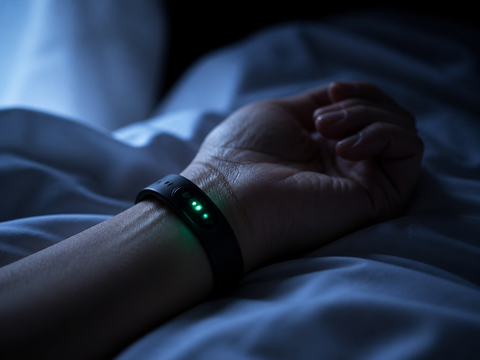
A wrist wearable has no electrode on your scalp. It has an accelerometer and a photoplethysmograph — a light source and detector reading pulsatile blood volume in the tissue under the band. From those two streams, a trained model infers stages. That model was trained by fitting movement-and-pulse patterns to PSG-scored labels in some sample of people, and what it has learned is the statistical shadow that deep sleep casts on heart rate variability and stillness in that sample.
So when caffeine flattens delta power without necessarily changing how still you lie or how your heart behaves, the shadow doesn't move much. The thing that changed is invisible to the sensor set. Your "deep sleep" number may go up, down, or nowhere, and the direction carries essentially no information about the actual slow-wave suppression.
What caffeine does do that a wrist device can plausibly detect: it lengthens sleep onset latency, increases wake after sleep onset, and cuts total sleep time. Drake et al. (2013), in the Journal of Clinical Sleep Medicine, gave 12 subjects 400 mg of caffeine at 0, 3, and 6 hours before bedtime. The six-hour-prior dose — the one that feels obviously safe, the one you'd defend at dinner — still reduced objectively measured sleep time by more than an hour. Twelve people, a large dose, so hold it loosely. But the detail that makes it stick is that subjects largely did not notice. Their self-reports failed to capture disruption the monitors caught.
Which is the strongest argument for objective tracking in this entire piece. Just not for the metric everyone stares at.
What Apple Health does to the number on the way in

There's a second mechanism here, and it's a data one.
HealthKit stores sleep as a category sample, HKCategoryValueSleepAnalysis, with a small fixed set of cases: in bed, asleep unspecified, asleep core, asleep deep, asleep REM, and awake. Every vendor writing sleep into Apple Health must map its own internal stage labels onto that enum. There is no other option — that's the schema.
So a Fitbit's "deep," produced by Google's model tuned on Google's validation data, and an Apple Watch's "deep," produced by a different model tuned on different data, arrive in your Health app as the same enum case. Rendered in the same color. Stacked in the same chart. Summed in the same weekly average.
They are not the same construct. They are two vendors' guesses at the same underlying thing, and the guesses disagree — which the validation literature shows plainly whenever anyone puts two consumer devices on the same person for the same night. The schema can't express that disagreement, so it doesn't. Consolidation flattens provenance into a small source label most people never tap.
The practical consequence: if you switch watches mid-year, or wear two at once, your Health sleep chart will show a discontinuity that looks exactly like a change in your sleep. It's a change in your estimator. And if you have two sources writing overlapping sleep segments on the same night, check what downstream apps do with that overlap before you trust any total they show you — deduplication behavior varies by app, and "eleven hours of sleep" is usually a merge artifact, not a triumph.
What actually crosses the bridge
| Data | Travels usefully | Why |
|---|---|---|
| Steps, distance | Yes | Simple count from a well-characterized sensor; disagreement between devices is small |
| Heart rate | Mostly | Optical HR is accurate at rest; sampling frequency differs by vendor, so density varies |
| Total sleep time, in-bed time | Yes, with caveats | The metric with the best PSG agreement; still overcalls sleep during quiet wake |
| Sleep stages (core/deep/REM) | Technically yes, meaningfully no | Model output coerced into a shared enum; no confidence, no provenance, no comparability |
| Sleep Score / Readiness | No | Proprietary composite with no HealthKit type; stays in the vendor app |
| SpO2, HRV | Partially | Different sampling windows and algorithms; cross-device comparison is not defensible |
An honest rule of thumb
Tonight, before bed, write down one thing: the clock time of your last caffeinated drink, and roughly how much. In Notes, on paper, wherever. Nothing else.
Do that for two weeks. Then split the nights into two piles — cutoff earlier than your personal median, cutoff later — and compare the piles on exactly two numbers your device is decent at: sleep onset latency and total sleep time. Compare medians, never individual nights, because a single night's difference in any of these metrics sits inside the device's error band and tells you nothing. Ignore the stage percentages entirely. Not "weight them less." Ignore them.
If the effect is real for you, it shows up as taking longer to fall asleep and getting less sleep overall. That's what caffeine's dose-response looks like through this instrument. And the useful default while you gather data, based on Drake and the pharmacokinetics rather than on any number your watch produced: if you're sensitive, put your last real dose eight hours before bed, not six. Six is where the study found an hour of lost sleep in people who didn't feel a thing.
Settled, thin, and folk
| Claim | Status |
|---|---|
| Caffeine antagonizes adenosine A1/A2A receptors and delays/shortens sleep | Well established |
| Caffeine suppresses EEG slow-wave activity, even from a morning dose | Well supported, small samples |
| Wrist trackers estimate total sleep time reasonably, stages poorly | Well established across multiple validations |
| Your CYP1A2 genotype predicts your sleep sensitivity to caffeine | Plausible but thin |
| Nightly "deep sleep" minutes from a wrist device track real slow-wave sleep | Not supported |
| "I metabolize caffeine fast, espresso after dinner doesn't affect me" | Folk wisdom — and Drake's subjects said the same thing |
None of this is an argument against wearing the thing. Sleep-onset latency and total sleep time, read as fourteen-day medians, are genuinely informative, cost you nothing, and are exactly the numbers that got easier to keep in one place this year. Use the instrument for what the instrument measures. The frustration isn't that the tools are bad — it's that the number with the weakest evidential footing is the one printed largest.
The myth: my tracker showed my deep sleep collapse after an afternoon coffee, so afternoon coffee is destroying my deep sleep.
The accurate version: afternoon coffee probably is suppressing your slow-wave activity, through a mechanism we understand well — and your tracker, now syncing beautifully to your phone, has no way to see it.
-
Worth knowing before you delete the bridge app you've been paying for: export or screenshot whatever history you care about first. HealthKit backfill behavior for previously-synced periods is inconsistent, and a gap in Apple Health is not recoverable from the vendor side after the fact. ↩