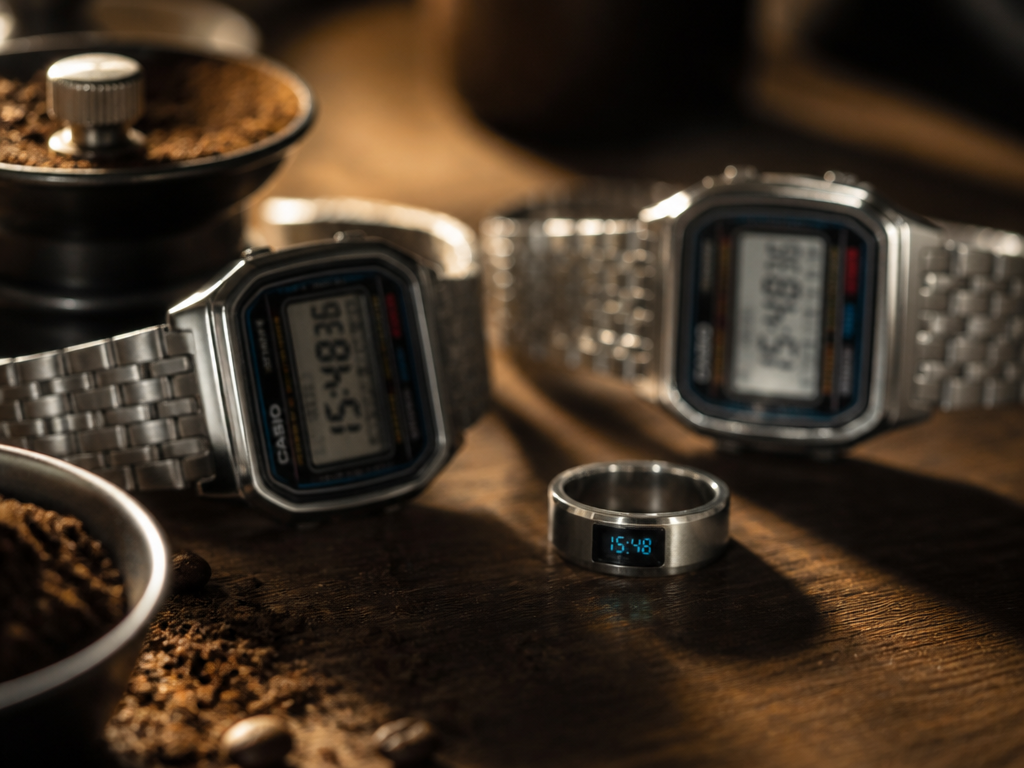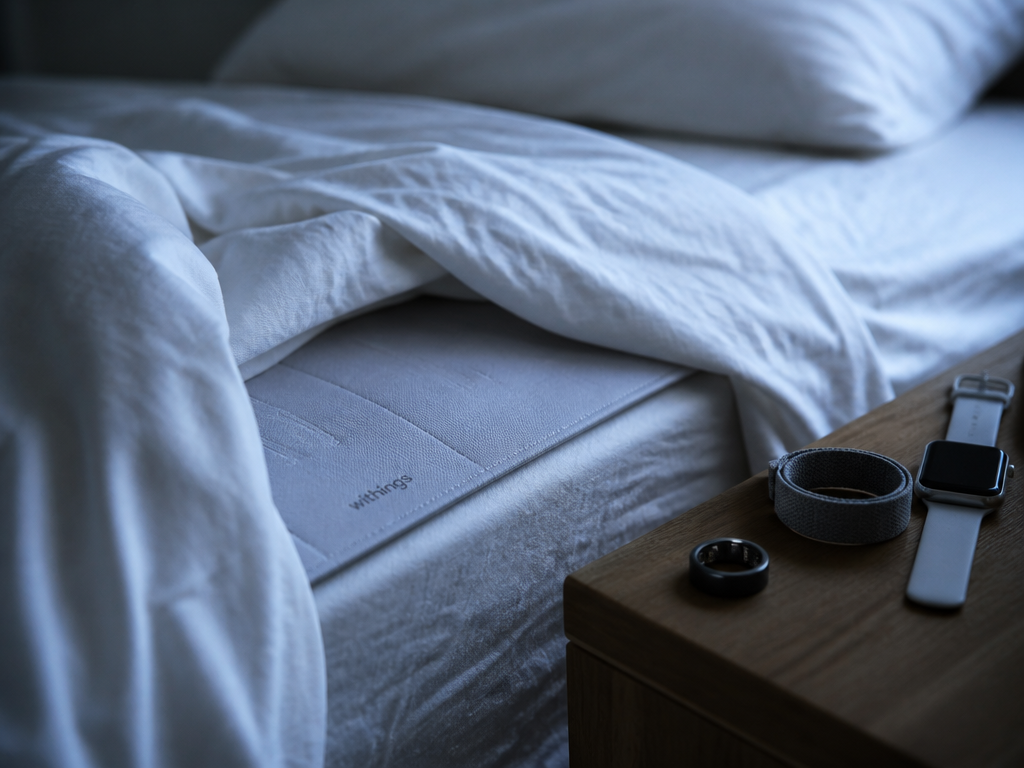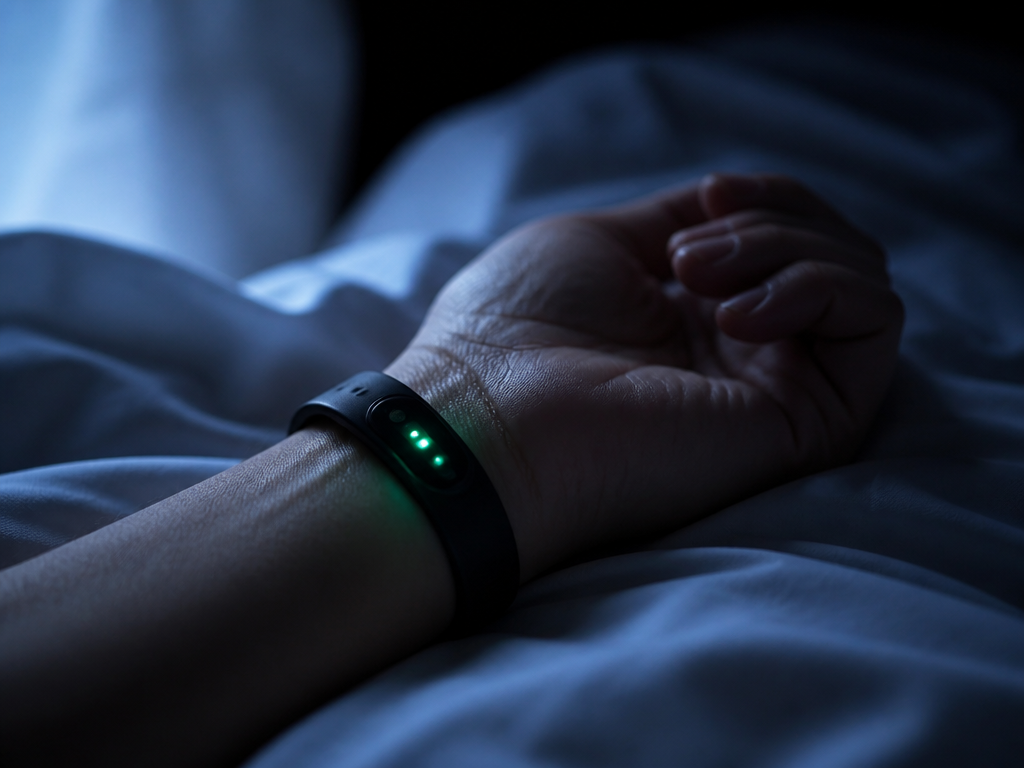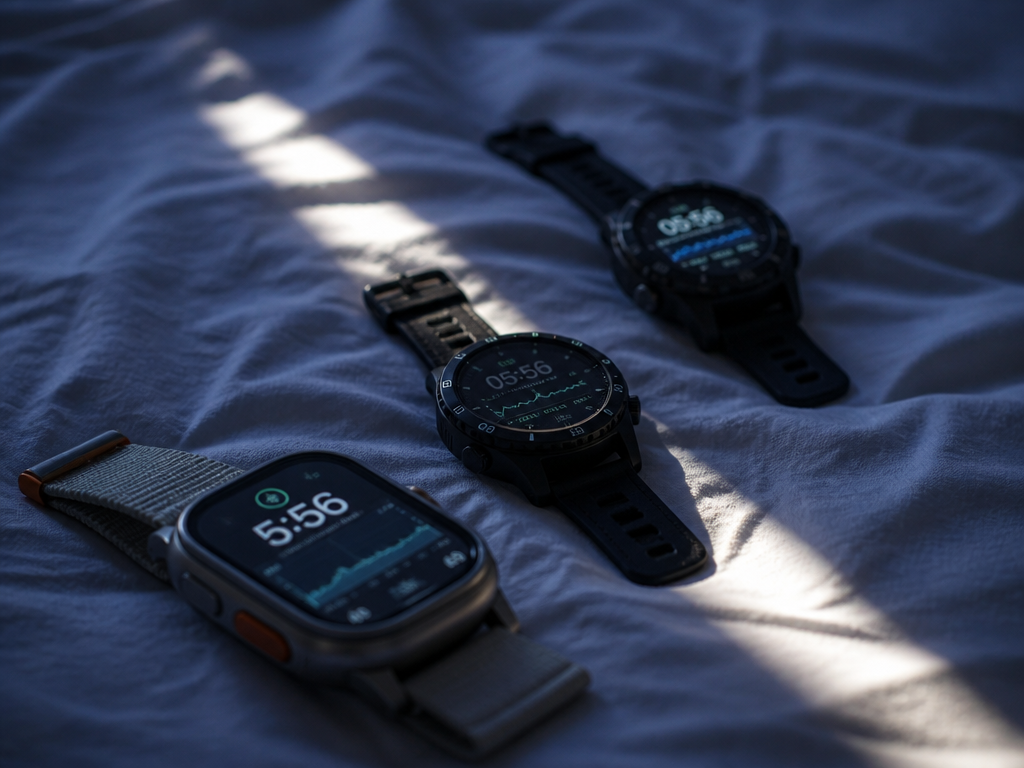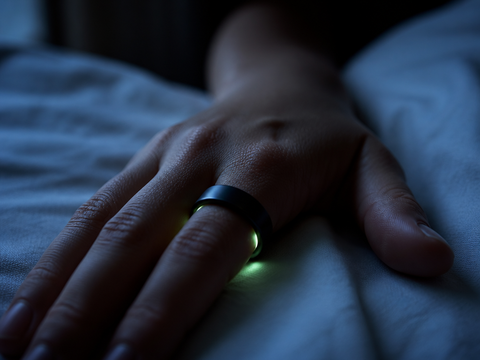
At around four in the morning, when your core temperature is sitting near its daily minimum and you are statistically deep into your longest stretch of REM sleep, a sensor pressed against the pad of your finger or the underside of your wrist takes your skin temperature for perhaps the three-hundredth time that night. It is a genuinely good moment to measure you. You are not moving, not eating, not standing barefoot in a cold kitchen. The recent run of wearable technology partnerships — Oura tying up with Natural Cycles back in 2021, Whoop arriving at the same door more recently — is essentially a bet placed on that moment: that a number harvested while you sleep is clean enough to hang a contraceptive decision on.
So here is the question, and I think most people who own one of these devices have asked some version of it in the checkout flow: does plugging my wearable into a fertility app make it a better instrument, or just a more confident one?
The honest answer has three parts, and only one of them is flattering.
What the sensor is actually measuring
Start with what the device does not have. It does not have a thermometer in your core. It has a thermistor sitting against skin, reading a signal that is several steps downstream of the thing you care about. Those steps are worth walking through in order, because the order is where the reliability lives.
The chain, in the order it happens
You ovulate. The follicle that released the egg collapses into a corpus luteum, which begins secreting progesterone in quantity — this is the loudest hormonal event of the cycle's second half and it is not in dispute.
Progesterone, or more likely one of its neuroactive metabolites, acts on thermoregulatory neurons in the preoptic area of the hypothalamus and nudges your temperature set point upward by roughly 0.3 to 0.5 °C. The phenomenon is well established; the precise receptor story is less settled than the textbook diagrams imply.
Your body then defends the new, higher set point the way it defends any set point — largely by adjusting how much heat it dumps through the hands and feet. This is the step that matters for a ring. Distal skin is not a passive readout of core temperature. It is the radiator. Kräuchi and colleagues (1999), writing in Nature, showed that distal vasodilation — warm hands and feet — is one of the strongest physiological predictors of how fast you fall asleep. Your fingertip is an actuator, not just a gauge.
The device samples that radiator every minute or so across six to eight hours, discards the restless parts, and extracts a nightly value: usually a minimum or a smoothed trend rather than a single reading.
Only then does the software arrive. A Bayesian model compares tonight's value against your own rolling baseline and updates a probability that ovulation has already occurred, which it renders as a red day or a green day.
Notice what happened there. Four biological translations and one statistical one, before you get a color.
Does linking a wearable to a fertility app make it more accurate?
No — not in the sense most people mean. The partnership does not improve the sensor. The thermistor in your ring reads exactly as well the day before the integration launches as the day after. What changes is what gets done with the output: instead of you eyeballing a temperature graph, an FDA-cleared algorithm ingests it and returns a decision. The accuracy in question is a property of that algorithm plus your compliance, not of the hardware's resolution.
The number everyone quotes comes from Berglund Scherwitzl and colleagues (2017), a cohort of 22,785 Natural Cycles users, which produced a Pearl Index of about 1.0 with perfect use and 6.9 with typical use. That is a real, large, prospective dataset and it is the reason the app cleared FDA review in 2018. It is also worth saying plainly: most of those users were taking oral basal temperatures with a dedicated thermometer on waking, not wearing a ring to bed. The wearable pathway inherits the algorithm's reputation more than it inherits the algorithm's evidence base. I'd file continuous wrist and finger temperature as plausible and improving, not as equivalently proven.
And there is a harder limit that no integration can engineer away. Temperature confirms ovulation after it happens. The fertile window, though, is mostly the five or six days before — sperm survive; eggs don't. So the temperature signal is retrospective by design, and the app's read on your risky days is a forecast built from your own history, not a live measurement. If your cycles are irregular, the forecast is thin, and the software knows it.

Where your coffee shows up in the data
This is a caffeine magazine, so allow me the detour — it turns out not to be a detour.
Caffeine's median half-life in a healthy adult is around five hours, with a genuinely enormous population range of roughly 1.5 to 9.5 hours, governed mostly by the CYP1A2 enzyme. Drake and colleagues (2013), in the Journal of Clinical Sleep Medicine, gave 12 subjects 400 mg of caffeine at zero, three, and six hours before bed. Even the six-hour dose cost them about an hour of objectively measured sleep. Twelve people is a small study, and it has been asked to carry a lot of weight since, but the direction of the finding has held up.
Here is why that lands on a fertility algorithm. Caffeine blocks adenosine receptors, which raises sympathetic tone, which affects peripheral vascular behavior — the exact radiator your ring is reading. Mechanistically, an evening coffee has every reason to perturb nocturnal distal skin temperature. Empirically, I can't point you to a study that has measured evening caffeine against wrist temperature in a cycle-tracking population. That gap is real, and the confidence with which people assert it in either direction is not earned.
The better-documented caffeine angle is the one nobody mentions in the launch posts. Abernethy and Todd (1985), in the European Journal of Clinical Pharmacology, found that low-dose estrogen-containing oral contraceptives cut caffeine clearance roughly in half — doubling the effective half-life. If you are reading this because you're leaving hormonal birth control for a wearable-and-app arrangement, your caffeine pharmacokinetics are about to change. The 4 p.m. flat white that was fine on the pill may be a different drug entirely without it, and it will feel like the coffee changed rather than you. There is also a smaller literature suggesting caffeine clears slightly more slowly in the luteal phase; the common citation is a modest crossover study from the early 1990s, and I'd call that plausible but thin.
The constraints that don't make the landing page
Hardware first: these integrations require a device with a temperature sensor and consistent overnight contact. Older bands and rings without one are simply not eligible, regardless of how much you paid. Free-first-year offers are real money, but they usually sit on top of a hardware subscription you're already paying, and the app's own fee resumes afterward.1
The subtler constraint is how the algorithm handles noise, and this is the part I find genuinely reassuring. A model that can't resolve your ovulation doesn't guess — it hedges, and hedging means more red days. Bad data doesn't make the app dangerous. It makes it useless in a specific, irritating way: you lose green days to your own late espresso, your Thursday night wine, your head cold. The failure mode is friction, not false safety.
An honest rule of thumb
| Last night's input | Likely effect on nocturnal skin temp | How the algorithm reads it |
|---|---|---|
| 200 mg+ caffeine after 4 p.m. | Small, direction not well characterized | Added variance; possible extra red day |
| Two or more drinks | Elevated, HRV suppressed — well documented | Often flagged as a deviation |
| Hard training within 3 hours of bed | Elevated | Deviation |
| Fever or oncoming illness | Clearly elevated | Usually excluded if you log it |
| Loose ring or band | Erratic, artificially low | Dropped night |
The practical version: the nights you most want your temperature to be honest are the nights to leave the last coffee before mid-afternoon, and if you didn't, log it rather than hoping the algorithm won't notice. Logging a confounder costs you one data point. Failing to log it corrupts your baseline for weeks.
A connected wearable will not tell you more than a $10 thermometer does about whether you ovulated; what these partnerships actually sell is the removal of a 6 a.m. ritual, which is worth something, but is not the same thing as precision.
So, tonight: if you want tomorrow's reading to mean anything, stop the caffeine six hours before bed and wear the thing properly — a clean night of ordinary data beats a clever night of interpreted noise.
-
A free year is customer-acquisition arithmetic, not generosity. The device makers want their hardware to be load-bearing in a decision you can't casually switch away from, and contraception is about as load-bearing as consumer health data gets. ↩