The question was narrow: if I take 200 mg of caffeine at 2 p.m., does the thing on my wrist notice? Not does it tell me I slept badly — that part is easy, and everything from a $99 band to a $349 ring gets there eventually. I wanted to know whether the sensors follow the drug through the body in the order the drug actually moves.
Most of a fitness tracker review is written from the outside in: features, app screens, battery claims. I ran this one from the inside out. Forty-two nights, three screenless or near-screenless wearables worn simultaneously, a chest strap as reference, and a caffeine schedule I kept like a medication.
The verdict: the Garmin Cirqa is the one I'd keep — not because it measured caffeine best (it didn't; the Oura Ring 4 did, by a clear margin) but because its blunt, unarguable output changed my drinking habit in a way the precise devices never managed.
How I ran it
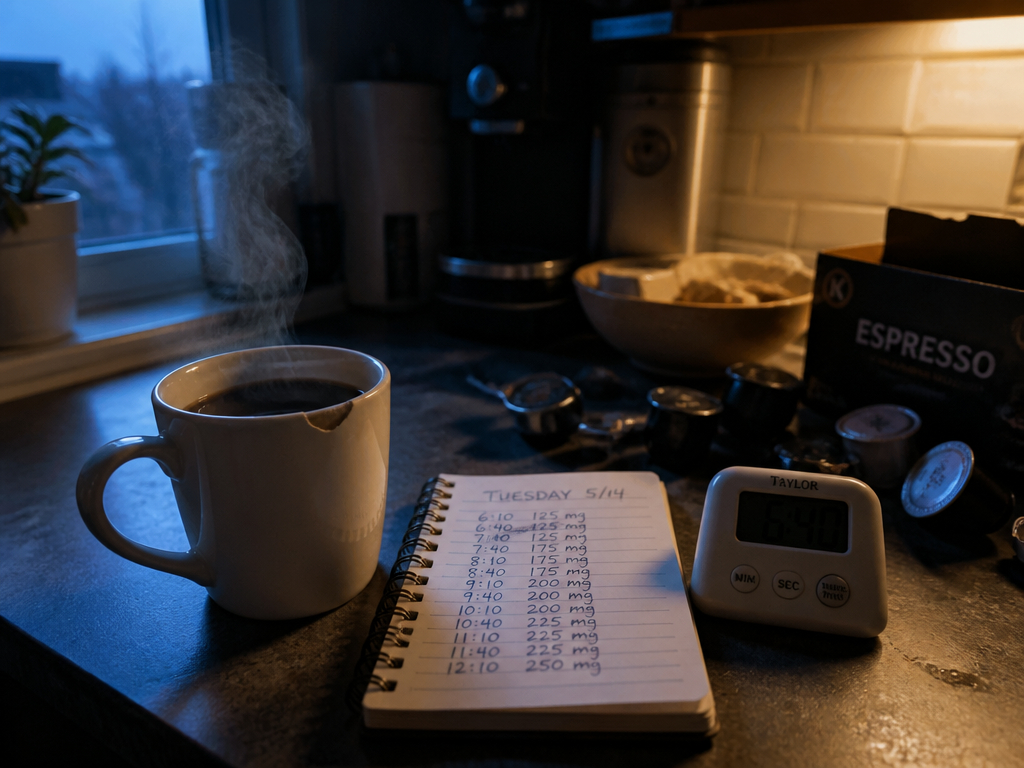
Three blocks of fourteen nights. On dose days I took a 200 mg caffeine capsule at 14:00 — roughly a double espresso and a half, but capsuled because espresso dosing is a guess and I wanted a number. On control days I stopped after a single 08:00 coffee, about 95 mg. I did not attempt full abstinence: a caffeine-naive baseline isn't the baseline I live in, and withdrawal headache would have contaminated every night that followed.
Target lights-out was 22:45; actual median was 22:52. Reference instruments were a Polar H10 chest strap ($89.95) worn 13:30–16:00 and again from 21:30 until sleep, a bedside Bluetooth button I clicked at roughly sixty-second intervals until I stopped clicking, and a paper log filled in before I touched any phone.
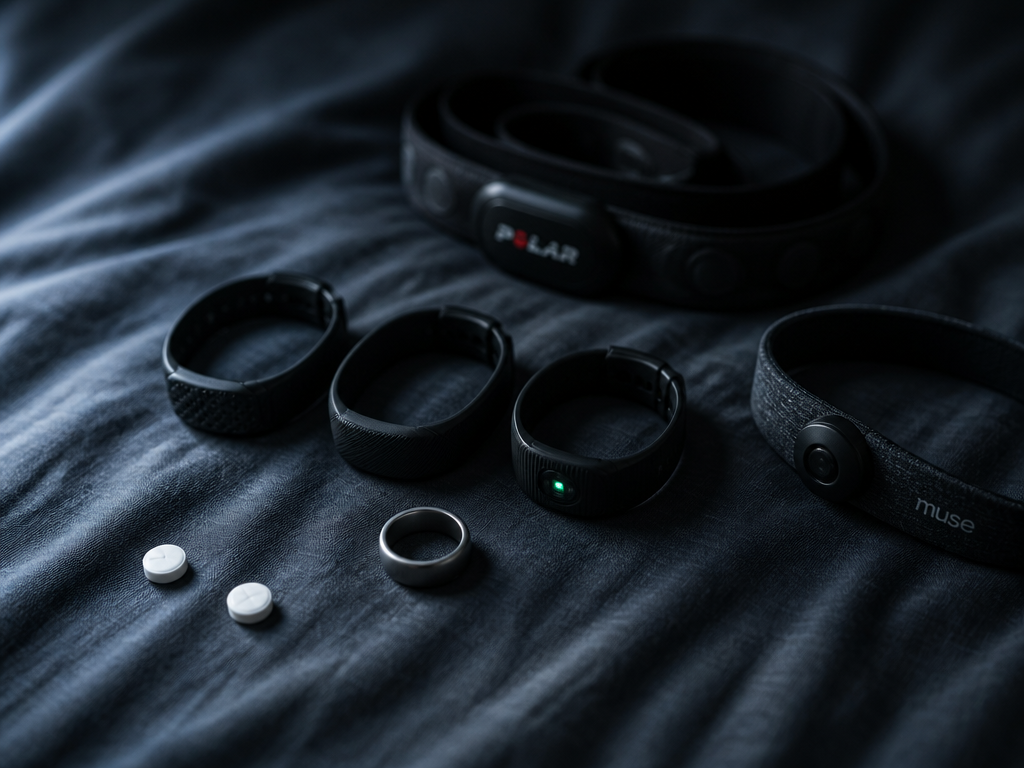
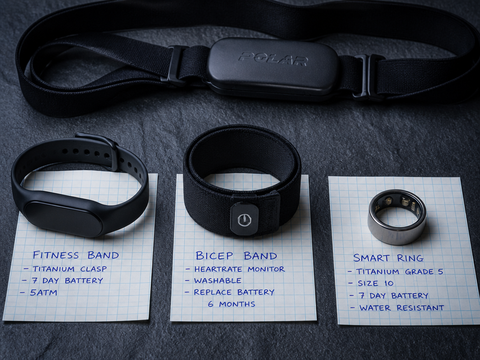
The devices: Garmin Cirqa, $169.99, no subscription, left wrist. Whoop 5.0 on the Peak tier, $239/year, worn in the bicep band on the right arm. Oura Ring 4, $349 plus $5.99/month, right index finger.
What I could not do matters as much. No EEG, so every sleep-stage number below is a claim I cannot check. No blood draws, so every plasma figure is textbook pharmacokinetics rather than my pharmacokinetics. One subject, one wrist, one metabolism. And I always knew whether I'd taken the capsule, so every subjective entry in that paper log is unblinded and worth exactly what unblinded entries are worth.
Stage one: mouth and gut, 0–45 minutes
Caffeine absorbs fast and almost completely — essentially all of an oral dose, mostly from the small intestine, with some uptake starting in the mouth. On a light stomach, plasma is climbing inside twenty minutes.
Nothing on your wrist knows any of this. There is no sensor for it and there isn't going to be. What the three devices offer instead is logging: Oura has a caffeine tag, Whoop a journal entry, the Cirqa nothing native — I typed it into a Connect note.
These are self-report fields, and the apps then correlate them against downstream outcomes, which is a procedure that looks like measurement without being it. After a few weeks Whoop will tell you something like caffeine after 2 p.m. is associated with 8% lower recovery. That is a correlation over your own tags, computed on a sample size you control, and it's the closest any of these devices gets to the drug itself.
What separates them here is tone. Oura's tag is neutral. Whoop's monthly summary states its associations with more confidence than the underlying data supports. The Cirqa doesn't pretend to know, which is the correct behavior for a device that has no way of knowing.
Stage two: plasma peak, 30 minutes to two hours
This is the first thing an optical sensor can genuinely see. Against matched control-day windows, my chest strap showed a mean resting heart rate increase of +4.1 bpm across the ninety minutes after the capsule. In two of fourteen sessions it was flat or a beat lower — consistent with the baroreflex response caffeine produces in some people, and a useful reminder that the effect isn't universal even within one person.
Device readings across the same windows: Cirqa +3.8 bpm, Whoop +4.4, Oura +2.1.
Oura's number is the interesting failure. It isn't a sensor problem; it's a sampling problem. On its default schedule the ring takes daytime heart rate sparsely, and my 14:00–15:30 windows often contained only a handful of points. Oura is not a daytime instrument and has never claimed to be. Ask it about the afternoon and you get an average of six readings pretending to be a trend.
The Cirqa held within about 2 bpm of the strap on eleven of fourteen sessions. One outlier ran 9 bpm high for a six-minute stretch while I was typing — band position, almost certainly, since it resolved when I pushed the puck an inch up my forearm. Whoop's upper-arm placement was the most stable during desk work, which is a real argument for the bicep band that nobody makes loudly enough.
Stage three: the receptor, hours one through six
Here is what caffeine actually does, and here is where every consumer wearable goes blind.

Adenosine builds through your waking hours. Caffeine occupies the A1 and A2A receptors and stops that signal landing. The sleep pressure doesn't disappear; the message just isn't delivered. No wearable measures adenosine. No wearable measures receptor occupancy. Every "caffeine impact" screen you have ever seen is inference from downstream autonomic proxies plus a tag you typed in yourself.
Gear reviews rarely say this outright, and for someone deciding whether to spend $349 it is the most important sentence in this piece.
Across these hours the three devices produced essentially interchangeable data. If any of them could see the mechanism, this is the window where it would show up. None of them can.
Stage four: the autonomic tail, hours four through eight
This is where they separate.
RMSSD from the chest strap in the thirty minutes before lights out: 62 ms mean on control nights, 51 ms on caffeine nights — a drop of about 18%. The devices, using their own overnight windows: Oura reported a 15% drop, Whoop 12%, Cirqa 9%. Right direction on all three, magnitude compressed on all three, most compressed on the Cirqa.
The compression isn't error so much as a different question being asked. Whoop computes HRV from a slow-wave sleep window. Oura weights the night with emphasis on its later portion. Garmin uses its own overnight aggregate. Comparing HRV numbers across devices is comparing three answers to three questions, and the internet does it constantly.
What's testable is internal consistency: could each device separate a caffeine night from a control night against its own trailing baseline? Whoop got 11 of 14. Oura 12 of 14. Cirqa 9 of 14. The Cirqa's flattening means a smaller dose — an afternoon green tea, a 60 mg cortado — would vanish into its noise entirely. If your actual question is how little can I get away with, the Cirqa cannot answer it.
Stage five: the thermal ramp and sleep onset, hours six through ten
Falling asleep is partly a plumbing problem. Heat has to move from your core to your hands and feet — distal vasodilation — so core temperature can drop. Caffeine blunts that redistribution, and the delay you feel at 23:00 is downstream of it.
Only one of these three measures distal skin temperature anywhere useful. A ring sits on a finger, over a digital artery, in the exact tissue that's supposed to warm. Wrist temperature is a much noisier stand-in, and the Cirqa's temperature data was not usable for this.
Oura's first-two-hours finger temperature deviation ran 0.18 °C lower on caffeine nights. That is small — close enough to the noise floor that I'd distrust it as a single night — but it went the same direction on eleven of fourteen nights, and consistency is what makes a small number believable.
Sleep latency from the button clicker: median 17 minutes on control nights, 29 minutes after the capsule. Device estimates for those same nights:
- Oura: 14 → 24 min. Closest, and it caught the direction every block.
- Whoop: 12 → 16 min. Direction right, magnitude halved.
- Cirqa: 8 → 11 min. Functionally decorative.
Caveat the clicker properly: pressing a button every minute delays sleep. My absolute latencies are inflated by some unknown amount. The delta between conditions is the number I trust, not the values themselves.
Stage six: the night
I cannot verify sleep staging without an EEG, and neither can you, and neither can anyone reviewing these devices from their own bedroom. So take what follows as a report on disagreement rather than accuracy.
All three reported less deep sleep after caffeine. They disagreed about how much by a factor of five: Whoop −22 min, Oura −31 min, Cirqa −6 min, averaged across the block. They cannot all be right. It's entirely possible none of them is.
Fragmentation was the one overnight metric I could partially check, because I wrote down remembered wake episodes before looking at any phone. My log: 1.4 per night on control, 2.6 after caffeine. Oura's wake count matched my morning log on 10 of 14 nights. Whoop consistently counted more awakenings than I remembered, though that's as likely to be my memory failing as its sensor. The Cirqa reported the fewest and moved the least — the same flattening that showed up everywhere else.
Battery, since it belongs to the night: I got about 7.5 days from the Cirqa with continuous HR enabled, roughly 10 from Whoop, and 4.5 from the Oura. The ring is the only one I ever had to take off at an inconvenient moment.
Stage seven: clearance, and the number waiting at 6 a.m.
Caffeine's half-life in a healthy adult is often quoted as five hours. The honest range is four to six, and it moves a lot: oral contraceptives can push it toward double, smoking shortens it, and CYP1A2 genotype spreads the population further still.
Run my dose through the nominal curve. 200 mg at 14:00. About 100 mg left at 19:00. About 50 mg at midnight. About 25 mg at 05:00.
There is still a quarter of the dose in me when the readiness score is computed. Every morning number these devices produce is calculated from the tail of a drug that hasn't finished leaving.

Score response across the caffeine block: Oura Readiness −9 points mean, Whoop Recovery −14, Cirqa's overnight score −5. Whoop swings hardest. That reads as sensitivity, and some of it is; some of it is just gain on a smaller underlying difference. Which brings up the subscription: what you rent from Whoop is the model, not the sensor. That's a defensible thing to pay for, and it is also the thing most likely to change under you without warning.
The grid
| Device | Price as tested | Caught the 2 p.m. dose? | Best signal | Worst failing |
|---|---|---|---|---|
| Garmin Cirqa | $169.99, no sub | Weakly — 9/14 nights | Daytime HR within ~2 bpm of strap | Compresses everything; onset detection unusable |
| Whoop 5.0 (Peak) | $239/year | Yes — 11/14 nights | Stable upper-arm placement; largest score response | You rent the model; confidence exceeds the data |
| Oura Ring 4 | $349 + $5.99/mo | Yes — 12/14 nights | Finger temperature; best latency estimate | Blind in the daytime; 4.5-day battery |
| Polar H10 (reference) | $89.95 | n/a — it's the ruler | RMSSD I actually trust | Measures nothing while you're not wearing it |
The thing I didn't expect
I went in assuming the most accurate device would be the most useful one. It wasn't, and the reason is slightly embarrassing.
Precise scores invite negotiation. A Whoop recovery of 61% comes with enough surrounding detail that I could always build a case: the HRV window was probably contaminated by the late dinner, the strap slipped, I'd ridden hard on Tuesday. Twelve weeks of that and I had a rebuttal for every number the device produced, and my caffeine cutoff hadn't moved an inch.
The Cirqa gives you one blunt overnight figure and no handle to grab. It says the night was worse. It doesn't offer a mechanism you can argue with. During the Cirqa block I moved my cutoff from 3 p.m. to 1 p.m. and it stuck past the end of the test, which is the only behavioral change in six weeks that outlived the experiment.
I also logged something I can't cleanly interpret. On nights when I opened any of the three apps after lights out, median sleep onset was 31 minutes versus 18 on nights I didn't. That is badly confounded — I was far more likely to reach for the phone on nights I already felt wired, so the causation may run entirely backwards. I'm reporting it because it's the largest effect in my whole dataset and I don't believe my own explanation of it.
Who this is for
You already own a Garmin Edge or a Forerunner, you want an overnight instrument for the arm you don't train with, and you are not willing to add a second subscription to a house that already has enough. The Cirqa is the obvious buy, and the three-year math is the argument: $169.99 once, against $717 for three years of Whoop Peak or $565 for Oura hardware plus subscription.
It's also for the reader whose caffeine question is roughly when should I stop rather than quantify what 90 mg does to me. The Cirqa answers the first question adequately and the second not at all.
Who this isn't for
If you want to see a small afternoon dose in your data, buy the ring. Oura was the only device with the temperature sensor and the onset resolution to register anything subtle, and it wasn't close.
If you're a cyclist hoping to consolidate — on the firmware I tested, the Cirqa would not broadcast heart rate to my Edge head unit, so the chest strap stays in the kit bag. For a rider buying a secondary wearable specifically to shed the strap, that's disqualifying, and it's the single change that would most improve the device.
Small wrists should try before buying; the puck is genuinely chunky and I slept on it wrong twice in the first week. And if you want the wearable to score your training rather than your recovery, none of these three is the right shape of tool.
If you want to measure caffeine, buy the ring. If you want to stop arguing with the number, buy the band.
What I still can't answer
Every device in this test scored my caffeine nights as a loss, and the loss they leaned on hardest was suppressed slow-wave sleep. None of them can tell me whether that's a cost I'm paying.
Chronic caffeine users appear to upregulate adenosine receptors — the tolerance you feel to the alerting effect is that adaptation showing up. But the effect on sleep architecture doesn't seem to tolerate away at the same rate. Whether a habitual drinker's nightly deficit of deep sleep is an accumulating debt, or a baseline the body has quietly renegotiated and is running fine on, is not something the literature has settled, and it is certainly not something an optical sensor on a wrist is in a position to adjudicate.
So the honest end of this test is a question rather than a rating. When your tracker docks you six points for last night's espresso, is it measuring damage — or is it measuring a body that has already adjusted, and simply doesn't match the model the device was trained on?