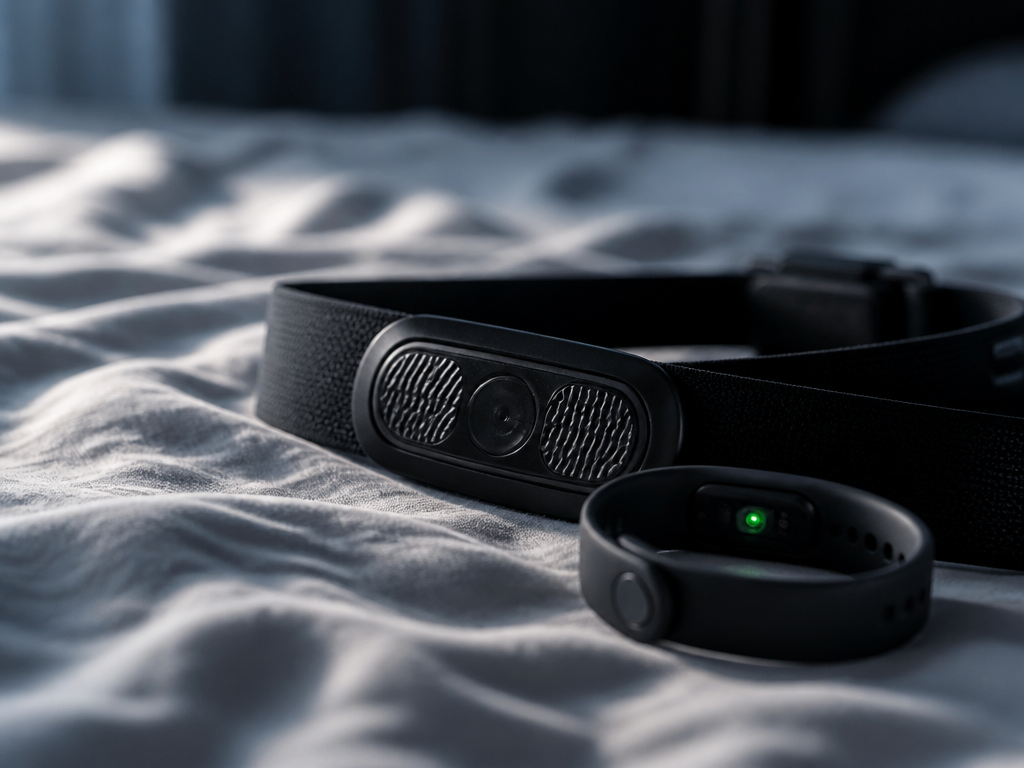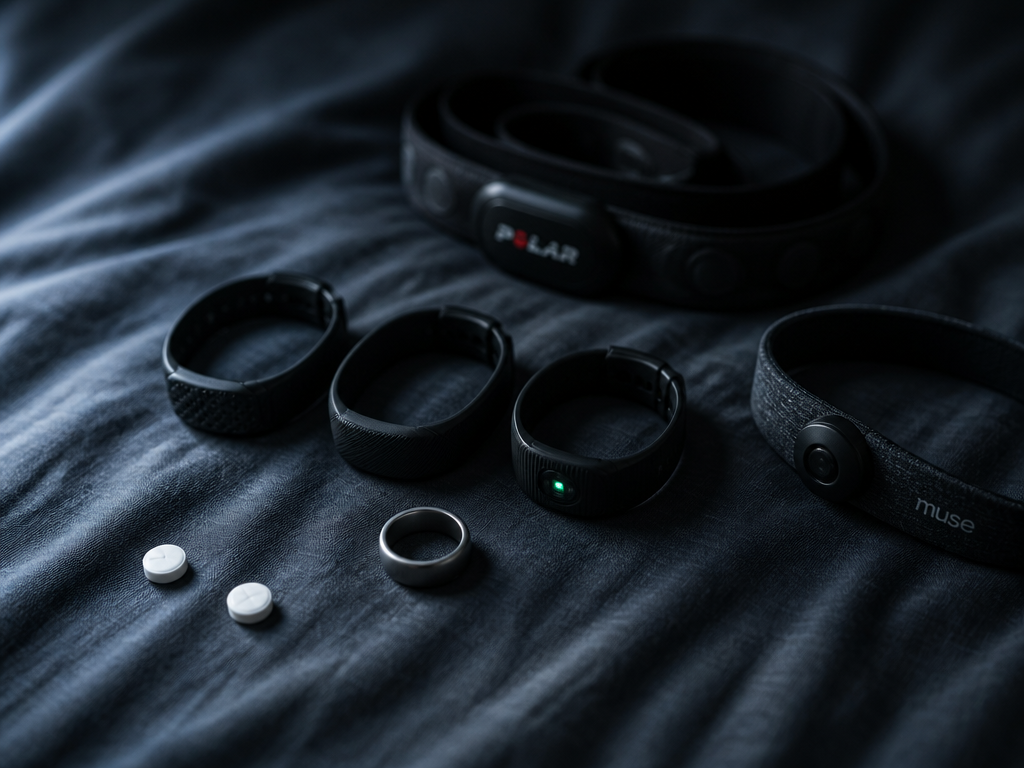
Every fitness tracker review I read before buying answered a question I didn't have. I didn't need to know whether the band segmented my intervals correctly. I needed to know whether a screenless band strapped to my left wrist could see the double espresso I drank at 2 p.m. — whether any of these devices resolve caffeine at the scale a person actually feels it, or whether they just wrap the same three signals in different adjectives. So I wore four of them at once for six weeks and ran the espresso at them deliberately.
The verdict: the screenless band was the only device that showed me caffeine's footprint in a form I could act on, and it won not because its sensor is better but because it has no screen and no headline score — it gives you the overnight heart-rate curve instead of a number that has already decided how you slept.
The test, and what it can't tell you
Forty-two nights. Twenty-one with a double espresso at 2 p.m. — roughly 150 mg, pulled on the same machine, same dose, same grinder setting. Twenty-one with a hard caffeine cutoff at 10 a.m. Arms alternated in blocks of two, assigned by coin flip so I couldn't drift into scheduling the espresso days around a light evening. Bedtime held within a 25-minute window. Alcohol: none, for the duration, which was the least pleasant part of the protocol.
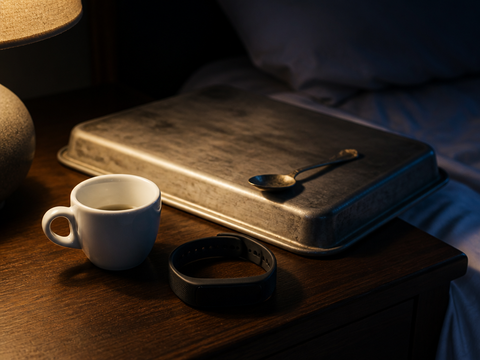
My reference for sleep onset was embarrassingly analogue. I held a metal spoon over an upturned baking tray and let my hand relax as I fell asleep; the clatter woke me, and a bedside recorder timestamped it. I did that once per night, at lights-out, then rolled over and slept. It's crude, it costs you one arousal, and it measures the approach to sleep rather than sleep itself. It is also the only home method I know of that produces a number nobody's algorithm had a hand in.
What this test cannot do: validate sleep stages. Not one of these devices' REM or deep-sleep splits can be checked at home, and I'm not going to pretend otherwise by quoting them at you as if they were measurements. I also can't generalise past one person, one dose, one bedtime. I'm a poor sleeper with a fast caffeine clearance — my father drinks a cortado after dinner and sleeps like furniture — so treat every number below as mine, not yours.
The two things I could measure honestly: hand-timed sleep onset latency, and overnight heart rate. Onset went from a median of 14 minutes on cutoff nights to 26 on espresso nights. Lowest overnight heart rate ran about 4 bpm higher on espresso nights, and — more interesting — arrived roughly 90 minutes later in the night.
The comparison
| Device | Year-one cost | Espresso nights visible? | What it got wrong |
|---|---|---|---|
| Garmin screenless band | ~$170, no subscription | Yes — clearly, on 18 of 21 nights | Wrist strap loosens; two junk nights |
| Whoop | ~$199/yr, hardware included | Only via recovery score, after the fact | Blamed the wrong day |
| Oura Ring 4 | ~$349 + ~$70/yr | Yes on heart rate, buried in the app | Sleep score smoothed it away |
| Garmin Forerunner (already owned) | $0 extra | Directionally, yes | Same data, worse to sleep in |
What each one actually saw
The screenless band
The useful thing about a band with no display is that it can't tell you a story at 6:45 a.m. You open the app and the first thing on the sleep view is the overnight heart-rate trace. On espresso nights that trace has a shape you learn to recognise inside a week: the descent from bedtime is shallower, the floor is higher, and the lowest point lands closer to 3 a.m. than to 1:30. It looked like that on 18 of 21 espresso nights. Two of the three misses were nights the fabric strap had worked loose — I found it halfway down my forearm — and the sensor was reading a lot of nothing. That's a fit problem, and it's a real one if you have thin wrists or sleep with your hands under a pillow.
It is also the only device here that asked nothing of me monthly. That matters more than it sounds. A subscription changes what a device is allowed to be: it has to justify itself every thirty days, which means it has to produce a verdict.
Whoop
Whoop produced verdicts. On espresso nights my recovery score the following morning was lower — median 61 against 74 on cutoff nights, which is a real and consistent gap, and credit where it's due. The problem is attribution. Whoop's framing pushes you toward strain: a bad recovery reads as you trained too hard yesterday, and on several nights it flagged exactly that on days I'd done nothing but sit. The information was in there. The interpretation layer sat on top of it pointing the wrong way, and I only untangled it because I already knew which nights were which. A reader running this blind would have concluded they were overtraining.
Oura
The ring's raw heart rate was arguably the cleanest signal of the four — finger PPG on a device that can't slide down your arm is a structural advantage, and the curve separation between arms was visible without squinting. But you have to dig for it. The screen you land on is a sleep score, and the sleep score barely moved: median 79 on espresso nights against 82 on cutoff nights, a gap so small I'd have called it noise if I hadn't known the protocol. Whatever weighting turns those inputs into that number is doing an excellent job of hiding a 26-minute onset behind a good total sleep time.
The watch I already owned
Honest answer for the Garmin users this is aimed at: your Forerunner already has most of this. The overnight trace on my watch and the trace on the band agreed on the shape of the espresso effect essentially every night, and the band is running the same broad approach to sleep data. What the band buys you is that you'll actually wear it — a lightweight strap versus a 47 mm watch case pressing into your wrist bone at 4 a.m. I stopped wearing the watch to bed years ago, which meant I had no sleep data at all. Zero data from a device you take off beats nothing, but it's not a close race.
Where the answer is "it depends"
At 150 mg at 2 p.m. — a genuinely large afternoon dose, eight hours before bed — the effect was legible on three of four devices. I ran a short unplanned side-arm of five nights at a single 75 mg espresso at 2 p.m., and nothing separated. Not the band, not the ring, not my spoon. So the honest position is: these devices resolve a big, late, deliberate caffeine dose. Whether they resolve your flat white at eleven is a different question and I didn't answer it.
It also depends on what you want the device to do. If you want a number that tells you how to train today, Whoop and Oura are built for that and the band isn't. If you want to run an experiment on yourself, the score is the enemy — every summarising number I looked at was less sensitive to the caffeine manipulation than the underlying heart rate it was made from.
Who this is for, and who it isn't
Buy the screenless band if: you already own a Garmin watch or an Edge computer and want overnight data without sleeping in a watch; you're skeptical of paying annually for a wellness verdict; you want the trace more than the score; you're testing something about your own habits and need an instrument, not a coach.
Don't buy it if: you have small wrists and won't fuss with strap tension — the fit failures were the only nights I lost data entirely; you want GPS from the band itself; you want stage-level sleep detail you can trust, which none of these deliver; or you want one device to replace a training watch. It doesn't, and it isn't trying to.
And if what you want is the caffeine answer specifically, the cheapest version of this fitness tracker review costs nothing: a spoon, a baking tray, and two weeks of writing down what time you drank what.
The winner
A $170 band with no screen beat two subscription devices at the only job I gave it, because it was the only one that showed me the data instead of its opinion of the data.
Rule of thumb for tonight: if your last coffee was after 2 p.m. and took longer than 20 minutes to get to sleep, don't ask the app why — move the coffee an hour earlier tomorrow and watch what the heart-rate line does.