I drink a double espresso at four in the afternoon about twice a week, and on those nights my resting heart rate runs roughly four beats higher than it does otherwise. I know that because a chest strap told me. The question behind this fitness tracker review was narrower and more useful than the usual one: can the screenless band on my other wrist see the same four beats?
Four beats is a small signal. If a wrist band can resolve it, the recovery numbers it sells you are worth reading. If it can't, they're decoration with a battery life.
The verdict, in one sentence: across 19 nights and 11 workouts, the screenless bands matched an ECG chest strap to within about a beat when I was still and warm, and failed badly — but predictably — the moment my effort changed fast.
How I tested
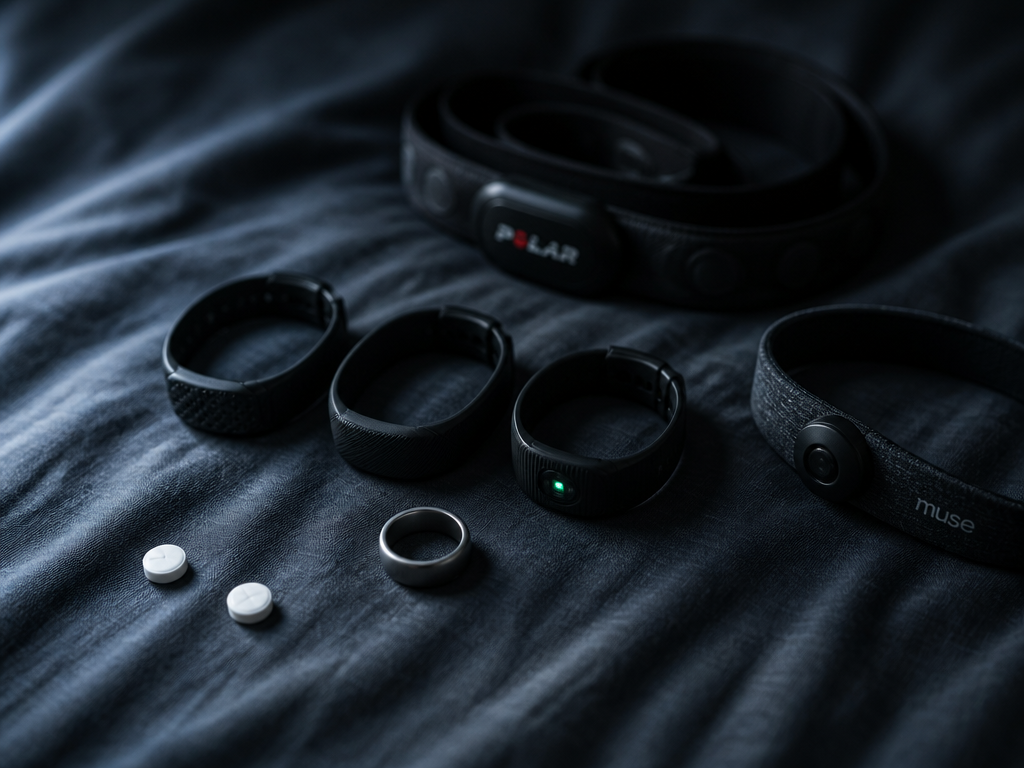
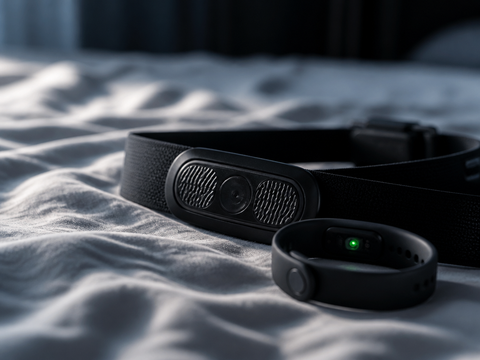
The reference was a Polar H10 chest strap. It reads the electrical depolarization of the heart itself rather than inferring a pulse from green light bouncing off capillaries, which makes it the closest thing to a ground truth you can buy for under $100.
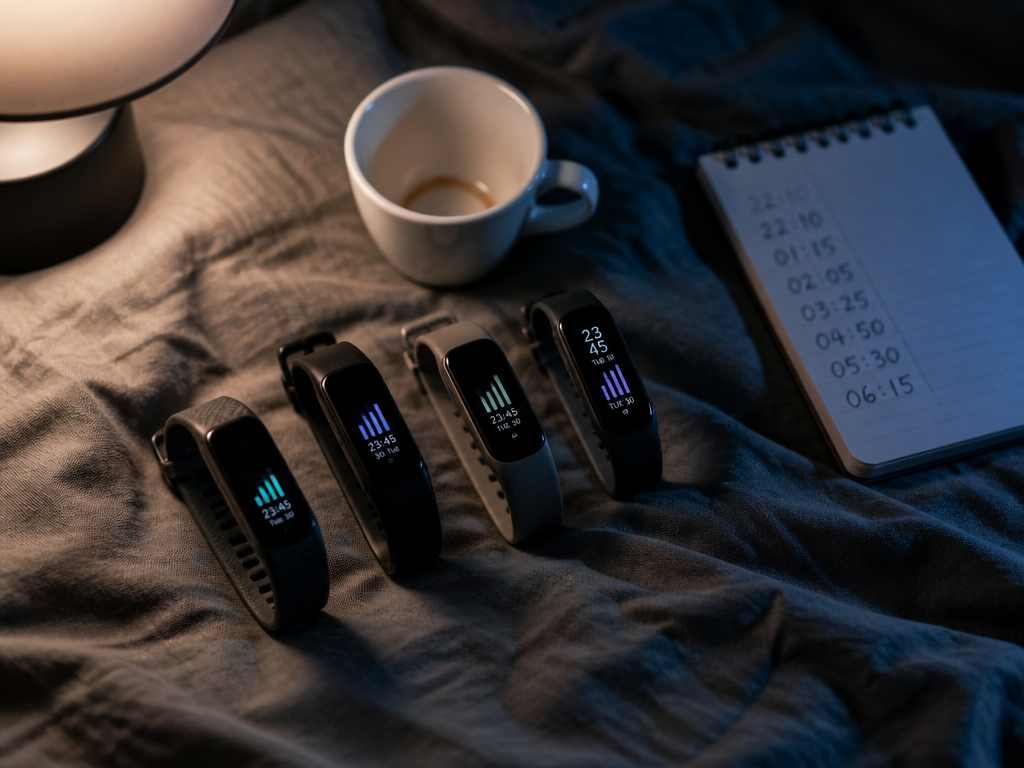
Against it I ran three screenless bands: a $99 budget unit, a $169 band from a running-watch brand, and a $229 band with a $10/month subscription attached to its recovery scores. All three use green-LED photoplethysmography. None has a display. Measured battery life came in at 9, 12, and 14 days respectively, all lower than the box claimed, none low enough to annoy me.
Protocol: strap and band worn simultaneously, band on the non-dominant wrist a finger-width above the ulnar head, snugged one notch tighter than I'd wear it in public. Nineteen nights alternating a 190 mg double espresso at 16:00 against a decaf control, no alcohol, no meals after 20:00. Eleven workouts — five steady runs, three interval sessions, three road rides. I exported both streams, aligned them on start timestamp, and compared second by second where both devices logged at 1 Hz.
Still and warm, the band wins its case
Overnight agreement was better than I expected and better than the internet led me to believe. Mean absolute error against the strap was 1.1 bpm for the running-brand band, 1.2 for the subscription band, 1.4 for the budget one. Nightly minimum heart rate — the number every recovery algorithm leans on — landed within 1 bpm on 17 of 19 nights.
Then the actual question. On control nights my overnight minimum averaged 51.8 bpm by strap and 52.1 by band. On espresso nights: 56.0 by strap, 56.4 by band. The strap measured a caffeine effect of 4.2 bpm. The band measured 4.3.
It saw the coffee. That's the finding I care about most, and it's the one that makes a screenless band defensible for a reader of this magazine.
Heart rate variability was messier but still usable. Overnight RMSSD from the bands ran consistently about 6 ms below the strap — 62 ms versus 68 ms on a typical night — but the offset held steady within ±2 ms across the whole run. That means trends are trustworthy and absolute values are not comparable across devices. Do not read your band's HRV next to a friend's and draw conclusions.
One caveat that nobody puts on the box: sampling rate at rest. The running-brand band logs a resting value every minute. The budget band logs every five minutes unless it thinks something interesting is happening. The five-minute band still found the caffeine delta, but it needed three nights of data to do what the one-minute band did in one.
Moving fast, the band loses
Steady state was fine. Twenty minutes at an easy 152 bpm produced a mean absolute error of 1.8 bpm, with 94% of samples inside 5 bpm of the strap. If your training is zone-2 and your discipline is running, you can stop reading here and buy one.

Intervals were another animal. Six repeats of 60 seconds hard, 90 seconds float. On the first rep the strap hit 171 bpm 38 seconds in; the band's peak for that rep was 149, and it arrived 22 seconds after I had already stopped running hard. Lag across all reps ranged from 22 to 41 seconds. By the fourth rep the band tracked within 8 bpm — not because it got smarter, but because my heart rate had stopped swinging. The session averages nearly agree: 148 bpm by strap, 145 by band. The average is right and every individual number inside it is wrong, which is the worst possible failure mode for anyone training to a target.
Cycling was worse, and for a boring mechanical reason: hands on the hoods means constant wrist load and road vibration. On the third ride, at a steady 88 rpm cadence, the budget band locked onto 176 bpm for roughly six minutes while the strap read 141. That's cadence harmonics, not a heartbeat. Cold made it worse still — at 4°C, the first 90 seconds of a ride had the band reporting 61 bpm while the strap read 128, because the blood it needed to see had left my wrist.
The grid
| Scenario | Chest strap | Best band | Usable? |
|---|---|---|---|
| Overnight resting HR | 51.8 bpm | 52.1 bpm | Yes — 1.1 bpm MAE |
| Caffeine effect (190 mg) | +4.2 bpm | +4.3 bpm | Yes |
| Overnight RMSSD | 68 ms | 62 ms | Trend only |
| Steady run, 20 min | 152 bpm | 1.8 bpm MAE | Yes |
| 60s intervals | 171 bpm peak | 149 bpm, 22s late | No |
| Cold ride, first 90s | 128 bpm | 61 bpm | No |
What I couldn't test
One wrist, one skin tone, no tattoos over the sensor — optical sensors are known to behave differently across all three, and I have no data on any of it. One metabolism, one caffeine dose, nine espresso nights. No polysomnography, so I have nothing to say about sleep staging, which is the claim these bands lean on hardest. Nineteen nights is enough to see a four-beat effect and not enough to separate it cleanly from everything else that moves resting heart rate. And the subscription band's readiness score is a black box I can't audit; I can only tell you the heart rate underneath it was sound.
Who this is for, and who it isn't
Buy one if your interest is recovery rather than performance: resting heart rate trends, HRV direction, whether the 4 p.m. cup is still in you at midnight, whether the taper is working. Buy one if you want data without carrying a phone or looking at a screen — the absence of a display is the feature, and after three weeks I stopped checking anything mid-run, which improved my runs.
Don't buy one if your training has sharp edges. Intervals, CrossFit, anything on a bike. A $60 strap solves that problem completely and pairs with the same app. And obviously don't buy one if you need a number in the moment — there is nothing to look at, by design.
The line worth screenshotting
If your training is steady and your interest is recovery, a screenless band is a chest strap you never have to remember to wear. If your training has sharp edges, it's a mood ring with good battery life.
The myth is that wrist heart rate is a rough approximation you shouldn't take seriously. The more accurate version is that wrist heart rate is excellent at the parts of your life that hold still — which is most of them, and all of the ones where caffeine and sleep meet — and genuinely bad the instant your pulse changes faster than light can follow it.