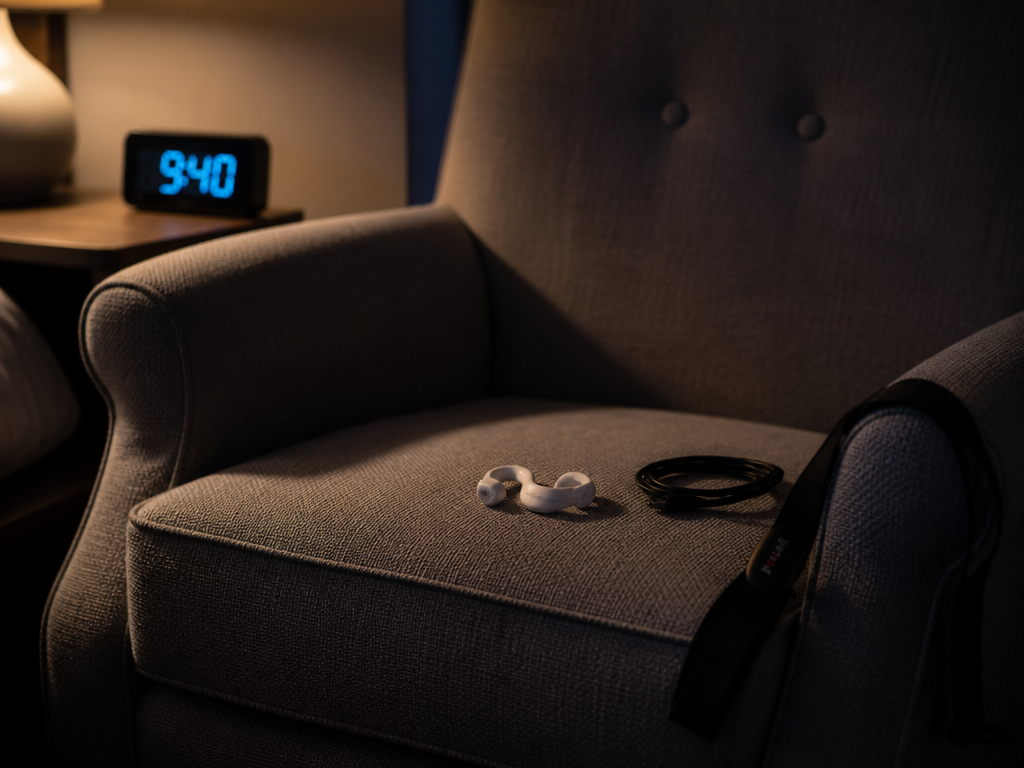
The most accurate thing a screenless band told me this summer was that I'd taken caffeine at four in the afternoon. It never used those words. It said it in an overnight resting heart rate running 4 bpm hot from 1 a.m. onward — a number sitting three taps deep in an app whose front page was, that same morning, congratulating me on a restful night.
So here is the plain version up front, because it is the thesis of this fitness tracker review and everything below is me earning the right to have said it: the sensors in these bands are better than their reputation, and the scores built on top of them are worse. Buy one for the raw traces. Ignore the number on the home screen.
The rig
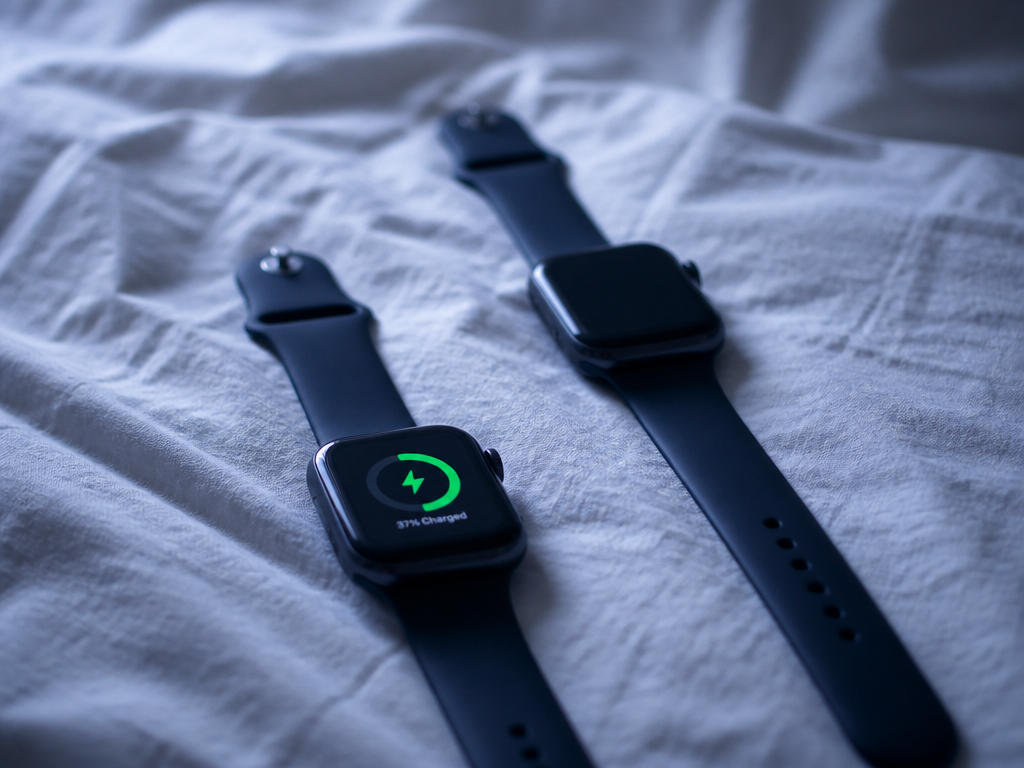
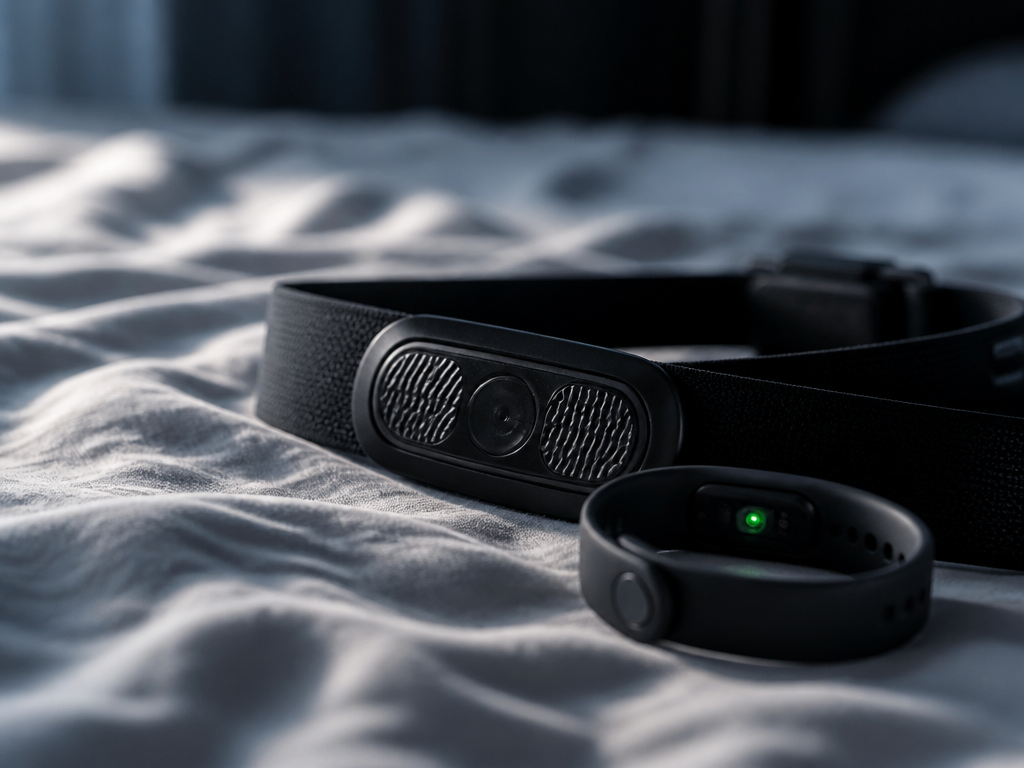
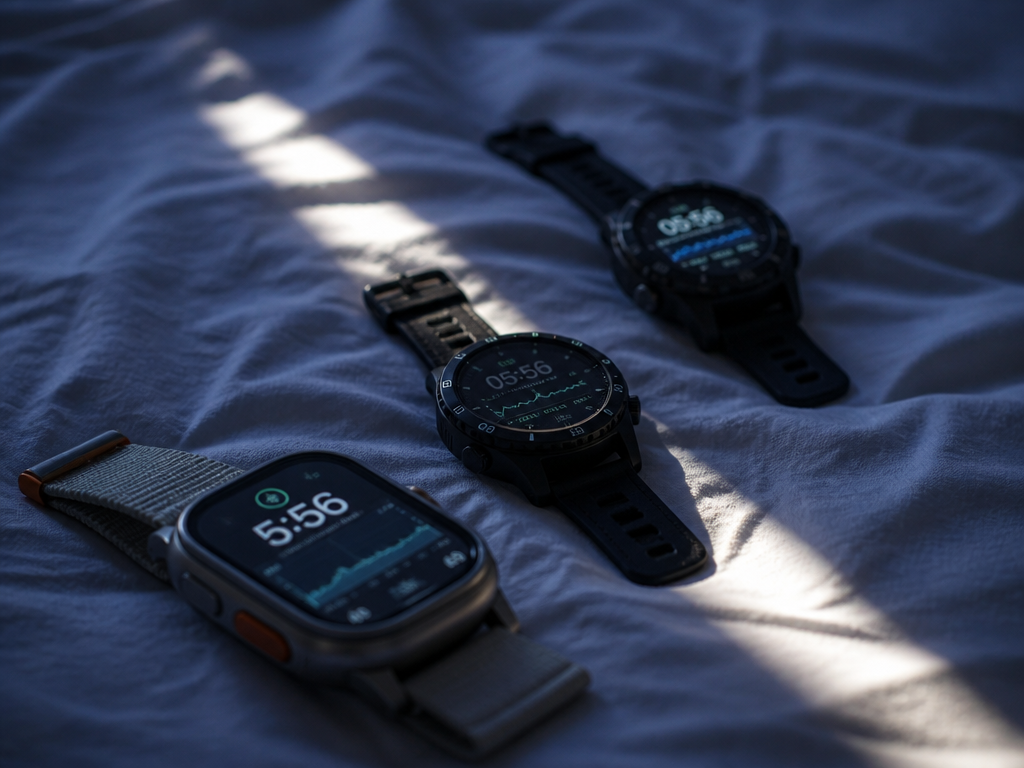
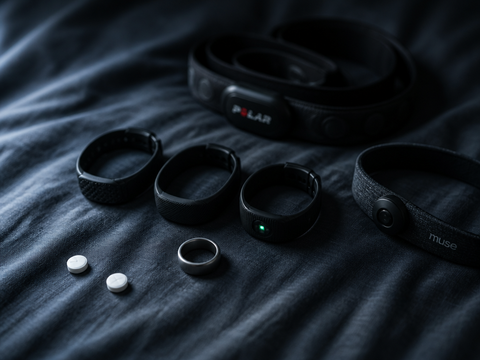
Three screenless bands, worn simultaneously for six weeks. I'm going to refer to them by architecture — the subscription band, the open band, the ring — rather than by brand, because what I set out to test is what this class of device can and can't measure, and because one reviewer's wrist is not a sample you should hang a brand verdict on.
Two reference instruments. For heart rate, a Polar H10 chest strap: electrical rather than optical, worn against the sternum, and the criterion device most heart-rate validation work reaches for. For sleep, a consumer EEG headband with a single frontal channel and automated staging.
That second one needs a caveat, and I'd rather give it now than bury it. I do not have a sleep lab. Single-channel EEG with an automated stager is a flawed reference — it is closer to the truth than a wrist accelerometer, but where it and the band disagree I cannot always tell you which one is wrong. What I can tell you is how much they disagree, and in which direction, which turns out to be enough.
Volume: 14 workouts, 11 hours 20 minutes of paired heart-rate data. 21 nights of paired sleep data. Ten of those nights ran a caffeine protocol — five dosed, five control, alternating.
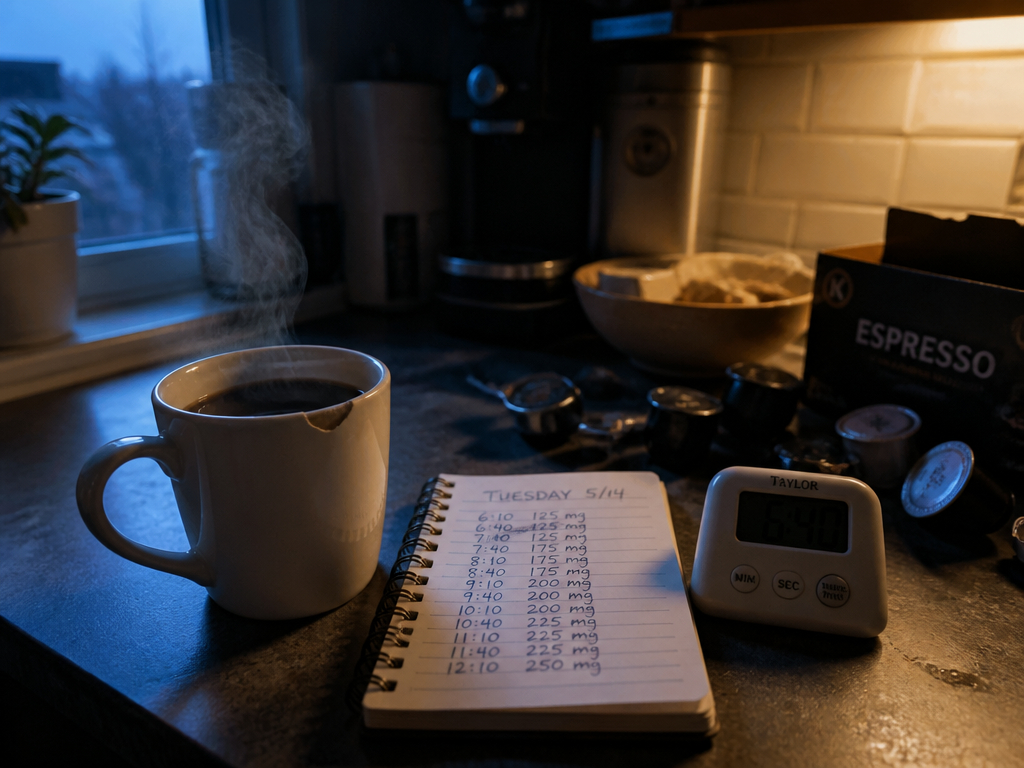
For the dose I used 150 mg caffeine tablets at 16:00 rather than coffee, which will disappoint this magazine's readership but is the only defensible choice. I cannot tell you what's in a cup of pour-over to within 40 mg. I can tell you what's in a tablet.
Nothing was blinded. You know when you've swallowed 150 mg of caffeine. Weigh the subjective findings accordingly; the cardiac ones came off instruments.
Heart rate is a solved problem, with one exception
At steady state, all three were close enough that I stopped worrying. Mean absolute error against the chest strap: 2.1 bpm for the subscription band, 2.6 bpm for the open band, 4.8 bpm for the ring. On a 60-minute Zone 2 ride, the subscription band sat within 3 bpm of the strap for 54 of those minutes. That's a measuring instrument.
Then I ran 30-second-on, 30-second-off intervals at roughly 170 bpm, and both wrist bands fell apart in the same direction. Lag of 12 to 20 seconds into each work block. Over the first 90 seconds of each interval set, MAE ballooned to 9.4, 11.2, and 16.8 bpm respectively. The failure wasn't random noise — it was smoothing. The bands consistently underread the peaks and overread the recoveries, compressing a 40 bpm swing into something closer to 25.
This is worth stating flatly rather than hedging: if your training is prescribed by heart-rate zones and your work intervals are shorter than about two minutes, a wrist optical sensor will lie to you, and it will lie in a predictable direction that makes hard efforts look easier than they were. Wear a strap for those sessions. Wear the band for everything else.
The ring inverted this. Worst of the three in motion, best of the three at night — finger perfusion is generous and a sleeping hand barely moves.
Sleep is not a solved problem
Total sleep time was fine. Median disagreement with the headband across 21 nights was 14 minutes, which is inside the range I'd call the same answer.
Everything downstream of that was not fine.
Wake after sleep onset: the bands reported a median of 11 minutes awake per night. The headband said 34. That gap is the textbook failure of motion-derived staging — lie still with your eyes open and you are, as far as an accelerometer is concerned, asleep.
Deep sleep was worse, and not in the way I expected. Band mean across the study: 1 hour 18 minutes. Headband mean: 61 minutes. But the mean offset isn't the problem, because a constant offset can be calibrated away. The problem is that the night-to-night correlation between the two was about r = 0.2. On a night the headband called deep-sleep-poor, the band was roughly as likely to call it excellent as to agree.
A per-night number that doesn't track a per-night reference isn't a measurement. It's a mood.
The caffeine nights
This is the section that changed what I think these devices are for.
Five dosed nights, five control, chest strap worn to bed on all ten — uncomfortable, and worth it.
- Overnight mean resting heart rate: the band reported +4.3 bpm on caffeine nights. The chest strap said +4.6. Agreement within half a beat.
- HRV (rMSSD): band −11.4 ms on caffeine nights, strap −9.8 ms. Same direction, close magnitude.
- Sleep onset latency: the headband measured +19 minutes on dosed nights. The bands' own onset estimate moved +4 minutes. They mostly missed it, for the same reason as above — motionless is not unconscious.
- The headline score: an average difference of 3 points between dosed and control nights. On four of the five caffeine nights, the app still filed the night in its top category.
Read those together. The hardware registered the cardiac signature of an afternoon dose almost exactly as well as a chest strap did. The software then weighted it into irrelevance and told me I was recovered. Whatever sits between the sensor and the score is discarding the single clearest physiological signal the device collected all night.
I don't think that's a bug. I think a score that told you four nights in five that you'd blown it would not survive contact with a retention meeting.
The grid
| Subscription band | Open band | Ring | |
|---|---|---|---|
| HR error, steady state | 2.1 bpm | 2.6 bpm | 4.8 bpm |
| HR error, short intervals | 9.4 bpm | 11.2 bpm | 16.8 bpm |
| Total sleep time vs. EEG | −9 min | −16 min | −11 min |
| Per-night deep sleep agreement | r ≈ 0.2 | r ≈ 0.2 | r ≈ 0.3 |
| Overnight RHR shift, caffeine nights | +4.3 bpm | +4.1 bpm | +4.5 bpm |
| Cost, year one | $343 | $149 | $371 |
What I couldn't test
Skin tone: I have one, and optical sensors are known to behave differently across melanin levels and under tattoos. My evidence there is a single wrist and it isn't evidence.
Cold: every session ran between 18 and 31°C. Peripheral vasoconstriction is the classic wrist-PPG killer and I never got near it.
Drift: six weeks tells you nothing about what these sensors read after a year of sweat and sunscreen.
Blood oxygen and respiratory rate: all three reported them nightly. I had no reference instrument for either, so I have no opinion, which is different from saying they're fine.
Who this is for, and who it isn't
Buy one if you'll actually look at trend lines — if you want to run the experiment I ran, testing a late espresso or a hard evening session or two glasses of wine against your own overnight resting heart rate. On that job these bands are genuinely instruments, and the screenless form factor helps, because there's nothing to check at 3 a.m. It also suits steady aerobic training and anyone who wants the phone out of the run entirely.
Skip it if you pace intervals off heart rate — a strap costs $90 and is right. Skip it if you need per-night sleep staging for a reason that matters, because those numbers don't survive contact with a reference and no subscription tier changes the sensor. And skip it if you're the sort of person who will read the score and feel a way about it. The score is the least trustworthy thing in the box.
If you want one recommendation: the open band. It produced the same traces as the subscription band — 2.6 versus 2.1 bpm is below my ability to care — and doesn't charge $144 a year for a verdict I've just spent 1,500 words telling you to ignore.
The band knew about the coffee. The score forgave it.