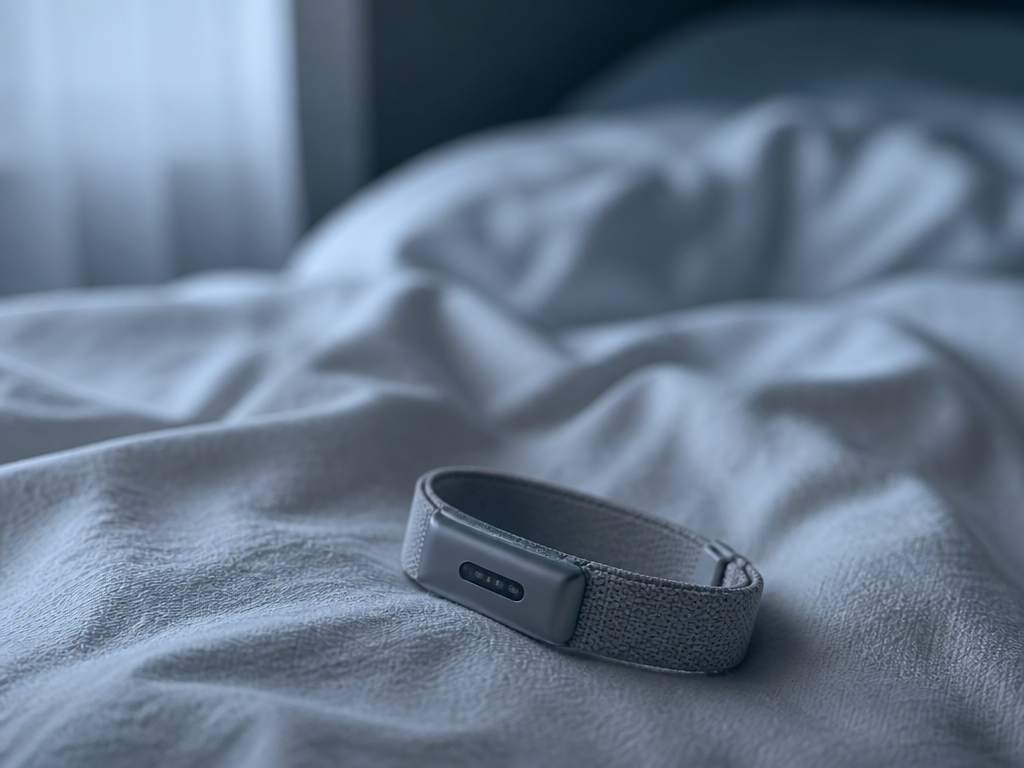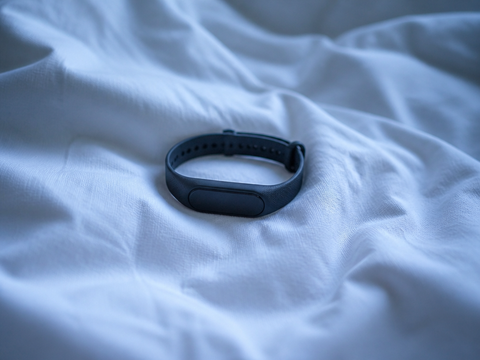
The Garmin Cirqa arrived in a padded envelope thin enough to go through the letter slot, which is the first honest thing about it. There is no screen, no watch face, no readiness number sitting on your wrist at 3 a.m. waiting to be consulted. That absence is the entire pitch. I wore it for six weeks — forty-two nights, logged against a caffeine schedule I set in advance and did not deviate from — to find out whether the absence does the work the marketing implies it does.
The verdict first, because it is the only sentence some of you need: the band is an excellent witness and a poor coach. It records the shape of a night accurately enough to be genuinely useful, and then draws conclusions from that record which my own data does not support.
The myth: the display was the problem
Here is the claim, which I have now heard from three people who should know better and read in considerably more places than that. Sleep trackers make some people sleep worse — orthosomnia, the anxiety of chasing your own metrics — and the culprit is the display. The number is right there, on your arm, glowing at you when you roll over. Remove the display and you keep the measurement while losing the compulsion. Clean data, no neurosis.
It is a tidy story. It is also, on the evidence of six weeks, the wrong variable.
I counted. iOS Screen Time gives you app-open counts, and I pulled the Garmin Connect number every Sunday. Week one: 6.4 opens per day. Week two: 5.9. By week five it had settled to 2.1 and stayed there, which looks like the story working — the compulsion decaying as the novelty wore off.
But the raw count buried the thing that mattered, which was when and how long. On the watch, checking my sleep was a wrist flick at 6:50 a.m.: three seconds, half-awake, easy to dismiss, and — critically — over before I had formed any opinion about it. Without a display, the only route to last night's data is the phone. So I picked up the phone. In bed. Before getting up. On roughly four mornings in five during the first fortnight, that three-second glance became an eleven-minute phone session, because the phone is a phone and Connect is not the only thing on it.
Removing the screen did not remove the checking. It relocated it to a worse device at a worse hour. If you are the kind of sleeper who argues with their own numbers, this band does not solve your problem; it moves it somewhere with a browser.
What I actually did
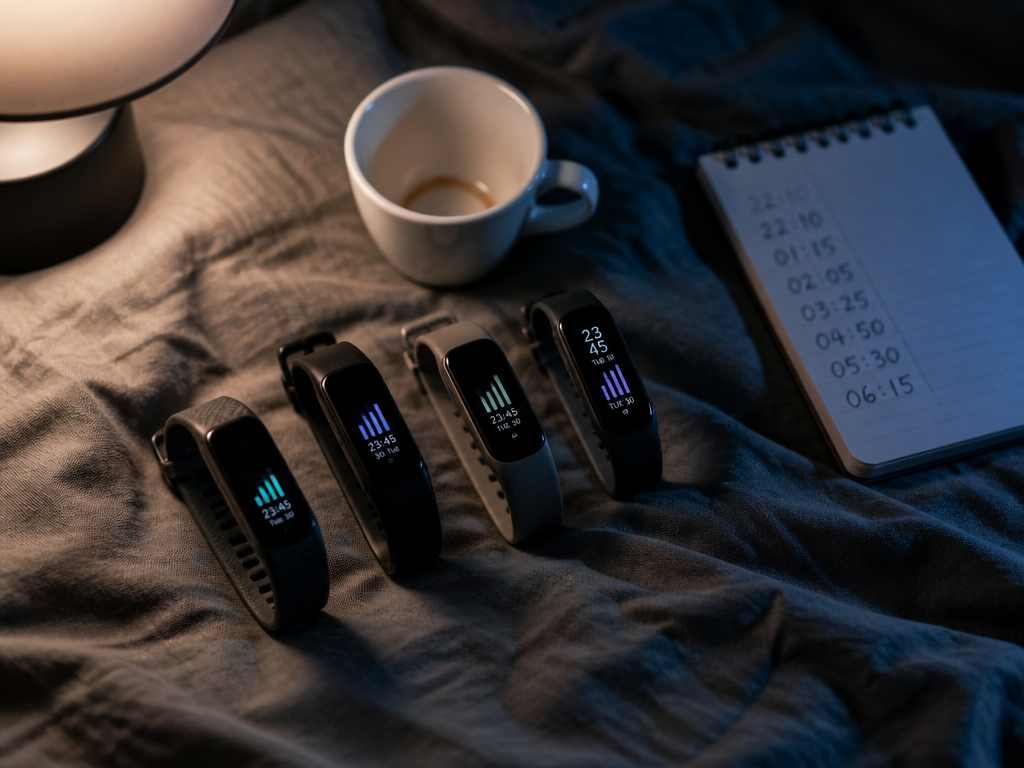
Forty-two nights, split into three blocks of fourteen. The only variable I changed was the caffeine cutoff: noon in block one, 2 p.m. in block two, 4 p.m. in block three. Bedtime target was 10:45 p.m. throughout and I hit it within twenty minutes on 38 of 42 nights.
Dose was held as constant as a home setup allows. Morning brew: 22 g dose, filter, roughly 350 ml in the cup, which puts it somewhere around 200 mg. Second cup mid-morning or early afternoon depending on the block, smaller, call it 140 mg. Nothing but decaf after the cutoff, and the decaf was the same Swiss Water Ethiopian all six weeks so I wasn't also swapping the ritual. I weighed the doses; I did not assay the coffee, so treat every milligram figure here as ±20%.
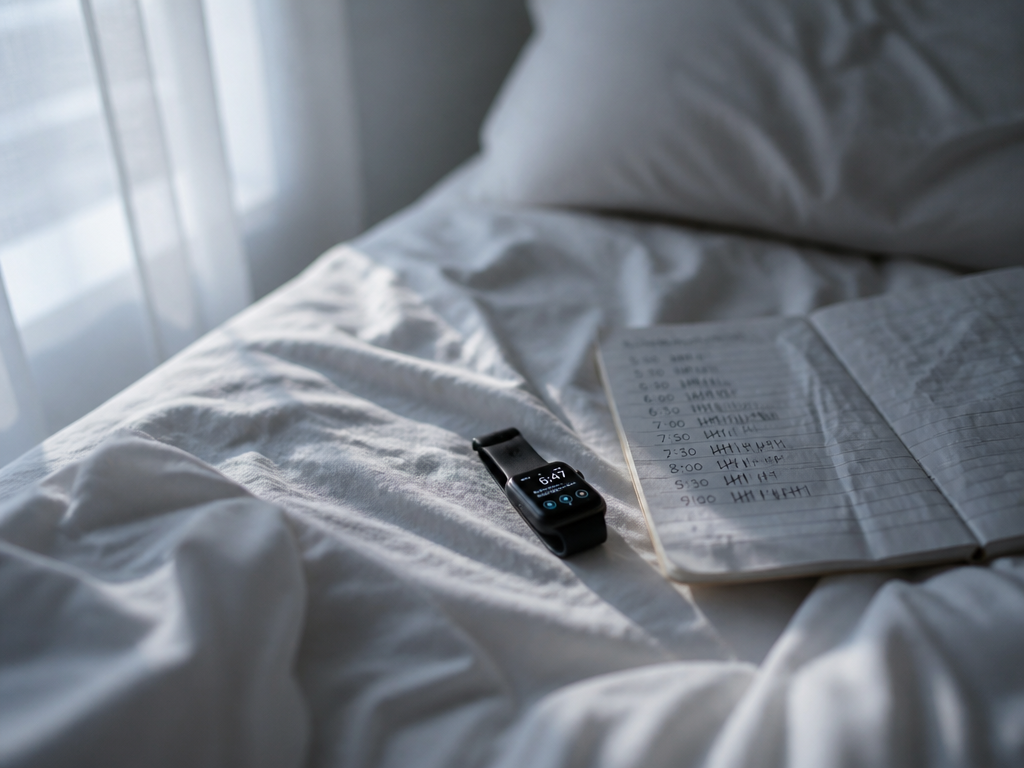
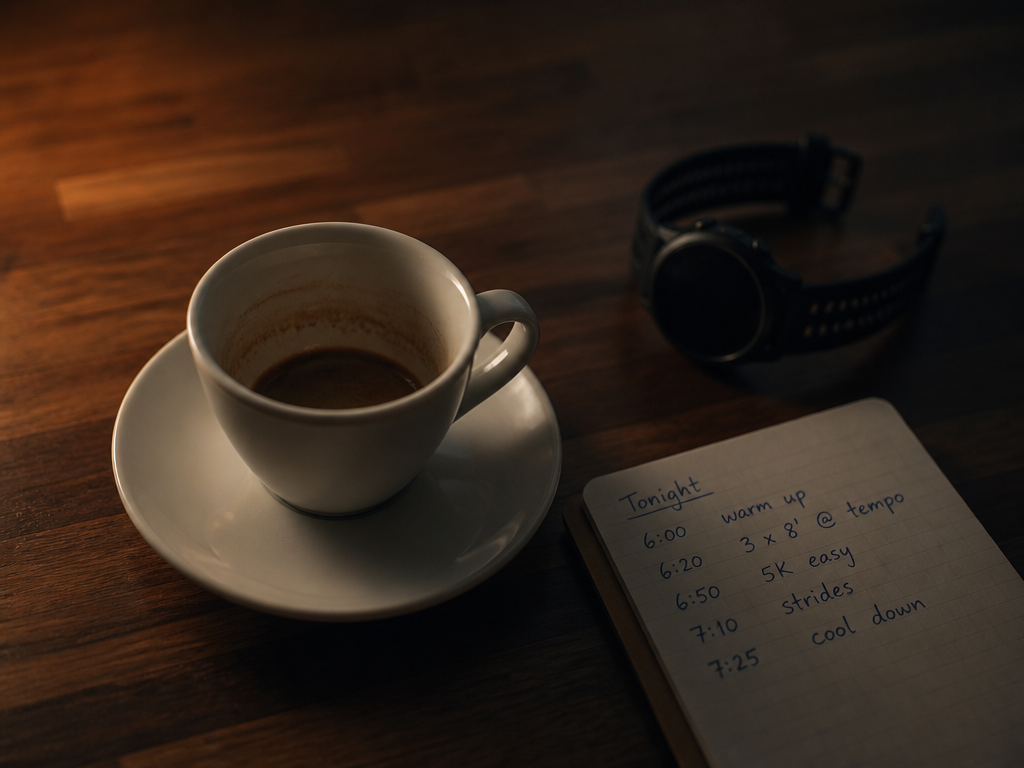
The reference instrument was a pad and a pen on the nightstand. I wrote down lights-out time, and in the morning I wrote down my own estimate of how long it took to fall asleep. This is the weakest part of the whole experiment and I want to be plain about it: self-reported sleep onset latency is known to run long, because lying awake feels longer than it is. What saves the comparison is that the bias should be roughly constant across all three blocks — I was the same person estimating the same way — so the differences between blocks survive even if the absolute numbers are inflated.
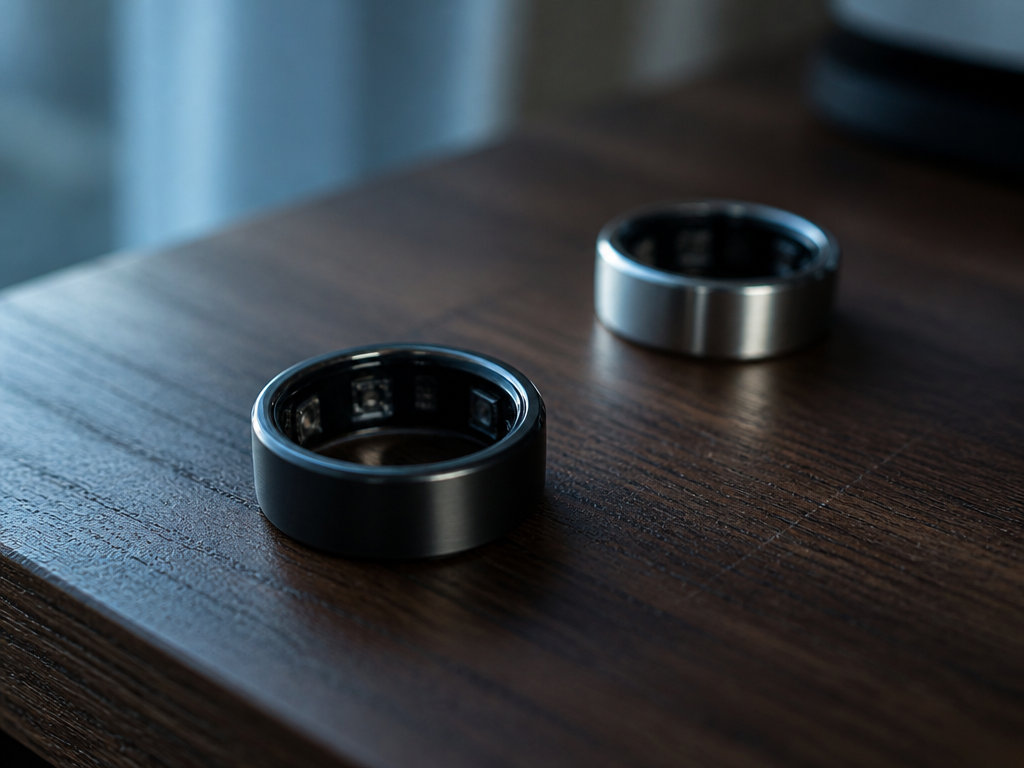
Alongside the screenless band I wore an Oura Ring 4 on the left index finger for all 42 nights, and a Forerunner 265 on the opposite wrist for 21 of them. No polysomnography, no lab, no clinician. One middle-aged body with a regular schedule and no diagnosed sleep disorder. Nothing here is a study; it is one person's forty-two nights, and I would not extend it past my own wrist.
The evidence
My own logged onset latency, median per block:
- Noon cutoff: 14 minutes (range 8–26)
- 2 p.m. cutoff: 19 minutes (range 9–41)
- 4 p.m. cutoff: 31 minutes (range 12–58)

The band's estimated onset latency for the same three blocks: 6 minutes, 7 minutes, 9 minutes. In forty-two nights it never once returned a figure above 12 minutes. On the night I logged 58 minutes of staring at the ceiling — a 4 p.m. cutoff night, a second flat white I regretted immediately — the band recorded 11 minutes and gave the night a score of 74.
The sleep scores across the three blocks averaged 78, 76 and 72. A six-point spread, across a set of conditions in which my own time-to-sleep had more than doubled. Whatever that score is tracking, it is not the variable this experiment was built to move.
Where the band was good, it was very good. Total sleep time landed within 15 minutes of my log on 34 of 42 nights. Wake time was within 6 minutes on 40 of 42, which is better than I can do unaided. Bedtime drift — the slow creep later across a working week — showed up clearly and honestly, and seeing it charted was the single most useful output of the entire six weeks.
Where it came apart was staging. On 12 of the 42 nights, the band and the ring disagreed about how much deep sleep I got by more than 45 minutes. The worst night was a 71-minute gap: one device said 38 minutes of deep sleep, the other said 109, from the same body on the same mattress. At least one of them was substantially wrong, and I have no way to know which, which in practice means I should act on neither.
The mechanism: what a wrist can and cannot know
None of this is a defect. It is what the sensors are.
A wrist band is an accelerometer and an optical heart-rate sensor. The accelerometer knows whether you are moving; the green LEDs know roughly how fast your heart is beating and something about the variability between beats. From those two streams, everything else is modelled.
Some inferences are easy. Horizontal, still, low heart rate, for hours, at night is a robust signature — that is why total sleep time and wake time were nearly perfect. Duration and timing are close to measurement.
Onset latency is the hard case, and it is hard in a specific and unfixable way: a person lying deliberately motionless because they are trying to fall asleep looks, to an accelerometer, exactly like a person who has fallen asleep. The failure case is the use case. That is why every onset figure the band produced was compressed toward single digits, and why it would be compressed no matter whose wrist it was on.
Stage breakdown — deep, light, REM — is a model output dressed as a measurement. The model is trained against lab data and it is not stupid, but the input resolution simply isn't there to resolve a 71-minute question. And the caffeine layer, where the app offers to tell you how your intake affected your night, is inference stacked on inference. The device does not know your dose. It does not know your CYP1A2 variation, and the spread in how fast people clear caffeine is not a rounding error — it is the difference between a 4 p.m. espresso being irrelevant and it being the reason you are awake at midnight. It does not know whether the cup at four was 90 mg or 190 mg. It knows your wrist was still and your heart rate was fourteen beats above your baseline, and it is doing its best with that.
So: the band measured precisely the thing I could already observe, and estimated precisely the thing I actually wanted to know.
The subscription question
Garmin's Connect+ tier runs $6.99 a month or $69.99 a year, and the Cirqa launched into a genuine mess about which side of that line the sleep features would sit on. Garmin reversed course after the complaints and moved the contested one to the free tier. That reversal is worth acknowledging, because the more common corporate response to this kind of pushback is a blog post about listening followed by no change at all.
But notice the shape of what ended up free and what stayed paid. The free tier holds the measurement-adjacent layer: duration, timing, the record of what happened. The subscription holds the interpretive layer — the coaching, the long-range trend narratives, the this-affected-that correlations. On my forty-two nights, that is exactly backwards from where the fidelity is. The reliable part is the part you already own; the part with the worst signal-to-noise is the part being sold on a recurring basis.

I want to be careful about how hard I lean on that, because the alternative arrangement — paywalling the raw record and giving away the horoscope — would be considerably worse, and it is the arrangement several competitors have landed on. Whoop bundles hardware into a subscription starting around $199 a year and you own nothing when you stop paying. Oura charges $349 for the ring and then $5.99 a month on top to see most of what it collects. Against that, a band you buy once for $169.99 (£149.99) whose core sleep record does not expire is a comparatively decent deal. Faint praise, but real praise.
The question I'd want answered before renewing anything is simpler than the pricing: is the paid layer telling me something, or is it telling me a story about something? Six weeks in, I could not distinguish its caffeine guidance from a coin flip weighted toward common sense.
Cirqa vs. watch vs. ring vs. a notebook
| Device | Year-one cost | Nights agreeing with my log within 15 min | Worst single-night deep-sleep disagreement | What it actually changed |
|---|---|---|---|---|
| Screenless Garmin band | $169.99 | 34 / 42 | 71 min (vs. ring) | Moved my checking from wrist to phone |
| Forerunner 265 | $449.99 | 31 / 42 | 66 min (vs. ring) | Glanceable; easiest to ignore |
| Oura Ring 4 | $349 + $71.88 | 33 / 42 | — (reference) | Most comfortable to sleep in |
| Pad and pen | ~$12 | it is the log | n/a | The only thing that moved my cutoff |
The winner of this comparison is a notebook, and I say that as someone who wanted the answer to be otherwise. Three weeks of writing down what time you stopped drinking coffee and how long it took you to fall asleep will find your caffeine cutoff more reliably than any wrist device I have worn. The band is the better instrument for duration and drift. The pen is the better instrument for cause.
On comfort, the ring wins outright — I stopped noticing it by night three, whereas the band's strap left a mark for the first week until I loosened it a notch and accepted slightly noisier heart-rate data as the price. On the wrist-versus-wrist question, the screenless band and the Forerunner produced sleep records close enough that if you already own a Garmin watch and sleep in it without complaint, this device gives you nothing new except a smaller object.
Who this is for, and who it isn't
It's for you if you want duration and timing without strapping a computer to your arm overnight; if your bedtime drifts across the week and you'd benefit from seeing that charted rather than arguing about it; if you find watches uncomfortable to sleep in but rings worse; or if you have already proved to yourself that you can look at a sleep number without relitigating your whole evening.
It isn't for you if you want to know why last night was bad — the band will offer an answer and the answer is a guess. Not if you plan to make decisions from stage data; on my nights, two well-regarded devices disagreed by over an hour often enough that I would not act on either. Not if you are an anxious sleeper who checks compulsively, because removing the display sends you to the phone in bed, which is a downgrade. And not if you are buying it specifically to find your caffeine cutoff, because you can find that with a pen and three weeks and considerably less money.
The honest takeaway
My caffeine cutoff, on this body, on these forty-two nights, is somewhere between noon and 2 p.m. for a 10:45 p.m. bedtime — call it ten hours, which is unglamorous and matches roughly what a pharmacokinetics textbook would predict from a five-hour half-life without any hardware involved at all. The band did not find that for me. My notebook found it, and the band then confirmed I was keeping to it, which turned out to be the job it is genuinely good at.
That is a narrower brief than the product implies, but it is not nothing. Most of us are not short on theories about our sleep; we are short on an accurate record of what we actually did. A device that reliably tells you that you went to bed forty minutes later on Thursday than you claimed you did is doing real work. A device that tells you your deep sleep was down 12% and implies a reason is doing something else, and the fact that the something-else lives behind a subscription while the useful part is free is, at minimum, a coincidence worth noticing.
If you change one thing tonight, make it the clock and not the wrist: put your last caffeine ten hours before lights-out, and let the band tell you whether you kept the promise rather than asking it why you didn't.