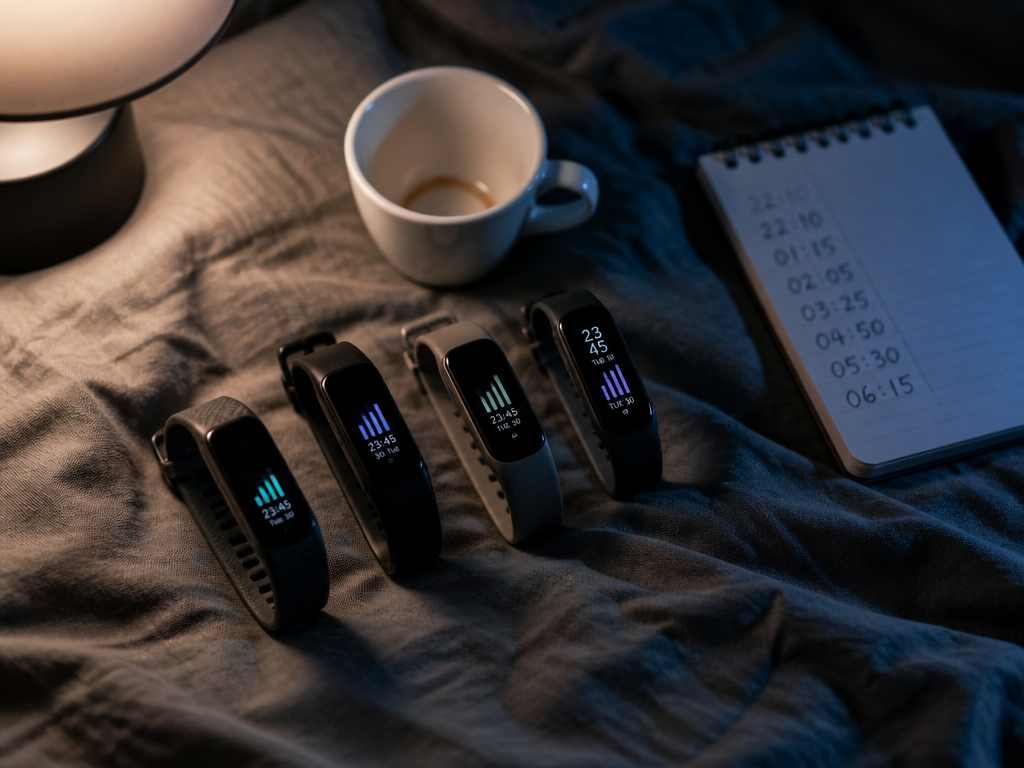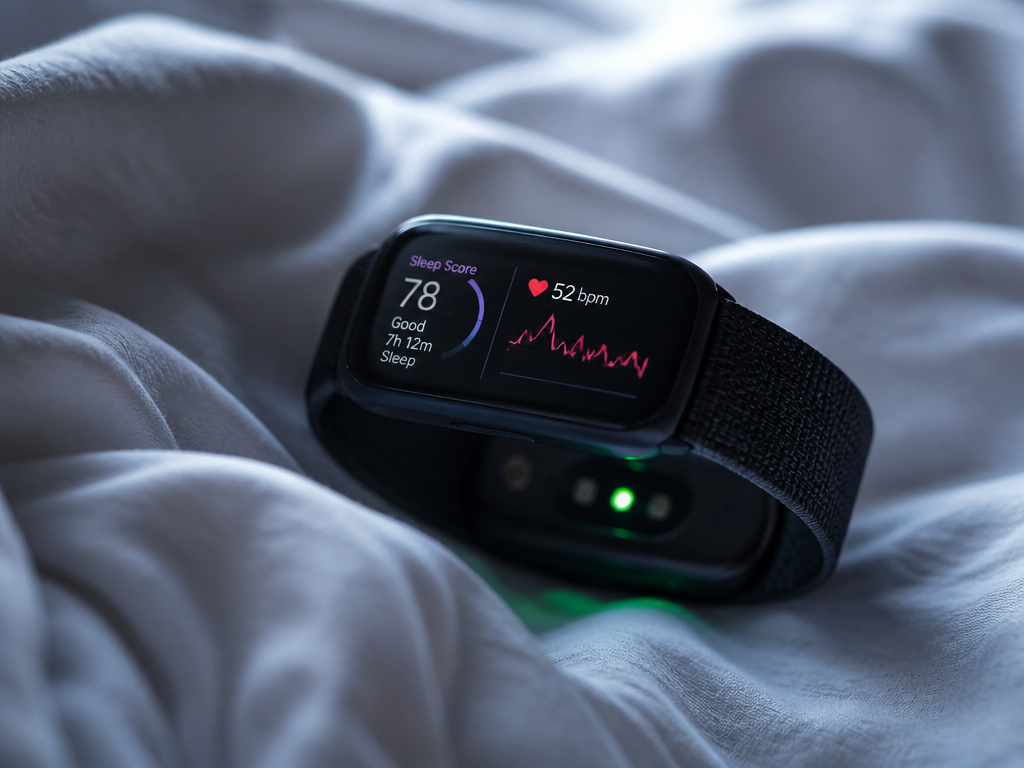
A line of metadata in a Play Console listing is a strange place to find hope, but that's where this one turned up. The Pixel Watch 5, according to the listing that surfaced this month, will ship with 3 GB of RAM and the same Qualcomm SW5100 that has been inside every Pixel Watch since 2022. Fourth generation, same silicon. One extra gigabyte as a consolation prize. The forums reacted the way forums do — but underneath the chip complaints ran a quieter, more interesting thread: maybe this is what finally fixes the sleep tracking.
That hope is worth taking apart, because it's wrong in a specific and instructive way.
The myth: sleep tracking is compute-limited
The belief goes something like this. Your watch guesses your sleep stages. The guesses are bad — everyone who has worn one knows the 3 a.m. bathroom trip that got scored as deep sleep. Sleep staging is a hard classification problem. Hard classification problems want more compute and more memory. Therefore a memory-starved watch produces bad sleep data, and a less memory-starved watch will produce better sleep data.
Every step of that is reasonable. The conclusion is still wrong, and the reason has less to do with Qualcomm than with what a wrist can physically detect.
What the leak actually says
The SW5100 is not one processor. It's a package containing a quad-core Cortex-A53 application processor and a separate always-on Cortex-M33 co-processor, and the whole architecture exists to keep the A53 unconscious as much as possible. That's the point of Wear OS's hybrid interface: the big cores wake for your face taps and your notifications, then go back down. The M33 keeps the sensors running.
Which means that for the eight hours you care most about — lights out to alarm — the application processor is asleep alongside you. Accelerometer sampling, photoplethysmography, skin temperature: all of it is co-processor work, buffered and batched, with the staging algorithm typically run in a burst at the end or offloaded to your phone. The 3 GB is memory the main processor gets to use while you're awake and looking at the thing.
If the leak is accurate — Play Console listings have been wrong before, and August will settle it — then Google spent this generation's budget on headroom for the parts of the watch you interact with. That is a defensible choice. It is just not a sleep choice.
Does more RAM make sleep tracking more accurate?
No. Sleep-staging accuracy on a consumer wearable is limited by the sensors, not by the memory available to process them. A watch infers sleep stages from three signals — how still your wrist is, what your heart rate and its beat-to-beat variability are doing, and sometimes peripheral temperature. Polysomnography, the clinical standard, scores stages from brain electrical activity, eye movement, and chin muscle tone. Those are different physical quantities. No amount of RAM converts one into the other.
What the validation studies actually measured
The most useful reference point here is Chinoy et al. (2021), published in SLEEP, which put seven consumer sleep trackers on 34 healthy adults simultaneously with in-lab polysomnography across multiple nights. The headline finding was lopsided in a consistent direction: the devices were very good at knowing you were asleep — sensitivity in the low-to-high nineties — and quite bad at knowing you were awake. Specificity for wake landed somewhere in the range of roughly 20 to 50 percent depending on device. In plain terms, if you were lying still and awake, most of these devices called it sleep.
That asymmetry propagates. Total sleep time gets overestimated. Wake after sleep onset gets underestimated. Sleep efficiency comes out flattering. Stage-level agreement — the four-color hypnogram your watch draws for you every morning — was weaker still, and this is the part that gets quietly omitted when the numbers are marketed.
Worth separating what's solid from what isn't. Well-established: wrist actigraphy detects sleep versus wake reasonably well in healthy sleepers, and modern heart-rate-augmented devices beat movement-only actigraphy at it. Plausible but thin: that consumer four-stage hypnograms are accurate enough for night-to-night decisions in an individual. Massimiliano de Zambotti and colleagues have spent years pointing out that most validation is run on healthy young adults in labs, and that per-night, per-person error is much larger than the pooled group statistics suggest. Folk wisdom: that your deep-sleep minutes are a number you should be optimizing.
One night, in the order it happens
Say you have a 200 mg latte at 3 p.m. Absorption is fast — plasma caffeine peaks roughly 30 to 60 minutes later. Elimination is slower and highly variable: median half-life around five hours, with a population range from about 1.5 to 9.5 hours depending mostly on your CYP1A2 activity.1
What caffeine does at the receptor is antagonism, not stimulation. Adenosine accumulates in the brain across waking hours as a byproduct of energy metabolism, and its binding at A1 and A2A receptors is a major part of what sleep pressure is. Caffeine occupies those receptors without activating them. The adenosine is still there. The pressure is still there. You've unplugged the doorbell, not cleared the house.
By 11 p.m., eight hours out, you're still carrying something on the order of a third of that dose. So you go to bed and — here's the part that misleads people — you fall asleep more or less on time. Sleep onset latency is the least sensitive thing caffeine touches at this range. What shifts is architecture: slow-wave sleep is suppressed, EEG delta power in the first cycles drops, and you accumulate more light N2 and more brief arousals of three to fifteen seconds.
Drake et al. (2013), in the Journal of Clinical Sleep Medicine, gave 12 subjects 400 mg of caffeine at 0, 3, and 6 hours before bed. The six-hour dose still cost about an hour of measured sleep relative to placebo. The subjects largely did not notice. Small sample, large dose — but the direction has held up in the broader literature, including Clark and Landolt's 2017 review in Sleep Medicine Reviews.
Now watch what your wrist has to work with. Your body is still. Your heart rate is somewhat elevated, your variability somewhat compressed. The arousals are three seconds long and involve no meaningful movement. In the morning the watch reports a decent night with slightly reduced restorative sleep, because that's the only shape the inference can take. The delta suppression — the actual injury — left no trace the sensor can read.
Where the extra gigabyte genuinely earns its place
Credit where it's due. If Google is putting on-device Gemini processing on the wrist, model weights have to live somewhere, and 2 GB is a genuinely tight ceiling for keeping a model resident alongside the OS and a watch face. The difference between a voice query that answers in 800 ms and one that answers in three seconds is largely a question of what got evicted from memory. Same for app switching, same for complications that don't blank when you raise your wrist. Those are real wins on a device people touch forty times a day.
The complaint isn't that the RAM is useless. It's that it's been quietly filed under the wrong heading.
What your wrist can and can't see
| Overnight event | Polysomnography | Wrist wearable |
|---|---|---|
| Sleep onset | EEG alpha dropout, K-complexes | Stillness plus heart-rate drop — decent |
| Slow-wave sleep | Delta power, 0.5–4 Hz | Inferred from HR/HRV — weak |
| Brief arousals (3–15 s) | EEG desynchronization | Largely invisible |
| Wake after sleep onset | Scored per 30-second epoch | Caught maybe 20–50% of the time |
The honest rule of thumb: treat your watch's total sleep time as roughly informative and its stage breakdown as roughly decorative. Use it for trends across a fortnight, never for verdicts about last night. And if you want to test your own caffeine cutoff, don't run the experiment against your sleep score — run it against a fixed cutoff for two weeks, then compare how you feel at 3 p.m., which is the only instrument you own that's actually measuring the thing.
Buy the Pixel Watch 5 for the software that runs while you're awake, because the hardware that runs while you're asleep isn't the part they upgraded.
-
Oral contraceptives roughly double caffeine's half-life; regular smoking cuts it by around 30 to 50 percent. Two people can drink the same 3 p.m. coffee and be in genuinely different pharmacological situations at midnight, which is one reason blanket cutoff advice tends to be either too strict or useless. ↩