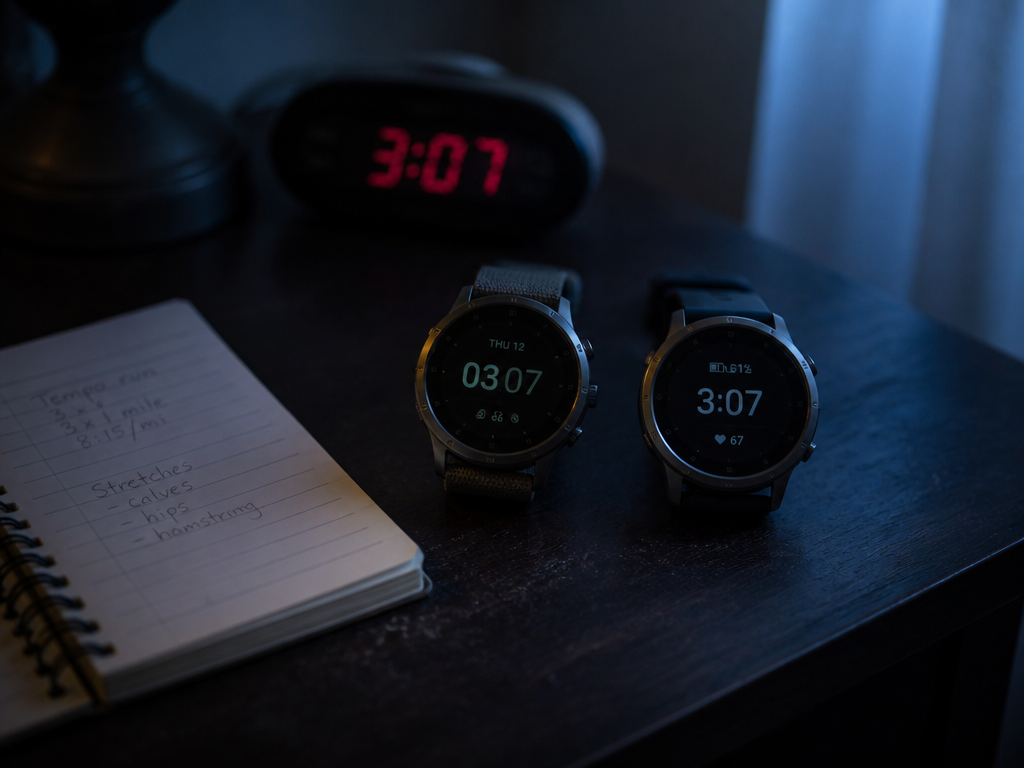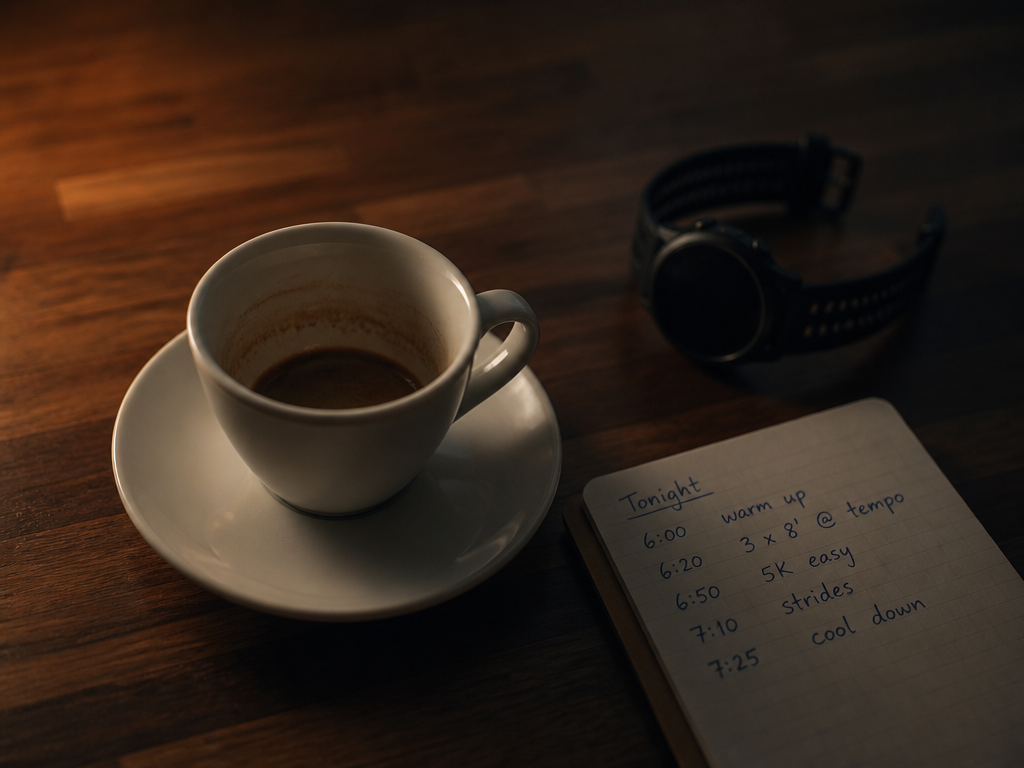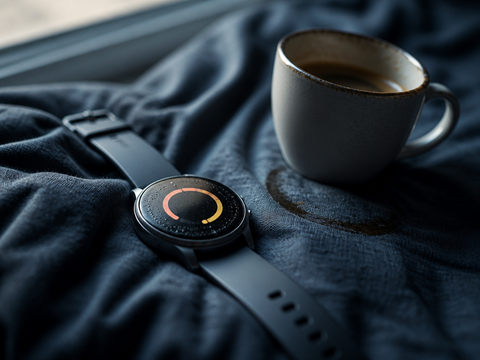
The advice comes bundled with the watch, usually somewhere in the setup wizard, phrased with more confidence than the underlying science has earned: stop training by the calendar and start training by your body. Let the adaptive coach read last night's sleep, your heart-rate variability, and your resting pulse, then hand you today's workout. That is the whole pitch for AI-assisted fitness training, and I want to say at the top that it mostly works. I followed it for nineteen weeks and became, at thirty-eight, a person who runs.
It also spent about a third of those weeks telling me to take it easy because I drink coffee at four in the afternoon.
I had bought running shoes twice before and quit twice before, both times because a printed twelve-week plan asked for a tempo run on a Tuesday when my legs were bricks and I was three hours short on sleep. The pitch for an algorithmic coach was that it would notice. It did notice. It just kept noticing the wrong thing.
What the watch is actually measuring
Not recovery. Recovery is not a quantity, and nothing on your wrist can measure it.
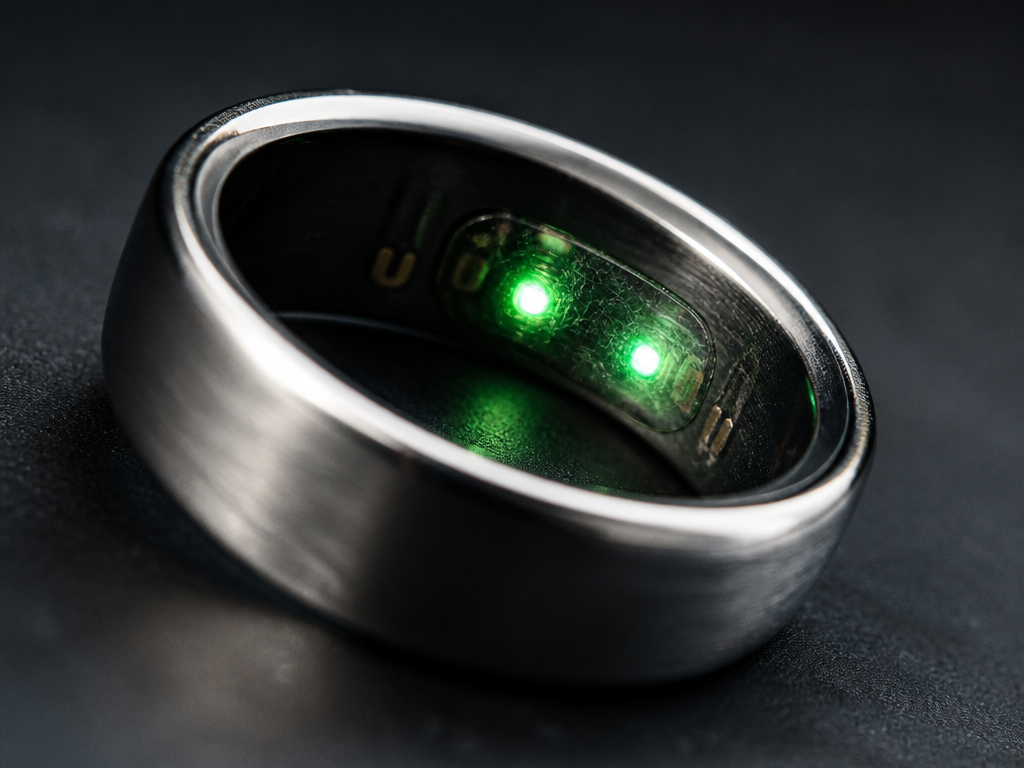
What the sensor measures is the interval between heartbeats, sampled optically through the skin during a window while you're still. From that it computes a heart-rate variability figure — usually RMSSD, the root mean square of successive differences, in milliseconds — which correlates loosely with parasympathetic tone. It logs your lowest sustained pulse of the night. It estimates sleep stages from movement plus pulse-derived respiratory patterns, which is a genuinely hard inference problem: the review work led by Massimiliano de Zambotti keeps landing on the same shape of finding, which is that consumer devices track total sleep time reasonably well and classify individual stages — deep sleep especially — much worse.
Those three numbers get blended into a single readiness or body-battery score by a weighting nobody outside the company has seen. Then a training plan reads that score and writes your week.
Does caffeine lower your HRV and recovery score?
Usually, yes — but indirectly. Caffeine's effect on your overnight numbers runs mostly through what it does to your sleep, not through what it does to your heart. The acute HRV literature is genuinely mixed; several controlled studies find resting vagal indices go up after a dose, which is the opposite of what most wearable users assume. The overnight collapse in HRV, and the two-to-five-beat bump in resting heart rate that usually comes with it, are downstream of fragmented, shallower sleep.
What happens, in the order it happens
An americano at 4:10 p.m. is about 150 mg. It clears the stomach and peaks in plasma somewhere between thirty and sixty minutes later. Caffeine is structurally close enough to adenosine to occupy its receptors — A1 and A2A — without activating them.
This matters because adenosine is the sleep-pressure signal. It accumulates in the brain across your waking hours as a byproduct of energy metabolism, and its binding is part of how you come to feel tired. Blocking the receptor doesn't clear the adenosine. It mutes the announcement.
Mean half-life is around five hours, with a real-world range of roughly two to eight depending on genetics, smoking, pregnancy, and oral contraceptives. Seven hours after that americano — lights out at 11:10 p.m. — you still have something like 55 to 60 mg circulating. Half a cup, arriving exactly at bedtime.
You may fall asleep fine. That's the trap. The cost shows up in architecture: suppressed slow-wave activity, more arousals, more time in lighter stages. Landolt et al. (1995), in Brain Research, gave subjects 200 mg in the morning and still found altered EEG power spectra that night. Drake et al. (2013), in the Journal of Clinical Sleep Medicine, dosed 12 subjects with 400 mg at zero, three, and six hours before bed; all three timings disrupted sleep, and the six-hour dose cost more than an hour of objectively measured sleep that participants largely did not notice losing. A 2023 meta-analysis in Sleep Medicine Reviews first-authored by Carissa Gardiner pooled the controlled trials and put the average cost around 45 minutes of total sleep time.
So the watch wakes up to an elevated resting pulse, a compressed HRV number, and a short night. It has no caffeine input. It attributes all of it to training load and prescribes an easy day. You take the easy day.
Where the advice held up
I don't want to be unfair to the machine, because twice it was clearly right and I wasn't.

The first was volume. Left alone I would have gone from 12 to 25 kilometers a week in a fortnight, because that is what enthusiasm does. The plan refused, added mileage in increments I found insultingly small, and I have no injury from those first nine weeks to report.
The second was an illness. In week eleven my resting heart rate sat 7 bpm above baseline for three consecutive nights while I felt entirely normal. On the fourth day I had a chest infection that took twelve days off me. This isn't a fluke of my physiology: Radin et al. (2020), in The Lancet Digital Health, used resting heart rate and sleep data from roughly 47,000 Fitbit users to improve real-time prediction of influenza-like illness at the state level. Wearables are legitimately decent at spotting that something systemic is happening before you consciously do.
What I did next was less impressive. I came back too fast, strained a soleus in week fourteen, spent eighteen days on a stationary bike, and did not run the half marathon I had signed up for in April. I ran it in June, slowly, and I've kept running since — which is the only outcome I actually cared about.
Where it broke down
During the injury layoff I ran the only experiment I was still capable of running. Two weeks with my usual habits, last coffee around 4:30 p.m. Two weeks with the same total dose — about 280 mg a day — but nothing after noon. Same bedtime window, same cross-training, same bed.
| Cutoff ~4:30 p.m. | Cutoff noon | |
|---|---|---|
| Mean overnight resting HR | 52 bpm | 48 bpm |
| Mean overnight HRV (RMSSD) | 41 ms | 52 ms |
| Nights flagged low readiness | 6 of 14 | 1 of 14 |
| Easy or rest days prescribed | 8 | 4 |
| How my legs felt | fine | fine |
That last row is the whole article. My prescribed training week moved by four days, and the only input that changed was when I stopped drinking coffee.
This is an anecdote with a spreadsheet attached. Unblinded, uncontrolled, n=1, and I knew exactly what I was hoping to see. Take the direction seriously and the magnitudes not at all.
There's a second confound running the other way, and it's the more interesting one. Caffeine reliably lowers perceived exertion — Doherty and Smith's 2005 meta-analysis in the International Journal of Sport Nutrition and Exercise Metabolism put the reduction around 5.6 percent — while doing nothing helpful to your heart rate at a given pace. So a caffeinated run feels easier than it is, and the watch's heart-rate-based load model scores it as harder than it felt. Caffeine drives a wedge between effort and its sensation, and the algorithm only has access to one side of that wedge.
An honest rule of thumb
Before you let a readiness score you cannot audit set your training week, remove the one input you fully control. Move your last caffeine to eight hours before lights-out for two weeks, keep the dose the same, and see how much of your "fatigue" was pharmacology. If your flagged-low nights drop by half, the score was never measuring your legs.
Which gives a more honest version of the advice that came with the watch: train by your body rather than the calendar, yes — but the score is not your body. It's a model of your body with your afternoon coffee baked into it, and it will hand you that coffee back as a rest day, indefinitely, because it has no idea it's there.
Something small to try this week: pick three nights, not seven. Move your last caffeine to eight hours before you plan to be asleep and write the actual clock time down. On each of those mornings, before you look at any number on any screen, write down how recovered you feel from 1 to 5. Then compare your three notes to the three scores. If they agree, trust the watch a little more. If they don't, you've learned which one to argue with.
A recovery score is a hypothesis about your body, and caffeine is the cheapest variable to remove before you start believing it. On why cutoff advice varies so wildly: clearance speed is partly genetic, largely via CYP1A2, and sensitivity to caffeine's sleep effects tracks variants in ADORA2A — Rétey et al. (2007) found carriers of one common polymorphism showed markedly larger caffeine-induced sleep disruption. Population-average cutoffs are a starting point, not your number.