The story I'd been told about fitness trackers and sleep goes like this: the leaderboard makes you train too hard, the extra load drags your resting heart rate up, and the elevated heart rate ruins your nights. I believed it. I have said it out loud, with some authority, at the start of a group run. So I spent six weeks testing it on myself — two weeks with every metric on and my feed public, two weeks running blind, two weeks on a band with no display at all.
The verdict: my training barely moved, my sleep went up about 38 minutes a night, and nearly all of that traces to caffeine — how much I drank and how late. The leaderboard was not overtraining me. It was rescheduling my stimulants.
The myth is about your legs
Ask a running club why Strava is bad for you and you will get a physiological answer, every time. You go too hard on the Tuesday session because three people from work will see the splits. You skip the genuine easy day because an easy day looks bad in a feed. Your body never climbs out of the hole, your resting heart rate creeps up four beats, and you lie there at midnight with a nervous system that still thinks it's working.
It is a coherent story and it is not made up. Hard evening efforts do raise core temperature and sympathetic drive, and both take hours to come back down. Chronic under-recovery does show up in overnight heart rate. Nobody who repeats this myth is inventing physiology.
The part I want to argue with is the causal arrow. The story assumes the competitive behavior reaches your sleep through your training. That the damage is done in the legs and arrives at the pillow secondhand. That's the claim I could actually test, because if it's true, stripping the social layer out of my running should show up first as less training — fewer hard minutes, lower volume, a calmer resting heart rate — and only then as better sleep.
That is not what happened. The training stayed. The sleep moved anyway. Which means something else was carrying the signal, and it took me most of six weeks to notice what was sitting in the mug.
What I ran, and what I actually measured
Three blocks of 14 days, run in order, no washout. Same shoes, same routes, same 6:30pm Tuesday club session.
Block A — everything on. Garmin Forerunner 965, four data fields per screen, auto-lap buzzing every kilometer, activities public, segments live, club feed open on my phone by the time I'd finished stretching.
Block B — blind watch. Same Garmin, same GPS recording, but I built a single data screen with nothing on it. No pace, no distance, no lap alerts, no vibration. Everything still saved; I just couldn't see it until I got home. Strava set to Only You, segment display off.
Block C — no screen. Garmin in a drawer. A screenless band on the wrist recording heart rate and sleep, phone left on the kitchen counter. Distance in Block C is an estimate: I logged elapsed time on a paper card by the door and multiplied by what those routes usually take me. Call it ±3 km a week and don't lean on it.
What I logged by hand, every day, in the same notebook: every caffeinated thing I drank, in milligrams, using label figures where they existed and a scale plus my grinder's dose for espresso; the clock time of the last one; lights-out; and my own guess at how long it took me to fall asleep, written the next morning. The band supplied heart rate, sleep duration, and its own onset estimate.
The caveats, since they're load-bearing. This is n=1, unblinded — I knew which block I was in, and I knew what I was hoping to find. The blocks ran in order rather than randomized, so six weeks of seasonal drift is baked in; the last fortnight was cooler and darker than the first, and darker evenings are their own sleep intervention. My milligram figures for espresso are dose-and-yield arithmetic, not lab assay, and beans vary by a lot. And I did not manage a proper control block where I changed the coffee without changing the watch, which is exactly the block that would have made this piece airtight.
The numbers
| A: everything on | B: blind watch | C: no screen | |
|---|---|---|---|
| Weekly volume | 51.4 km | 48.9 km | ~46 km (estimated) |
| Weekly minutes above threshold HR | 44 | 39 | 41 |
| Median resting HR | 48 | 47 | 46 |
| Daily caffeine | 412 mg | 330 mg | 244 mg |
| Median last dose | 4:50 pm | 3:10 pm | 1:35 pm |
| Median lights-out | 11:48 pm | 11:26 pm | 10:58 pm |
| Sleep, diary onset / total | 27 min / 6h41 | 19 min / 7h07 | 14 min / 7h19 |

Read the top three rows and the bottom four rows as two separate stories, because that's what they are. The training rows are noise. A five percent drop in volume across six weeks is within the range of any two random fortnights of my year. Threshold minutes went down two and then back up two, which is a way of saying nothing happened. Resting heart rate moved by two beats in the direction you'd expect from mid-autumn alone.
The caffeine and sleep rows are not noise. Daily intake fell 41 percent. The last dose of the day moved more than three hours earlier. Lights-out came 50 minutes earlier. Total sleep went up 38 minutes, and my own sense of how long I lay there dropped by half.
I want to be careful about the last column. Block C is contaminated by everything else that happens when you leave your phone at home for two weeks, and I can't separate "no running metrics" from "no phone on a Sunday morning." Block B is the cleaner experiment, and Block B moved most of the distance.
Where the overtraining story falls apart
Here is the thing I keep coming back to. If competitive tracking hurt my sleep by making me train too hard, then removing the competition should have made me train less hard. It didn't. I ran the Tuesday session in all three blocks. In Block C, with no watch and nothing recording that anyone would see, I hit 41 minutes above threshold — more than the fortnight where every effort was public.
I was not running less. I was running the same, at a pace my legs picked instead of a pace a screen picked, and my legs turned out to have opinions very close to the screen's. That's the least flattering finding in this piece and the one I trust most, because I did not want it. I had a tidy narrative queued up about how the leaderboard was flogging me, and my own heart rate file refused to support it.
So the load was constant and the sleep changed by 38 minutes. Something in between had to be doing the work.
A leaderboard is a caffeine scheduler
I never decided to drink less coffee. I want that on the record, because it's the whole finding. I changed what my wrist told me, and my coffee changed by itself, and I didn't notice until I added up the notebook at the end of Block B and thought the arithmetic was wrong.
Three things were going on.
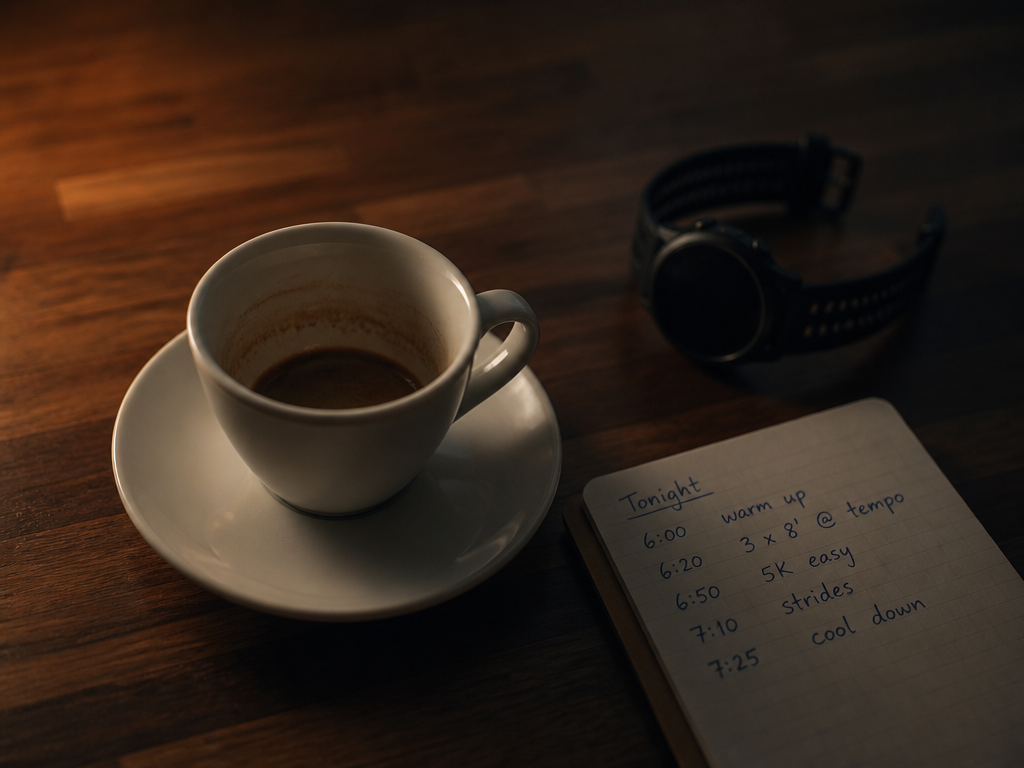
The first is pre-loading. On Block A Tuesdays I took a double espresso at about 5:15pm and a 100 mg tablet with it — roughly 230 mg, ninety minutes before a session where the splits were going to be visible to people I work with. I'd have told you that was a training decision. It was a spectator decision. In Blocks B and C, with the same session and the same effort, I took nothing, because there was no audience to be sharp for.
The second is the afternoon holding pattern. In Block A my last dose landed at 4:50pm because I was keeping myself in a state where an evening session was possible. Once the evening session stopped carrying stakes, the runs drifted toward mornings on their own, and the 4pm americano — which existed to bridge me to a 6:30pm start — had nothing to bridge to.
The third is compensation. On mornings after a bad night, Block A me would look at a low recovery figure and answer it with an extra cup. The number said I was under-resourced; coffee is the resource I know how to add. That cup then sat in the same day as the pre-load, and the day after that started worse.
The half-life arithmetic
Caffeine's median half-life in healthy adults is somewhere around five hours, with a genuinely wide spread — three to seven is the range you'll see quoted, and individual clearance varies enough that population medians are a weak guide to any one person. Take five hours as a working number and run my own medians through it.
Block A: last dose about 145 mg at 4:50pm, lights-out at 11:48pm. Seven hours of decay leaves roughly 55 mg still circulating when I turn off the lamp — about a mug of strong black tea, drunk in bed.
Block C: about 90 mg at 1:35pm, lights-out at 10:58pm. Nine and a half hours leaves roughly 24 mg — about a bar of dark chocolate.
That gap is not dramatic in isolation. Fifty-five milligrams will not keep anyone awake all night. But it lines up almost exactly with the thirteen minutes of extra onset latency I was writing in my notebook, and it is present every single night for two weeks, and it compounds through the next morning's cup. The leaderboard didn't need to overtrain me. It only needed to move my last coffee three hours later and hold it there.
The screen wasn't the variable I thought
I went into Block C expecting the absence of a display to be the active ingredient — that the glancing was the disease. It wasn't, or not mostly. Blind-watch Block B, where I still wore a full running watch and still had every metric waiting at home, captured 26 of the 38 minutes. Two-thirds of the benefit came from turning off two things: the live numbers during the run, and the public feed after it.

And the screenless band was not the clean escape it looks like on paper. It has no display, but it has an app, and at six in the morning that app hands you a recovery score whether you asked for one or not. The two lowest scores of Block C landed on the two highest-caffeine days of Block C — 340 mg and 355 mg, against a block median of 244. I saw a number that said I was depleted and I went and got more coffee, on a device I had specifically chosen because it couldn't show me numbers.
Removing the screen from the run does nothing about the number that greets you before you're properly awake. If anything, the screenless band concentrated the whole day's data into one unavoidable morning verdict, which is a worse delivery mechanism than a watch face I could learn to ignore.
Three ways to strip the data, compared
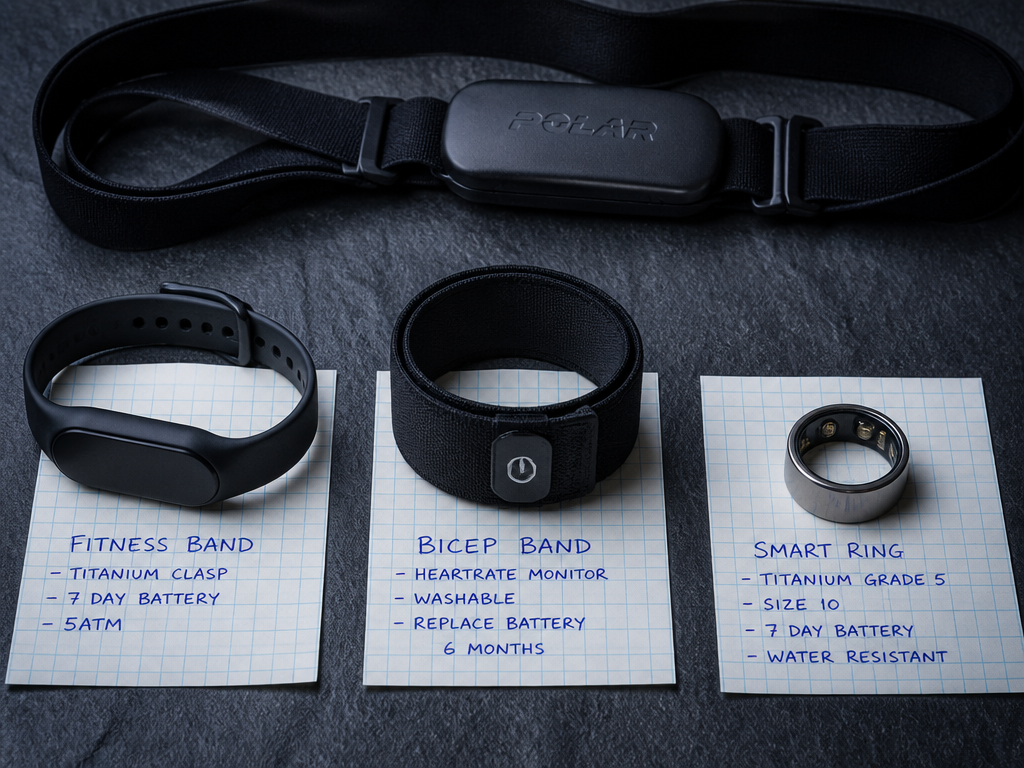
On cost: the blind watch is free if you already own a Garmin or a Coros — it's a custom data screen and a privacy toggle, twenty minutes of setup. The screenless band is a subscription in the region of $200–$240 a year with no hardware you own outright. Buying a simpler watch to fix a behavioral problem is the most expensive of the three and the least likely to work, because the behavior follows you.
On what you lose: the blind watch loses nothing. Every file is intact, every split is there when you get home, and structured sessions still work if you allow one alert. The screenless band loses pace, distance, and route permanently — there is no version of Block C where I know what I ran. That's fine for base miles and useless for anything with a target.
On what it actually fixes: the blind watch kills mid-run glancing and post-run comparison. The screenless band kills those plus the phone habit around them, but leaves the morning score fully intact and arguably louder.
The winner is the blind watch with a private feed. It cost nothing, kept every file, and bought two-thirds of the sleep. If you take one thing from this piece, take that — and then look at what time you stopped drinking coffee yesterday, because that's the part doing the work.
Who this is for
Runners in a base phase, or between goal races, who already own a capable watch and have noticed themselves reaching for the phone before they've stopped breathing hard. Anyone whose caffeine habit has an evening session shape to it — a mid-afternoon dose whose real job is to make a 6:30pm start survivable. Anyone who has been blaming their sleep on training stress while quietly drinking 400 mg a day.
Who this isn't for
Anyone with a race inside twelve weeks who needs pace discipline. Running blind for a fortnight is a fine way to discover you have no idea what marathon pace feels like, and I'd rather you discovered that in January than at 30 km.
Anyone doing genuine zone-2 work who can't hold it by feel. Blind running works because perceived effort is a decent instrument for hard and easy; it is a poor instrument for a narrow heart-rate band, and everyone I know who tries runs their easy days too fast.
Anyone whose relationship with training data is doing real harm rather than mild annoyance. Swapping devices is a hardware answer to something that isn't a hardware problem, and I'd be uncomfortable if this piece read as a suggestion otherwise.
And anyone whose caffeine is already front-loaded and modest. If your last cup is at ten in the morning, the mechanism I found isn't operating on you, and the 38 minutes aren't there to be won.
What I still don't know
My notebook and my band disagreed, and the disagreement is not small. I wrote down 27 minutes to fall asleep in Block A and 14 in Block C. The band recorded 9 and 8 — essentially flat across the whole six weeks. Consumer devices infer onset from movement and heart rate, and the validation for that inference against a proper sleep lab is thinner than the confidence of the number in the app suggests. One of those instruments is wrong about my best result. It might be mine: I was invested, and a morning diary is a memory of a memory. It might equally be the band's, which has no way to see a person lying still and awake.
The bigger open question is the direction of the arrow, and I can't resolve it from three blocks run in a row. I've told you a story where the late caffeine pushed my bedtime later. The evidence is equally consistent with the reverse: the evening session moved my bedtime to 11:48pm first, and a bedtime that late simply left room in the day for a 4:50pm americano that an earlier bedtime would have squeezed out. Those two stories predict identical notebooks. They imply completely different fixes — one says move your last cup, the other says move your session — and I ran the one experiment that couldn't tell them apart.
So which is it: does the leaderboard reach your sleep through the coffee, or through the clock?