The most upvoted question in Samsung's Reddit AMA wasn't about hinge durability or the crease. It was a complaint, phrased politely and voted to the top by people who clearly meant it: take some risks again. Ship something that isn't last year's slab with a brighter panel and a new adjective in front of the AI. If you want one sentence that captures how the internet currently reads Samsung product strategy, that's it — a decade of competence, received by the audience as a decade of coasting.
Samsung answered on the record, in a thread anyone can scroll. Annika Bizon, who runs product and marketing for the company's mobile business in the UK and Ireland, took most of the incoming fire. A fair amount of what came back was the expected material: roadmap language, the polite deflection, a couple of replies that were functionally tech support. But the moments where the company actually pointed at something new kept landing in the same place. Not the hinge. Health. Rings, watches, sleep staging, sleep apnea detection, an AI that claims to know what kind of day you had.
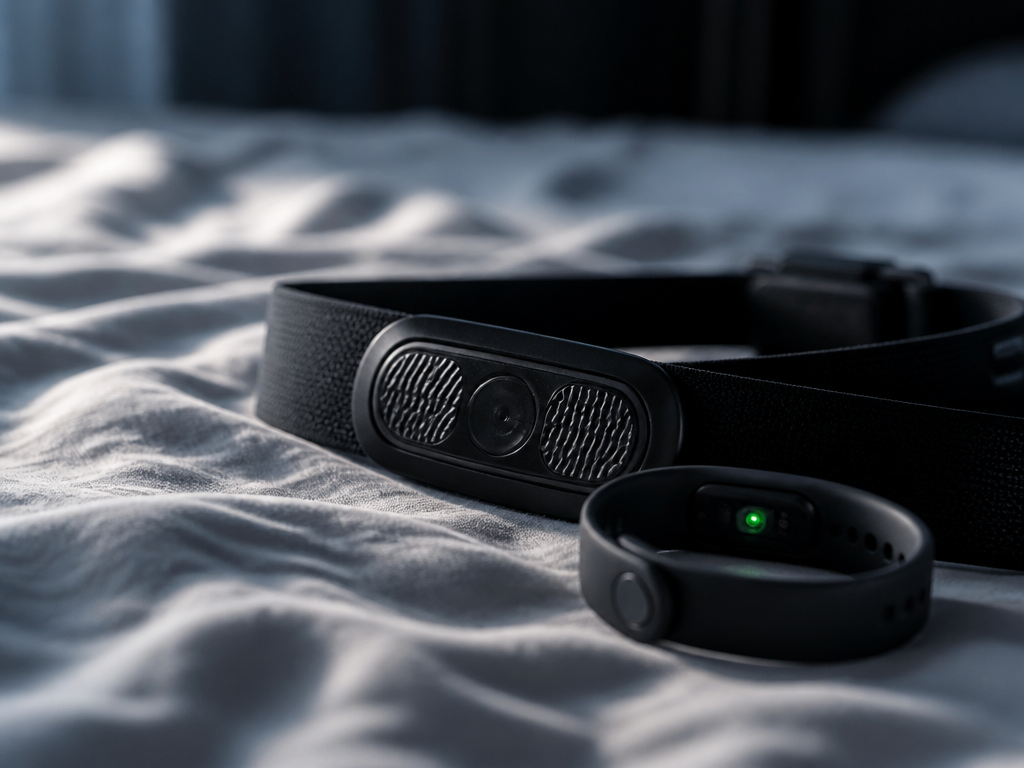
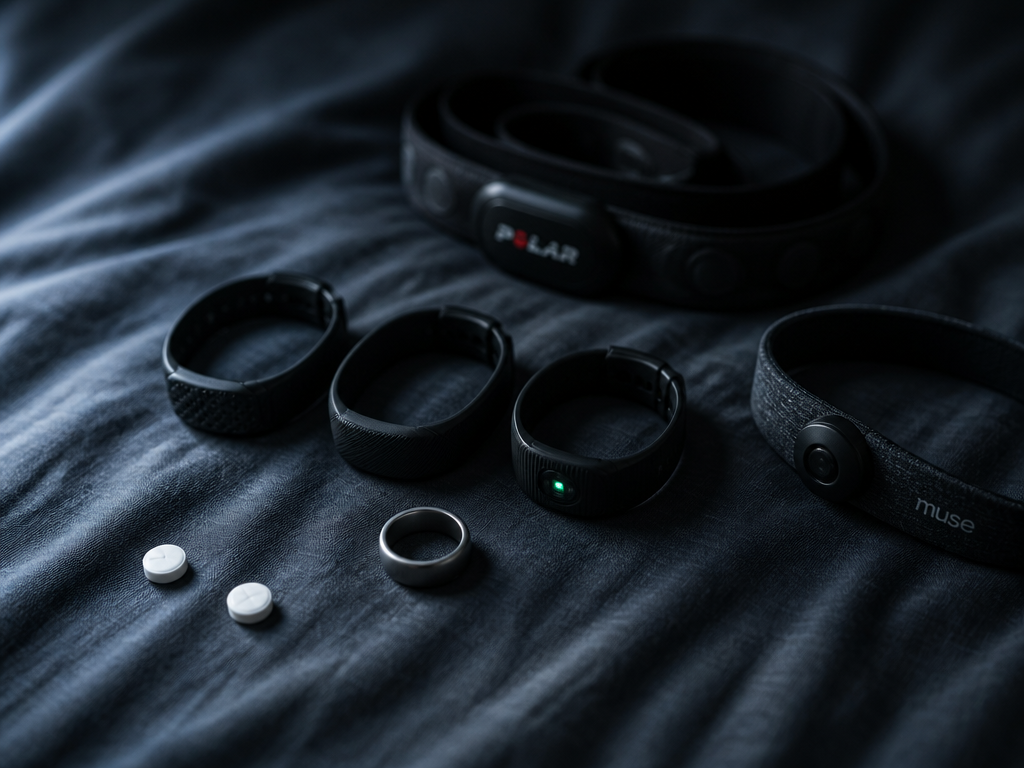
Which is why a magazine about caffeine is covering a phone company's AMA. Samsung's product direction now runs through your bedroom, and the sensors it's betting on are being asked to do something genuinely hard. It's worth separating what they can see from what they can only guess — and from what they will never see, because you didn't tell them.
What most people do
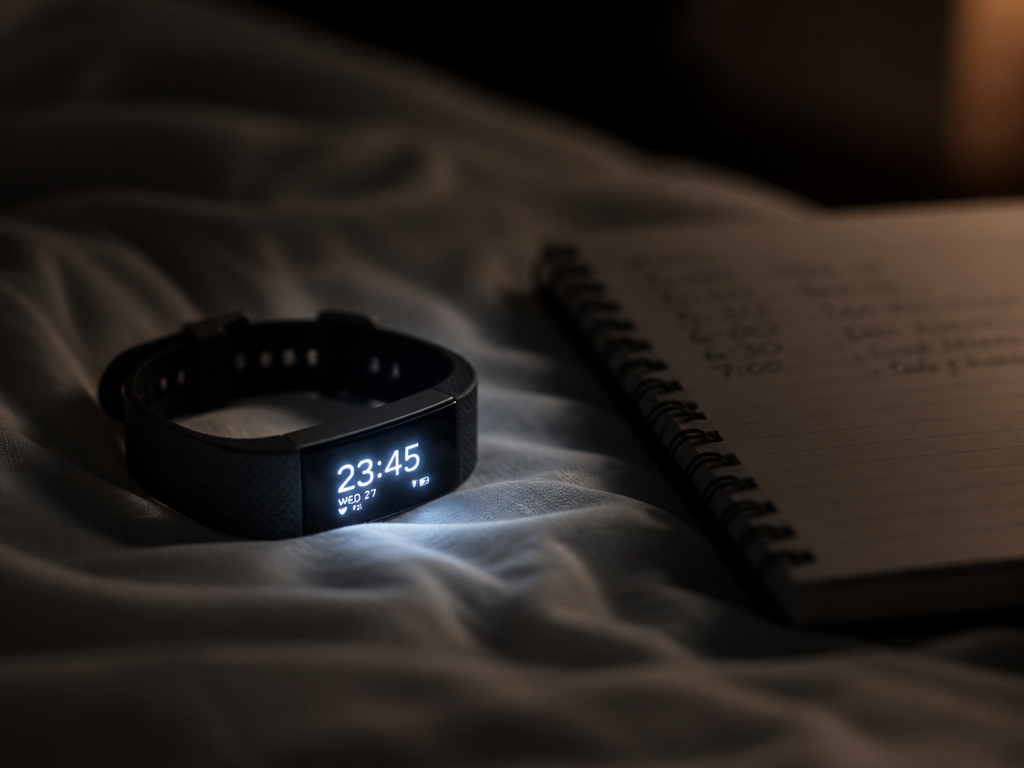
Here is the ritual, and I'd bet money it's yours. You wake up. Before you've spoken to another human, you check a number. Sleep score: 71. Deep sleep, 42 minutes, flagged in a slightly disapproving shade of orange. You feel fine, actually, but now you feel fine with an asterisk, and by 10 a.m. you've built a small theory about your mattress.
What almost nobody does is log the input that most plausibly moved that number. The 3 p.m. coffee — the one you stopped counting as a decision somewhere around 2019 — doesn't appear anywhere in the app. Neither does the pre-workout, the afternoon Diet Coke, or the square of dark chocolate at nine. The device tracked your wrist all night with impressive fidelity and remained perfectly ignorant of the pharmacology you introduced eight hours before lights-out.
There's a matching posture in the AMA thread itself, and I say this with affection for everyone in it: a lot of us are asking a hardware company to innovate on our behalf while declining to run the one experiment we could run ourselves for free. The ring is not the variable. The coffee is the variable.
Can a smartwatch really tell what sleep stage you're in?
No. It estimates. A consumer wearable does not measure sleep stages — measuring them requires electrodes on your scalp reading cortical activity, plus eye movement and chin muscle tone, which is what a polysomnogram does in a lab. Your watch infers stages from pulse, motion, and skin temperature, then hands those signals to a model trained to guess what the electrodes would have said.
The guessing is decent at the coarse question and mediocre at the fine one. Chinoy et al. (2021), in Sleep, ran 34 healthy adults through a night of polysomnography alongside seven consumer devices. The devices were reasonably good at total sleep time and very good at calling sleep sleep. They were poor at catching wake — if you lie still with your eyes open, most of them will happily score you as asleep. Stage-by-stage agreement was substantially worse than the total-sleep-time numbers implied. de Zambotti et al. (2019), in Behavioral Sleep Medicine, tested the Oura ring against polysomnography in 41 adolescents and young adults and found individual-stage agreement in roughly the 50–65% range depending on the stage. That is better than chance. It is not a measurement.
From a green light to the words "deep sleep"
Walk it forward in the order it actually happens, because the order is where the uncertainty enters.
A green LED on the underside of the ring or watch fires into your skin. Hemoglobin absorbs green light, so as blood volume in the capillaries rises and falls with each heartbeat, the amount of light bouncing back changes. A photodiode reads that flicker. That's photoplethysmography, and it gets you a pulse waveform.
From the waveform, firmware extracts interbeat intervals — the gap between beats, in milliseconds. Average those and you get heart rate. Look at the variability between consecutive intervals and you get a proxy for autonomic balance: parasympathetic tone rises in deep sleep, sympathetic activity spikes in REM. Meanwhile the accelerometer logs gross movement and wrist angle, and a thermistor tracks skin temperature drift.
Those four streams get chopped into 30-second epochs and fed to a classifier trained on nights where humans scored the real polysomnogram. The classifier outputs a label per epoch. The labels get summed into minutes, the minutes get weighted into a score, and the score gets a color.
Every step after the photodiode is inference. Which matters here specifically, because caffeine raises resting heart rate a few beats per minute and blunts heart rate variability for hours — the same two signals the classifier leans on hardest to distinguish deep sleep from light. A late dose doesn't only degrade your sleep. It nudges the instrument that's grading it.

What the evidence suggests
Start with the drug, because the drug is the settled part. Caffeine is a competitive antagonist at adenosine A1 and A2A receptors. Adenosine accumulates in the basal forebrain across your waking hours as a byproduct of neural metabolism, and its buildup is a large part of what sleep pressure physically is. Caffeine doesn't remove it; it occupies the parking spaces. Lazarus et al. (2011), in the Journal of Neuroscience, narrowed the arousal effect specifically to A2A receptors in the shell of the nucleus accumbens — mice lacking those receptors there didn't get wired on caffeine. The adenosine keeps arriving the whole time. When the caffeine clears, it's all still there, waiting.
Clearance is the number people get wrong. The commonly cited half-life is about five hours, but the population range runs roughly three to seven, and the tails are wide. CYP1A2 genotype moves it. Smoking cuts it by something like half. Oral contraceptives roughly double it. Late pregnancy can stretch it past 15 hours. So a 200 mg coffee at 3 p.m. leaves about 100 mg in you at 8 p.m. and about 50 mg at 1 a.m. — a half-espresso, circulating, at the hour you most want your adenosine receptors unoccupied.
The cleanest demonstration remains Drake et al. (2013) in the Journal of Clinical Sleep Medicine: 12 subjects, 400 mg of caffeine at 0, 3, and 6 hours before bed. The six-hours-before dose still cut objectively measured sleep by more than an hour. Twelve people is a small sample and the dose is large — two strong coffees, not one — but the striking finding was that subjects largely failed to notice the damage in their own self-reports. Gardiner et al. (2023), a meta-analysis in Sleep Medicine Reviews pooling two dozen studies, landed on a cutoff of roughly 8.8 hours before bed for a standard ~107 mg coffee, and around 13 hours for a full pre-workout dose. And Landolt et al. (1995), in Brain Research, gave healthy young men 200 mg in the morning and still saw altered EEG power spectra that night — a small study, repeatedly cited, and the reason "I only drink it before noon" is a weaker defense than it sounds.
Now grade the hardware against that.
| What the device reports | How well it holds up | Confidence |
|---|---|---|
| Total sleep time | Usually within ~15–20 min of lab scoring, on average; worse for people who sleep badly | Well-established |
| Asleep vs. awake | Catches sleep reliably; misses wake after sleep onset | Well-established |
| Deep / REM breakdown | Roughly 50–65% agreement with lab staging | Well-established (as a limitation) |
| Sleep apnea detection | Real screening value; Samsung's feature cleared FDA De Novo review in February 2024 | Well-established for what it claims |
| "Energy score" / readiness | Composite of sleep, HRV, resting HR, prior-day load; no published independent validation | Plausible but thin |
Give Samsung the credit it earned: the sleep apnea feature is a genuine answer to the accusation of coasting. Detecting signs of moderate-to-severe obstructive apnea over two nights, in a population that mostly doesn't know it has the condition, is not a spec bump. It cleared a regulatory bar that marketing departments cannot talk their way over. That is what experimenting looks like when it works.
The readiness scores are where the marketing outruns the evidence — a single number synthesized from four noisy inputs, presented with a confidence the underlying data doesn't support. And here's the gap that actually bothers me: not one of these platforms asks you what time you drank caffeine, or how much. It's a timestamp and an integer. Paired against sleep onset latency, it's the only n-of-1 experiment most owners would ever run, and it would cost less engineering than the antioxidant sensor.
What I actually do
I still wear the thing. I just demoted it. I read exactly two of its outputs — the time I fell asleep and the total hours — and I ignore the stage pie chart entirely, because I know it's a classifier's opinion dressed as a chart.
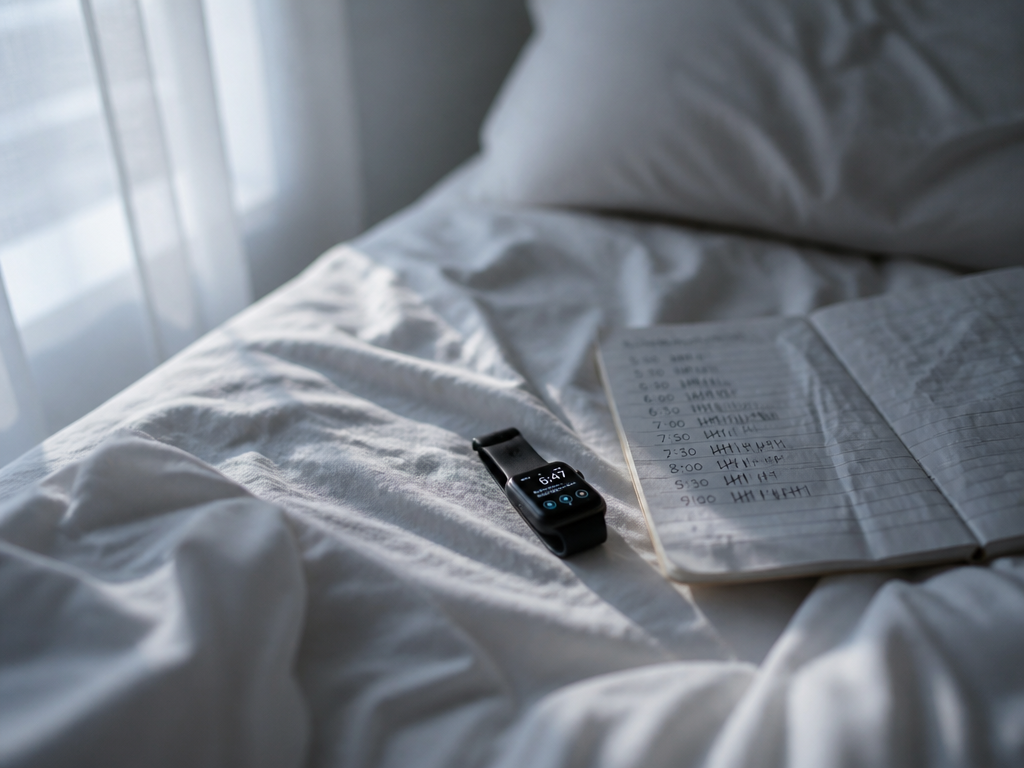
The caffeine goes in a plain note on my phone: time, and milligrams, guessed honestly. Drip coffee gets 150. Espresso, 75. The 16-ounce cold brew that tastes like a dare, 250. Two weeks of that against sleep-onset latency told me more about my own physiology than three years of scores had.
What it told me: my personal wall is about nine hours, not the five the half-life folklore implies. Coffee at 1 p.m. is invisible. Coffee at 4 p.m. adds twenty-odd minutes of lying there composing emails I won't send. That's an n-of-1, and yours will differ — which is precisely the point, and precisely what a device sitting on your finger all night could be helping you find out.
So: count back nine hours from the time you want to be asleep, make that your last caffeine of the day, and write down the time — because your ring won't.