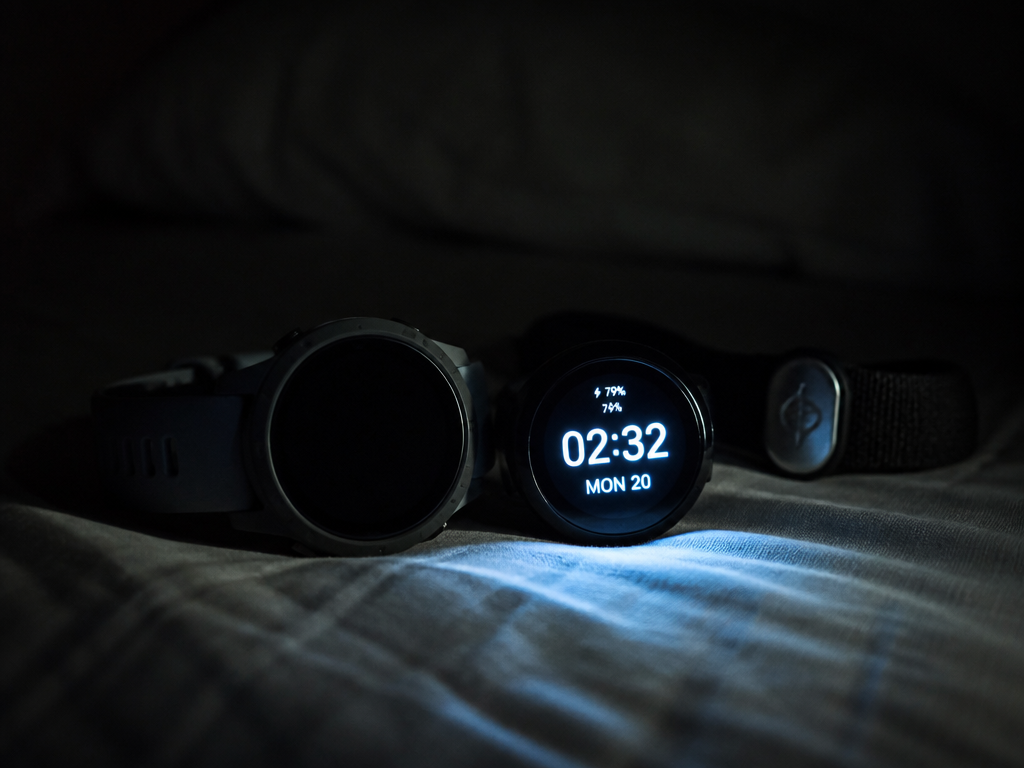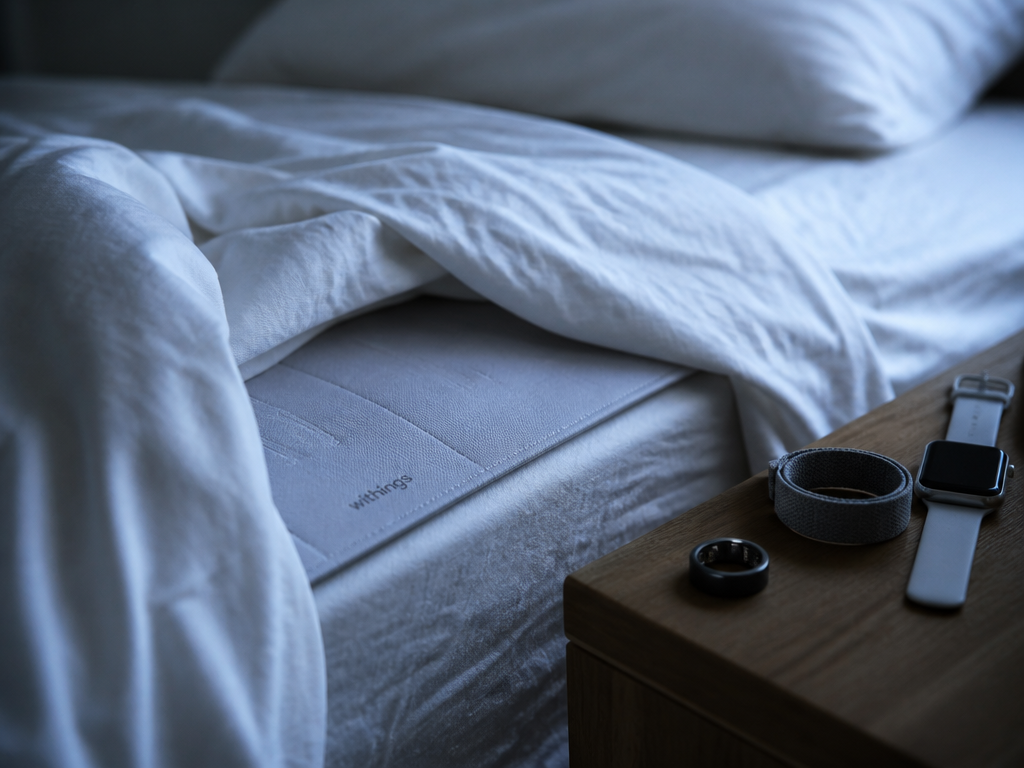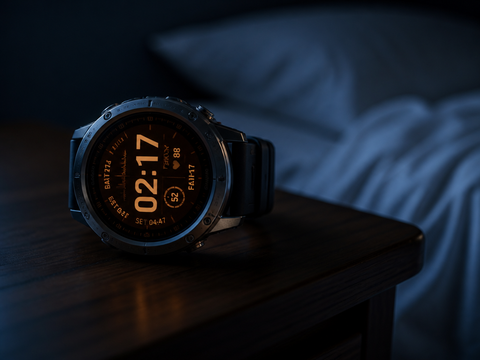
The most consequential component in the next Fenix is the screen, and it has almost nothing to do with how the screen looks.
That sounds like a dodge, so let me be specific. The Garmin Fenix 9 rumors circulating this summer are, on their face, a display story: three models, an AMOLED-heavy lineup, and an unresolved question about whether memory-in-pixel survives anywhere in the range. Enthusiasts have read this as an argument about sunlight readability and battery anxiety, which is the same argument the forums have been running since the Fenix 7 Pro. It's a bigger deal than that. The screen determines the battery, the battery determines when you charge, when you charge determines which nights the watch is actually on your wrist, and those nights are the entire substrate underneath every sleep, HRV, and recovery number Garmin sells you.
So the display fight is a sleep-data fight. Here's the case.
What the leak actually claims, and how much of it to believe
I'm characterizing the shape of the rumor set, not vouching for it. That distinction matters more in Garmin coverage than in most gear writing, because the leak pipeline has tiers of reliability that get flattened into a single confident headline.
Firmware strings pulled from beta builds are the good stuff — they're artifacts of things Garmin has already written code for. Retailer SKU listings and regulatory paperwork are next; they tell you how many models exist without telling you what's in them. Forum extrapolation from a previous generation's positioning is the bottom tier, and it's where most display speculation lives, because display panels are exactly the thing that doesn't leave a fingerprint in a firmware string.
| Claim | Evidence tier | Weight it deserves |
|---|---|---|
| A three-model lineup rather than two | SKU counts, listings | Moderate–high; model counts leak early and leak accurately |
| AMOLED as the default across the mainstream tiers | Listings plus Garmin's own investor framing | High, directionally |
| MIP surviving only on a solar/expedition variant | Inference from Fenix 8 Solar's position | Low — this is the part everyone is guessing |
| A new optical heart-rate sensor generation | Firmware references | Moderate |
| microLED anywhere in the range | Industry speculation | Very low |
The context for all of it is the Fenix 8, which split the line in August 2024: AMOLED at 43, 47, and 51 mm, and a separate Fenix 8 Solar keeping the transflective MIP panel with a solar lens over it. That split was Garmin hedging. The Fenix 9 rumor mill mostly describes Garmin un-hedging.
And the business logic is not mysterious. Garmin has spent two years telling investors that AMOLED is what's growing the outdoor segment, and the sales data plainly supports them. MIP is beloved by a loud, expert, unrepresentative minority — which is to say, by us.
Does an always-on AMOLED watch actually disturb your sleep?
Probably not the way people assume. The common worry is melatonin suppression, and the doses involved are far too brief for that. The realistic harm is much dumber: a bright panel firing at 3 a.m. wakes you, or keeps you from dropping back under. Arousal, not endocrinology.
The canonical dose-response work here is Zeitzer et al. (2000), Journal of Physiology, which exposed 23 subjects to controlled light for about 6.5 hours overnight and found roughly half-maximal melatonin suppression somewhere near 100 lux. Note the exposure duration. A wrist flash lasts two seconds. Extrapolating a 6.5-hour curve down to a two-second event is not something the data supports in either direction — the honest summary is that brief nocturnal flashes are plausibly trivial for melatonin and clearly non-trivial for whether you stay asleep.
What a wrist flash actually does, in the order it happens
Photons hit the retina. Most of the sleep-relevant ones are absorbed not by rods or cones but by melanopsin inside intrinsically photosensitive retinal ganglion cells — a small population, peak sensitivity around 480 nm, in the blue. Those cells project through the retinohypothalamic tract to the suprachiasmatic nucleus, the hypothalamic pacemaker. The SCN signals down a multi-synaptic path to the pineal gland, which throttles melatonin synthesis. That chain takes sustained input to move meaningfully, which is why a flash doesn't shift your phase.
But the same ipRGC pathway also feeds arousal-promoting regions more directly, and that response is faster. This is the part I'd file under plausible but thinner than it's usually stated: the alerting effect of light and its circadian effect are partly separable, and the acute-arousal literature in real bedrooms is much weaker than the melatonin literature in labs.
The practical upshot favors MIP, mildly. A transflective panel at night is dark until you backlight it, and Garmin's red-shift mode pushes the backlight away from the melanopsin peak.¹ An AMOLED in always-on mode is emitting continuously, and gesture-activated brightening is exactly the failure mode above. Both are manageable in settings. Neither is the main event.

The real mechanism is charging, not photons
Here's the main event. Garmin's own figures put the Fenix 8 AMOLED 47 mm at roughly 16 days in smartwatch mode and the 51 mm Fenix 8 Solar at around 28 days, extendable well past that with enough sun. Call it a two-to-three-fold runtime gap between panel technologies, before you account for always-on display, which cuts AMOLED figures further.
A 16-day watch and a 28-day watch are not the same object in terms of behavior. At 28 days you charge it when you notice it, which is roughly never, and almost never at night. At 10 to 16 real-world days — less if you're doing multi-hour GPS activities — charging becomes a scheduled chore. And the natural slot for a scheduled charging chore is bedtime, because that's the block of time you're not using the watch.
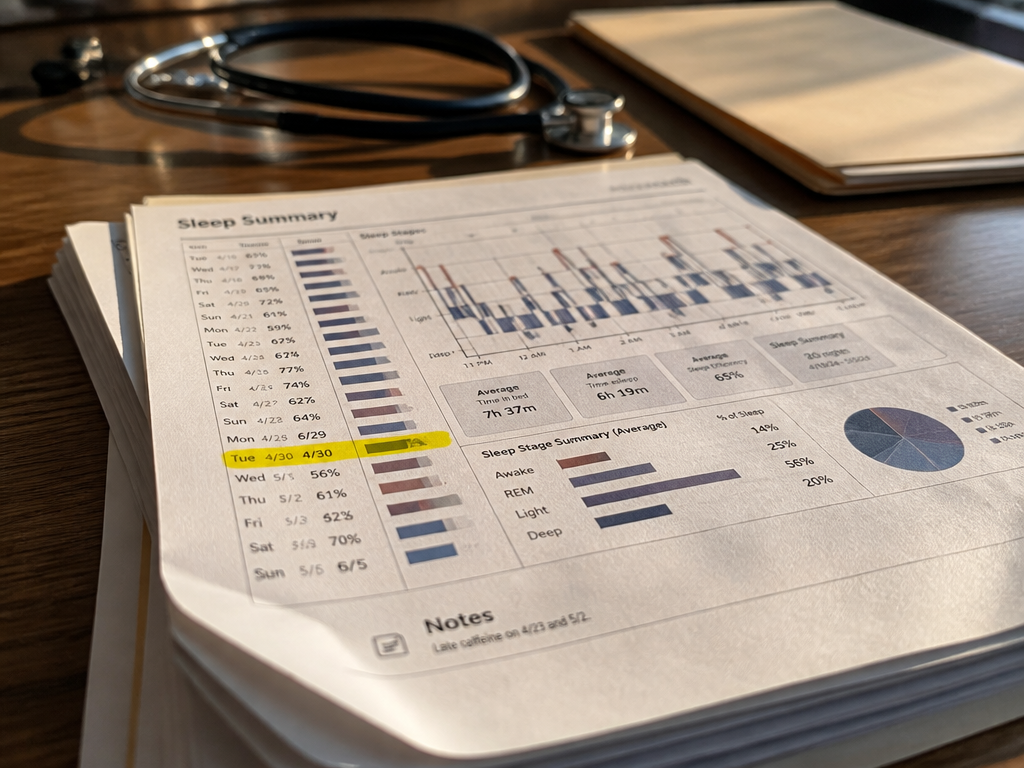
That's how a display decision becomes a sleep-data decision. Garmin's derived metrics are baseline-dependent, not snapshot-dependent. HRV Status needs roughly three weeks of overnight readings to establish your personal range, and lapses back toward unavailable when nights go missing. Training Readiness consumes sleep and HRV Status as inputs, so a charging gap doesn't just blank one number — it degrades the stack that sits on top of it. You lose a night, and the watch quietly gets worse at knowing you for a while afterward.
Why continuity beats accuracy anyway
This matters more than it should because the absolute accuracy was never the selling point. Wrist optical devices infer sleep stages from movement and pulse-derived features, and against polysomnography the four-stage epoch-by-epoch agreement for consumer wearables generally lands somewhere in the 50–70% range, with deep sleep the weakest category. De Zambotti and colleagues have spent the better part of a decade running these devices against lab PSG; the consensus is consistent — good at sleep-versus-wake, mediocre at architecture, and systematically overconfident about wake after sleep onset.
Which produces a genuinely funny problem for this magazine's subject. Caffeine's most reproducible signature in sleep is spectral: Landolt and colleagues (1995), Brain Research, gave a small crossover sample 200 mg at 7 a.m. and still saw altered EEG power spectra that night. Drake et al. (2013), Journal of Clinical Sleep Medicine, dosed 12 subjects with 400 mg at 0, 3, and 6 hours before bed and found the six-hour-prior dose still cost about an hour of measured sleep. Both findings live in EEG. Your Fenix has no EEG. It's blind to the exact fingerprint you'd most want to see.
What it can do is stay consistent with itself. If you run the arithmetic — caffeine's mean half-life sits near 5 hours, with a real spread from about 2 to 8 depending largely on CYP1A2 activity — a 200 mg cortado at 3 p.m. leaves roughly 50 mg circulating at 1 a.m., still antagonizing adenosine A1 and A2A receptors while your homeostatic pressure is trying to cash in. Whether that costs you 20 minutes or 90 is an N-of-1 question, and a device with stable, biased, unbroken measurements answers N-of-1 questions better than a more accurate device with holes in it.
An honest rule of thumb
Charge the watch at 7 p.m. while dinner cooks, not at bedtime. Twenty-five minutes on the cable gets a modern Fenix most of the way back, and it protects the one window the device can't reconstruct.
If you're running a caffeine experiment, give each arm two full weeks — one at your normal cutoff, one moved four hours earlier — and compare only within-device, within-person. Never compare your deep-sleep minutes to a friend's. And if the numbers start dictating your bedtime anxiety rather than describing it, that has a name: Baron et al. (2017) coined orthosomnia in a small case series in the same journal as Drake. It's a real failure mode of good instruments.
What this doesn't answer
Whether MIP survives at all, obviously. But also the question I'd actually like answered: has Garmin changed its sleep algorithm alongside a new sensor generation, and if so, does the baseline reset? A silent algorithm change invalidates your prior three weeks as thoroughly as taking the watch off does, and Garmin has never been forthcoming about that.
Watch three places. FCC filings, which surface four to eight weeks before launch and confirm model counts, not panels. Beta firmware release notes in Garmin Connect, which is where sleep-algorithm language actually appears. And the outdoor-segment commentary on the next earnings call, which will tell you how committed Garmin is to the AMOLED thesis long before any spec sheet does.
A watch that measures your sleep imperfectly every single night will teach you more than a watch that measures it beautifully five nights out of seven. ¹ Red-shift is worth turning on for a second reason nobody mentions: it makes the display legible without triggering the pupillary constriction that costs you 20 seconds of dark adaptation when you look back at the ceiling.