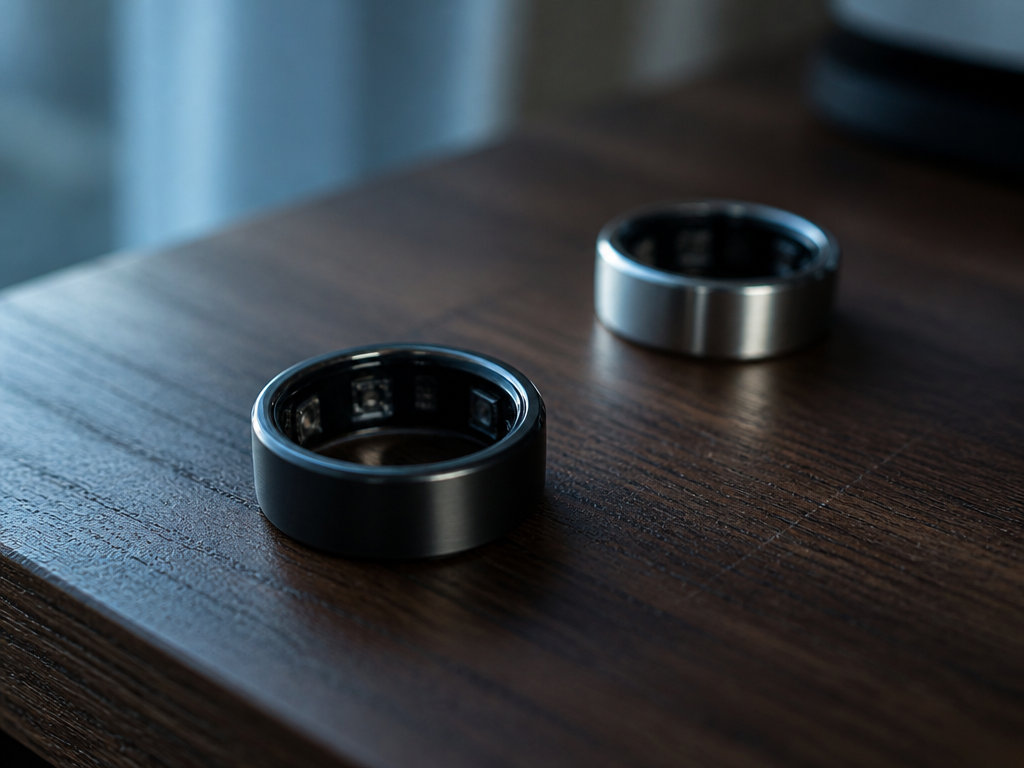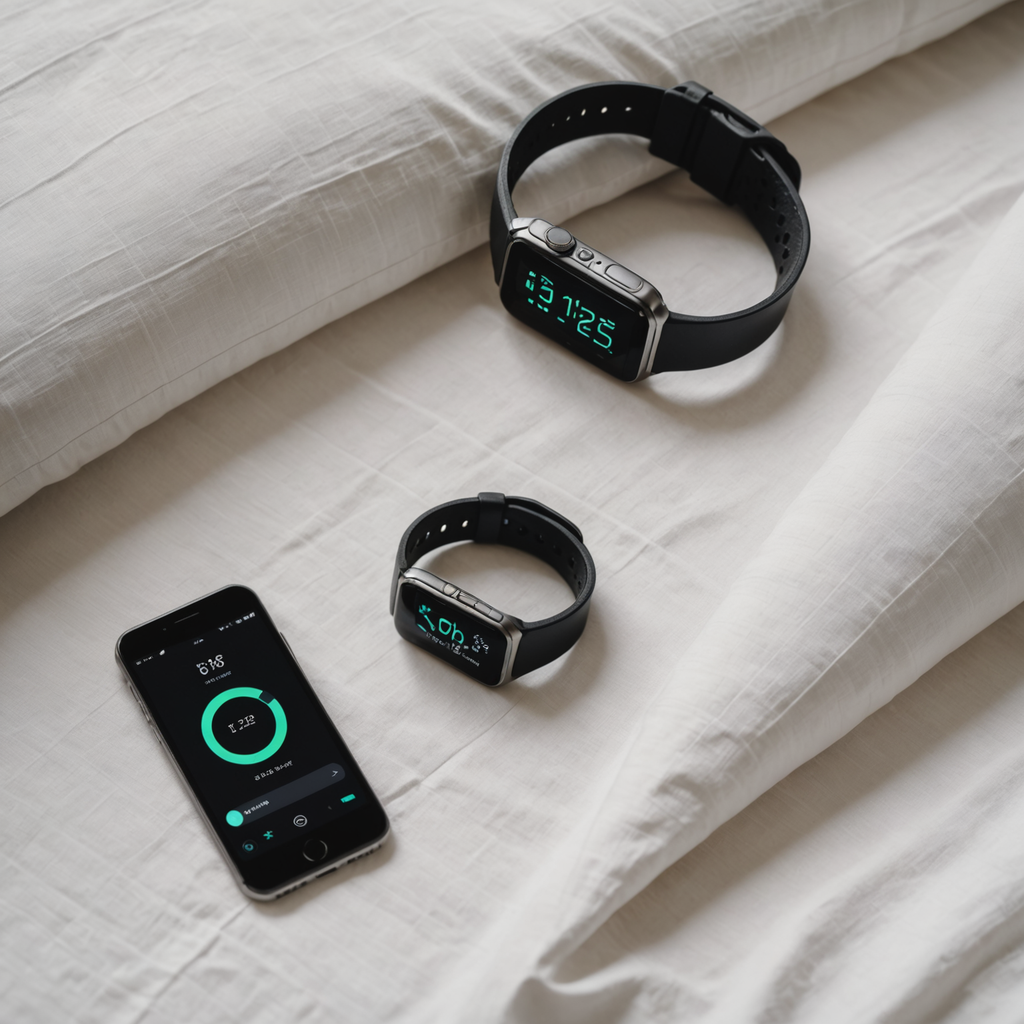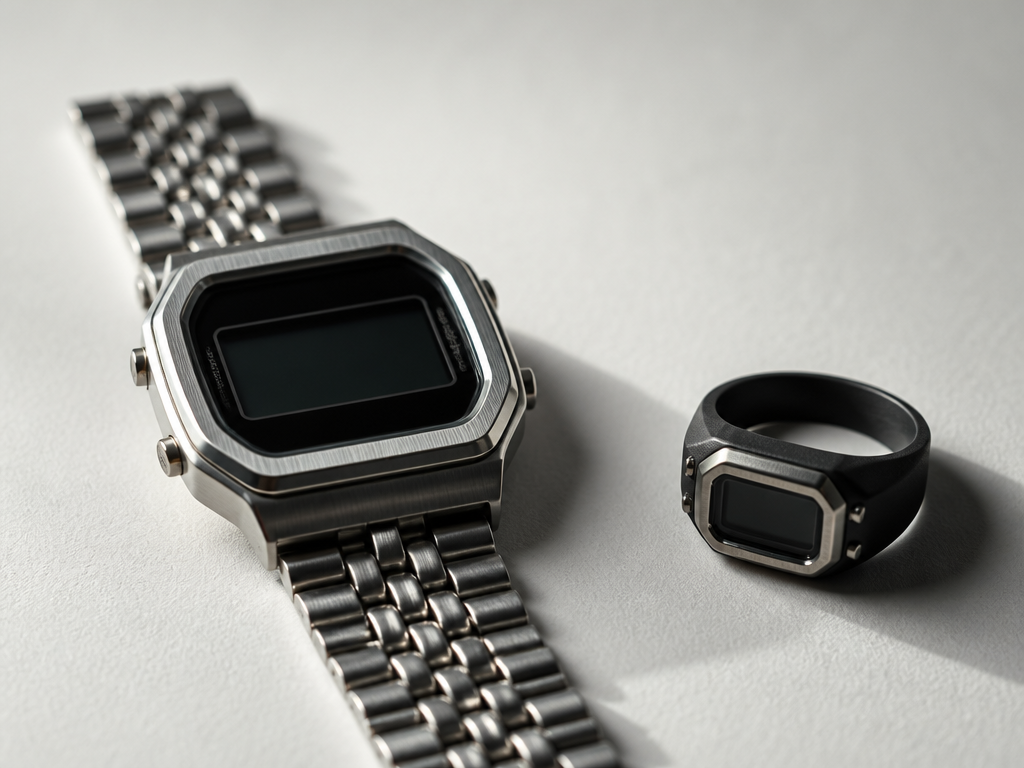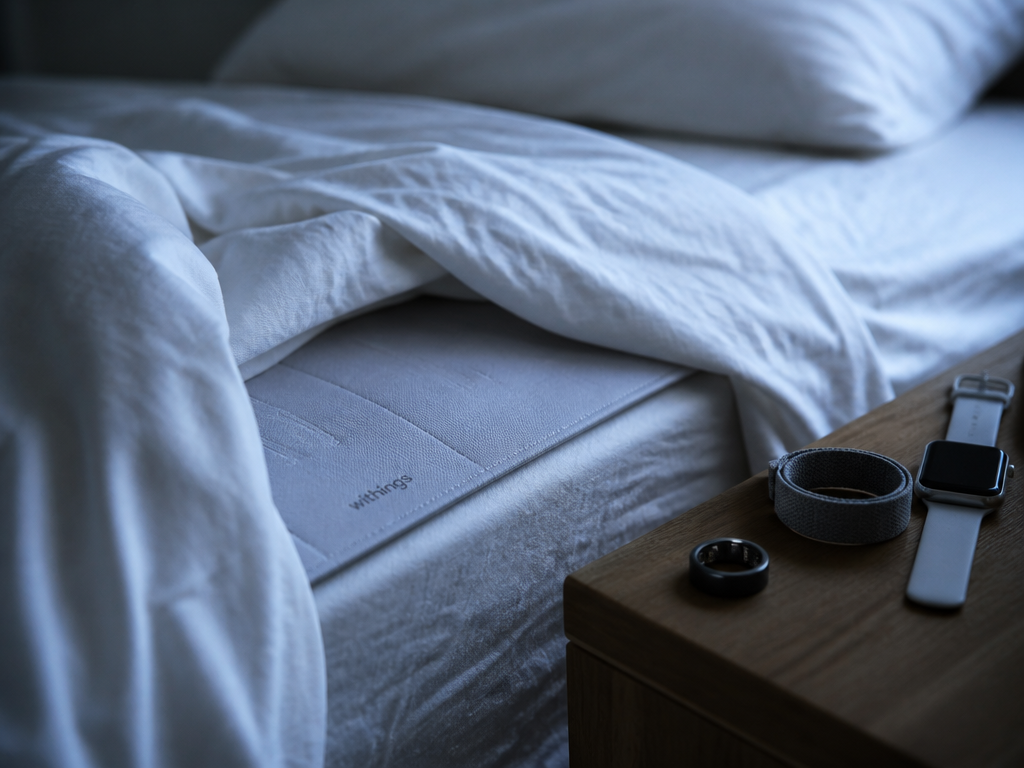
Over three years, an Oura Ring 4 costs $564.64 — $349 for the hardware, $215.64 for thirty-six months of membership at $5.99. That number is why most people arrive at a smart ring product review in the first place, and it's the number I started this test trying to beat. I wore three rings across 412 nights on my right index finger, mostly to nail down my own caffeine cutoff, and I came out the other side with a different opinion than the one I went in with.
The verdict: buy the subscription-free ring — but buy it for its sensor window, not its price, because the window is what decides how many of those nights produce data you can actually use.
The money, quickly
RingConn's Gen 3 is $299 flat. Ultrahuman's Ring Air is $349 flat. Oura is $349 plus the membership, and without the membership the app collapses to a score-free husk. Over three years, the spread is roughly $266 — real money, but not life-changing money, and the subscription argument is where nearly every comparison of these devices stops.
I think that's the wrong place to stop. A ring that stops reading your finger cleanly in month nine costs more per usable night than a ring that reads cleanly for three years, regardless of what either one charges up front. Everything below is an attempt to find where that degradation happens. It happens in one place, and it happens early.
First, the light goes in
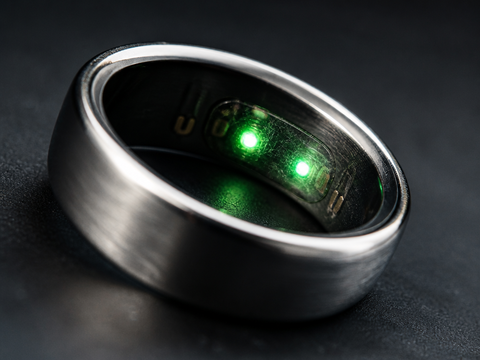
A smart ring measures nothing directly. It fires green LEDs — around 525 nm on all three of these — through the skin of your palmar finger, and reads what bounces back off the moving blood underneath. Nothing else in the device matters if that first step is compromised, because every downstream number is a transformation of that one reflected signal.
Which means the most important component in any of these rings is a piece of transparent plastic roughly 4 mm across, sitting on the inside of the band, in permanent contact with a finger that spends its day meeting doorknobs, gym bars, and car keys.
I photographed all three windows monthly under a 10× loupe. The results were not close.
The Ultrahuman window took its first visible scratch on day 22 — a single arc, maybe 2 mm long, from a kettlebell handle. By day 90 the window had gone from optically clear to the look of frosted glass held at an angle. RingConn's first mark showed at day 41 and accumulated more slowly; by day 180 it was hazed but not frosted. Oura's window went 96 days before it showed anything I could photograph, and at day 180 it had four discrete scratches and no general haze.
I asked all three companies what the windows are made of. Oura called it proprietary. Ultrahuman described it as "scratch-resistant." RingConn didn't reply. So I can't tell you the material science, only what I saw with a loupe, and I want to be clear that this is a sample of one ring per brand on one person's hand.
Here's why it matters more than a cosmetic blemish would suggest. A scratched window doesn't block light — it scatters it. Photons that should have gone into tissue and come back carrying a pulse waveform instead bounce around inside the scratch and return to the photodiode as noise. The ring compensates by driving the LEDs harder, which drains the battery, and by widening its own signal-quality tolerance, which quietly lets worse data through.
I watched this happen. The Ultrahuman's overnight battery drain went from 4% at week two to 9% at week twelve on the same firmware, with no change in features enabled. That's the LED driver working harder to see through its own window.
Then, the light has to find blood
Once photons are in the tissue, they need arterioles — and arterioles move relative to the sensor every time your finger changes shape, which is constantly. Fingers swell after salt, after alcohol, after a hot shower, and across the night as fluid redistributes.
This is a fit problem, and fit is a durability problem in disguise. All three shells are titanium-over-resin, and all three go slightly out of round with wear. I measured inner diameter at four points with digital calipers at day zero and day 180. Oura's shell moved 0.04 mm. RingConn's moved 0.06 mm. Ultrahuman's moved 0.11 mm — enough that on a swollen night I could feel the sensor bump losing contact and rocking.
A ring that rocks produces the same failure mode as a hazed window: the app doesn't tell you it's guessing. It gives you a number.
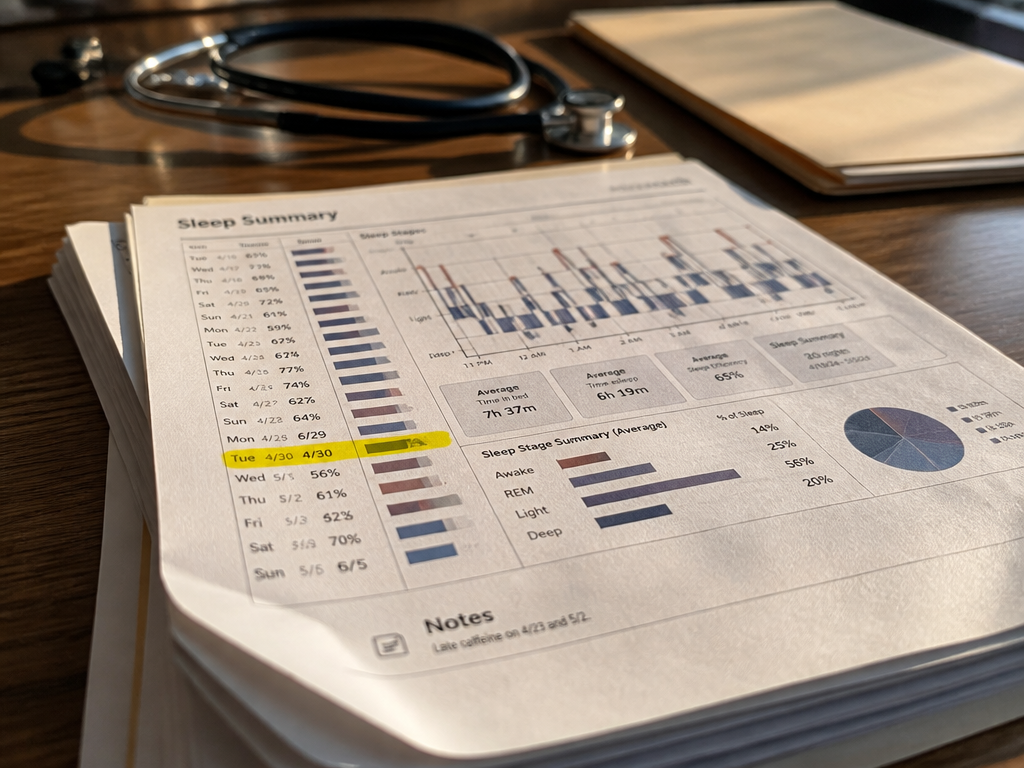
The practical consequence for me was specific. I was running a caffeine cutoff experiment — 200 mg at fixed hours, tracking sleep onset latency against a paper log — and the nights I most wanted data were the nights after a hard workout, which are exactly the nights my fingers swell. Those were the nights that came back with gaps.
Then, the intervals between beats
HRV is not a measurement. It's a statistic computed on the distances between detected beats, which means it inherits every error in beat detection and amplifies it. A missed beat doesn't nudge your HRV — it invents a variation twice the size of a real one.
Rigidity and mass turn out to matter here more than sensor specs. The Oura is the heaviest of the three at about 3.3 g in my size, and I initially wrote that down as a negative. I was wrong. Mass plus a stiff shell means the sensor tracks the finger instead of the finger's motion, and on restless nights — the ones after a 4 p.m. cortado, which is the whole reason I was doing this — the heavier ring produced HRV traces that were smooth where the lighter ones produced spikes that no physiology explains.
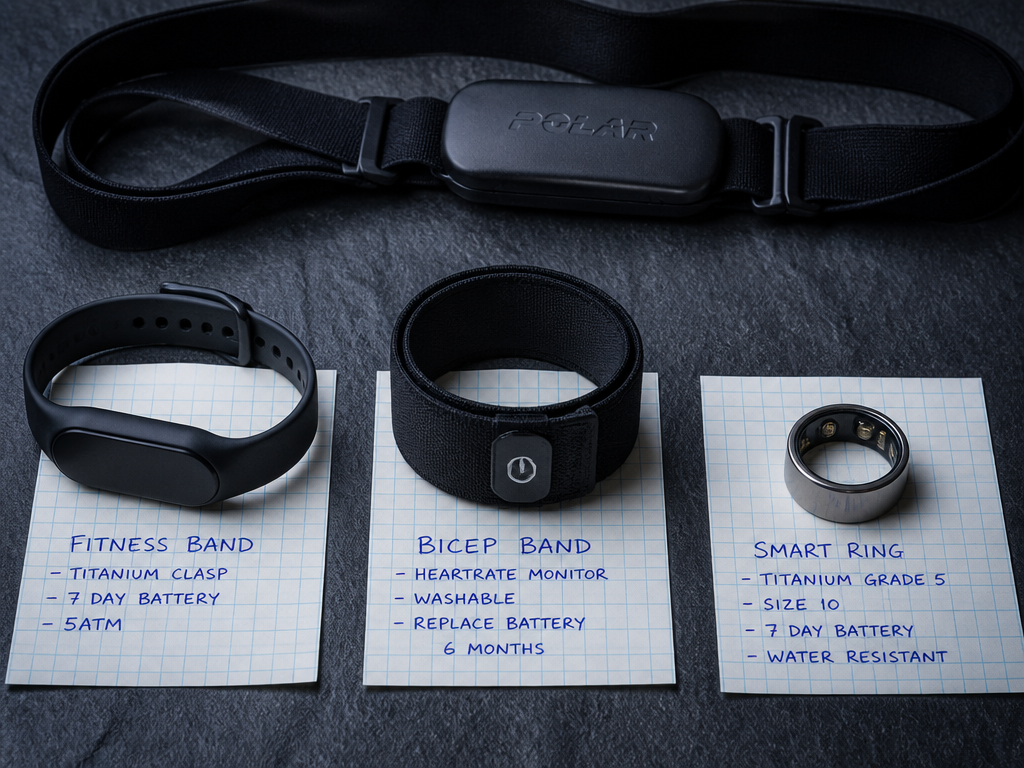
I can't validate any of these against an ECG chest strap during sleep; I only wore one for daytime spot checks, where all three agreed within about 6 ms of RMSSD. So treat the nighttime claim as an artifact-plausibility judgment, not a validation.
Last, the slow signals
Skin temperature and SpO2 are the tail end of the chain, and they're the most forgiving of a degraded front end because they're averaged over hours. They're also where cheap assembly shows.
Temperature comes off a thermistor bonded to the inner shell. If the potting compound around it develops a gap — and thermal cycling plus sweat will find any gap — the sensor starts measuring air as much as skin. The Ultrahuman's nightly temperature deviation got noticeably choppier after month four: night-to-night swings of 0.4 °C on weeks when nothing about my sleep or my caffeine schedule changed. Oura and RingConn both held within about 0.15 °C of their own baselines under the same conditions.
SpO2 depends on the red/infrared ratio, and a hazed window scatters those two wavelengths unequally. All three rings reported me between 94% and 97%, which is where a fingertip pulse oximeter also put me. None of them is a medical instrument and none of them claims to be. I'd use the trend and ignore the digits.
The grid
| Ring | Sticker | 3-year cost | First window scratch | Nights with >20% signal gaps |
|---|---|---|---|---|
| Oura Ring 4 | $349 | $564.64 | Day 96 | 6 of 168 |
| RingConn Gen 3 | $299 | $299 | Day 41 | 11 of 142 |
| Ultrahuman Ring Air | $349 | $349 | Day 22 | 19 of 102 |
Who should buy which
Buy the RingConn if you want trend data — sleep timing, resting heart rate direction, whether last week's espresso schedule is costing you — and you'd rather own the thing outright. It gives up roughly a third of a scratch-free year to Oura and charges $266 less over three. That's a good trade.
Buy the Oura if your use is diagnostic rather than directional: you're chasing a specific effect, you need HRV you can defend on a night you slept badly, and a corrupted month is genuinely expensive to you. You are buying window durability and shell rigidity, and you're paying $5.99 a month for the privilege of keeping your own history readable.
Skip the Ultrahuman unless you're desk-bound and gentle with your hands. Its window did not survive contact with a gym.
If you handle tools, lift, climb, or cook for a living, none of these is a three-year purchase. Budget for two years and buy the cheaper ring.
Back to $564.64
That number only means something divided by nights of data you'd stand behind. Oura's works out to about $0.52 a night across 1,095 nights — if the hardware makes it that far, which I can't prove past 168. The RingConn, priced at $299 and hazing on the schedule I watched, needs roughly 575 clean nights to beat it, and I'd bet on it getting there.
The subscription was never the interesting variable. A 4 mm piece of plastic was.