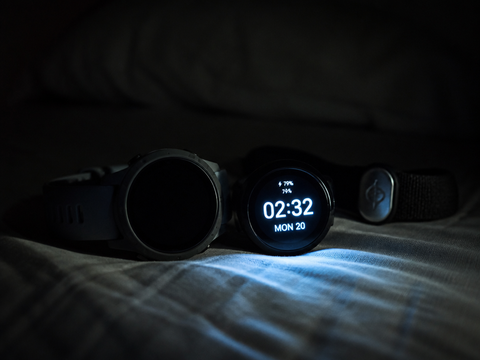
Eleven lux, measured at forty centimetres, in a bedroom my meter otherwise read as 0.0. That is what an AMOLED smartwatch puts on your face when you roll over at 3 a.m. and the watch decides the movement was a request. Everything in this fitness tracker review hangs off that one number and the twenty-one nights I spent collecting it.
The verdict, up front: if you actually sleep in your wearable — and every recovery metric these devices sell you requires that you do — a transflective memory-in-pixel panel is the best display technology you can buy, and going screenless is a close second for reasons that turn out to have almost nothing to do with light.
That is an unfashionable position. MIP is the dull, grey, low-contrast screen Garmin puts on the Instinct line and its Edge bike computers, and next to a Venu it looks like a graphing calculator from 1997. I expected to write the opposite piece.
What eleven lux actually measured
The meter was a £27 handheld unit off a marketplace, uncalibrated against anything traceable. So treat the absolute figures as soft and the comparisons as firm: same meter, same tripod, same 40 cm — roughly where a watch face sits when you're on your side with a forearm folded toward your chest — with all four devices measured back to back in one sitting, blackout blind down, every standby LED in the room taped over.
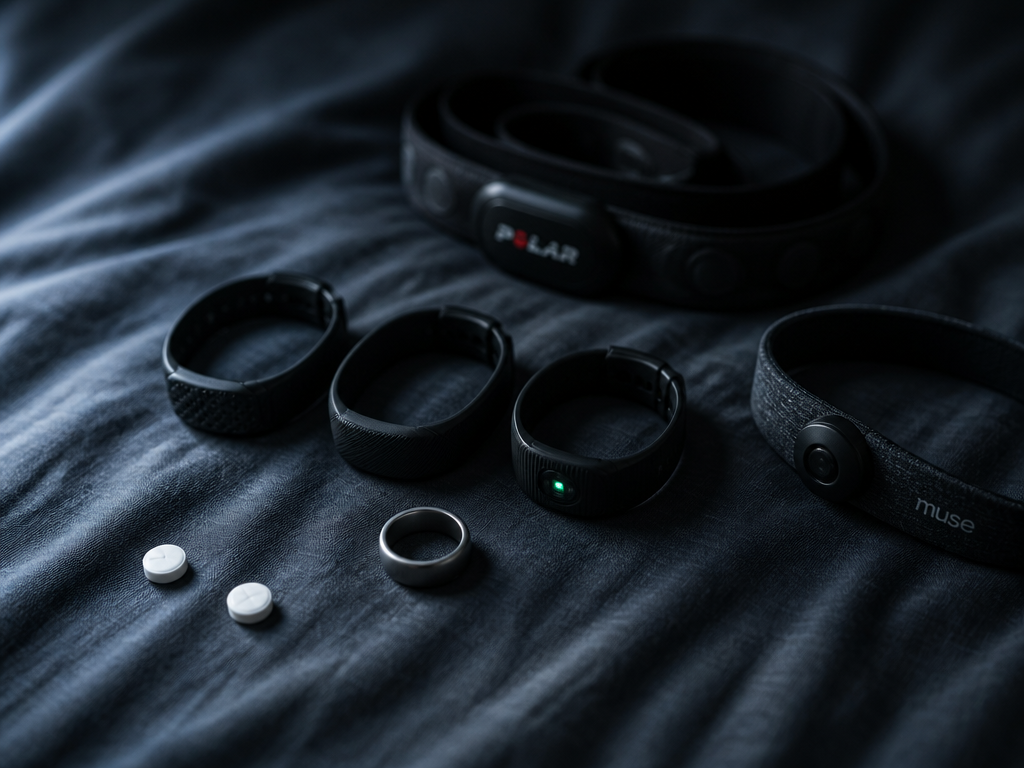
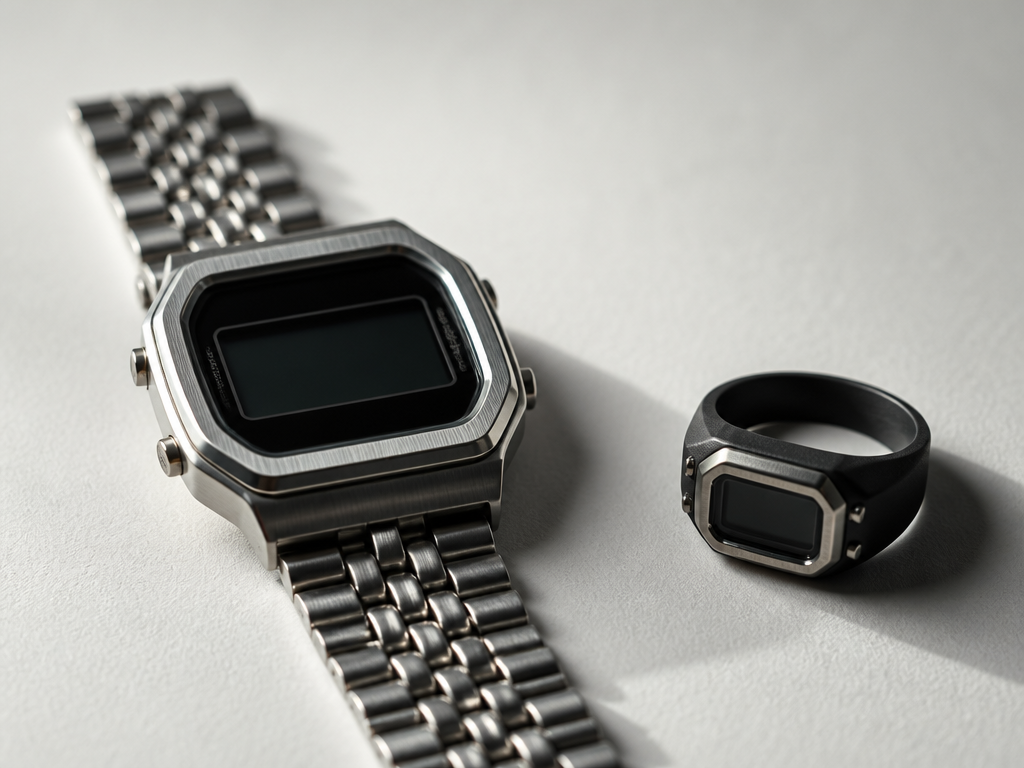
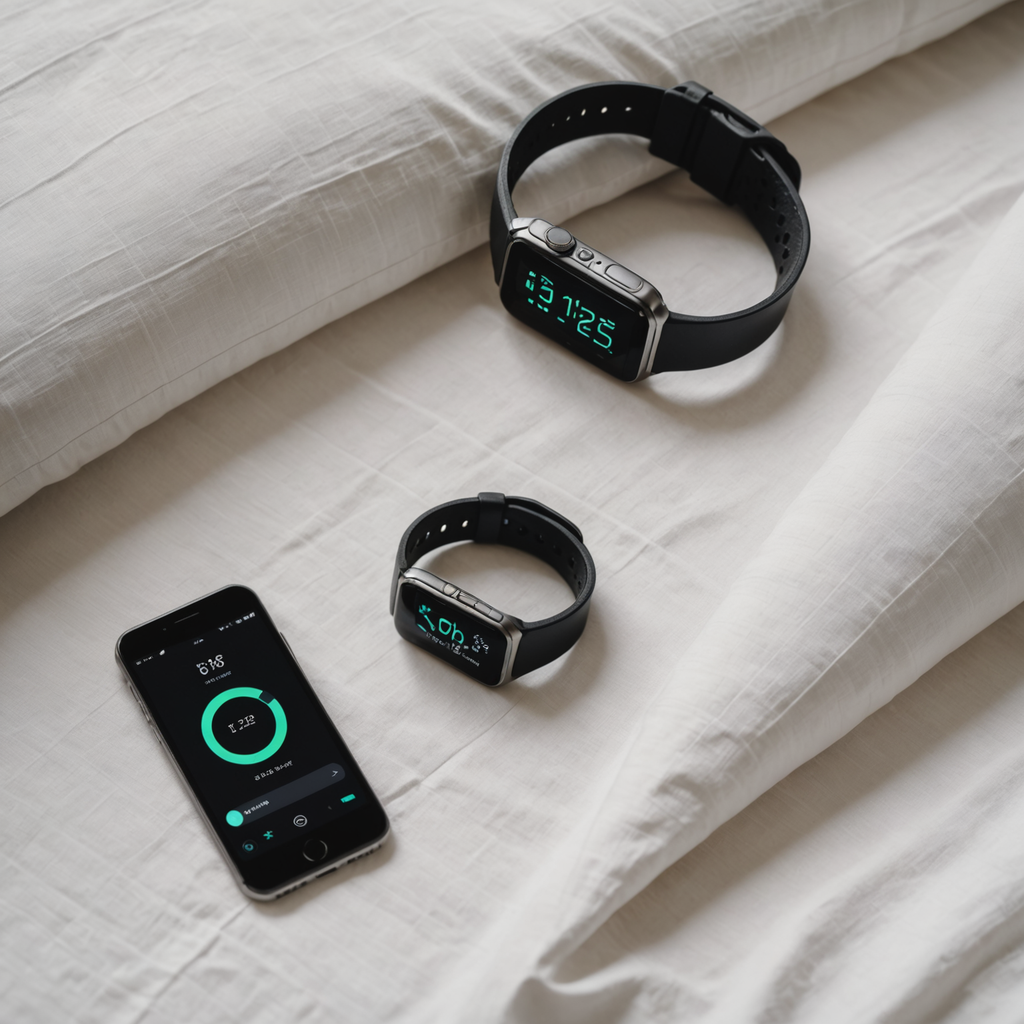
Four devices, three technologies. A Garmin AMOLED of the Venu class, which is the panel that has quietly taken over Garmin's consumer range. An Instinct 2X with the old transflective MIP. An Edge 840 on the nightstand as a second MIP reference, because a lot of you own one. And a screenless band of the Whoop persuasion: a sensor puck on a fabric strap with nothing to read at all.
| Display mode | Peak at 40 cm, dimmest setting | Lights up unbidden? | Readable in a dark room | Readable in direct sun |
|---|---|---|---|---|
| AMOLED, gesture wake | 11 lux for ~5 s | Yes, often | Instantly | Yes |
| AMOLED, always-on | ~3 lux, continuous | Never off | Yes | Yes |
| MIP + backlight, lowest | 2 lux | Only if you enable gesture backlight | Dimly | Yes |
| MIP, backlight off | 0.0 lux | No | Not at all | Best of the four |
| Screenless band | 0.0 lux | No | Nothing to read | Nothing to read |
At default brightness rather than minimum, the AMOLED measured 74 lux. That is the setting the watch ships with, and it is the setting most people leave it on, because at 11 lux the face is hard to read in daylight and the watch does not change its own mind about brightness as fast as you walk outdoors.
What eleven lux doesn't measure
Quite a lot, and this is where most gear writing about screens and sleep goes wrong.
It doesn't measure duration. Eleven lux for five seconds and eleven lux for five hours are the same reading and are not the same exposure. The lab work I can read on light and circadian timing overwhelmingly uses sustained exposure; nobody has handed me a number for a flash, and I am not going to invent one.
It doesn't measure spectrum. Lux is weighted for daytime human vision, which peaks in the green. It systematically undersells short-wavelength content — the part everyone actually cares about. A white AMOLED face and a warm amber backlight can read identically on my meter and be doing different things to you.
It doesn't measure my pupils, which after four hours in the dark are nothing like the pupils that reading holds up as a baseline. It doesn't measure melatonin, because I did not draw saliva at 3 a.m. and neither did you. And it is one sleeper, one bedroom, twenty-one nights. Everything below is an observation, not a finding.
The thing the number missed entirely
Alongside the meter work I pointed an old phone at the bed on a two-second time-lapse for the full twenty-one nights. A lit watch face in an otherwise black frame is unmistakable. Over three weeks: 71 nocturnal display events, about 3.4 a night.
I scored each one from the frames as either a hold — face up and stationary for more than four seconds — or a flash, the screen catching a roll and dying again. Thirty-eight holds, thirty-three flashes. That split is an imperfect proxy for deliberate versus accidental and I'll own it; a hold with my eyes shut looks the same on camera.
But the split is the story. The flashes are what the eleven-lux number is about, and they are the half that doesn't matter. In not one frame does a flash precede movement that looks like waking. The screen lit because I had already turned over. The holds are different. A hold is me, awake, deciding to find out what time it is.
On nights with two or more holds, the watch logged a mean of 41 minutes awake after sleep onset. On nights with one or none, 24 minutes. That gap is confounded to the point of near-uselessness in the obvious direction — I check the watch on nights I'm awake, so of course the checking nights are the awake nights. What the video adds is sequence, and the sequence is consistent: short awakening, hold, then a long tail of movement afterward. Learning that it is 3:12 and that you are sitting at 61% recovery is a small task, and a small task is enough to convert a four-minute awakening into a twenty-minute one.
This is the case against the AMOLED, and it isn't photobiology. It's that a good screen is an interface, an interface invites use, and 3 a.m. is a bad hour to be given something to read about yourself.
The caffeine column
I logged last-caffeine time on all twenty-one nights. Seven of them had a coffee after 2 p.m. Those nights averaged roughly 3.3 holds; the other fourteen averaged about 1.1.
I'd love to tell you the screen and the caffeine are interacting. They aren't, as far as I can tell. Late caffeine gave me more awakenings, and more awakenings gave me more opportunities to reach for the watch. The screen didn't cause anything — it just monetised the extra wakefulness in attention. Also, the late-coffee days were my busiest days, which is not a variable I controlled for and not one I can separate.
Screenless is not free
The screenless band solves the 3 a.m. hold completely. There is nothing to check, so I didn't check. Across the nights I wore it, the camera caught zero display events, for the obvious reason.
What it costs is the morning. Every question the band answers has to be answered by a phone, which means the first thing I do on waking is unlock a device that has notifications on it. That is a worse trade than it sounds. And on the subscription: at list prices, three years of a Whoop-style membership runs to something like $600, against roughly $300 once for an Instinct. If you keep wearables for three years, the screenless band is the expensive option, and you are renting access to your own resting heart rate.
Cyclists get the cleanest version of this. If you already own an Edge, you own the screen — the ride data, the mapping, the workout structure all live on the bars, in daylight, on a MIP panel that is at its best in exactly the conditions AMOLED is at its worst. The wrist device is then only a sleep and recovery sensor, and a sleep sensor has no business having a display at all.
Who this is for, and who it isn't
Buy the MIP watch if you sleep in your wearable, ride or run outdoors in bright light, and want one device that does both. It is the only option here that is genuinely dark at night and genuinely legible at noon, and the battery arithmetic is not close.
Buy the screenless band if you have already caught yourself checking recovery scores in bed, if a bike computer or a phone already covers your live metrics, and if you have honestly priced three years of subscription and are fine with it.
Buy the AMOLED if you want a watch you also wear to dinner. It is a much nicer object, and if you disable gesture wake and always-on overnight you remove most of what I measured. Don't buy it and leave it on defaults.
This is not the wearable review for anyone chasing structured GPS training, running power, or lab-grade metrics. Those readers already know which Forerunner they want and none of this changes it.
Eleven lux never woke me. The 3 a.m. recovery score did.
Buy the ugly screen.