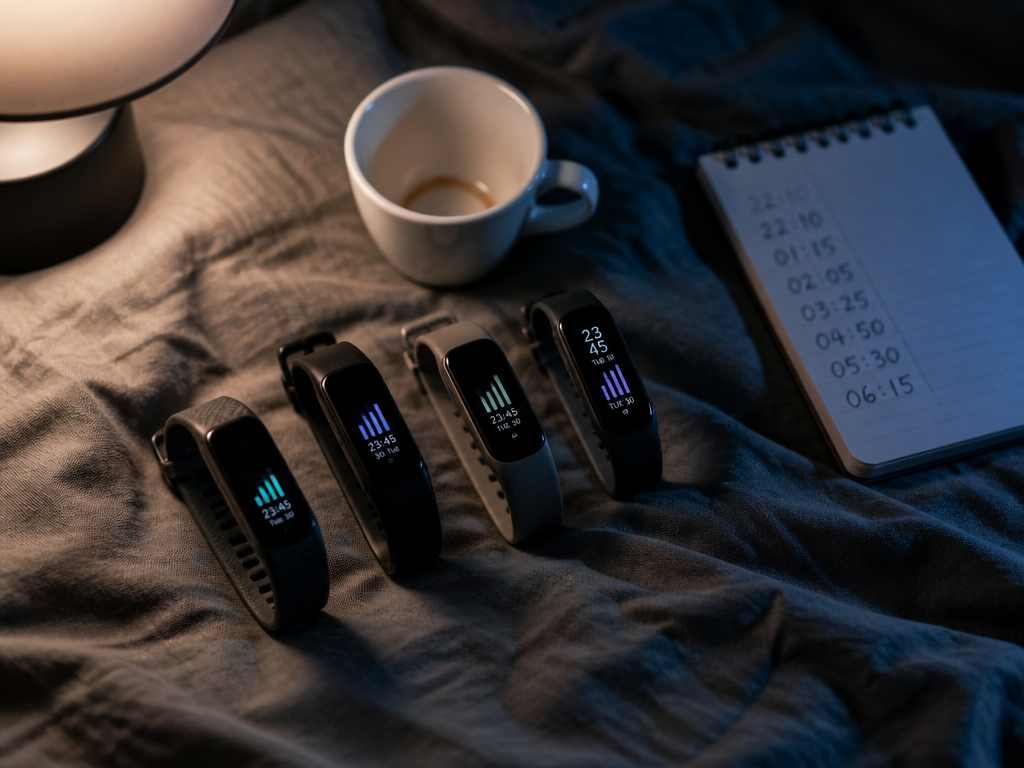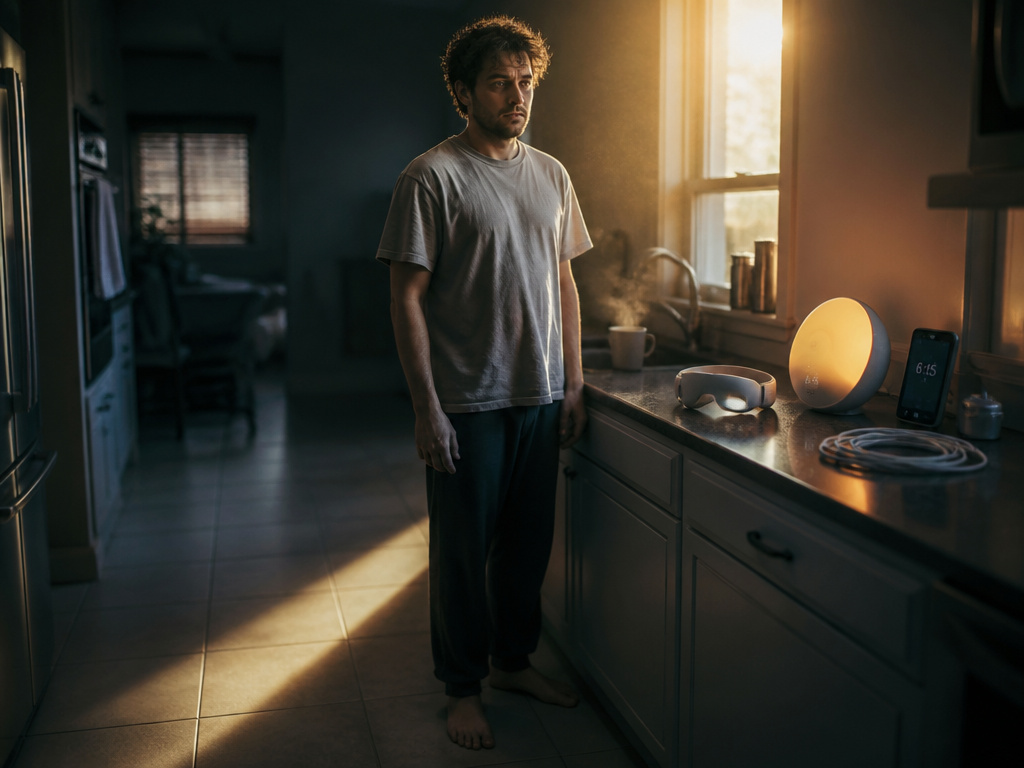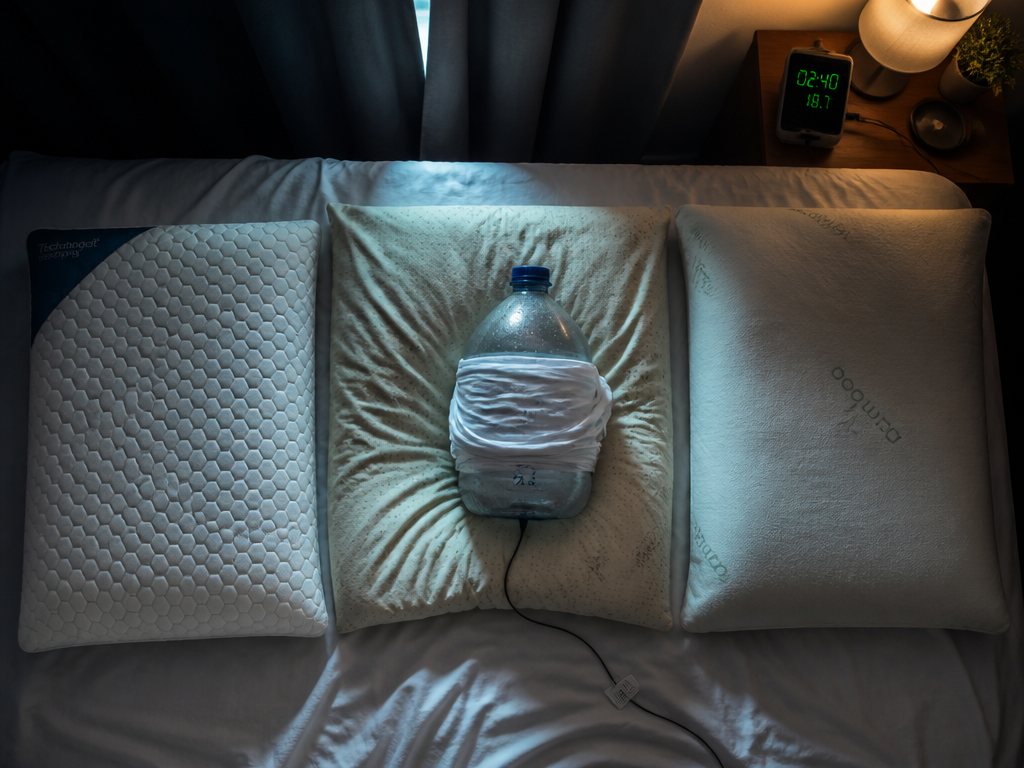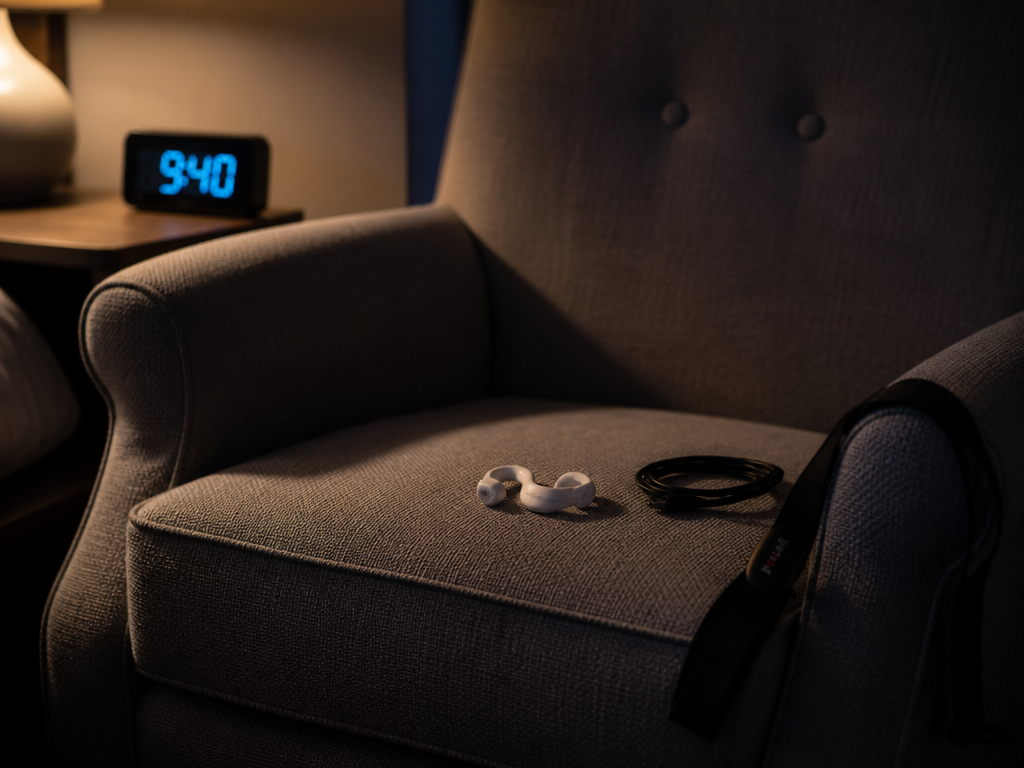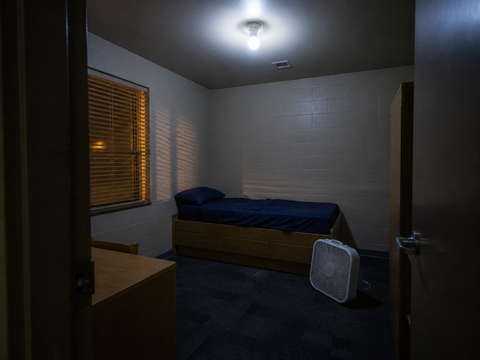
The question is the one almost everyone in a shared room asks at 2:40 in the morning, staring at a cinder-block ceiling: is this a gear problem or a room problem? I gave myself $200 and nine weeks of dorm-grade sleep technology to find out — roughly the budget a first-year student has left after textbooks, not the budget of a wellness catalog.
The verdict: about two-thirds of a bad night in a shared room is a gear problem, and the cheapest items fix most of that two-thirds. A $19 box fan and $5 of foam earplugs beat everything else I bought. The product I expected to be a gimmick — a $27 Bluetooth sleep mask — solved the one problem the cheap gear couldn't touch, and it's a narrower problem than the category's marketing implies.
The setup, and what it isn't
I need to be straight about this before any of the numbers mean anything: I don't live in a dorm. I graduated long enough ago that the microwave in my hall was communal and the router wasn't.
What I have is a second-floor bedroom that reproduces most of the relevant conditions. The head of my bed shares a wall with a stairwell door that latches with a bang. The window faces a street on a bus route. The radiator is controlled by a building, not by me. My partner keeps hours two hours offset from mine, which is the closest thing I have to a roommate problem. Nine of the sixty-three nights were spent somewhere closer to the real thing: four in summer conference housing in an actual residence hall — extra-long twin, one overhead fixture with no lamp option, foam pillow with the structural properties of a folded towel — and five in a hotel next to an ice machine.
I also handed a duplicate kit to a sophomore I'll call R., who lives in a double that the university converted to a triple. They ran it for three weeks and logged what they wore and what they abandoned. Where we disagree, I've said so, because they disagreed with me on the single item I was most confident about.
Instruments, and their limits: sound levels come from the NIOSH Sound Level Meter app on an iPhone, which is more trustworthy than most phone meters and still not a Class 1 meter — treat every dB figure here as ±3. Light readings come from a phone lux app, which is worse; I'd trust the direction of those numbers and not the decimal. Sleep onset is self-reported. I noted lights-out time, and in the morning I estimated when I'd gone under. That is a soft measurement and I'm not going to dress it up. I wore a wrist tracker for part of the test and then stopped citing it, because consumer staging estimates built from movement and heart rate are not evidence of what happened to my deep sleep, and pretending otherwise is how this genre gets dishonest.
Structure: nine baseline nights with nothing, then one variable at a time for a week each, then two weeks with the full kit running.
What the room is actually doing to you
This is the part that changed how I shopped.
With the window shut at 1 a.m., my room's noise floor sits at 34–38 dBA. That's quiet. The stairwell door peaks at 61–67 dBA, and on a Friday it does that somewhere north of forty times. The 5:52 bus hits 72 dBA at the window. The radiator, when it decides to participate, knocks at 58 dBA.
So the problem was never loudness. Sixty-six decibels is a conversation. The problem is the jump: a 28-decibel step out of near-silence, delivered without warning, dozens of times a night. Once I had that number I stopped thinking about blocking sound and started thinking about two levers — lower the peak, or raise the floor. Almost everything worth buying does one or the other, and the cheap things do them better than the expensive things.
Light was smaller than I expected and more annoying than I expected. A parking-lot floodlight put roughly 9 lux on my pillow through a standard roller shade. A laptop screen across the room, about 4. The strip under the door in the residence hall was the worst offender because it was the only light that moved — every person walking past cast a moving shadow, and moving light is a different problem from steady light.
Heat was the third variable and the one nobody sells students a gadget for. My room hit 78°F at 2 a.m. in September with the radiator not even on yet.
Noise, part one: lowering the peak
3M E-A-Rsoft foam plugs, about $0.30 a pair. Lab-rated NRR 33, which you will not get, because NRR is measured with a technician inserting them for you. It took me a week to stop wasting them: roll thin between the fingers until it's the width of a pencil lead, reach over your head and pull the ear up and back, insert, hold for twenty seconds while the foam expands. Done properly, the stairwell door disappeared. Not softened — gone. The bus became a thing I felt in the mattress rather than something I heard. I'd guess I was getting somewhere in the low twenties of real-world attenuation; done sloppily, on the nights I was too tired to care, more like ten, and ten is not enough.

Two real costs. By night five my ear canals were sore — a low, hot ache that took a night off to clear, and I ended up on a five-nights-on, two-nights-off pattern. And I slept through a 7 a.m. alarm twice in the first fortnight, which for a student is not a minor inconvenience. Fix: phone face-down on the mattress with vibration on. The bed becomes the alarm.
Loop Quiet 2, $24.95. Silicone, reusable, claimed SNR 24. Less attenuation than well-inserted foam, and audibly so — the stairwell door became a distant thud rather than nothing. But I could sleep on my side without the plug pressing into the canal, my ears never got sore, and after week six I reached for them automatically.
That's the honest comparison, and it isn't a spec-sheet comparison. Foam is the plug that worked better on night four. Loop is the plug I was still wearing on night forty. If you'll only ever buy one, adherence beats attenuation, and I say that as someone who spent three weeks arguing the opposite with myself.
R. went further and never used the foam at all — they found it claustrophobic, and more to the point, they didn't want to be sealed off from a roommate coming in at 1 a.m. in a room where the beds are four feet apart. That's a real constraint that no review written by someone with their own bedroom would surface.
Noise, part two: raising the floor
A $19 twenty-inch box fan, on low. Measured 48 dBA at the pillow. That lifted my noise floor by ten to twelve decibels, which shrank the stairwell-door delta from 28 dB to something closer to 17. On the nights I ran the fan and nothing else, I stopped noticing the door by about the fourth night. It is the single best purchase in this test and it costs less than two weeks of coffee.
It also solves the heat problem, which is the argument that ends the debate with its main competitor.
Yogasleep Dohm, $44.99. A mechanical fan in a housing, so it makes broadband sound without a loop or a rattle, and you can tune the pitch by twisting the collar. It sounds better than the box fan — smoother, less low-end rumble, no cold draft in February, and small enough for a desk shelf. In a February dorm room with an aggressive radiator you can't turn off, the draft argument flips and the fan still wins. In a cold room, or a room where you've already got airflow, the Dohm is the better instrument. It just does one job, and at this budget every item needs to do two.
Free phone apps. They work, and I still can't recommend them as the primary. The two free ones I tried used short loops — one was about thirty seconds with a faintly audible seam at the join, and once you hear the seam you cannot unhear it. More importantly they occupy the phone, and the phone is the alarm, the flashlight, and the thing you shouldn't be holding at midnight.
Light: harder than it looks in a room you're not allowed to modify
Dorm housing contracts generally forbid drilling, which eliminates the actual solution. A tension rod inside a recessed window frame works and costs $12. Adhesive hooks do not: mine held a $34 lined blackout panel for nineteen nights and then let go at 3:10 a.m., which was funnier than it was restful. Even mounted properly, the panel leaked at the sides — I measured about 2 lux still landing on the pillow, down from 9. Real improvement, not a solution, and it's the largest single line item on the receipt.
A $9 contoured eye mask blacked things out well and migrated up my forehead by 4 a.m. roughly half the time.
The Bluetooth mask, which I expected to dislike
$27, a padded fabric band with flat speakers sewn into pockets over the ears and a light-blocking panel over the eyes. I bought it assuming it was two mediocre products stapled together.
Comfort. The speaker pads are about 4mm thick. On my own soft pillow I stopped noticing them after two nights. On the residence hall's foam slab, I noticed them every night — a dull pressure on the underside ear that woke me once. That's the test most reviews skip, and it's the one that matters for the target buyer, because the buyer is sleeping on institutional foam.
Light. Better than the loose $9 mask because the band is elastic all the way around and doesn't slide. Not total blackout — there's a consistent leak at the bridge of the nose, and my meter still read about 1 lux at the eye. If you need genuine darkness for medical or shift-work reasons, this is not the product.
Battery. Claimed ten hours. From a full charge, playing a brown-noise track at moderate volume, I measured 8 hours 10 minutes on the first test and 7 hours 20 by week nine — normal lithium decline, but worth knowing that a claimed ten becomes a real seven-and-change by the end of a term. It charges over micro-USB, which in this decade is a small insult; budget a dedicated cable you keep by the bed.
Controls. Three buttons under fabric. I learned volume and play-pause by feel in about four nights. The sleep timer needs a long-press combination, and I'd say I got it right in the dark maybe half the time. I gave up and used my phone's own timer instead.

Audio. Speech is clear. Podcasts and audiobooks are entirely fine. Bass is effectively absent — anything with a kick drum arrives as a rhythmic suggestion. Don't buy this to listen to music; buy it to listen to a voice or a noise floor.
And here's the thing I didn't anticipate, the reason it survived the cull. Earplugs and a fan handle noise coming from outside your head. Neither does anything about the 3 a.m. wake-up where the room is silent and you are lying there running a conversation from six hours ago on a loop. Audio in your ears, with nothing to hold and no screen, was the only item in the kit that addressed that, and it addressed it well enough that I kept using it after the test ended. One hygiene note nobody mentions: the outer band is washable and you should wash it, because it spends eight hours a night on your face.
The grid
| Item | Price | What it fixed | What it didn't | Buy again |
|---|---|---|---|---|
| Box fan, 20" | $19 | Raised noise floor ~11 dB; dropped perceived room temp | Nothing above ~65 dBA; cold rooms | Yes, first |
| Foam earplugs (bulk) | $5 / 20 pair | Biggest real attenuation; killed door slams | Canal soreness; alarm risk | Yes, as backup |
| Loop Quiet 2 | $25 | Side-sleeping comfort; nightly adherence | Less attenuation than foam | Yes |
| Bluetooth sleep mask | $27 | Racing-mind wake-ups; light + audio in one | Total darkness; music; firm pillows | Yes, situationally |
| Blackout panel + rod | $46 | 9 lux → ~2 lux at pillow | Side leak; mounting rules | Only if the window is the problem |
What failed, and what I can't distinguish from placebo
A borrowed $100 smart sunrise light spent five nights on my desk. Its wake-up light is genuinely good — waking to a slow amber ramp is better than waking to a marimba, and I'd believe someone who told me it changed their mornings. But it doesn't address noise, and its speaker was worse than the $27 mask's, and the content library sits behind a subscription. It's a nice object aimed at a different problem than the one a dorm creates, at five times this budget.
The adhesive hooks failed, as covered, at 3:10 a.m.
A $12 lavender pillow spray produced no measurable change in anything I recorded and no subjective change I'd swear to. I can't separate it from placebo, and I'm not going to write a paragraph pretending I can.
Who this is for, and who it isn't
This kit is for you if your room has a big gap between its quiet floor and its loud peaks — a stairwell, an elevator, a street, a roommate on the opposite schedule. That's the specific condition all of this gear is good at. It's also for anyone sleeping in rotating rooms: everything here except the curtain fits in a backpack pocket, and the mask plus a pair of plugs has fixed more hotel nights for me than any hotel has.
It isn't for you if you need to hear something — a roommate with a medical condition, a child, a fire alarm you don't trust the building to route to your phone. Seal your ears and you accept that trade. It isn't for anyone who wants total darkness; nothing here delivers that, and the mask least of all. It isn't for audio quality, at any price point in this test.
And it isn't for the biggest dorm sleep problem, which is not acoustic. If you're going to bed at 2 and getting up for an 8 a.m., no amount of gear closes that gap. I can measure a decibel. I can't sell you four hours.
If you buy one thing, buy the fan. If you buy two, add foam earplugs. Everything after that is $27 to $100 spent narrowing the distance between a good night and a very good one.
What I still don't know
Sixty-three nights of self-reported onset say that masking works — that raising the floor and covering the peaks gets me under faster and keeps me there. I believe that about my own room, at n=1, with an uncalibrated meter and a memory-based stopwatch.
What I can't tell you is what eight continuous hours of broadband sound does to the rest of the night. The auditory system doesn't switch off when you do; it's the sense that keeps working through sleep, which is exactly why the door slam wakes you. So a fan running until 7 a.m. is not silence — it's a sound your brain is processing all night, chosen by you instead of by the building. Does that cost anything in sleep depth? My wrist tracker has an opinion and no standing to hold it, and the only instrument that could settle it involves electrodes and a lab, not a box fan and a phone app.
The question underneath it interests me more. Is the benefit of masking the sound itself, or just the absence of surprise? If it's the surprise — if what your nervous system objects to is the unpredicted 28-decibel step and not the noise — then the goal isn't a louder room, it's a more consistent one, and half of what's sold as sleep technology is solving the right problem for the wrong stated reason. I don't know which it is. I know which one I'd want tested before I spent another two hundred dollars.