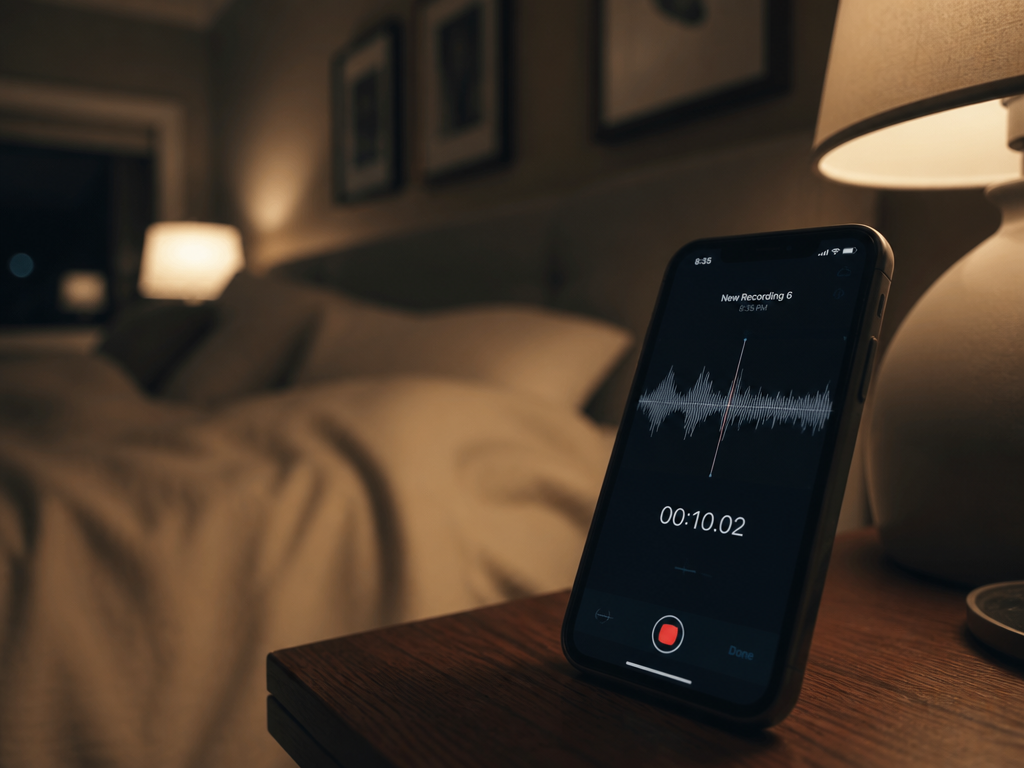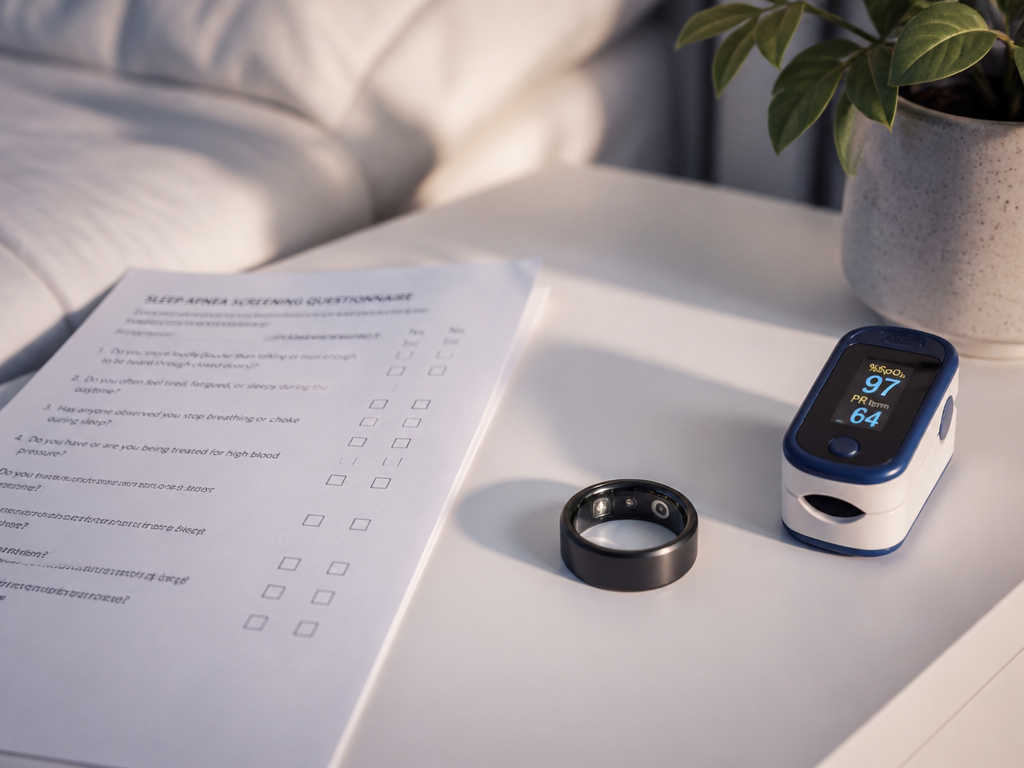
Across forty-five nights I logged twenty-one mid-night wake-ups. The median clock time was 3:07 a.m. That number is the only reason I ran this sleep tech review at all, and by the end of it the number meant something different than it did at the start.
I tested three approaches to a quiet bedroom in fifteen-night blocks: the room as it is, then 33-NRR foam earplugs at about $0.40 a pair, then $279 noise-masking sleep earbuds with an environment log. I'm a side sleeper throughout, on a soft latex pillow, top floor, shared hot-water riser in the wall behind the headboard.
The verdict, in one sentence: the masking buds did not make my bedroom quieter than forty cents of foam did, and they still earned the $279, because they were the only thing in the test that told me what was waking me.
I'm describing these by category and price rather than by model name. I bought one unit of each, and one unit is a sample, not a brand verdict.
What I actually ran
Every block held the same variables: lights out between 23:15 and 23:45, bedroom at 19.5°C, blackout blinds, and caffeine pinned flat — 180 mg a day from weighed beans, last cup at 13:00, no exceptions, no weekend drift. Wakes went on a bedside pad by hand: clock time, and my best guess at cause. I cross-checked against a ring's wake detection, which disagreed with my pad about twice per block.
Sound floor came from a calibrated phone meter at pillow height. Below about 30 dBA that meter is guessing, and I'm treating my "31–33 dBA floor" as a floor-ish rather than a figure. Above 40 dBA I trust it within a couple of decibels.
Where the 3 a.m. story comes from
If you have searched your own wake-ups, you have met the explanation: humans used to sleep in two shifts, the 3 a.m. interval is ancestral, and the anxiety about it is the only real problem.
That belief has two sources and they are both narrower than what's built on top of them. The first is a photoperiod experiment run at the NIH in the early 1990s, in which a small group of healthy men spent fourteen hours a night in darkness for weeks. Their sleep did split into two bouts with a placid interval between. The second is the historian A. Roger Ekirch's archival work, published in book form in 2005, which turned up several hundred references to "first sleep" and "second sleep" in pre-industrial English texts.
Both are real, and both are interesting. Neither is a claim about you. The experimental subjects were in enforced darkness far longer than any modern night, which is closer to a study of winter at high latitude than of a Tuesday. And the archive records what people wrote down, which is what struck them as worth writing down. The compression from sleep can segment under long darkness to your 3 a.m. wake-up is ancestral and fine happened somewhere on the internet, and it quietly rules out the boring explanation: something in your room made a noise.
And where the 30-decibel bedroom comes from
The other number under every sleep-gear pitch is that your bedroom should stay below 30 decibels. That figure traces to the World Health Organization's 1999 community-noise guidelines — 30 dB LAeq for continuous indoor noise, 45 dB LAmax for individual events — with the 2009 European night-noise document adding a 40 dB outdoor target. Careful documents, but expert-consensus thresholds, not trials of people in beds.
The masking side is thinner still. A 2021 systematic review in Sleep Medicine Reviews looked at noise used deliberately as a sleep aid and found a small, low-quality literature with mixed results, including signals that continuous sound can fragment sleep as easily as it smooths it. That's the actual evidentiary floor under a $279 purchase, and no reviewer who tells you otherwise has read it.
What my own log said
The buds' environment log put an event at 03:04 on eleven of fifteen nights, running six to eight minutes, peaking 48–52 dBA at the pillow. In absolute terms that barely clears the WHO event guidance. As a delta it's about 18 dB above my floor, which is the number that actually matters, and it lines up with the building's hot-water recirculation pump on a timer.

It also exonerated the coffee. I'd moved my cutoff from 15:00 to 13:00 the previous spring on the assumption that the afternoon cup was the culprit. The wake-ups hadn't shifted by a minute. I'd been holding a hypothesis for eight months with no instrument capable of testing it.
The comparison
| Approach | Cost | Wakes / 15 nights | Median onset | What it actually did |
|---|---|---|---|---|
| Bare room | $0 | 11 | 17 min | Baseline. Two wakes I never explained. |
| Foam earplugs (33 NRR) | $0.40/pair | 6 | 12 min | Best raw attenuation. Fell out ~1 night in 4. |
| White-noise machine* | $60 | — | — | Raised the floor to 44 dBA. Masked the pump, masked my alarm. |
| Masking earbuds | $279 | 4 | 13 min | Modest sleep gain; the log was the product. |
*Run informally the previous winter, not as a matched block. Included because leaving it out would flatter the expensive option.
On attenuation alone, foam wins and it isn't close. The buds seal loosely by design — they're masking, not blocking — and a good foam plug is a better wall. What foam can't do is tell you what it stopped.
What the buds got wrong
They sit about 5 mm proud of the ear opening, which sounds trivial and isn't; on my old firm pillow I felt them for the first twenty minutes every night, and the fix was a softer pillow rather than anything the buds did. Rated battery is ten hours of masking; I measured nine hours twenty on night one and eight and a half by night fifteen, which is fine for sleep and no more than fine.
No active cancellation, so they're bed-only — don't buy them imagining an office use. The app's cause attribution is inference from a decibel curve, not a recording; a clank I heard on night nine is still unidentified. And track choice mattered more than the marketing suggests: a flat brown-noise bed at around 48 dBA worked, while a "rain" preset full of transients was measurably worse than silence for me, four wakes across the three nights I tried it.
What I couldn't test
Fifteen nights a block is thin. There was no blinding — I knew which block I was in every night, and expectancy is a real effect at exactly this magnitude. One room, one body, one pillow, no partner in the bed, no street-facing window. I can't separate the buds' masking from the buds' logging in the wake counts, because I got both at once. And I have nothing to say about wearing in-ear devices nightly for years.
Who this is for, and who it isn't
Buy these if your wake-ups cluster at a consistent clock time and you don't know why. That's the whole case. The diagnostic value is real and it is not available at any lower price point I know of.
Don't buy these if you already know your noise source and just want it gone — foam is better and costs 0.14% as much. Don't buy them if you wake at scattered times, which points at something other than sound. And don't buy them if $279 is a stretch, because the honest expected sleep gain from the masking alone, on this evidence base, is small.
If your wake-ups cluster at one clock time, buy the diagnostic, not the earplugs.
Back to 3:07
The building manager moved the pump's timer to 05:40. My wakes over the following two weeks: three, both blocks of seven nights combined. The best night of this entire sleep gear review was one where I didn't wear anything at all.
Twenty-one wakes, median 3:07 a.m. I'd read that as a fact about my physiology, and the ancestral-sleep story was standing by to confirm it. The WHO number would have told me my room was fine on average, which it was. Neither was wrong, exactly; both were too general to be any use at my pillow. It was a fact about a pump on a timer, and it cost $279 to find out — absurd or cheap, depending on how many more years you'd have spent blaming the coffee.