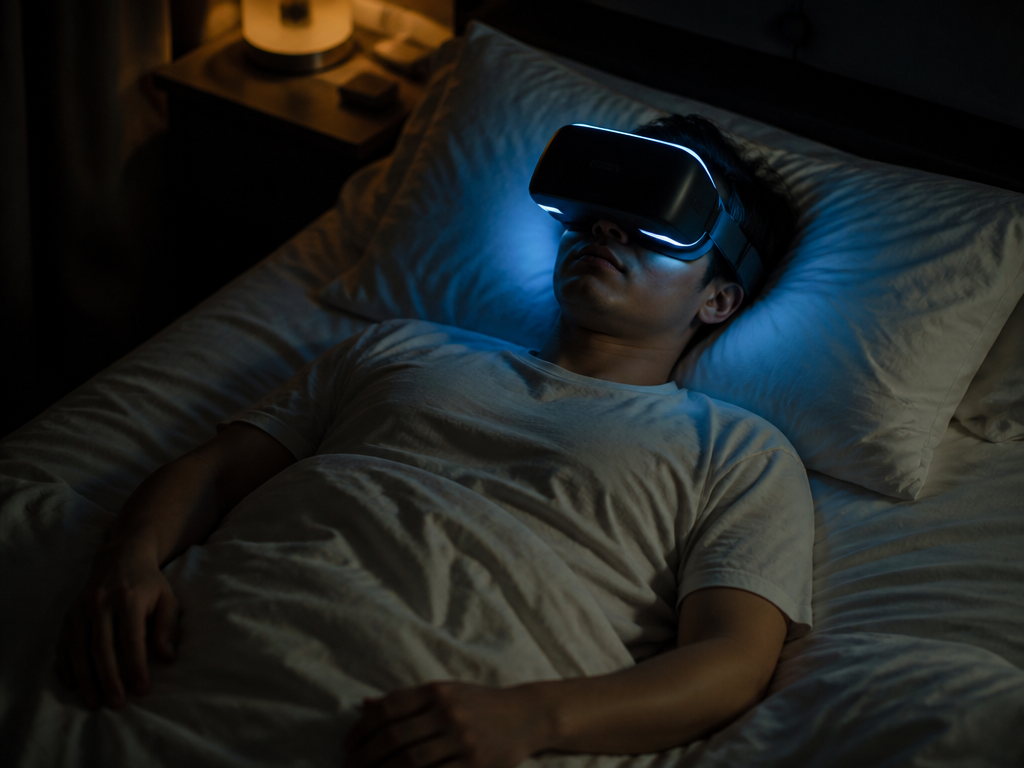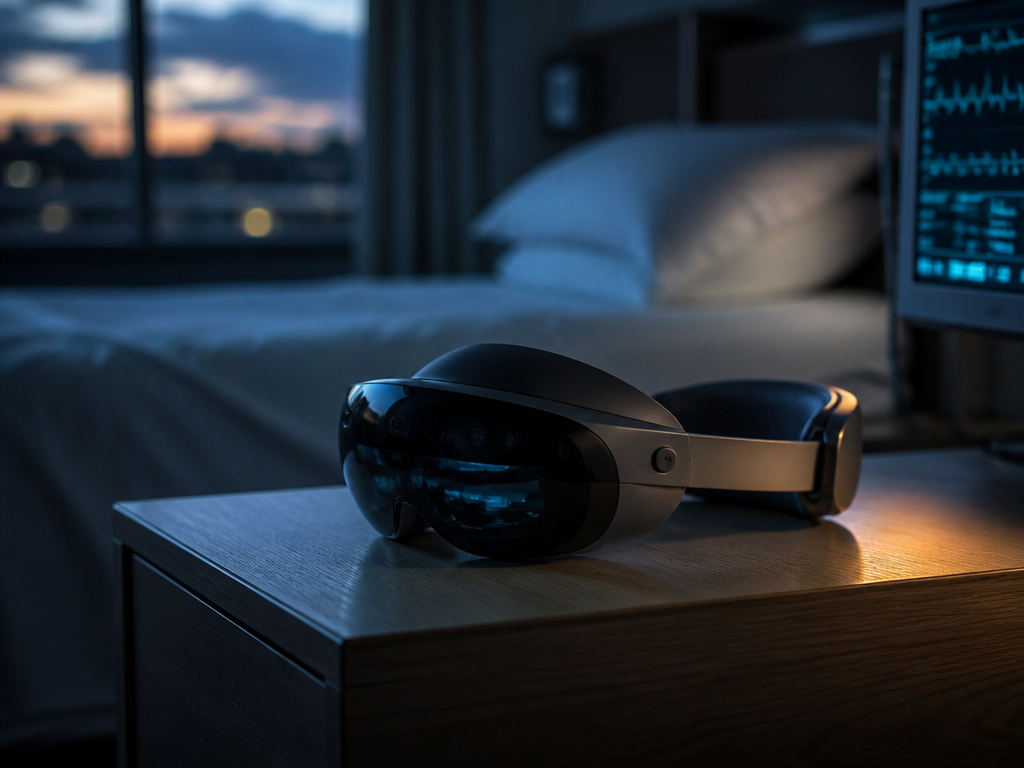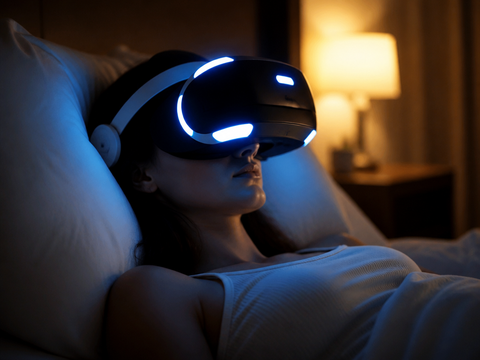
Here is a claim that should not be true: the single most overstimulating consumer device of the decade — a screen strapped two inches from your eyes, rendering a glowing world at 90 frames per second — might, for some people, be a faster route to sleep than lying in the dark.
It sounds backwards. The whole architecture of sleep hygiene says remove the screens. And yet a small and uneven body of evidence suggests that extended reality (XR) — the family of headset technologies that includes virtual, augmented, and mixed reality — can lower the physiological arousal that keeps tired people awake. The rest of this piece is about earning the right to have said that, including the parts where the data does not cooperate.
What XR actually is, in one paragraph
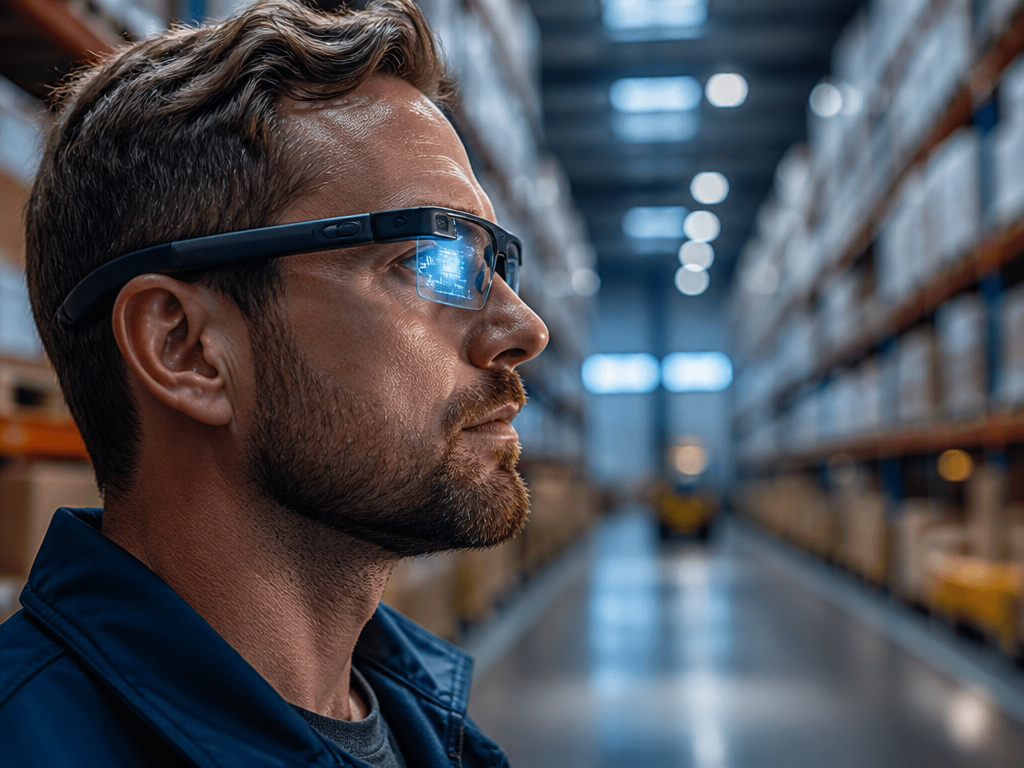
The acronyms describe how much of your visual world is synthetic. Virtual reality (VR) replaces it entirely: opaque headset, no room, just the rendered scene. Augmented reality (AR) layers digital objects over the real room you can still see, the way your phone camera drops a virtual couch into your living room. Mixed reality (MR) is the harder version of AR — digital objects that are aware of physical surfaces, that you can place on a real table and walk around. For the sleep question, VR matters most, because total visual replacement is the only version that can fully control what your nervous system sees in the minutes before you close your eyes.
What a headset does to your body, in order
Start with light. The retina contains melanopsin-sensitive ganglion cells that report ambient brightness — especially short-wavelength blue light around 480 nm — straight to the suprachiasmatic nucleus, the brain's master clock. Bright blue light at night suppresses melatonin and tells the clock it is still daytime. A VR headset is, physically, two bright displays close to those cells. That is the strike against it, and it is real.
Now the countervailing force: attention. Sleep onset is gated less by tiredness than by arousal — the cognitive and autonomic activation that a racing mind sustains. People with insomnia are not usually short on sleep pressure; they are long on pre-sleep cognitive arousal, the mental chatter that keeps the sympathetic nervous system humming. This is where immersion does something a dark ceiling cannot. A fully enclosed audiovisual environment crowds out rumination by occupying the working memory and visual cortex that worry depends on. You cannot easily rehearse tomorrow's meeting while a guided forest scene fills your entire field of view.
The net effect, then, is a tug-of-war: blue light pulling arousal up through the circadian system, immersive distraction pulling it down through attention. Which wins depends on the dose, the content, and the person.
What the research actually measured
The strongest evidence is borrowed from pain, not sleep. VR distraction analgesia is well-established: Hoffman and colleagues, beginning in the early 2000s, showed that burn patients in immersive VR during wound care reported large drops in pain and in pain-related brain activity on fMRI. The mechanism — immersion competing for limited attentional resources — is the same one that would, in theory, quiet a pre-sleep mind. That transfer is plausible but unproven.
On relaxation itself, the data is thinner than the confidence with which it is usually stated. There are small trials — typically a few dozen participants — showing that a single VR relaxation session lowers self-reported anxiety and sometimes heart rate relative to a 2D video or no intervention. A representative example: studies of VR-based relaxation in pre-operative and clinical-anxiety settings have found short-term reductions in state anxiety, but they measure the half-hour after the session, not whether you sleep better that night. Direct measurement of sleep onset latency — how many minutes to fall asleep — using polysomnography after XR use is largely missing. That is the gap. We have good evidence that VR can relax you in the moment and weak evidence that it then shortens the path to sleep.
And the blue-light worry has not been retired. The common consensus, drawn from studies like Chang et al. (2015) on light-emitting eReaders, is that bright short-wavelength evening light delays melatonin and pushes the clock later. A headset displaying a bright daytime beach at 11 p.m. is, on this logic, working against you even as it calms you. The newer wrinkle is that some VR relaxation content is deliberately dim, warm-toned, and low-motion — engineered to keep the soothing without the circadian cost. Whether that engineering is sufficient is exactly what nobody has cleanly tested.
An honest rule of thumb
If you want to try it tonight: treat the headset as a wind-down tool, not a bedtime device. Use it for a 10-to-15-minute low-light, low-motion experience while sitting up, then take it off, dim the room, and get into bed without it. You are borrowing the attentional benefit while spending as little time as possible under the displays. Do not fall asleep wearing it — beyond the obvious discomfort, you lose the dark-room melatonin window entirely.
| If your problem is… | XR is… | Better-evidenced alternative |
|---|---|---|
| A racing mind at lights-out | Plausibly useful (attention/distraction) | CBT-I, audio-only meditation |
| Waking too early | Not your tool | Light timing, sleep scheduling |
| Pain keeping you up | Most evidence-backed use | Same VR analgesia research |
| Wanting deeper sleep | No good evidence | Consistency, cool dark room |
For the people writing the checks
Enterprise and clinical buyers are being pitched XR "wellness" as a productivity and benefits play. The defensible version is narrow: immersive relaxation and exposure therapy have a real, if modest, evidence base for acute anxiety and pain, and those are conditions that wreck sleep secondhand. The overstated version is the headset marketed as a sleep cure, with sleep-quality claims that the studies underneath simply do not support. The distinction matters for procurement, because the regulatory and reimbursement bar for a relaxation aid is nothing like the bar for a sleep medical device.1
The honest framing is that XR is a promising arousal-reduction tool wearing a costume that looks like sleep technology. Sometimes the costume fits. Sometimes it is a bright screen on your face at midnight.
So the unsettled question is not whether immersion can calm a body — it clearly can — but whether the calm it buys is ever worth the light it costs, and for whom: does the right person, with dim enough content and a short enough session, come out ahead, or does the circadian bill always come due?
-
In the United States, a general wellness relaxation product faces little FDA oversight; a device making a diagnostic or therapeutic sleep claim faces a great deal. The marketing language tends to live carefully on the cheaper side of that line. ↩