There is a version of the future that has been roughly two years away for about fifteen years. In it, augmented reality technology finally arrives — light glasses, all-day battery, a display you forget you're wearing — and the enterprise use cases follow automatically. The pitch is almost always framed as a hardware problem. Wait for the optics. Wait for the silicon. Then the rest falls into place.
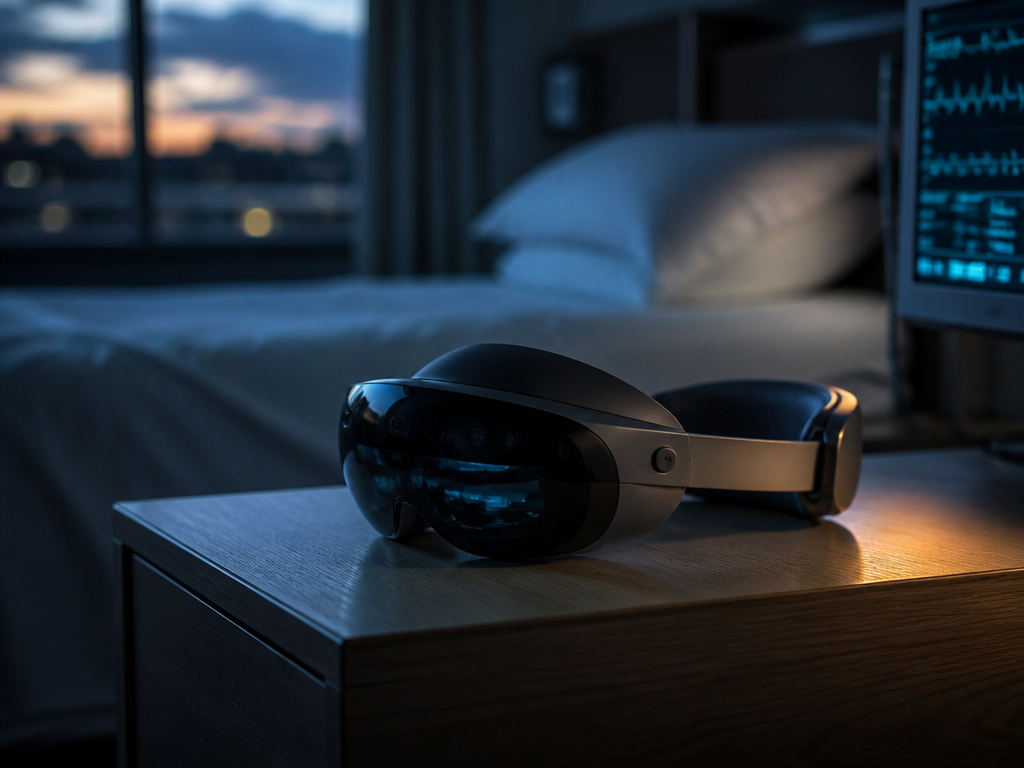
It's a tidy story, and it gets one important number wrong. The number is roughly 20 milliseconds: the motion-to-photon latency budget below which a head-locked AR overlay feels stable instead of swimming. Miss it, and no amount of industrial design saves the experience. The headset can weigh as little as a pair of reading glasses and still make a trained surgeon nauseated, because the digital world will lag a beat behind the real one. That lag — not weight, not price, not field of view — is the thing that has quietly killed more enterprise pilots than any spec sheet would suggest.
The myth: AR is just waiting for better glasses
Ask a procurement lead why their company hasn't deployed AR at scale, and you'll usually hear some version of "the hardware isn't there yet." It's a reasonable belief. The headsets that defined the last decade — Microsoft's HoloLens, Magic Leap, and the wave of enterprise smart glasses behind them — were genuinely awkward: heavy at the brow, narrow in their field of view, short on battery. Apple's Vision Pro, launched in 2024, was praised for its displays and criticized for its weight and its $3,499 price. The conclusion writes itself: better glasses, broader adoption.
The trouble is that the places where AR has actually stuck didn't wait for the glasses to get good. They worked around the hardware and solved a different set of problems. And the places where AR failed mostly failed for reasons that have nothing to do with how the device sits on your face.
The evidence: what actually broke the pilots
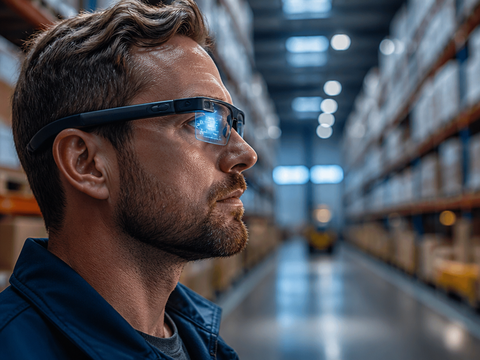
Consider where AR earns its keep today. In warehouses, "vision picking" — overlaying pick locations and quantities onto a worker's view — has been in production for years. DHL began publicizing its vision-picking trials around 2015 and reported double-digit productivity gains; the deployments ran on relatively modest monocular smart glasses, not cutting-edge optics. In manufacturing and field service, Boeing's widely cited internal study of AR-guided wiring assembly reported reductions in production time and error rates compared with paper instructions. Again: unglamorous hardware, real results.
Now consider the failures. They cluster around a few recurring problems, and the device's form factor is rarely the headline.
The first is registration — whether the virtual object actually stays glued to the physical thing it's annotating. A surgical overlay that drifts two centimeters from the patient's anatomy is worse than no overlay at all. The second is content: the realization, usually mid-pilot, that someone has to author, version, and maintain the 3D models, work instructions, and CAD-derived overlays, forever. A clever demo built on one hand-tuned scene does not survive contact with a catalog of ten thousand parts. The third is integration — the overlay is only as useful as its connection to the systems of record, the PLM database, the electronic health record, the warehouse management system.
None of those are optics problems. You could ship a perfect pair of glasses tomorrow and every one of these would remain.
The mechanism: where the milliseconds actually go
To see why latency dominates, it helps to follow a single frame through the system, in the order the device experiences it.
Step one: sensing. Cameras and an inertial measurement unit (IMU) capture the world and the headset's own motion. The IMU is fast — it reports orientation changes hundreds of times per second — but it drifts. The cameras are accurate but comparatively slow and computationally expensive to interpret.
Step two: pose estimation. The system runs SLAM — simultaneous localization and mapping — to answer two questions at once: where am I, and what does the room look like? This is the step that decides whether your overlay is anchored to the real table or floating near it. It is also where a surprising amount of the time budget disappears, because building and querying a spatial map from camera frames is genuinely hard math done many times a second.
Step three: rendering. Knowing the new pose, the GPU draws the virtual content from the correct viewpoint. Render too slowly and you drop frames; the overlay stutters.
Step four: display. The finished frame is pushed to the waveguide or screen and reaches the eye.
Add those stages up and you have your motion-to-photon latency: the time between your head moving and the photons updating to match. The roughly 20-millisecond threshold is well-established in the VR and AR literature as the point below which most people stop perceiving lag; some users notice misalignment well under that. Michael Abrash, working at Oculus, popularized the figure in the mid-2010s, and it has held up as a practical design target.
Here's the engineering trick that reveals what the real constraint is. Because the full pipeline can't reliably stay under 20ms, modern systems cheat with late-stage reprojection (sometimes called timewarp): they render a frame, then, just before display, use the very latest IMU reading to nudge the image to match where your head is now. It's a patch over a timing problem. The fact that the entire industry leans on it tells you that latency, not resolution, is the hard wall. Spatial computing is, underneath the optics, a real-time systems problem.
The distinction that matters for buyers
Most enterprise AR splits into two buckets, and confusing them wastes budgets.
Assisted reality puts simple, screen-locked information in your peripheral vision — a checklist, a metric, a video call with a remote expert. It doesn't try to anchor anything to the world, so it sidesteps the registration and latency problems almost entirely. This is the boring, profitable end: remote assistance, guided workflows, hands-free reference. It works now, on cheap monocular glasses, and the ROI is legible.
Spatial AR anchors 3D content precisely to physical objects — the surgical overlay, the engine annotated in place, the building rendered on the empty lot. This is where the magic lives and where the 20ms problem bites hardest. It's worth pursuing, but it demands you take registration, tracking, and content pipelines seriously as first-class line items, not afterthoughts.
The common mistake is buying spatial-AR hardware to solve an assisted-reality problem, then blaming the device when the project stalls.
An honest rule of thumb
If you're evaluating augmented reality for your organization, run the pilot against these questions before you fall in love with a headset:
- Does the value depend on precise registration, or just on hands-free information? If the latter, you need far less device than the vendor will sell you.
- Who owns the content for the next three years? If there's no answer, the project will die after the demo, not because of the glasses.
- Does it write back to your system of record, or only read from it? One-way overlays are demos; two-way integration is infrastructure.
- Can you tolerate the failure mode? A drifting overlay on a delivery van is an annoyance. On an operating table, it's a different conversation.
Tonight's version, if you remember nothing else: buy the workflow, not the headset. The device is the cheapest part to swap later. The latency budget, the content pipeline, and the integration are what you actually live with.
Back to the 20 milliseconds
The story that AR is gated by glasses survives because it's comforting. It locates the problem in a factory in Cupertino or Redmond, somewhere far from your roadmap, on a timeline you don't have to manage. The truth is less convenient and more useful: the hard parts are the ones you'd have to own anyway — keeping the virtual world locked to the real one, feeding it accurate content, wiring it into the systems that already run your business.
Which brings us back to that 20 milliseconds. It was never really a number about hardware. It's a number about whether the digital and the physical can be made to agree, frame after frame, fast enough that a person stops noticing the seam. The companies getting value from AR right now aren't the ones who waited for the perfect glasses. They're the ones who treated those twenty milliseconds — and everything behind them — as the actual product.