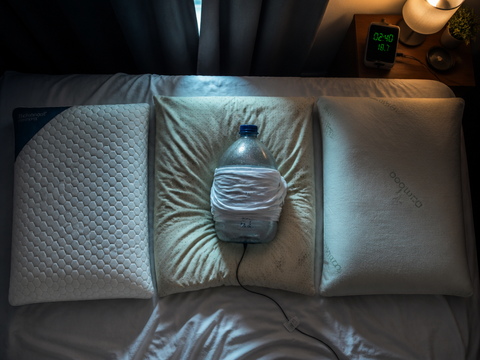
At 2:40 a.m. on the fourth night of the heatwave, I held an infrared thermometer against the spot my head had just left. It read 35.1°C. The room, air conditioning running, read 24.6°C. A pillow sitting ten and a half degrees above the room you are paying to cool is the whole argument for cooling pillows, and it is why I spent the following two weeks testing three of them against a sealed jug of warm water standing in for my head.
The verdict: the expensive one wins the first fifteen minutes and almost nothing after that. A $28 shredded-latex pillow came within 0.5°C of an $89 phase-change pillow by the half-hour mark. The only test where the price gap paid for itself was recovery — how fast a surface dumps heat once your head comes off it.
The three, and the rig
I am describing these by construction and price rather than by brand, because construction is what determines the physics and brands change their fill every eighteen months anyway.
- $89 — gel-topped foam core with a phase-change panel quilted into the cover. The luxury tier.
- $28 — shredded latex, zippered, cotton-poly cover. The workhorse tier.
- $14 — a bamboo-viscose case pulled over the memory-foam pillow already on my bed. This is the control for the question nobody selling pillows wants asked: do I need a new pillow at all?
The rig was a 2.5-litre sealed jug filled to 36.8°C, wrapped in one cotton t-shirt, set on the pillow with a thermocouple probe at the contact surface. Bedroom held at 24.5°C ±0.3 with the curtains shut, same hour each afternoon, three runs per pillow, everything returned to room temperature between runs.
A jug is not a head. It does not sweat, it does not move, it weighs less than my skull, and it has no blood supply adjusting flow to the skin. It was also the only way I could get numbers that repeated. Every time I ran the same test with my actual head on the pillow, the reading moved half a degree depending on how much I fidgeted.
The first minute is where the money goes
Before contact, all three surfaces measured between 24.4 and 24.7°C. None of them was cold. Nothing sitting in a 24.5°C room is cold, and no pillow on the market changes that — they have no power supply.
What "cool to the touch" actually describes is how quickly a material pulls heat out of your skin. On that measure the phase-change panel is genuinely different, not marketing. At one minute the interface read 27.1°C against 29.4°C for the latex and 28.8°C for the cased foam. Two degrees is well above what a cheek can detect. The sensation being sold is real, and it is the first thing you feel in a showroom or in the ninety seconds after you lie down.
Then the hour happens
| Minutes under the jug | $89 phase-change | $28 shredded latex | $14 case + old foam |
|---|---|---|---|
| 1 | 27.1°C | 29.4°C | 28.8°C |
| 5 | 29.8°C | 33.0°C | 32.2°C |
| 15 | 33.4°C | 34.9°C | 34.4°C |
| 30 | 34.6°C | 35.4°C | 35.2°C |
| 60 | 35.1°C | 35.6°C | 35.5°C |
The spread between best and worst is 2.3°C at one minute and 0.5°C at sixty. Phase-change material works by absorbing heat while it melts, and it holds a fixed amount — once it has melted through, you are lying on foam with a nice cover. My measurements put that crossover somewhere between fifteen and thirty minutes with a 36.8°C load in a 24.5°C room. In a hotter room it would come sooner.
That 35.1°C at sixty minutes is also, to within a rounding error, what my infrared thermometer read off my own pillow at 2:40 a.m. The jug was telling the truth.
The flip is where the price earns itself
This was the test I nearly didn't run, and it produced the only result that changed what I'd buy. After sixty minutes I lifted the load and measured the bare surface at one, four, and ten minutes.
- Phase-change: 30.2 → 25.9 → 24.9°C
- Shredded latex: 31.6 → 27.4 → 25.3°C
- Case over foam: 33.0 → 31.2 → 28.1°C
Foam is an excellent insulator, which is a compliment when you are talking about a wall and an insult when you are talking about the thing under your head. Four minutes after the load came off, the foam had shed 1.8°C. The phase-change pillow had shed 4.3°C and was within half a degree of the room.
So the case did improve my old pillow early on — it moved the one-minute reading from 30-something to 28.8°C — but it could not fix what was underneath it. A cooling cover over a heat-hoarding core is a thin fix.
Why the head is a bad place to be trapping heat
Your core temperature drops as you fall asleep, and it drops by moving heat outward to the skin — hands, feet, face. That is the mechanism, and it is why a cold room feels like permission to sleep and a warm one feels like an argument. A pillow is the single largest piece of insulation your body is in contact with above the shoulders, and it is pressed against a well-perfused, thin-skinned surface.
Which sets a hard ceiling on what any of these products can do. A pillow cannot remove heat from the room; it can only take longer to give it back to you and let go of it faster when you move. That is the entire mechanism. Any claim beyond it — and there are plenty on the boxes — is describing a fan.
Twelve nights, one notebook
I slept four nights on each, order shuffled, with a notebook and a pen on the nightstand. I logged the last time I checked the clock before sleep and every wake-up I could remember at breakfast. Median wake-ups: one on the phase-change pillow, one and a half on the latex, two and a half on the foam-plus-case.
Four nights each, one of them the worst night of the heatwave, one head, no blinding, and a tester who knew which pillow he was on: this is not data I would defend. What I will defend is the specific thing I noticed, because it matches the recovery numbers exactly. At 4 a.m. on the foam, turning the pillow over bought me nothing — both sides were warm and stayed warm. On the latex and the phase-change pillow, flipping still worked at 4 a.m. That is a small comfort and it is the one I'd pay for.
What I couldn't test: humidity, because a sealed jug doesn't sweat and a real head does; durability, because phase-change panels are supposed to fade over a summer of use and I had two weeks; and whether any of this holds for a side sleeper, since I sleep on my back and loft changes the contact area.
Who this is for, and who it isn't
Buy the $28 shredded latex if you sleep in a room you can hold under about 25°C and you mostly stay put once you're down. It gets you within half a degree of the expensive pillow at the half-hour mark and recovers well enough to make flipping worthwhile.
Buy the $89 phase-change pillow if you flip several times a night, or your bedroom runs hot despite the AC, or you take a long time to fall asleep — the first fifteen minutes are exactly where it's strongest.
Buy neither if your current pillow is latex, down, or buckwheat and you were only shopping because of one bad week. Try the $14 case first.
Do not buy the $14 case as your fix if the pillow underneath is memory foam. The core is the problem, and a cover cannot out-argue it.
The line worth screenshotting: the cheap latex pillow was 0.5°C behind the luxury one after thirty minutes, and the expensive one only wins if you're a flipper.
Tonight's rule of thumb: if you flip your pillow more than twice a night, pay for the phase-change panel; if you don't, put the $61 you saved toward getting the room a degree cooler.