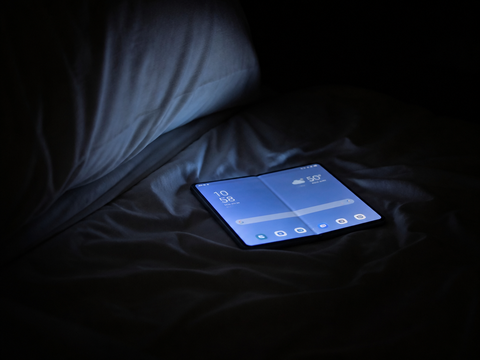
At 11:52 p.m. the object in your hands is roughly eight inches of OLED, held about a foot from your face, refreshing a liveblog that updates every ninety seconds. Somewhere on a stage, someone in a very good jacket is holding the same panel up to a key light. You have had two coffees since six, the second one specifically so you could be awake for this.
That is the actual physiological situation Samsung Galaxy Unpacked 2026 creates for a few million people, and it is more interesting than the usual scolding suggests. The Z Fold 8 and Z Fold 8 Ultra are, among other things, the largest light sources most of their owners will ever hold near their faces after dark. Whether that matters has a real answer. It is not the answer you have been trained to expect.
One caveat before anything else: I am writing this from the leak pile. Every brightness figure and panel dimension circulating this week is unconfirmed until Samsung says it on stage, and the leak-to-launch delta on foldables has historically been real. So I am going to reason about the class of device — a phone that unfolds to roughly double its screen area — rather than pretend I have a verified spec sheet. The biology doesn't care about the model number anyway.
Does a bigger foldable screen actually ruin your sleep?
Probably not much — think ten minutes of delayed sleep onset, not hours. Unfolding a Fold roughly doubles the emitting area, which roughly doubles the amount of light landing on your retina at a fixed distance and brightness. But melatonin suppression follows a roughly logarithmic dose-response curve. Zeitzer, Dijk, Kronauer, Brown, and Czeisler (2000), in the Journal of Physiology, exposed subjects to a range of nocturnal light intensities and fitted a four-parameter logistic: half-maximal melatonin suppression sat near 100 lux, with saturation approaching 1,000. A phone in a dark room delivers something in the single-to-low-double-digit lux range at the cornea. Doubling a number that far down the flat tail of a logistic curve moves you very little. Doubling a small number leaves you with a slightly larger small number.
This is also why the spec-sheet brightness war is nearly irrelevant at midnight. Peak nit figures — the 2,600s and 3,000s that get screenshotted from leak accounts — are measured on a small window of the panel, often under 10% of pixels, with HDR content.1 Sustained full-screen brightness is far lower. And in a dark bedroom, auto-brightness is driving that panel down to a handful of nits regardless of what it can do. The brightest phone ever made and a four-year-old midrange phone are, at 1 a.m. with the lights off, emitting roughly the same trivial amount of light.
What most people do
The launch-night ritual is remarkably consistent. You stack a caffeine dose in the late afternoon or evening to guarantee alertness through a keynote that will mostly confirm things you already read in January. You turn on the blue-light filter, which feels like due diligence. You watch the stream, then the hands-on videos, then the comparison threads, then — and this is the part nobody budgets for — you lie in bed for forty minutes re-litigating whether the Ultra's hinge is worth the delta, with the phone eight inches from your face.
The blue-light filter is the piece I'd push back on hardest, because it does the least work while absorbing the most credit. Nagare, Plitnick, and Figueiro (2019), in Lighting Research & Technology, tested tablets with and without Night Shift–style warming in a small sample — roughly a dozen participants — and found that melatonin suppression persisted at high brightness even with the color shift applied. Reducing intensity mattered more than reducing short-wavelength content. Warming the screen while leaving it bright is treating the symptom the marketing named rather than the one the retina responds to.
Meanwhile the coffee is metabolizing on its own schedule, unbothered by anyone's display settings.
What the evidence suggests
The study everyone cites for screens-and-sleep is Chang, Aeschbach, Duffy, and Czeisler (2015), in PNAS. Twelve participants, five consecutive nights, four hours of reading on a light-emitting iPad before bed versus a print book. The results are real and worth quoting precisely: roughly 55% melatonin suppression, a circadian phase delay of about an hour and a half, reduced next-morning alertness — and sleep onset delayed by about ten minutes.
Ten minutes. After four hours of screen exposure, at full brightness, repeated five nights running. That is the ceiling of what a well-controlled study produced under conditions considerably more extreme than a two-hour liveblog.

Gooley et al. (2011), in the Journal of Clinical Endocrinology & Metabolism, is the stronger warning, and it isn't about phones. In 116 participants, ordinary room light of under 200 lux in the hours before bed suppressed melatonin in the majority of subjects and shortened the duration of the melatonin signal by about 90 minutes compared with dim light. Your ceiling fixture is doing more to your circadian system than your foldable is. So is the bathroom on the way to bed.
And individual variation is enormous. Phillips et al. (2019), also in PNAS, measured melatonin suppression thresholds across 55 participants and found more than a fifty-fold range in sensitivity. Some people show substantial suppression around 10 lux; others need over 400. This means the friend who scrolls until 1 a.m. and sleeps like a stone may be telling the literal truth about their own retina, and it tells you nothing about yours.
The mechanism, in the order it happens
Photons leave the panel and hit the back of your retina. Some are absorbed by melanopsin, a photopigment in intrinsically photosensitive retinal ganglion cells (ipRGCs), with peak sensitivity near 480 nm — the blue-cyan region the filters target.
Those cells are slow integrators. They aren't edge detectors; they're photon counters, summing over tens of minutes. A ten-second glance at a notification barely registers. Ninety minutes of steady viewing does.
Their signal travels the retinohypothalamic tract to the suprachiasmatic nucleus, the hypothalamic pacemaker. From there a multisynaptic path — paraventricular nucleus, spinal cord, superior cervical ganglion — reaches the pineal gland and throttles melatonin synthesis.
Here's the part that gets garbled: melatonin is not a sedative. It is a timing signal, the body's announcement that biological night has begun. Suppressing it doesn't remove sleepiness so much as move the announcement later.
Running in parallel, and mostly ignored on launch night, is adenosine. It has been accumulating all day as a byproduct of cellular energy metabolism, binding A1 and A2A receptors and building the pressure you experience as sleepiness. Caffeine is a competitive antagonist at those receptors — structurally similar enough to occupy them without activating them. The pressure is still there. You've disconnected the doorbell.
Drake et al. (2013), in the Journal of Clinical Sleep Medicine, gave 12 subjects 400 mg of caffeine at 0, 3, and 6 hours before bed. Even the six-hours-before dose reduced total sleep time by more than an hour — and subjects did not reliably notice. Caffeine's half-life averages about five hours, but the population range runs roughly 1.5 to 9.5 hours, driven largely by CYP1A2 activity. A 200 mg cup at 6 p.m. leaves you with something like 100 mg at 11 p.m. and 50 mg at 4 a.m.
To label the confidence honestly: the light-suppresses-melatonin pathway is well-established. That evening caffeine measurably degrades sleep architecture is well-established. That screen content — the argument in the comments, the spec you didn't expect — delays sleep through arousal rather than photons is plausible but thin; it's hard to isolate experimentally, though the effect sizes in screen-and-sleep field studies are consistently larger than the light physics alone predicts. That blue-light glasses fix the problem is closer to folk wisdom dressed in an amber tint.
What I actually do
I treat launch night as a caffeine problem with a light problem attached, in that order.
Rough order-of-magnitude illuminance at the eye — estimates from typical geometry, not measurements of any specific device:
| Source, dark room | Approx. lux at the cornea |
|---|---|
| Foldable closed, auto-brightness, ~12 in. away | 3–10 |
| Same phone unfolded, same setting | 6–20 |
| Bedside lamp with shade, 3 ft away | 30–80 |
| Bathroom vanity light, 2 a.m. | 200–500 |
| Overcast noon, outdoors | ~10,000 |
Four things, and only four:
- Last caffeine at 2 p.m. on launch day. If the event runs late, I'd rather be genuinely tired at 1 a.m. than chemically alert at 3.
- Drop brightness before warming color. Intensity is the lever the ipRGCs respond to; the amber tint is a rounding error by comparison.
- Hold it farther away. Illuminance falls with the square of distance: moving the panel from 12 inches to 24 cuts the dose at your eye by roughly four. That single adjustment beats every software setting on the phone.
- Do not turn on the bathroom light on the way to bed. It is, per the table above, an order of magnitude worse than anything the Fold 8 Ultra can do to you.
The honest rule of thumb: if you're staying up for the Fold 8, dim the screen and push it an arm's length out — then skip the coffee you were going to use to get there, because the panel costs you about ten minutes and the espresso costs you an hour.
-
Nits measure luminance leaving the screen. Lux measures illuminance arriving at your eye. They are related by screen area, distance, and geometry, which is why a 2,600-nit spec tells you almost nothing about your retina without those three numbers. ↩