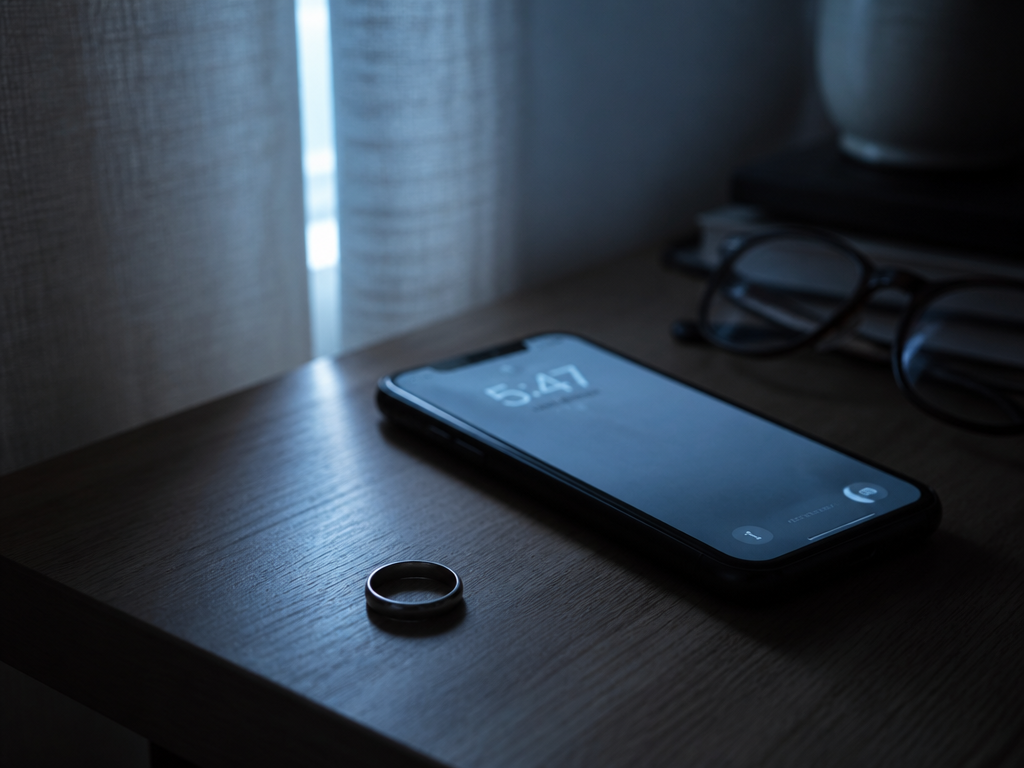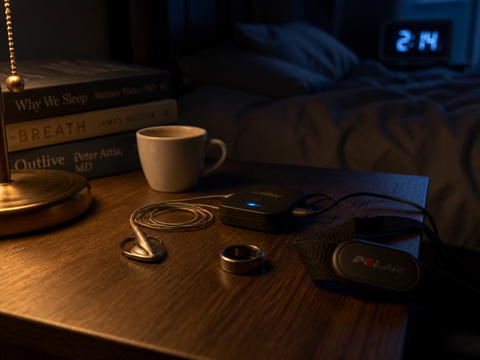
For twenty-one nights I ran a 4 p.m. double espresso against a clip on my left ear, because the consumer pitch for vagus nerve stimulation — that a small current at the right patch of cartilage can pull you back toward a parasympathetic state before bed — is either the most genuinely useful idea in consumer neurotech or the most expensive way ever invented to sit still for half an hour. I own the trackers. I drink the coffee too late. It seemed like a fair fight.
The verdict: the device moved my autonomic numbers in the direction it promised, moved my actual sleep about half as much, and could not be cleanly separated from the thirty minutes of doing nothing that using it requires.
Some housekeeping before the numbers, because the numbers are only as good as the method behind them. This was n=1. It was not blinded — I knew every night which condition I was in, and I am not immune to wanting a $400 purchase to work. Sleep onset came from an Oura ring, which infers onset rather than measuring it, and heart rate variability came from a chest strap I wore for the first three hours of each night because wrist and finger RMSSD drift too much for a difference this small. Three conditions, seven nights each, plus a fourth arm I added at the end that turned out to be the most interesting part of the whole thing.
First input: 130 milligrams, 4 p.m.
The caffeine goes in first, so the article starts where the physiology starts. A double shot from my machine lands around 130 mg. It clears the gut in about forty-five minutes and reaches peak plasma concentration somewhere near the hour mark, at which point it does one thing that matters: it sits in adenosine receptors without activating them.
That detail is the whole reason this experiment has a ceiling. Adenosine accumulates across a waking day and its binding is a large part of what registers, subjectively, as sleepiness. Caffeine occupies the parking space and leaves the pressure unread. With a half-life around five hours, my 4 p.m. shot is still roughly 65 mg at 9 p.m., when I clipped the electrode on, and roughly 32 mg at 2 a.m., when I was often awake and annoyed about it.
Here is the mechanistic fact that no ear clip changes: nothing downstream in this piece touches the caffeine molecule. Vagal outflow does not clear it, does not displace it from receptors, and does not restore the adenosine signal it is masking. Whatever the device can do, it has to do it around the blockade, not through it. That framing set my expectations low before the first night, and the data did not raise them much.
The subjective experience of a late espresso, for me, is not jitter. At 10 p.m. I feel completely normal. Then I lie there feeling completely normal for half an hour longer than I should.
Second input: 0.8 milliamps, 9 p.m.
The unit I used is a left-ear clip in the $300–$400 band, which is the crowded middle of this category — Pulsetto sits below it, Nurosym well above, and Neuvana's Xen occupies roughly the same shelf. Its app ran 25 Hz at a 200 µs pulse width for thirty minutes, and I settled at 0.8 mA after a few nights of calibration.
The sensation is worth describing accurately, because reviews tend to either dramatize it or skip it. At 0.8 mA it is a fine prickle inside the ear, sharpest in the first ninety seconds, unnoticeable by minute four. Above about 1.2 mA I got a dull metallic pressure behind the jaw on the same side and, twice, a faint pulling at the corner of my mouth — that is facial nerve recruitment, it means you are too high, and it is the one clear signal the device gives you about placement.
Placement is where cheap versions of this category quietly fall apart. The auricular branch of the vagus surfaces in the cymba conchae — the small bowl above the ear canal opening. The earlobe is served by the great auricular nerve, which is a cervical plexus branch with no vagal fibers in it. A device that clips your lobe is delivering current to the wrong nerve. Mine gripped the concha, which meant the clip was visible, slightly uncomfortable after twenty minutes, and impossible to wear while lying on that side.
Where the signal actually goes
Afferent fibers from the concha carry the stimulus to the nucleus tractus solitarius in the medulla. From there the anatomy fans out — to the locus coeruleus, to the dorsal motor nucleus of the vagus, to structures that are genuinely involved in arousal regulation. Efferent vagal fibers reach the sinoatrial node, and increased vagal tone at the sinus node lengthens and destabilizes the beat-to-beat interval, which is what RMSSD measures.
That chain is textbook. Every link in it is real and none of it is in dispute. What is in dispute — or more accurately, what is under-evidenced relative to how it's marketed — is the last mile. Imaging work shows concha stimulation produces brainstem activation. Getting from the brainstem responds to your sleep after coffee improves requires several inferential jumps that the product pages make silently and the literature makes cautiously. Transcutaneous vagal stimulation has a much stronger evidence base in epilepsy and depression, at parameters and durations nothing like thirty minutes on a couch, and consumer devices inherit the credibility of that research without inheriting its protocols.
So: strong mechanism, real anatomy, thin bridge to the claim. That is the state of the category, and my data did not resolve it.
What the heart did
RMSSD is the first three hours of sleep, chest strap. Resting HR is the overnight minimum.
| Condition | Nights | Median sleep onset | RMSSD (first 3h) | Overnight resting HR |
|---|---|---|---|---|
| No afternoon caffeine, no device | 7 | 14 min | 62 ms | 54 bpm |
| 130 mg at 4 p.m., no device | 7 | 31 min | 48 ms | 58 bpm |
| 130 mg at 4 p.m. + 30 min tVNS | 7 | 24 min | 55 ms | 57 bpm |
| 130 mg at 4 p.m. + 30 min, current off | 4 | 26 min | 52 ms | 57 bpm |
Read the second and third rows first. The espresso cost me 14 ms of RMSSD and 4 bpm of resting heart rate. The device gave back 7 ms of the RMSSD and 1 bpm of the heart rate. That is a real directional effect, roughly half the autonomic damage recovered, and it showed up on five of seven nights rather than being carried by one outlier — I checked, because a single 80 ms night can carry a seven-night median.
Resting heart rate barely budged, and that asymmetry is the tell. RMSSD is more sensitive to short-term vagal modulation; overnight heart rate reflects something slower and more stubborn. The device nudged the fast marker and left the slow one alone.
What sleep did
Onset went from 31 minutes to 24. Seven minutes back on a seventeen-minute penalty. Wake-after-sleep-onset was noisier and I do not trust it at this sample size — 38 minutes caffeinated versus 33 with the device, which is inside the range my ring produces on identical nights.
Subjectively, the difference was smaller than seven minutes felt like it should be. I still noticed the gap between lying down and going under. It was a shorter, less irritating gap.
The chair problem
The fourth row is the one that reorganized my opinion of the whole experiment.
After the three main arms, I ran four nights with the electrode clipped in, the app open, and the current at zero — sitting through the same thirty minutes without a screen, without stimulation, doing the thing the device forces you to do rather than the thing it claims to do. Onset: 26 minutes. RMSSD: 52 ms.
The gap between the device working and the device sitting on my ear doing nothing was 2 minutes of onset and 3 ms of RMSSD. The gap between either of those and simply going about my evening was 5 to 7 minutes and 4 to 7 ms. Four nights is not enough to call the sham arm equivalent, and I want to be exact about that: this is suggestive, not conclusive. But the intervention with the largest measured effect in my data was thirty screenless minutes in a chair, and the current was a smaller term stacked on top of it.
The cheapest thing I tested
On a whim I added four nights of the same 130 mg moved to 1:30 p.m. Median onset: 17 minutes. RMSSD: 59 ms.
Two and a half hours of timing beat a $400 electrode by three times the margin, and cost nothing.
Who this is for, and who it isn't
Buy one if you are already tracking RMSSD nightly, already have a fixed wind-down, and want to test whether a small additional vagal input moves your numbers — you will be able to see the effect, because you have the baseline to see it against. Buy one if you find the forced thirty minutes structurally useful and know you won't sit still without a gadget giving you permission. That is not a joke; it is most of what I measured.
Don't buy one to offset late caffeine. The device works on efferent tone and caffeine works on receptor occupancy, and those are different floors of the same building. Don't buy one if your evenings are already inconsistent — you will not be able to distinguish its 7 ms from your own night-to-night noise. And don't buy one that clips the lobe.
The espresso is still the biggest number in the equation. Everything I did afterward was arithmetic on the remainder.