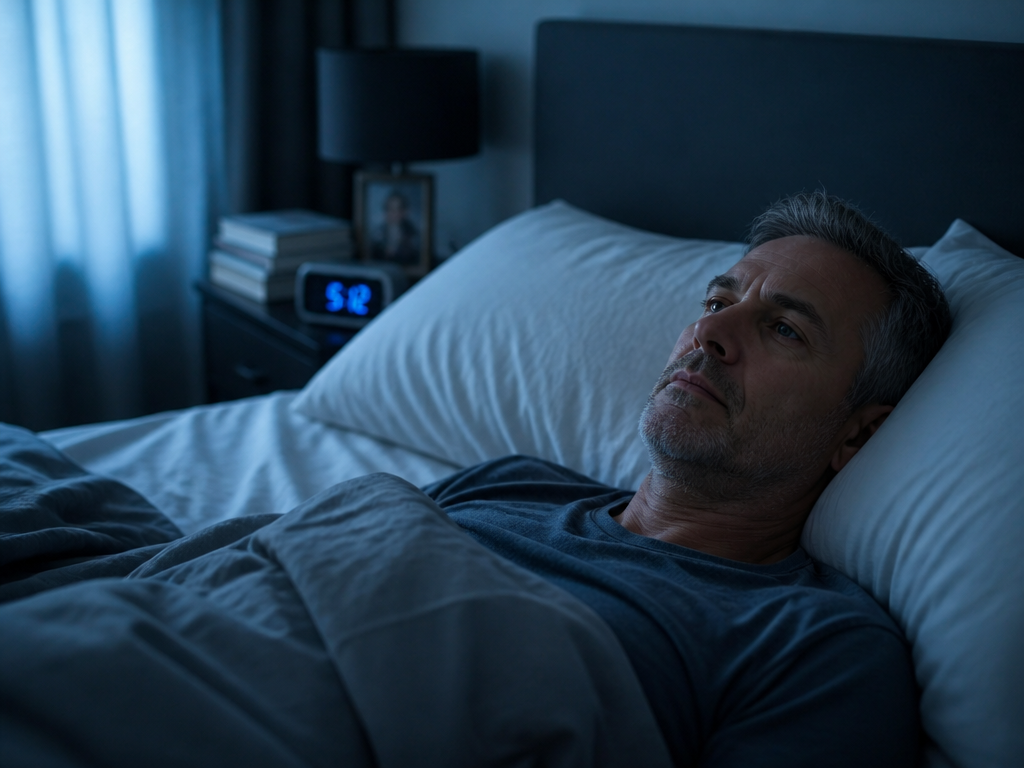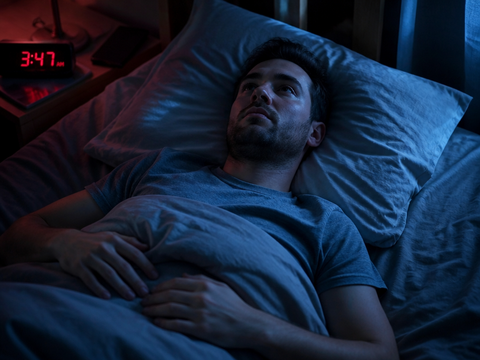
You have heard the rule. Get eight hours, every night, or you are slowly dismantling your own health — heart, brain, blood sugar, mood, all of it. The number gets repeated with the confidence of a physical constant.
It is roughly right. It is also, as stated, wrong in ways that matter — especially if you are the kind of person who lies awake doing the math on how little sleep you are about to get. Sleep deprivation is real, it is measurable, and it is common. But the eight-hour rule compresses a messy body of science into a single integer, and the compression hides the part you actually need.
This piece is about what poor sleep does to three systems — your brain's overnight maintenance, your stress hormones, and your glucose control — and about where the standard advice holds and where it quietly breaks.
What the eight-hour rule gets right
Start with the part that is well-established. Chronic short sleep is associated with worse cardiovascular and metabolic outcomes across large populations. A frequently cited synthesis is Cappuccio et al. (2010) in Sleep, a meta-analysis pooling prospective studies covering more than a million people, which found higher all-cause mortality risk at the short end of habitual sleep. The CDC, drawing on its Behavioral Risk Factor Surveillance System, has repeatedly reported that roughly a third of American adults report sleeping less than seven hours on a typical night.
So the premise behind the advice is sound: a lot of people are under-slept, and being chronically under-slept tracks with worse health. The validation the reader wants — this is a real problem, not a personal failing — is earned. Where the trouble starts is in turning a population-level association into a nightly target you either hit or fail.
How many nights of bad sleep before it shows up?
Short answer: a single bad night degrades you the next day; the lasting health damage comes from weeks and months of insufficient sleep, not one rough Tuesday.
Acute effects arrive fast. After one night of total sleep deprivation, reaction time, attention, and emotional regulation measurably worsen — the Van Dongen et al. (2003) study in Sleep is the standard reference here, and it showed something sharper: subjects restricted to six hours a night for two weeks ended up performing about as badly as people kept awake for two full nights, while consistently rating themselves as only mildly impaired. The deficit accumulated. The self-awareness did not. That gap — feeling fine while testing poorly — is the most reliably reproduced finding in the field, and it is the reason "I function fine on five hours" should be treated as a hypothesis, not a report.
What is happening, in the order it happens
When you stay awake, a molecule called adenosine builds up in the brain as a byproduct of cellular energy use. Adenosine binds to its receptors and produces the heavy, thick feeling of sleep pressure. Caffeine works by blocking those receptors — it does not remove the adenosine, it just stops you from feeling it, which is worth remembering at 4 p.m.
Sleep clears the backlog. During deep non-REM sleep, the brain's glymphatic system — described by Xie et al. (2013) in Science, in mice — appears to widen the spaces between cells and flush out metabolic waste, including the amyloid-beta proteins associated with Alzheimer's. The human evidence for this is younger and thinner than the mouse work, and worth flagging as plausible-but-not-settled.
Meanwhile, the endocrine system reacts. Cut sleep short and cortisol, the stress hormone, tends to run higher into the evening rather than tapering off. And glucose handling degrades quickly: Spiegel, Leproult, and Van Cauter (1999) in The Lancet restricted eleven healthy young men to four hours in bed for six nights and found their glucose tolerance dropped into a pre-diabetic range — fully reversible once they slept normally. Six nights. Eleven men. A small study, but a clean one, and it has held up directionally.
Where the rule breaks down
Here is what eight-hours-or-else cannot account for.
People genuinely differ. Sleep need is distributed across a population, roughly seven to nine hours for most adults, but with real outliers. A small number of people carry mutations — the DEC2 variant identified by He et al. (2009) in Science is the famous one — that let them thrive on six hours. The catch: true short sleepers are rare, and most people who think they are one are simply adapted to feeling tired. The label is over-claimed.
Deprivation and insomnia are not the same thing. Sleep deprivation is not getting the opportunity to sleep. Insomnia is having the opportunity and being unable to use it. The downstream biology overlaps, but the fix does not. Stacking more hours in bed onto insomnia often makes it worse — more time awake and frustrated in bed strengthens the association between the bed and wakefulness, which is exactly what cognitive behavioral therapy for insomnia (CBT-I) works to undo.
The hours can lie. This is the one that matters most for anyone worried about a partner. You can spend eight hours in bed and still be profoundly under-rested if the sleep itself is broken. Untreated obstructive sleep apnea fragments sleep with dozens or hundreds of brief arousals a night, most of which the sleeper never remembers. The clock says eight hours. The brain got far less. Loud snoring, witnessed pauses in breathing, and waking unrefreshed despite adequate time in bed are the signals to take to a doctor — the rule simply has no way to see them.
A more honest rule of thumb
Tonight, stop optimizing for a number and start watching for a pattern. Protect a consistent window of roughly seven to nine hours, and pay attention to how you feel on the days after — not how many hours the tracker logged.
| If you... | The eight-hour rule says | The more honest version says |
|---|---|---|
| Feel sharp on 6.5 hours, consistently | You're harming yourself | Possibly fine — but verify with daytime alertness, not vibes |
| Get 8 hours but wake exhausted | You're covered | Investigate quality; rule out apnea |
| Lie awake despite 8 hours in bed | Stay in bed longer | Look into CBT-I, not more hours |
| Pull one bad night | It's catastrophic | It's recoverable; consistency matters more |
What this piece did not answer
Plenty. It did not settle how much you can truly "catch up" on weekends — the data on recovery sleep is mixed, and Depner et al. (2019) in Current Biology found weekend recovery did not undo the metabolic costs of weekday restriction. It did not cover how sleep need shifts with age, or why women report insomnia at higher rates than men, or what the glymphatic findings will look like once human studies mature.
If you suspect apnea, the next step is a sleep study, not another article. If you suspect insomnia, look up CBT-I, which has better long-term evidence than any sleeping pill. The number on the clock was never the thing to chase.
The body keeps an honest ledger of sleep, and it is the daytime, not the bedtime, where the balance shows.