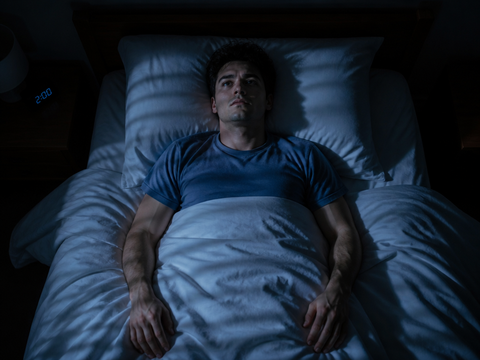
For a month I went to bed in a different posture each week — back, right side, left side, and a propped semi-upright wedge — and logged how long it took me to fall asleep. I did this because the internet kept telling me that insomnia has a posture fix, that the right sleeping position is the difference between staring at the ceiling and drifting off. The short answer, which I'll defend below: position is a real lever for some sleep problems and a near-irrelevant one for others, and the trouble most people have is they don't know which kind of trouble they have.
If your nights are ruined by snoring, choking, reflux, or a partner reporting that you stop breathing, position is worth taking seriously. If you lie down feeling fine and simply cannot switch your brain off, no amount of rolling onto your left side is going to rescue you.
What most people do
Most people pick a side, complain about it, and read a headline.
The headlines aren't evenly distributed. "Sleep on your left side" advice circulates constantly, usually attached to digestion or circulation claims. "Back sleeping is best for your spine" comes from the posture corner. "Stomach sleeping is the worst" is repeated almost universally. None of this is paired with the question that actually matters: what is keeping you awake in the first place?
That's the conflation I want to flag. Difficulty falling or staying asleep is one category of problem. Disrupted breathing during sleep — which fragments sleep without the person necessarily knowing — is a different one. They produce overlapping symptoms (unrefreshing nights, daytime fatigue), so the same person searches the same forums and walks away thinking a pillow arrangement will fix a racing mind, or that meditation will fix a collapsing airway. Most people, in my reading, are solving the wrong problem with the wrong tool.
What the evidence suggests
Here the literature splits cleanly, and the split is the whole point.
For sleep-disordered breathing, position is well-documented. Obstructive sleep apnea is frequently positional — meaning the airway collapses far more when a person lies on their back than on their side. The clinical convention, used in sleep studies for years, defines positional OSA as a supine apnea-hypopnea index (AHI) at least twice the non-supine value. A substantial share of people with mild-to-moderate OSA meet that threshold; gravity pulls the tongue and soft tissue backward when supine, and turning onto the side relieves a meaningful fraction of events. This is why "positional therapy" — devices and techniques that discourage back-sleeping — is a recognized, studied intervention. It doesn't replace CPAP for moderate-to-severe disease, but for the right milder cases it can lower the event count without a machine.
For reflux-related awakenings, position also matters, and the direction is specific. Sleeping on the left side and elevating the head of the bed are both associated with reduced nighttime acid exposure in reflux studies. Right-side sleeping tends to perform worse on those same measures. So the popular "sleep on your left" advice isn't baseless — it's just been stripped of its actual indication, which is reflux, not generic insomnia.

For primary insomnia, the evidence is thin to absent. I went looking for trials showing that changing body position improves sleep-onset latency or reduces middle-of-the-night awakenings in people whose core problem is the inability to fall or stay asleep. I didn't find a credible body of work supporting it. The first-line, well-evidenced intervention for chronic insomnia is cognitive behavioral therapy for insomnia (CBT-I), endorsed across major guidelines as the recommended starting treatment ahead of medication. Position simply isn't on that map. Comfort matters — pain that keeps you awake is its own issue — but "which side fixes a busy brain" is a question the literature mostly shrugs at.
So the evidence suggests a clean rule: position is a breathing-and-reflux lever, not an insomnia lever.
What I actually do
I'm one person with one nervous system, so treat this as a case report, not a study. I logged perceived sleep-onset latency in a notebook (clock when I lay down, best guess at when I last remember being awake) and cross-checked against a wrist wearable, which I trust for trends and distrust for precision — consumer trackers are decent at sleep/wake patterns and unreliable for fine timing.
Here's how the four weeks landed for me, a back-sleeper by default with no diagnosed apnea and mild occasional reflux:
| Position | Median onset (perceived) | Notes |
|---|---|---|
| Back (supine) | ~22 min | Comfortable to fall asleep, but the most snoring per my partner |
| Right side | ~25 min | Worst reflux nights; woke twice with throat burn |
| Left side | ~20 min | Fewest reflux complaints; took adjustment |
| Propped wedge (~30°) | ~24 min | No reflux at all, but I slid down and woke stiff |
The honest read: the differences in falling asleep were within noise. Four to five minutes of median variation across a single sleeper over one week each proves almost nothing about onset. What was not noise was reflux. The left-side and wedge weeks genuinely eliminated the throat-burn awakenings I'd quietly normalized. And my partner's snoring reports tracked back-sleeping almost perfectly.
So what I actually do now: I fall asleep however I'm comfortable — usually on my back, because that's when my mind quiets fastest — and I've put a modest wedge under the mattress to keep my torso slightly elevated. I stopped trying to engineer my way out of slow nights with posture, because my slow nights were never about posture.
Who this is for
- People whose partner reports snoring or pauses in breathing — position is a legitimate first conversation, alongside seeing a clinician.
- People with nighttime reflux — left side and head elevation are cheap, evidence-aligned experiments.
- People who want to stop chasing a fix that doesn't fit their problem.
Who this isn't for
- Anyone whose main issue is lying awake with a racing mind. Your lever is CBT-I, not your pillow. Don't let a position experiment delay that.
- Anyone with diagnosed moderate-to-severe sleep apnea hoping to skip prescribed therapy. Positional tactics are an adjunct, not a substitute.
If you take one line: change your position to fix breathing or reflux, and change your behavior — not your posture — to fix insomnia.
The myth is that there's a correct sleeping position that cures sleeplessness. The more accurate version is that position quietly fixes the breathing and reflux problems that masquerade as sleeplessness, while the genuine inability to fall asleep needs a different tool entirely.