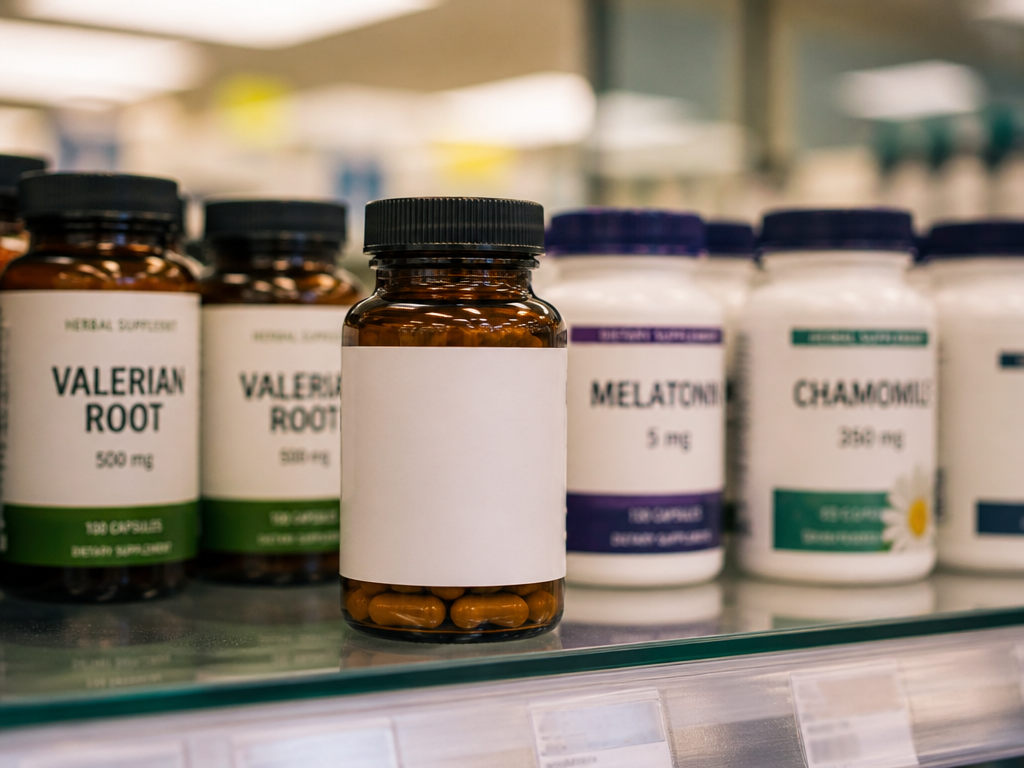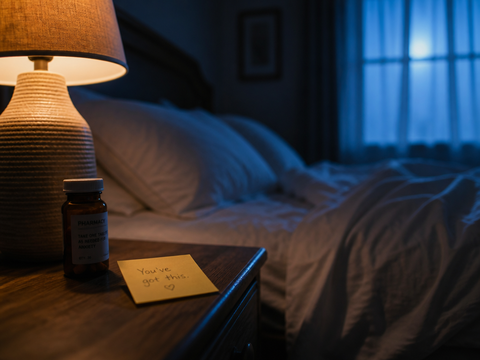
The night I decided to test this, I took 200 mg of magnesium glycinate at 9:40 p.m. and wrote the time on a sticky note. My phone's sleep tracker — imperfect, accelerometer-based, the kind that guesses — logged me as asleep by 10:18. Thirty-eight minutes. The night before, untreated, it had been fifty-one. One data point is not evidence. It is an anecdote with a timestamp. But it is where I started, because the question I actually had was not "does magnesium work" but "where does good sleep hygiene end and the rest of the body begin?"
Most people reading this already know the hygiene part. You've dimmed the lights, banished the phone, kept the bedroom cool and dark, held a consistent wake time. Sleep hygiene — the behavioral scaffolding around when and how you sleep — is well-established and worth doing. It is also, for a meaningful number of people, not enough. So the interesting territory is what's left: the nutritional and physiological levers that get mentioned constantly and explained almost never.
Does magnesium actually help you sleep?
For most healthy adults with normal magnesium levels, the honest answer is: probably a little, possibly not at all, and the effect is smaller than the supplement aisle implies. For people who are genuinely deficient — older adults, heavy drinkers, those on certain diuretics or with poorly controlled diabetes — correcting the deficiency more plausibly improves sleep. The distinction matters. Magnesium is not a sedative you take to feel sleepier; it is a mineral your nervous system needs to regulate excitation, and topping up a tank that's already full does less than topping up one that's low.
That framing is doing a lot of work, so let me walk through why it's plausible at all.
The mechanism, in the order it happens
Here is the chain, biologically, more or less as it unfolds. Your brain runs on a balance between excitatory and inhibitory signaling. The main inhibitory neurotransmitter is GABA — the same system benzodiazepines and alcohol lean on. When GABA binds its receptors, neurons quiet down, and that quieting is part of how the brain transitions toward sleep.
Magnesium sits at two points in this system. First, it acts as a natural blocker of the NMDA receptor, which is excitatory; with magnesium in place, the receptor is harder to over-activate, and the brain's "stay awake, stay alert" signaling is dampened. Second, magnesium appears to support GABA-receptor function. So in theory you get less excitation and slightly more inhibition — the physiological direction of sleep onset.
Theory is the operative word. The receptor pharmacology is real and well-characterized. Whether swallowing a 200–400 mg pill at 9:40 p.m. moves those receptors enough to shorten your sleep latency by a noticeable margin is a separate, much shakier claim. Mechanism tells you something is possible. It does not tell you it's happening in you, tonight, at that dose.
What the research actually measured
The most-cited human trial is Abbasi et al. (2012), published in the Journal of Research in Medical Sciences. It gave 46 older adults with insomnia either 500 mg of elemental magnesium or placebo for eight weeks. The magnesium group showed improvements in sleep time, sleep efficiency, and early-morning waking, plus changes in serum melatonin and cortisol. Promising — but 46 people, all elderly, many likely starting from low magnesium status. That is not a result you can cleanly extend to a well-nourished 34-year-old.
A 2021 systematic review by Mah and Pitre, in BMC Complementary Medicine and Therapies, pooled the randomized trials and reached a deflating conclusion: the evidence is low-quality, the studies are small, and the effect on sleep, while pointing in a hopeful direction, is uncertain. They found that magnesium might reduce time-to-fall-asleep by around 17 minutes versus placebo — but explicitly cautioned that the confidence in that number is weak.
So here's the tiering, honestly stated. Well-established: magnesium is essential, deficiency is common, and deficiency disrupts sleep. Plausible but thin: supplementing improves sleep in already-replete people. Folk wisdom: that magnesium is a reliable, dose-dependent sleep aid for everyone.
What about tryptophan, glycine, and "sleepy" foods?
The same logic recurs. Tryptophan is the precursor your body converts to serotonin and then melatonin, which is why turkey and warm milk get their reputation. The conversion is real. The problem is that the amount of tryptophan in a glass of milk is small, and it competes with other amino acids for transport across the blood-brain barrier, so the dose reaching your brain from food is modest. Purified tryptophan or its metabolite 5-HTP has stronger effects in trials, but those are pills, not dinner.
Glycine is the more interesting underdog. A few small Japanese studies — Inagawa et al. (2006) and Yamadera et al. (2007), the latter in Sleep and Biological Rhythms — found that 3 grams of glycine before bed improved subjective sleep quality and shortened sleep latency, possibly by lowering core body temperature, which is one of the physiological triggers for sleep onset. Small samples, mostly industry-adjacent, but the temperature mechanism is at least concrete.
The pattern across all of these: the mechanism is legitimate, the food dose is usually too low to matter, and the supplement evidence is real but small.
An honest rule of thumb for tonight
If you want to try a nutritional lever, treat it as a low-cost experiment, not a cure. Magnesium glycinate or citrate at 200–350 mg, taken an hour before bed, is cheap and, in those forms, gentle on the gut.1 Give it two weeks, not two nights, because your own night-to-night variance is enormous and one good sleep proves nothing. And do it on top of the behavioral basics, not instead of them — no mineral outperforms a consistent wake time.
Here's the same idea as a map of what to trust:
| Approach | Mechanism | Evidence tier |
|---|---|---|
| Consistent wake time, dark/cool room | Circadian and arousal control | Well-established |
| Magnesium (if low or older) | NMDA blockade, GABA support | Plausible, modest |
| Magnesium (if already replete) | Same | Thin |
| Glycine 3 g | Lowers core temperature | Plausible, small studies |
| Warm milk / turkey for tryptophan | Melatonin precursor | Mostly folk wisdom |
If sleep stays broken after a few weeks of honest effort, that's a signal to see a clinician, not to buy a fourth supplement. Chronic insomnia has treatments — CBT-I chief among them — that beat anything in this table.
Back to the sticky note
So: thirty-eight minutes versus fifty-one. The night I started with. I kept the experiment going for three weeks, and the truth is that my average sleep latency drifted down only slightly, and inside so much noise that I can't honestly credit the magnesium over the fact that I was, for once, paying attention to my own bedtime. That attention may have been the active ingredient. The thirty-eight-minute night, reframed, wasn't proof the mineral worked — it was proof that a measured, repeatable routine does, and that the supplement was riding along on the back of better sleep hygiene rather than replacing it.
The pill might help. The habit definitely does.
-
Magnesium oxide, the cheapest form, is poorly absorbed and more likely to act as a laxative — which is its own reason you might be awake. ↩