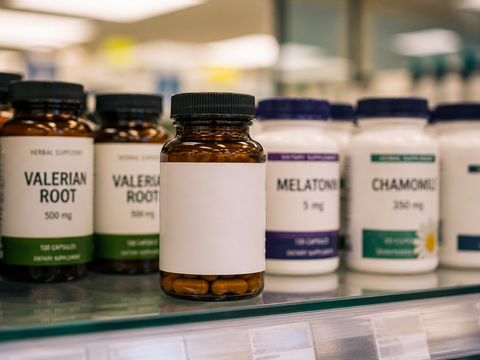
You have probably heard the advice, maybe from a friend, maybe from the side of a supplement bottle: don't reach for a prescription, try something natural first. It sounds prudent. It sounds gentle. And the appeal of natural sleep aids is easy to understand — they're cheap, they're sold next to the toothpaste, and they carry none of the dread that surrounds the word sedative.
The trouble is that "natural" and "gentle" and "proven" are three different claims, and the supplement aisle tends to collapse them into one. Some of what's on that shelf does something measurable. Some of it does almost nothing but is harmless. And some of it does little while costing more than it should and arriving in a bottle whose label may not describe what's inside. This piece is an attempt to sort those categories without either selling you anything or sneering at the hope that brought you here.
The advice, stated fairly
Start with what's right about it, because there's real logic underneath.
Most people who go looking for a sleep aid don't have a diagnosed disorder. They have a stretch of bad nights — a deadline, a newborn, a breakup, jet lag, a stretch of 2 a.m. wakefulness with no obvious cause. For that population, the calculus genuinely favors the low-risk option. Prescription hypnotics like zolpidem carry a real dependency profile and a next-day cognitive cost; the FDA added a boxed warning in 2019 about complex sleep behaviors — driving, eating, walking — while not fully awake. If your problem is three rough weeks rather than a chronic condition, swallowing a Z-drug is a large intervention for a small problem.
So the instinct to start mild is sound. Where the advice breaks down is in the quiet assumption that follows it: that "mild and natural" also means "effective." Those don't travel together as reliably as the bottle suggests.
Do natural sleep aids actually work?
Some do a little, for some people, under specific conditions; most of the popular ones have effects that are small, inconsistent across studies, or hard to separate from placebo. That's the honest one-sentence answer, and the rest of this section is about why it's so hard to do better than "a little."
The deepest problem isn't that the supplements are inert. It's that the people who take them are unusual in ways that corrupt the evidence. This is called healthy-user bias, and it haunts nearly every observational study of complementary remedies. The person who buys valerian root and drinks chamomile tea is, on average, also the person who exercises, doesn't smoke, has health insurance, and reads the label on their food. When that person sleeps better, was it the valerian — or the entire life that the valerian is a marker for? Observational data can't tell you. It can only tell you that valerian-users and good-sleepers overlap, which is not the same as valerian causing sleep.
This is why the gold standard is the randomized, placebo-controlled trial: it scrambles the healthy users evenly across both groups so their tidy habits cancel out. And it's exactly in those trials that the impressive effects from the surveys tend to shrink. The gap between "popular" and "proven" is, in large part, the gap between observational data and randomized data.
Placebo deserves its own line here, because in sleep it is unusually powerful. The act of taking something before bed, with intention, reliably improves how people rate their sleep — sometimes by 20 to 30 minutes of self-reported time-to-sleep — even when the something is a sugar pill. A remedy doesn't have to be pharmacologically active to make you feel better. That's not a knock on the remedy; it's a warning about the evidence. Beating placebo is a high bar, and most of the cabinet doesn't clear it cleanly.
How melatonin actually works, in the order your body does it
Melatonin is the most-studied supplement in this category and the most misunderstood, so it's worth walking through the mechanism in sequence — because the sequence explains both what it does and what it can't.
It begins with light. Specialized cells in your retina, the intrinsically photosensitive ganglion cells, detect ambient brightness — especially blue wavelengths — and send that signal to the suprachiasmatic nucleus (SCN), a cluster of about 20,000 neurons in the hypothalamus that serves as the body's master clock. The SCN reads the light and decides, roughly, what time it is.
When the SCN senses darkness, it releases the brake on the pineal gland, which then secretes melatonin into the blood. Levels climb in the evening, peak in the small hours, and fall before dawn. Melatonin circulates and binds to MT1 and MT2 receptors — including, in a tidy feedback loop, receptors on the SCN itself. The message it carries is not go to sleep now. The message is it is biological night. Melatonin is a timing signal, a chemical announcement of darkness.

This is the crucial distinction. Melatonin is a chronobiotic, not a sedative. It nudges the clock; it does not switch off the brain the way alcohol or a benzodiazepine does. Which is why its real, well-established successes are in problems of timing: jet lag, delayed sleep-phase syndrome, shift work, and helping blind people without light cues entrain a 24-hour rhythm. For ordinary "I'm lying here wired" insomnia, where the clock is fine but the off-switch is stuck, melatonin is working on the wrong variable.
The numbers bear this out. Auld and colleagues, in a 2017 meta-analysis in Sleep Medicine Reviews, found melatonin reduced the time to fall asleep — but modestly, on the order of a few minutes for general insomnia, with larger and more reliable effects for circadian disorders. Other reviews land in a similar place: a real signal, a small magnitude.
Then there's dose. The endogenous nightly surge is tiny — your pineal gland produces a fraction of a milligram. Yet the bottles on the shelf routinely contain 5 mg or 10 mg, doses that can push blood melatonin to 20 times the natural peak and keep it elevated into the morning, leaving some people groggy. The counterintuitive finding from timing research is that less is often more: a low dose (around 0.5 mg) taken at the right time can move the clock as well as a large dose, sometimes better, because flooding the receptors doesn't sharpen a timing signal. Most people are taking too much, too late, for the wrong problem — and then concluding melatonin "doesn't work."
The rest of the cabinet, graded honestly
Beyond melatonin, the popular options sort into a spectrum from "plausible but thin" down to "mostly folk wisdom with a pleasant ritual attached." A few notes before the table: a grade of "thin" doesn't mean useless, and "well-established" is reserved for very little here. These are judgments about the evidence, not about your experience.
Valerian is the herbal heavyweight, traditionally used for centuries. The honest verdict is that the trials disagree with each other. Bent and colleagues, in a 2006 systematic review in The American Journal of Medicine covering 16 studies, found that valerian might improve sleep quality, but the studies were so methodologically uneven — different preparations, doses, and quality — that they couldn't draw a firm conclusion. That phrase, "might, but the studies are too inconsistent to say," is the recurring epitaph of this entire category.
Magnesium has a plausible mechanism — it modulates NMDA and GABA activity, and deficiency is associated with poor sleep — but the trials in people who aren't deficient are small and weak. If you're genuinely low on magnesium, correcting that may help. As a general sleep aid for the well-nourished, the evidence is thin.
L-theanine, an amino acid from tea, appears to promote a relaxed-but-alert state and may take the edge off anxiety; its direct effect on sleep onset is modest and under-studied. Glycine (around 3 g before bed) has a handful of small Japanese trials suggesting it improves subjective sleep quality, possibly by lowering core body temperature — interesting, but preliminary. CBD is the newcomer with the loudest marketing and the murkiest data: early studies are confounded by dose, product inconsistency, and the fact that low doses can be mildly alerting while high doses sedate. Chamomile is, charitably, a warm and pleasant ritual; the controlled evidence for a pharmacological sleep effect is close to absent.
| Aid | Plausible mechanism | Evidence grade | The honest caveat |
|---|---|---|---|
| Melatonin | Circadian timing signal (MT1/MT2) | Well-established for timing problems | Wrong tool for non-circadian insomnia; doses too high |
| Valerian | GABAergic, uncertain | Plausible but thin | Trials contradict each other (Bent 2006) |
| Magnesium | NMDA/GABA modulation | Thin (unless deficient) | Works best for the deficient |
| Glycine | Lowers core temperature | Preliminary | Small trials, mostly subjective measures |
| L-theanine | Reduces anxious arousal | Thin for sleep itself | Helps calm more than sleep onset |
| CBD | Endocannabinoid, dose-dependent | Murky | Biphasic; products wildly inconsistent |
| Chamomile | Apigenin binds GABA-A (weakly) | Mostly folk wisdom | Pleasant ritual; little controlled support |
The label may be lying, and that's a regulatory feature
Here is the part that gets the least attention and deserves the most. In the United States, supplements are governed by the Dietary Supplement Health and Education Act of 1994, which regulates them as food, not drugs. A manufacturer does not have to prove a supplement works, or even prove that the dose on the label is the dose in the bottle, before selling it. The FDA can act after the fact if a product is shown to be dangerous, but the burden runs backward compared to pharmaceuticals.

This isn't an abstract worry. Erland and Saxena, in a 2017 study in the Journal of Clinical Sleep Medicine, analyzed 31 melatonin supplements and found the actual content ranged from about 83% below to 478% above what the label claimed. Roughly a quarter of them also contained serotonin, an unlisted compound. So a person carefully taking "3 mg" might be getting 0.5 mg one night and 14 mg the next, from the same product line — which makes "melatonin didn't work for me" a nearly meaningless statement, because we don't know what they took.
When the dose is unknown and inconsistent, you cannot run the experiment on yourself, and neither, reliably, can the scientists. The regulatory gap doesn't just permit weak products; it corrupts the evidence base for the good ones.
What "natural" is quietly competing against
There's a comparison the supplement aisle would rather you not make. The most effective treatment for chronic insomnia is not a pill of any kind, natural or otherwise. It's cognitive behavioral therapy for insomnia (CBT-I), and the American College of Physicians recommended it in 2016 as the first-line treatment — ahead of medication.
CBT-I is unglamorous. It involves stimulus control (the bed is for sleep, not for lying awake frustrated), sleep restriction (temporarily compressing time in bed to rebuild sleep pressure), and undoing the catastrophic thinking that turns one bad night into a feedback loop. Its effects are comparable to sleep medication in the short term and, crucially, durable after treatment ends — which no pill, herbal or pharmaceutical, can claim. There are now app-based versions with reasonable evidence behind them.
This reframes the whole question. If your sleeplessness is genuinely situational — jet lag, a noisy week, a single stressful event — a low dose of well-timed melatonin or simply a placebo-grade ritual is a perfectly reasonable, low-stakes move. But if you've been searching for the right supplement for months, the supplement is probably not the missing variable. The thing that works is behavioral, and it's being out-marketed by everything on the shelf precisely because no one profits from selling you a habit.
The familiar sleep-hygiene advice — cool dark room, consistent wake time, no screens late — mostly works for the same reason the mechanism section described: it manages the light and timing inputs to the SCN, and the consistent wake time builds the adenosine-driven sleep pressure that actually puts you under. That's not a supplement. It's free, and it's the part the bottle can't sell you.
An honest rule of thumb
So where does this leave a careful, skeptical reader standing in the aisle tonight?
Match the tool to the problem. If your issue is timing — you flew across time zones, you work nights, you can't fall asleep until 3 a.m. and need to be up at 7 — a low dose of melatonin (start near 0.5 mg, not 10 mg), taken several hours before your target bedtime rather than at lights-out, is the one evidence-backed move in the category, and it's cheap and safe enough to try.
If your issue is arousal — your body is tired but your mind won't stop — no supplement has strong evidence, the placebo-grade options are harmless, and the thing with the best track record is behavioral, not chemical. Spend the supplement money on a few sessions or a decent CBT-I app first.
A short pre-sleep audit, in plain terms:
- Is the problem when I sleep, or whether I can let go? (Timing vs. arousal — they need different tools.)
- Have I given the free interventions — fixed wake time, dark, no late screens — a real two weeks?
- If I'm buying a supplement, am I buying the smallest sensible dose from a brand with third-party testing, knowing the label may still be off?
- Has this lasted longer than a month, or come with snoring, gasping, or daytime exhaustion? (If so, that's a doctor's question, not a supplement's.)
None of this requires giving up the ritual. Warm chamomile before bed costs little and may genuinely calm you, even if the calm is half the warmth and half the expectation. The error isn't in trying the gentle thing. The error is in believing the gentle thing has been proven when the evidence, read honestly, says small, inconsistent, and easy to confuse with hope.
Treat a natural sleep aid as a low-risk experiment with a modest upside, not a proven cure — and if you're still running the experiment a month from now, the answer you need isn't in the bottle.