Somewhere in the last decade you probably absorbed a number, even if you can't place where: melatonin helps you fall asleep about seven minutes faster. Not seven hours. Seven minutes. That figure — the most-cited result in the entire conversation about natural sleep aids — comes from a 2013 meta-analysis, and it is both true and almost perfectly designed to be misunderstood. Most people considering over-the-counter alternatives to a prescription hear "melatonin works" and picture something like an off switch. The number says something quieter, and more interesting.
So let's start there, with the seven minutes, and work outward to what it does and doesn't tell you.
What the seven minutes actually measured
The source is Ferracioli-Oda, Qawasmi, and Bloch (2013), published in PLoS ONE. The authors pooled 19 randomized controlled trials covering 1,683 subjects and asked a narrow question: compared with placebo, what does melatonin do to three measurable things — how long it takes to fall asleep (sleep latency), how long you stay asleep (total sleep time), and self-rated sleep quality?
The answers were modest and consistent. Sleep latency dropped by an average of about 7 minutes. Total sleep time rose by roughly 8 minutes. Sleep quality improved by a small but statistically real margin. The effects were genuine — this was not a null result — but they were small, and the authors said so plainly.
For scale: trials of zolpidem (Ambien) and similar prescription hypnotics typically show sleep-latency reductions in the range of 15 to 30 minutes, often with larger gains in total sleep time. Melatonin is playing a different sport, with a different ball. That difference isn't a flaw in melatonin. It's a clue about what melatonin is.
Does melatonin actually work as a sleep aid?
Yes, but not the way most people assume. Melatonin is a chronobiotic — a signal that tells your brain what time it is — not a sedative that switches consciousness off. It nudges the timing of your sleep rather than forcing the onset of it. That's why the average healthy person gets a few minutes of benefit, while someone whose internal clock is genuinely misaligned — jet lag, night shifts, a delayed sleep phase — can get a much larger one. The pill is the same. The problem it's solving is not.
This distinction is the single most useful thing to understand about it, and it explains nearly every disappointed review you've ever read.
What melatonin does, in the order your body does it
Walk through it as your own physiology would. As evening light fades, your retinas stop signaling brightness to the suprachiasmatic nucleus (SCN), the cluster of cells in the hypothalamus that runs your master clock. The SCN releases its brake on the pineal gland. The pineal gland begins secreting melatonin, usually a couple of hours before your habitual bedtime — a moment chronobiologists call the dim-light melatonin onset.
That melatonin circulates and binds to two receptors, MT1 and MT2, including receptors back on the SCN itself. MT1 activation dampens the clock's wake-promoting firing. MT2 is more involved in shifting the phase of the clock — moving the whole schedule earlier or later. The signal is essentially a chemical announcement: it is biological night now.
A supplement at the right dose and time amplifies that announcement. A supplement at the wrong time can send it when your body wasn't expecting it, which is how people occasionally make their sleep worse with a substance they took to fix it. The molecule doesn't sedate. It informs. Everything downstream depends on whether your brain needed that information.
What the seven minutes doesn't measure
A pooled average across 1,683 mostly healthy or mixed subjects can't tell you several things you might actually want to know.
It doesn't cleanly measure chronic insomnia. Many of the trials enrolled people without a formal insomnia diagnosis, and the populations were heterogeneous. The American Academy of Sleep Medicine's 2017 clinical practice guideline for chronic insomnia (Sateia et al.) declined to recommend melatonin for it, citing weak evidence — not because melatonin is dangerous, but because the data supporting it for that specific condition is thinner than its reputation.
It doesn't measure what's in the bottle. Erland and Saxena (2017), in the Journal of Clinical Sleep Medicine, analyzed 31 commercial melatonin supplements and found actual content ranged from 83 percent below the labeled dose to 478 percent above it. More than two-thirds were off by more than 10 percent. Some products even contained serotonin as a contaminant. Because melatonin is sold as a dietary supplement in the United States, not a drug, the FDA does not verify potency before sale. The seven-minute figure was generated with controlled, measured doses. Your gummy is not a controlled, measured dose.
And it struggles with healthy user bias — the persistent finding that people who reach for supplements tend to be healthier, more sleep-conscious, and more motivated to begin with, which inflates apparent benefits in observational data. The randomized trials in the meta-analysis partly control for this, which is exactly why their effect sizes are smaller than the glowing testimonials. The honest version of the evidence is the less impressive one.
Where melatonin clearly earns its keep
There is a body of research where melatonin stops being marginal and starts being genuinely useful, and it's the circadian-disorder literature. For jet lag, a 2002 Cochrane review (Herxheimer and Petrie) covering 10 trials concluded melatonin was "remarkably effective" at reducing jet-lag symptoms when taken close to the target bedtime at the destination. For delayed sleep-wake phase disorder, low doses given in the early evening can shift the clock earlier. For totally blind individuals whose clocks free-run without light cues, melatonin can entrain sleep to a 24-hour day — one of its best-documented uses.
Notice the pattern. These are all problems of timing, not problems of sedation. When the complaint is a misaligned clock, the chronobiotic is the right tool. When the complaint is "my mind races at 2 a.m. and I'm exhausted," it's often the wrong one.
An honest rule of thumb
The instinct to take 10 milligrams an hour before bed is backwards on both counts. The physiologic range your pineal gland produces is tiny, and lower doses given earlier tend to work better for shifting the clock; higher doses don't shift it more and may linger into the morning as grogginess.
| Goal | Reasonable dose | Timing | What it's actually doing |
|---|---|---|---|
| Eastward jet lag | 0.5–3 mg | At destination bedtime | Resetting the clock earlier |
| Delayed sleep phase | 0.5–1 mg | 4–6 hrs before current sleep onset | Pulling the schedule earlier |
| Occasional mild trouble falling asleep | 0.5–1 mg | 1–2 hrs before bed | A modest "it's night" signal |
| Chronic insomnia | — | — | Not the right tool; see CBT-I |
Tonight, if you try it: take the smallest dose you can find — half a milligram or one, not five or ten — a couple of hours before you want to be asleep, and judge it over a week, not one night. If it does nothing, that's not a personal failure. It may simply mean your clock wasn't the problem.
What this piece didn't answer
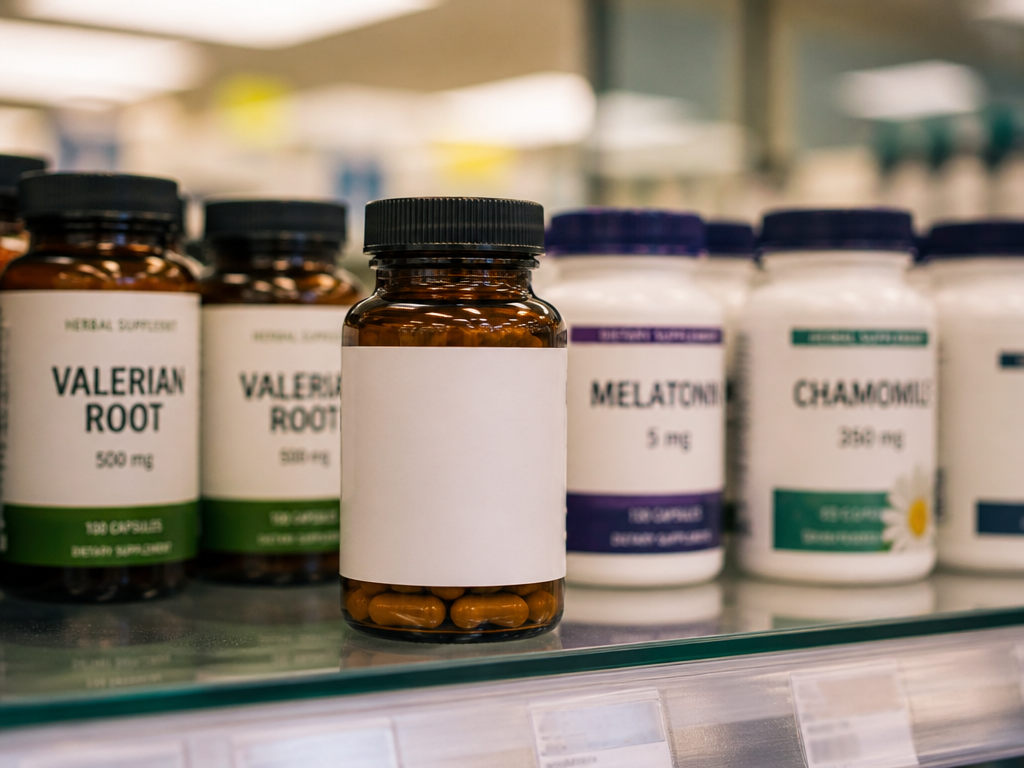
It didn't settle long-term safety. Most trials run weeks, not years, and the data on nightly use over decades — and on use in children, where pediatric prescribing has climbed faster than the evidence — remains thin. It didn't adjudicate the rest of the supplement aisle: valerian, magnesium, and L-theanine each have their own small, inconsistent literatures that deserve the same scrutiny applied here rather than a shared halo. And it didn't touch the intervention that consistently outperforms every pill for chronic insomnia in head-to-head trials: cognitive behavioral therapy for insomnia (CBT-I), which the same 2017 AASM guideline recommends first.
If melatonin disappointed you, the next place to look isn't a stronger dose. It's a better question about what's actually keeping you awake.
Seven minutes is a real number; it's just an answer to a smaller question than the one you were asking.