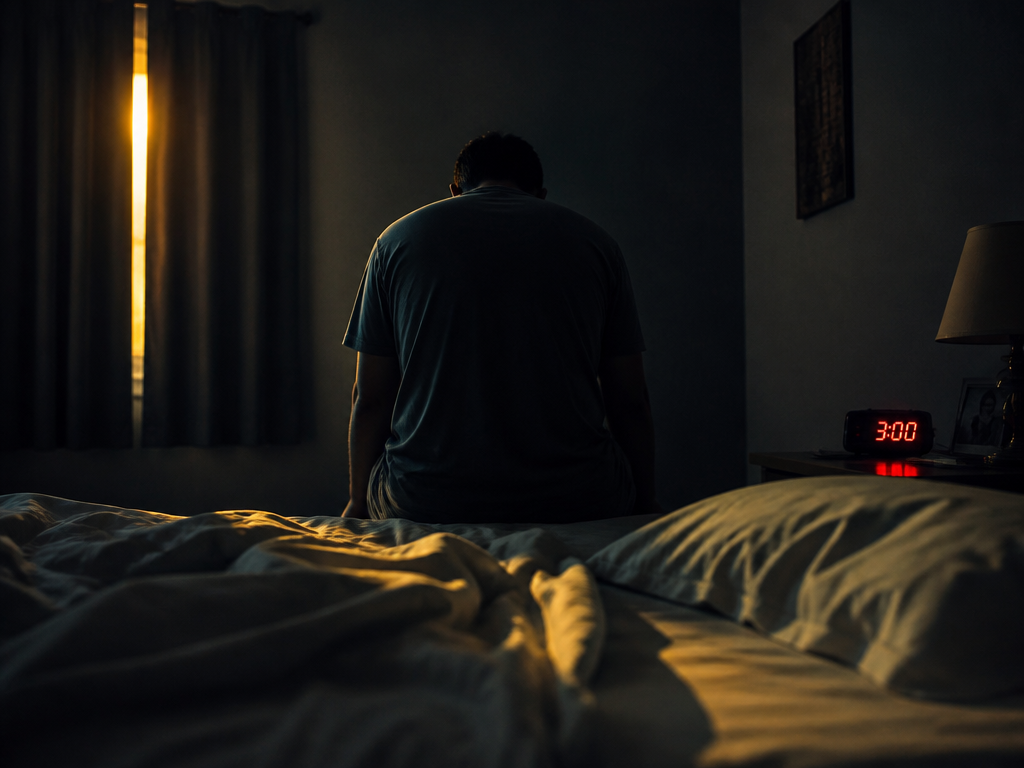
The bass starts around 11:40, and it is not, by any reasonable measure, loud. Maybe 35 decibels at your pillow — quieter than a refrigerator, quieter than rain on a window. And yet here you are at 2:15, awake, tracking the gaps between songs, doing arithmetic about how many hours are left.
This is the arithmetic of noise-induced insomnia: the sound that ruins your night is very often not the loudest sound in it.
The question most people eventually ask, lying there in the dark, is narrower and more useful than is noise bad for sleep. It is this: if I fall back asleep, did the noise still do something to me?
The honest answer is yes, partly, sometimes — and the size of the partly depends on some things researchers can measure and some things they can't.
What happens between the sound and the waking
The ear has no lid. That single anatomical fact explains most of what follows. Vision shuts down at the eyelid; hearing runs all night, and the sleeping brain has to decide, continuously and without you, what deserves an interruption.
In the order it actually happens
The pressure wave hits the eardrum and the cochlea converts it into nerve impulses — this part is unchanged by sleep. Those impulses climb the brainstem to the thalamus, which during non-REM sleep is running something like triage. Sleep spindles, the 11–16 Hz bursts of thalamocortical activity visible on an EEG, appear to be part of that gate. Dang-Vu and colleagues (2010, Current Biology) played graded noise to 12 healthy sleepers across three nights; the people producing more spindles stayed asleep at higher volumes. Twelve subjects is a small study, and it has held up better than most small studies, but it is still twelve people.
If the signal gets past the gate, the brainstem arousal systems fire. Heart rate rises within a beat or two. Peripheral blood vessels constrict. This is fast, automatic, and entirely below the level of anything you'd report in the morning.
Then, possibly, a cortical arousal — three to fifteen seconds of faster EEG activity, a shallowing of sleep. Then, possibly, actual waking, and the conscious registration of the neighbor's amplifier.
Those last two steps are optional. That is the whole point.
Can noise hurt your sleep if it never wakes you up?
Yes. The cardiovascular response to a noise event can occur with no cortical arousal at all — the heart accelerates, the sleep stage never changes, and you wake up with no memory of it. Alain Muzet's review (2007, Sleep Medicine Reviews) is the standard citation here, and it makes a more unsettling point than the bare finding: the EEG response habituates over nights of repeated exposure, while the cardiovascular response habituates much less. You stop noticing. Your circulatory system doesn't.
Basner and McGuire's systematic review (2018, International Journal of Environmental Research and Public Health), prepared for the WHO's European noise guidelines, pooled dozens of field and laboratory studies and found dose-response relationships between night-time transportation noise and both self-reported sleep disturbance and objectively measured awakenings — with the important wrinkle that self-report and polysomnography disagree constantly about how much. People generally underestimate how often they woke. They also, sometimes, report ruined nights that the electrodes recorded as fine.
The downstream health claim is where honesty is required. The HYENA study (Jarup et al., 2008, Environmental Health Perspectives) surveyed 4,861 people living near six major European airports and found night-time aircraft noise associated with hypertension — roughly a 14 percent increase in the odds per 10 dB of night exposure. That is a real, well-conducted study. It is also cross-sectional, in populations who did not randomly choose where to live, and it does not directly show that a heart-rate bump at 2 a.m. becomes a blood-pressure reading at 45. The chain from arousal to disease is plausible, partially supported, and stated with more confidence than it has earned almost every time it is repeated.
Why the bass gets through and the highway doesn't
A wall is a low-pass filter. Sound transmission through a partition improves with mass and with frequency — the standard construction rule of thumb is that doubling the mass of a wall buys you around 5 to 6 dB, and that the benefit climbs as frequency rises. High frequencies are stopped efficiently. Low frequencies go through drywall, through floor joists, and into the structure itself, where they radiate out the other side.
Then there's the measurement problem. Nearly every decibel figure you will ever encounter — in a noise ordinance, on a phone app, in a news story — is A-weighted (dBA), a filter designed to mimic the ear's reduced sensitivity to low frequencies at quiet levels. A-weighting discounts 63 Hz by about 26 dB. So a subwoofer two floors down can be the thing keeping you awake and simultaneously read as an unremarkable number on the enforcement officer's meter.
If you are documenting a neighbor complaint, this is the single most useful technical fact available to you: measure in both A-weighting and C-weighting (dBC), which is much flatter at low frequencies. A dBC−dBA gap greater than about 15–20 dB is the accepted signature of a low-frequency problem. It converts "I can feel it more than hear it" into a number someone else has to take seriously.
Where the answer is honestly "it depends"
Two people in the same building, exposed to the same 38 dBA, will not have the same night.
Part of that is noise sensitivity, which behaves like a stable personality trait rather than a symptom. It predicts annoyance and sleep complaints substantially better than measured exposure does in most field studies. It is not imagined, and it is not, so far, something anyone knows how to change.
Part of it is meaning. Intensity is not what the sleeping brain is grading — salience is. The classic demonstration is Oswald, Taylor, and Treisman (1960, Brain), who found that sleepers responded selectively to their own name played among other names, at volumes that otherwise did nothing. A handful of subjects, sixty-six years ago, and it has been replicated in spirit many times since. Your neighbor's guitar carries information: he is still up, he does not care, this will happen again tomorrow. A passing truck carries none. This is why the noise that comes with a dispute attached is worse than louder noise that doesn't.
And part of it is that the insomnia outlives its cause. Spielman's three-factor model (Spielman, Caruso, and Glovinsky, 1987, Psychiatric Clinics of North America) separates the thing that started the sleep problem from the things that maintain it — the anticipatory monitoring at bedtime, the extra hour in bed to compensate, the bedroom that has become a place where you brace. Six weeks of a loud neighbor can install all three. Which means the honest answer to "if he moves out, will I sleep?" is: probably, eventually, and not necessarily right away.
What the guidelines actually say
The WHO's Environmental Noise Guidelines for the European Region (2018) set night-time targets by source, using Lnight — an annual average outdoor level at the façade, not what your bedroom hears.
| Source | Recommended Lnight (outside) | Strength |
|---|---|---|
| Road traffic | below 45 dB | Strong |
| Railway | below 44 dB | Strong |
| Aircraft | below 40 dB | Strong |
| Wind turbines | no night recommendation issued | Evidence rated too weak |
That last row is the most trustworthy thing in the table. Faced with insufficient evidence, the committee declined to invent a number. Very few sources of sleep advice do that.
Note also what none of these cover: a person, in an apartment, at 1 a.m. Residential neighbor noise is regulated locally, inconsistently, and usually in dBA.
An honest rule of thumb
Tonight, do this: write down the time the noise starts, the time it stops, and whether you woke — and keep doing it for fourteen nights before you do anything else. Two weeks of dated entries is the difference between a complaint an authority can act on and one they can file. If you can borrow or buy a meter, log both dBA and dBC; the gap is your evidence.
Then treat the two problems separately. Attenuate what you can at the source and the structure — a sealed door gap is worth more than a thicker curtain — and treat the insomnia as its own condition, because after a few weeks it is one.
One caution: the reflexive fix, a white-noise machine, is on thinner ground than its popularity suggests. Riedy, Smith, Rand, and Basner (2021, Sleep Medicine Reviews) reviewed the literature on continuous noise as a sleep aid and found the studies small, heterogeneous, and mostly low quality, with some evidence that continuous sound can itself fragment sleep. Masking may help you. It is not established that it helps people.
Noise doesn't have to wake you to take the night. Footnote on earplugs: rated attenuation (NRR) is measured under laboratory conditions with expert fitting, and real-world performance is routinely well below the number on the package. Foam plugs also attenuate least at low frequencies — which is to say, least against exactly the bass that penetrated the wall in the first place.