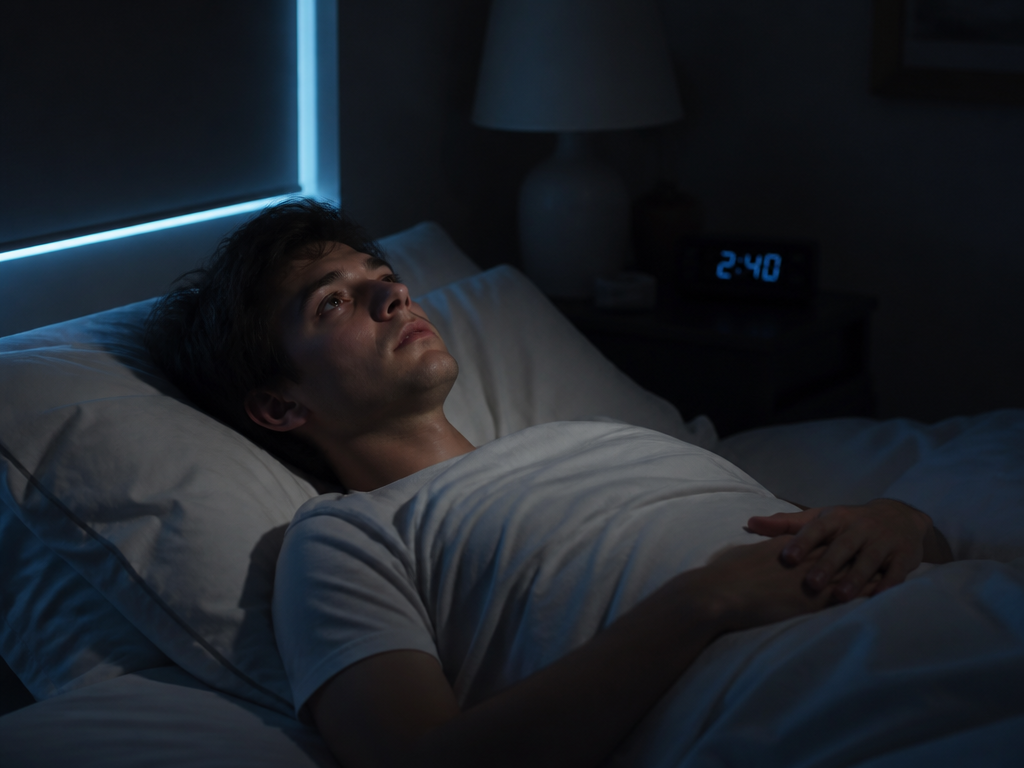
At 2:40 on a Tuesday I drank a cortado — one shot, about 130 milligrams of caffeine — because the four-year-old had been up at 4:50. I went to bed at 10:50, fell asleep fast, surfaced once around 3. In the morning my Oura ring said I'd been awake 41 minutes and handed me a sleep score of 68. What I felt was a small, specific dread about a night I had, until that moment, experienced as fine. The clinician I later asked about it offered no cutoff time. She offered insomnia redefined.
Not as a number on a dashboard. Not even as the absence of sleep. As a mismatch — between what your body did overnight and what you needed from the following day.
What the diagnostic manual actually requires
The clinical definition of insomnia is less dramatic and more demanding than the way we use the word. Under DSM-5, insomnia disorder requires dissatisfaction with sleep quantity or quality, paired with difficulty falling asleep or staying asleep, at least three nights a week, for at least three months. And then the part everyone skips: clinically significant daytime distress or impairment. No daytime consequence, no diagnosis. A bad night is a bad night.
The most useful framework here is old. Spielman, Caruso, and Glovinsky (1987) proposed what sleep medicine still calls the 3P model: predisposing traits, a precipitating event, and perpetuating factors. The first two explain how a rough patch starts — a newborn, a layoff, a parent's illness. The third explains why it stays. Perpetuating factors are almost always the things you do about the problem. Going to bed at 9:30 to bank sleep. Lying there doing arithmetic on hours remaining. Checking.
Harvey (2002), in Behaviour Research and Therapy, sharpened this into a cognitive model: worry about sleep raises arousal, arousal narrows attention onto sleep-related threat, and that attention makes you a worse judge of your own night. You start monitoring for evidence of deficit, and monitoring reliably finds some.
Which is a strange thing to read while wearing a device that monitors for evidence of deficit.
Is waking up in the middle of the night a sign of insomnia?
Usually not. Brief awakenings are a normal feature of adult sleep architecture, and the amount of them considered unremarkable rises steadily with age. Ohayon et al. (2004), a meta-analysis in Sleep pooling quantitative sleep parameters across the lifespan in healthy people, found wake after sleep onset increasing consistently with age — by midlife, something in the range of half an hour of accumulated overnight wake is ordinary in people with no sleep complaint at all.
My 41 minutes, in other words, was slightly above a median that includes a great many people who sleep fine and have never thought about it once.
There's an irony buried in the research literature. Historically, people with insomnia underestimate how much they slept — sleep-state misperception is a well-documented clinical phenomenon. Trackers may have quietly inverted the problem: they hand good sleepers a nightly, precise-looking case for a deficit they wouldn't otherwise have noticed.
What the ring actually knows
An Oura ring measures movement, heart rate, heart rate variability, and skin temperature, and infers everything else. That inference is decent at one job and mediocre at another. De Zambotti et al. (2019), in Behavioral Sleep Medicine, compared the first-generation ring against overnight polysomnography in 41 young adults: sensitivity for detecting sleep was around 96 percent, while specificity for detecting wake was roughly half that. The algorithms have been revised several times since. The asymmetry is structural, though — lying still and awake looks a lot like sleeping, and the reverse error is easy too.
So the number is not fiction. It's an estimate with a wide, mostly invisible error bar, reported to you as an integer.
Baron and colleagues (2017), writing in the Journal of Clinical Sleep Medicine, gave the resulting problem a name: orthosomnia — patients whose sleep complaint was driven by their tracker data, and who resisted clinical reassurance because the device disagreed. It's a short case series, not an epidemiological finding. Treat it as a described pattern rather than a measured prevalence. But it's the pattern I recognized in myself at 6:15 in the morning, holding a phone.
What the cortado did, in the order it happened
Worth walking through, because the mechanism is more specific than "caffeine keeps you up."
The caffeine cleared my stomach and absorbed through the small intestine, hitting peak plasma concentration somewhere between 30 and 60 minutes later — call it 3:20. Being small and fat-soluble, it crossed the blood-brain barrier easily. There it did one main thing: occupied adenosine receptors, principally A1 and A2A, without activating them.
This matters. Adenosine accumulates in the brain across the waking day and is the chemical substrate of sleep pressure. Caffeine doesn't drain it. It stands in the doorway. The pressure kept building all afternoon; I just stopped hearing it.
Then my liver went to work, mostly via the CYP1A2 enzyme, with a population-average half-life near five hours and a real range of roughly three to seven. By 10:50 p.m., 8.2 hours after the cortado, about 40 mg remained — a third of a cup, still docking at receptors, still muffling the signal.
What 40 mg does at that point is subtler than keeping you awake. Drake et al. (2013), in the Journal of Clinical Sleep Medicine, gave 12 normal sleepers 400 mg at 0, 3, and 6 hours before bed; even the six-hour dose measurably cut total sleep time. Twelve people is a small study carrying a lot of internet weight, and the dose is roughly a large drip coffee, not a cortado. Burke et al. (2015), in Science Translational Medicine, found that 200 mg three hours before bed delayed the circadian melatonin rhythm by about 40 minutes — in five participants, under 49 days of laboratory control. Elegant, mechanistically important, and thinner than the confidence with which it gets quoted.
An honest rule of thumb
Halve your last dose every five hours until bedtime. If more than about 40 mg is still circulating when you lie down, move the cup earlier — not out.
For a 130 mg cortado, with an 11 p.m. bedtime:
| Last cup | Hours to bed | Approx. mg remaining |
|---|---|---|
| 10 a.m. | 13 | ~21 mg |
| Noon | 11 | ~28 mg |
| 2 p.m. | 9 | ~37 mg |
| 4 p.m. | 7 | ~49 mg |
| 6 p.m. | 5 | ~65 mg |
Three caveats that change the math more than the table does. Estrogen-containing oral contraceptives slow caffeine clearance enough to roughly double the half-life. Pregnancy extends it dramatically — up to around 15 hours by the third trimester. And CYP1A2 activity varies severalfold between individuals, which is why your friend's espresso-at-nine habit is not evidence about you, and yours is not evidence about her.
Back to the 41 minutes
I moved the cortado to 1 p.m. and kept it, because a mother of two on four hours of broken sleep is entitled to a stimulant with a 6,000-year safety record. The change I actually noticed wasn't in my scores.
The clinician asked what my day had been like after that 68. I said fine. Good, even. She said that was the measurement.
This week, try one thing: don't open the app until you've been awake an hour and have already decided, unprompted, how you slept. Then look, and notice which of the two you believe.
Your ring can tell you what your body did last night; only your Tuesday can tell you whether it was enough.