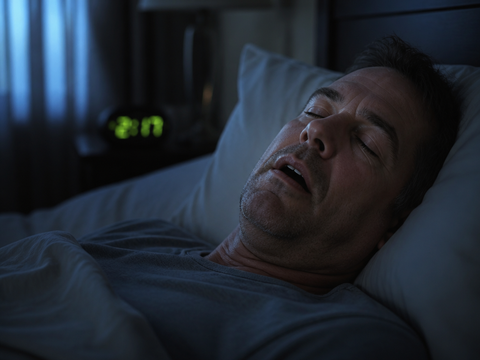
There's a statistic that gets repeated so often it has worn smooth: roughly 80 percent of people with moderate-to-severe sleep apnea don't know they have it. It shows up in clinical talks, patient brochures, and the opening line of nearly every awareness campaign. It sounds enormous, and it is. But a number that large deserves to be handled, not just quoted — because once you understand what it counted, you understand something useful about your own odds.
So start with the number. Then we'll take it apart.
Where the 80 percent comes from
The figure traces back to the Wisconsin Sleep Cohort, the longest-running study of its kind. In a 1997 analysis (Young et al., Sleep), researchers had been recording overnight sleep studies on a sample of working-age adults and then checking those results against whether the same people had ever received a clinical diagnosis. The mismatch was stark. Among participants whose lab data showed clinically significant breathing disruption, the large majority had no diagnosis on record — roughly 80 percent of men and over 90 percent of women in the moderate-to-severe range.
What the study actually measured was that gap. Not how dangerous apnea is, not how many people "have a sleep problem" in some loose sense — but the distance between measurable, lab-confirmed disrupted breathing and a doctor having written it down.
That distinction matters, because it tells you the bottleneck is recognition, not rarity.
What the number does not tell you
Here is where the smooth-worn statistic gets slippery.
First, prevalence has moved. The Wisconsin cohort was assembled in the late 1980s. Later estimates — notably Peppard et al. (2013, American Journal of Epidemiology), which re-ran the analysis with updated scoring rules — found substantially higher prevalence overall, partly because the population got heavier and partly because the definition of an "event" changed. The 80 percent figure is a snapshot from a moving system.
Second, "sleep apnea" is not one thing. The standard metric, the apnea-hypopnea index (AHI), counts breathing interruptions per hour. Five to fifteen is mild. Fifteen to thirty is moderate. Above thirty is severe. A person with an AHI of 6 and a person with an AHI of 45 both technically "have" it, and lumping them together is part of why the headline number feels both alarming and vague.1
Third — and this is the honest part — being undiagnosed is not the same as being untreated-and-doomed. Plenty of mild cases are stable. The reason the gap matters is that the severe cases, the ones with the clearest links to hypertension and daytime risk, are hiding in the same statistic as the mild ones. The number can't sort them for you. Only a measurement can.
What one apnea event actually does
It helps to watch a single episode in the order it unfolds in the body, because the mechanism explains nearly every symptom worth knowing.
You fall asleep. Muscle tone drops, including in the soft tissue at the back of the throat. In a vulnerable airway, that tissue collapses inward and the channel narrows or seals. You keep trying to breathe — the chest and diaphragm work harder — but little or no air moves. Over the next ten, twenty, thirty seconds, blood oxygen falls and carbon dioxide rises. Chemoreceptors notice. The brain, sensing the chemistry going wrong, fires a brief alarm: a micro-arousal. You don't wake up in any way you'd remember. But sleep lightens just enough for throat muscles to regain tone, the airway snaps open, and air rushes back, often with a gasp or snort. Then you settle, and the cycle restarts. In severe cases this happens more than thirty times an hour, all night.
Now the symptoms make sense. The gasp is what a bed partner hears. The fragmentation — not a lack of hours, but a lack of uninterrupted hours — is why people sleep eight and wake exhausted. The repeated oxygen dips and adrenaline surges are the plausible link to morning blood pressure.
The signs that actually predict it
The single most reliable signal is not something you can observe about yourself: witnessed pauses in breathing. A partner describing silence followed by a gasp is, clinically, worth more than almost any symptom you'd report on your own. Loud, habitual snoring is common but far less specific — most snorers don't have apnea, though most people with apnea snore.
On your side of it, the pattern to watch is unrefreshing sleep paired with daytime sleepiness that doesn't track with how long you were in bed. Waking with a dry mouth or headache, needing to urinate repeatedly overnight, and a stubborn fog that coffee dents but doesn't clear all point the same direction. None of these alone is diagnostic. Together, with a witnessed pause, they're a strong case to get measured.
And "I don't snore" doesn't clear you. Quiet apnea exists, especially in women, who are underdiagnosed in part because the textbook picture was built on men.
An honest rule of thumb
The closest thing to a validated home screen is the STOP-Bang questionnaire. It's eight yes/no items, and it's deliberately tuned to catch cases rather than rule them out — high sensitivity, lower specificity. A high score doesn't confirm anything. A low score is genuinely reassuring.
| STOP-Bang score | What it suggests |
|---|---|
| 0–2 | Low risk |
| 3–4 | Intermediate risk — worth a conversation |
| 5–8 | High risk for moderate-to-severe apnea |
Treat it as a smoke detector, not a diagnosis. It tells you whether to look closer, nothing more.
What to try this week
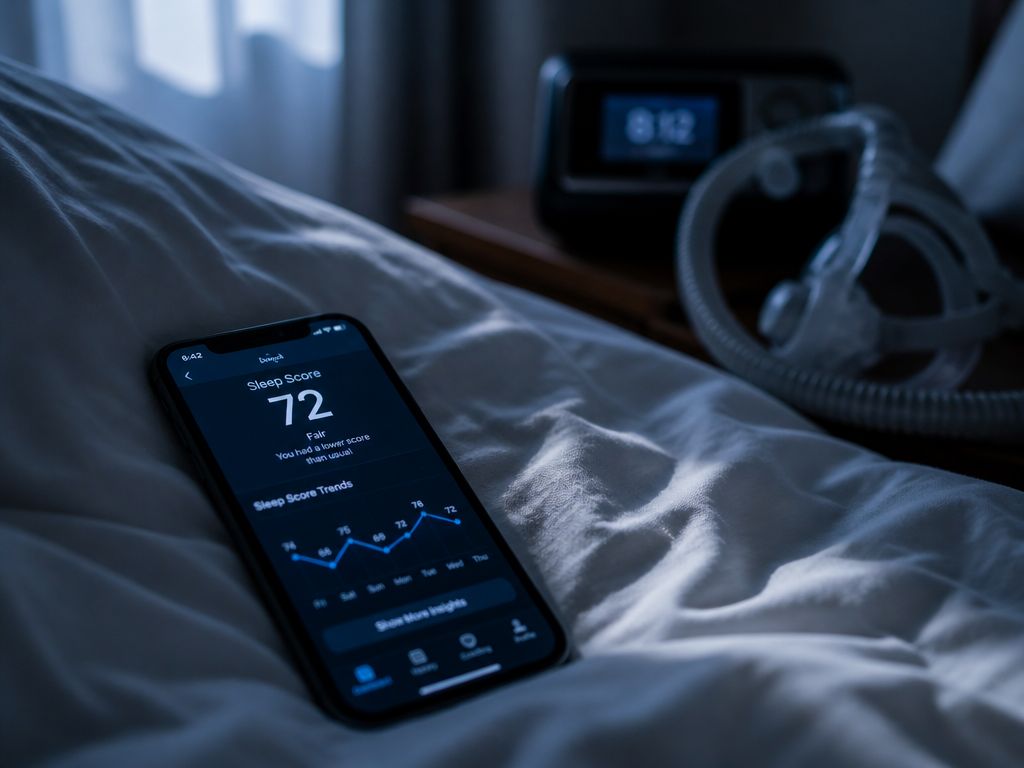
Pick one night. Put your phone on the nightstand and run a free sleep-audio app, or simply ask whoever shares your bed to listen for two things: does your snoring ever go silent, and does the silence end with a gasp? That pause-then-gasp pattern is the one observation that moves a vague worry into a specific question your doctor can actually answer.
You don't have to diagnose yourself. You just have to gather the one piece of evidence that a recording, or a partner, can give you for free — and then let a measurement do the rest.
-
Hypopneas — partial reductions in airflow — are scored differently across labs and eras, which is one quiet reason prevalence numbers shift between studies even when nothing about human throats has changed. ↩