For ninety nights I wore a sleep-tracking ring, logged a four-item symptom diary every morning before coffee, and let my CPAP machine record its own usage to the minute. I have PTSD — service-connected, diagnosed in 2018 — and moderate obstructive sleep apnea diagnosed three years after that. The question I wanted answered was narrow and personal: on the nights I actually used the machine, did my trauma symptoms move, and by how much?
This is not a study. It is one person, one airway, one set of nightmares, measured carefully. But the numbers were less ambiguous than I expected, so I'm reporting them.
The verdict, in one sentence: across three 30-day blocks at deliberately different adherence levels, my nightmare frequency and morning hyperarousal scores tracked my nightly mask hours closely enough that the worst symptom month was also the month I averaged under two hours of use.
I'm going to walk through this the way the air does — in the order the body encounters it. What enters first, what happens to it next, what reaches the brain, and what's left in the morning. The physiology has an order. The article follows it.
The air in: the mask, the pressure, the leak
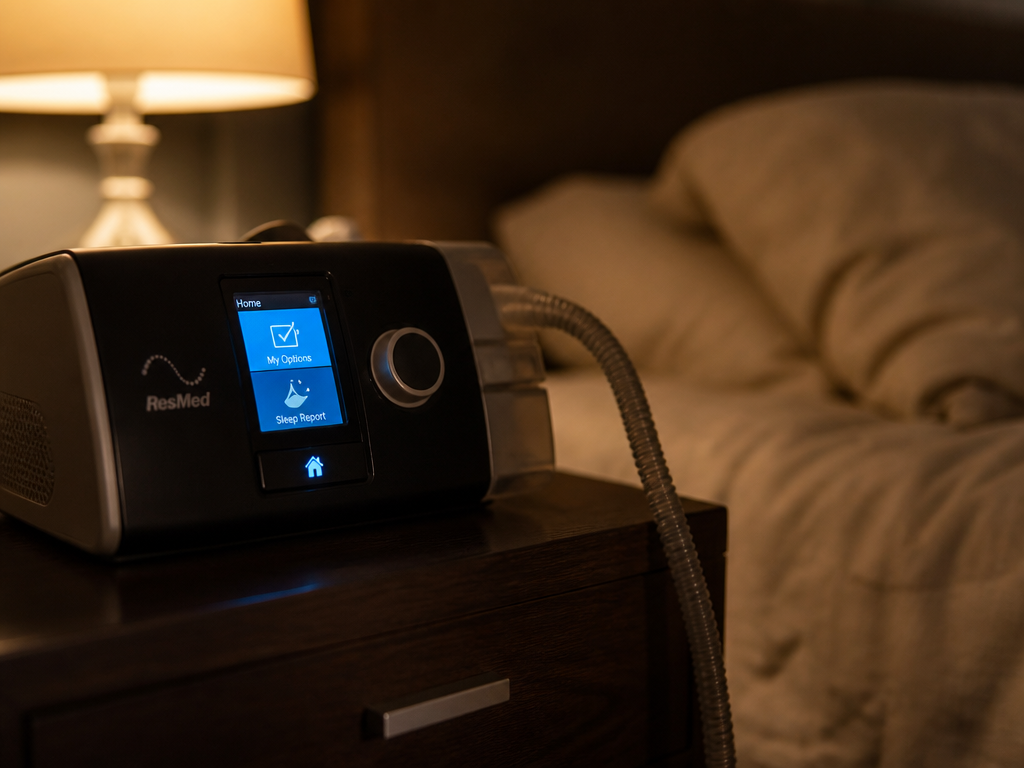
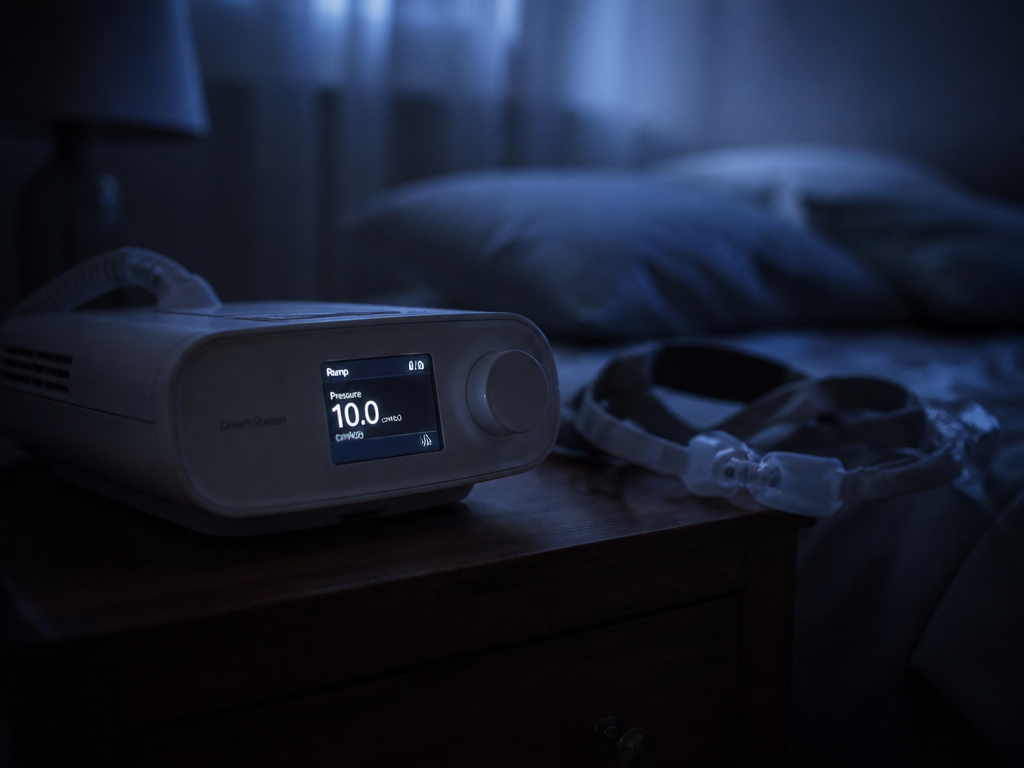
The first measurable event each night is mechanical. My machine runs at a fixed pressure of 9 cm H₂O. The mask is a nasal pillow style — I switched to it from a full-face cushion in week two, and that switch matters more to this story than I'd have guessed.
The full-face mask leaked. The machine logs leak rate in liters per minute, and on the full-face setup my median leak sat around 31 L/min, spiking past 50 whenever I turned onto my side. Above roughly 24 L/min the device can't reliably hold pressure, which means the therapy is running but not necessarily working. My "compliant" nights in week one — over four hours of recorded use — were partly fictional. The mask was on; the air wasn't getting where it needed to go.
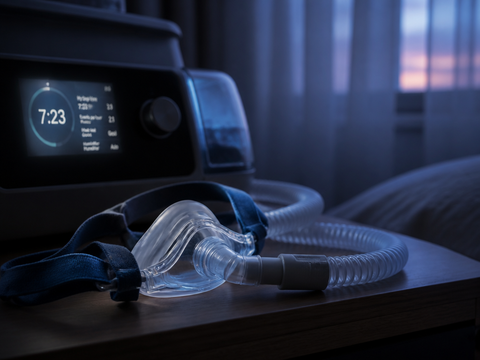
The nasal pillows dropped my median leak to 8 L/min. This is the unglamorous reality of adherence that the word "adherence" hides: it is not a yes/no. You can wear the device faithfully and still get a fraction of the pressure if the seal is wrong. For anyone with PTSD, there's a second layer here — a mask that pushes against the face, that you can't easily pull off, that covers the mouth, is asking a lot of a nervous system primed to read restraint as threat. The first three nights I woke up having clawed it off without remembering doing it. The smaller mask was easier to tolerate not because it was more comfortable but because it covered less of me.
If you take one mechanical thing from this section: check your leak rate before you trust your usage hours. Most machines display it. Mine was telling me I was treated when I wasn't.
The airway: what collapses, and why a trauma brain notices
Once the air is moving, the question is whether the airway stays open to receive it. In obstructive apnea it doesn't. The soft tissue at the back of the throat relaxes and collapses, the airway narrows or shuts, and breathing stops or shallows until the brain registers the falling oxygen and jolts the body awake enough to reopen it. The metric is the AHI — apnea-hypopnea index, the number of these events per hour of sleep.
My untreated sleep study put me at an AHI of 18 — moderate. Treated, on a good night with the nasal pillows sealing, the machine reports a residual AHI under 3.
Here is where the trauma and the breathing interlock. An apnea event is, physiologically, a micro-arousal: a small surge of the same sympathetic nervous system machinery that runs the startle response. Heart rate climbs, the body half-wakes, then settles. In someone without PTSD this happens dozens of times a night and is mostly forgotten. In a nervous system already tuned toward threat detection — already spending the night closer to the surface — each of those arousals is a nudge against a door that doesn't latch well to begin with.
The clinical literature has been circling this for over a decade. Sleep-disordered breathing turns up in PTSD populations at rates well above the general adult baseline, and the studies in combat-veteran samples in particular report prevalence figures high enough that several sleep physicians now treat a PTSD diagnosis as reason to screen for apnea by default rather than waiting for the patient to complain of snoring. The two conditions don't just coexist. They feed each other: the fragmented, shallow sleep of apnea worsens the daytime arousal, and the heightened arousal makes the sleep lighter and easier to fracture.

I felt this without being able to name it for years. I assumed the 3 a.m. wakings were the trauma. Some of them were the airway.
The blood: the nightly insult you can measure
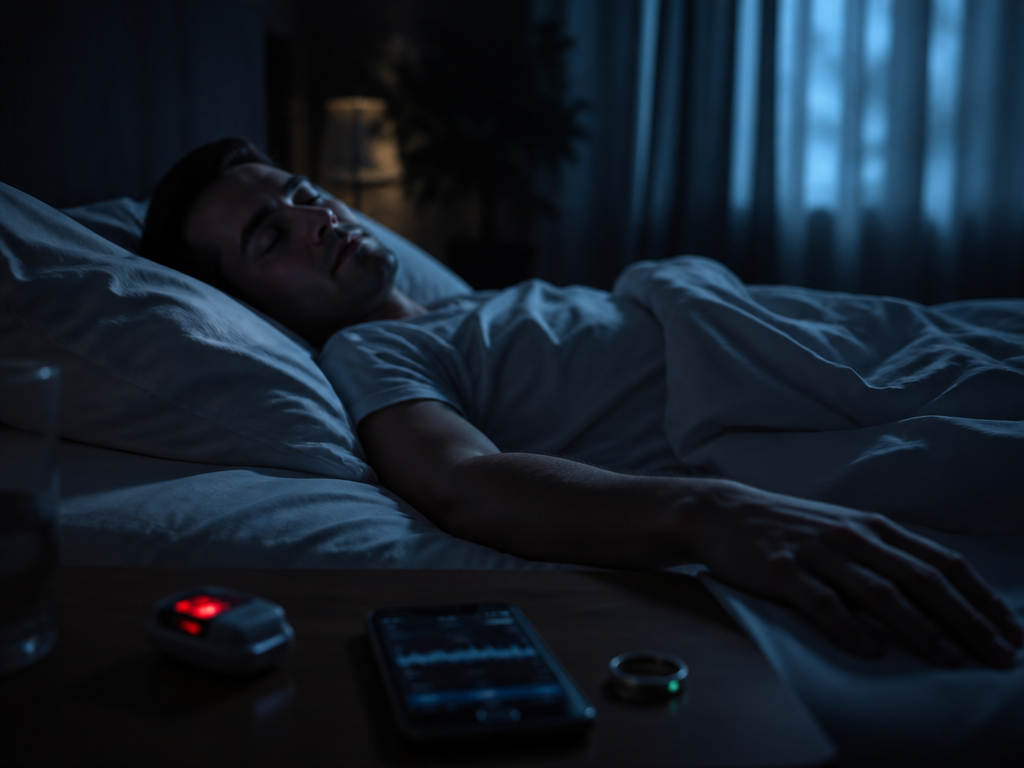
When the airway closes, oxygen saturation falls. My ring estimates blood oxygen overnight — consumer-grade, not a clinical oximeter, so I treat the absolute numbers loosely and the patterns seriously.
On my low-adherence nights the ring logged repeated desaturation dips, the trace looking like a saw blade: down to the high 80s, recovery, down again, recovery, two or three dozen times before morning. On well-treated nights the trace was nearly flat, holding in the mid-90s with only shallow dips around what I assume were REM periods.
This is the part of the chain easiest to dismiss as abstract — so the oxygen dipped, so what. But the dip is the body's alarm trigger. Each desaturation is the physiological event that recruits the arousal that fractures the sleep. The blood-oxygen trace is, in effect, a recording of how many times your body decided it had to wake you to keep breathing. On my worst single night during the experiment the ring logged 41 distinct dips. That morning's diary is the one I least want to reproduce here.
The point of the oximetry, for me, was to make the insult concrete. I could no longer tell myself the bad nights were "just stress." There was a measurable, mechanical reason my body kept hauling itself toward wakefulness.
The brain: REM, nightmares, and where the symptom lives
Now we reach the organ this whole article is actually about. The thing apnea does to PTSD that no other comorbidity does quite the same way is that it attacks REM sleep specifically — and REM is where the nightmares live.
Apnea events cluster in REM, because muscle tone, including the tone of the airway, drops furthest during it. So the stage of sleep most associated with emotional processing and with trauma nightmares is also the stage most likely to be repeatedly interrupted. Researchers studying CPAP in trauma populations have reported that restoring continuous breathing — and with it more consolidated, less fragmented REM — corresponds to meaningful drops in nightmare frequency in patients who actually use the device consistently. The mechanism is plausible and the direction of effect is repeated across the small studies that exist: protect the breathing, protect the REM, and the nightmares have less broken ground to grow in.
This is the hinge of my own data. I track nightmares as a simple nightly count — zero, one, or more than one, recorded on waking while it's still legible. Over the 90 days the relationship between my mask hours and that count was the clearest signal in the whole dataset. It was not perfect. There were nightmare-free nights with the mask off and bad nights with the mask on. But the monthly averages separated cleanly, which is the comparison I'll show next.
I want to be careful here. CPAP did not treat my PTSD. The trauma is still there in the daylight, and no amount of clean airflow touches the source of it. What the therapy seems to have done is stop the breathing from amplifying it overnight — to take a hand off the scale, not to remove the weight.
The next morning: the four numbers I logged
Every morning before coffee I scored four things 0–4: nightmare intensity, how rested I felt, irritability/hyperarousal, and intrusive daytime thoughts (logged the following evening for the prior day). I deliberately ran three different adherence regimes, one per 30-day block, to see the contrast — Block 1 inconsistent, Block 2 deliberately minimal, Block 3 strict.
I'll say plainly that Block 2 was unpleasant to live through and I would not design it that way again. But it produced the cleanest contrast.
The comparison: three months, three adherence levels
| Metric (30-day mean) | Block 1: Inconsistent (3.1 hrs/night) | Block 2: Minimal (1.8 hrs/night) | Block 3: Strict (6.4 hrs/night) |
|---|---|---|---|
| Nights with mask ≥4 hrs | 11 of 30 | 2 of 30 | 28 of 30 |
| Residual AHI (machine) | 9.2 | 14.1 | 2.6 |
| Nightmares per night | 0.7 | 1.3 | 0.3 |
| Morning hyperarousal (0–4) | 2.4 | 3.1 | 1.6 |
| "Rested" score (0–4, higher better) | 1.9 | 1.2 | 2.8 |
A few things in that grid are worth stating outright rather than leaving in the cells.
Minimal use was worse than inconsistent use on every line. That surprised me less than how much worse it was on hyperarousal — a full point on a four-point scale is the difference between a manageable workday and one where I cancel things. The residual AHI in Block 2 (14.1) tells you why: at under two hours of use, I was essentially untreated for most of the night, and the events came back.

The strict month wasn't just the best — it was the only month I scored a "rested" average above 2.5. Six-plus hours of sealed therapy didn't merely reduce the bad numbers; it produced something on the positive side of the ledger that the other two months never reached.
Nightmare frequency moved the most, proportionally. From 1.3 a night down to 0.3 is a roughly four-fold drop. If I had to point to a single line as the headline of this whole experiment, it's that one.
What the table can't show is that the blocks weren't perfectly controlled. Life happened during them. A stressful work stretch overlapped the back half of Block 1 and probably worsened those numbers independent of the mask. I'll come back to that.
What I couldn't test
This is one nervous system over ninety days, and I knew the hypothesis going in, which means I cannot rule out that my expectations shaded my morning scoring. A blinded version of this is essentially impossible at home — you know whether you slept in the mask.
I also couldn't separate the breathing effect from the simple sleep-duration effect. On strict-adherence nights I slept longer overall, not only more continuously, and longer sleep alone improves mood and lowers irritability in almost anyone. Some of Block 3's advantage is probably just more hours of sleep, full stop, and not specifically the protected REM. I can't apportion the credit.
And the confounds were real. The work stress in Block 1, a course of a new medication that started mid-Block 2 and may have affected sleep architecture on its own, two nights of travel with no machine. A clinical trial controls for these. I just logged them and noted them. Treat the table as a strong personal signal, not a finding.
One last limit, the most important: this experiment says nothing about whether you have apnea. I knew I did, from a proper overnight study. The entire chain in this article only applies if the airway is actually the problem. Plenty of PTSD-related sleep disruption has nothing to do with breathing, and chasing a CPAP solution for it would be a costly detour.
Who this is for, and who it isn't
This is for you if:
- You've been diagnosed with both a trauma-related condition and obstructive sleep apnea, and you've quietly decided the mask isn't worth it. The Block 2 numbers are my argument against that decision.
- You're a clinician or sleep-clinic referral partner trying to convey to a skeptical patient why adherence matters in concrete, livable terms rather than as a compliance lecture.
- You have PTSD, you snore or wake gasping or sleep poorly despite trauma-focused treatment, and no one has yet sent you for a sleep study. The airway is worth ruling in or out.
This isn't for you if:
- You haven't had a sleep study. None of this applies until you know whether apnea is part of your picture. Start there, not with a machine.
- Your sleep disruption is clearly insomnia or trauma nightmares without a breathing component. CPAP is the wrong tool, and the literature on it doesn't claim otherwise.
- You're hoping a device will treat the trauma itself. It won't. At best it stops the night from making the trauma louder.
The line you can screenshot
If you have diagnosed apnea alongside PTSD, the adherence question isn't about compliance — it's that the nights you skip the mask are the nights your nervous system spends rehearsing the thing you're trying to recover from. My worst symptom month and my lowest mask-hour month were the same month. That's the whole experiment in one sentence.
How it actually looks, lived out
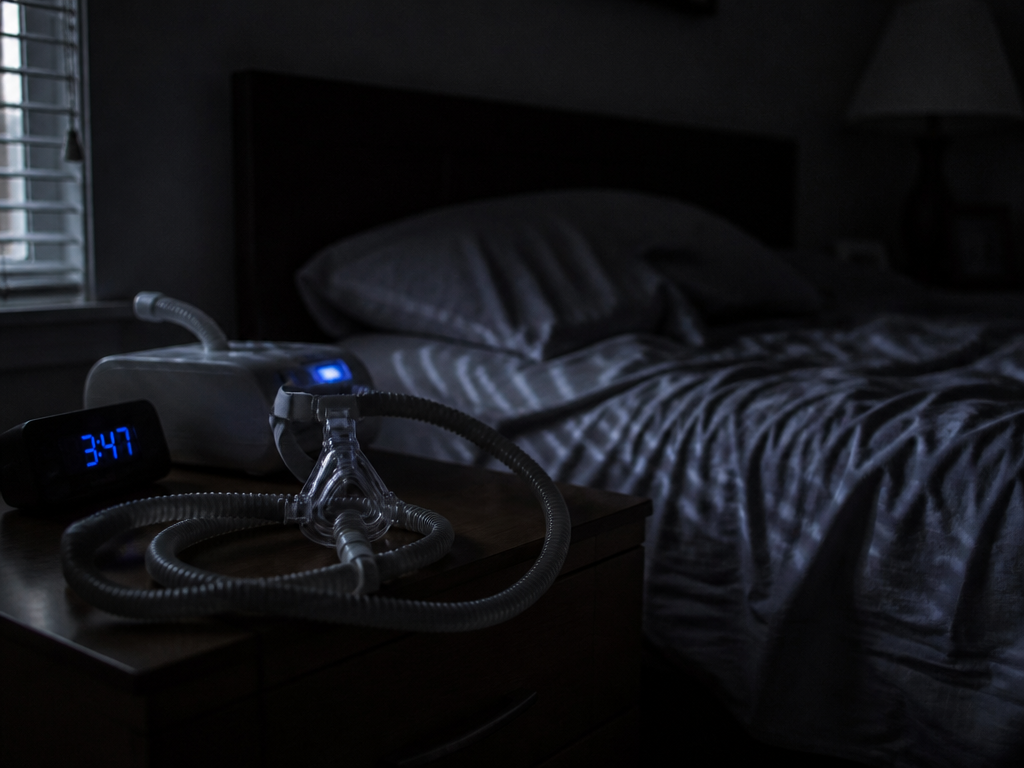
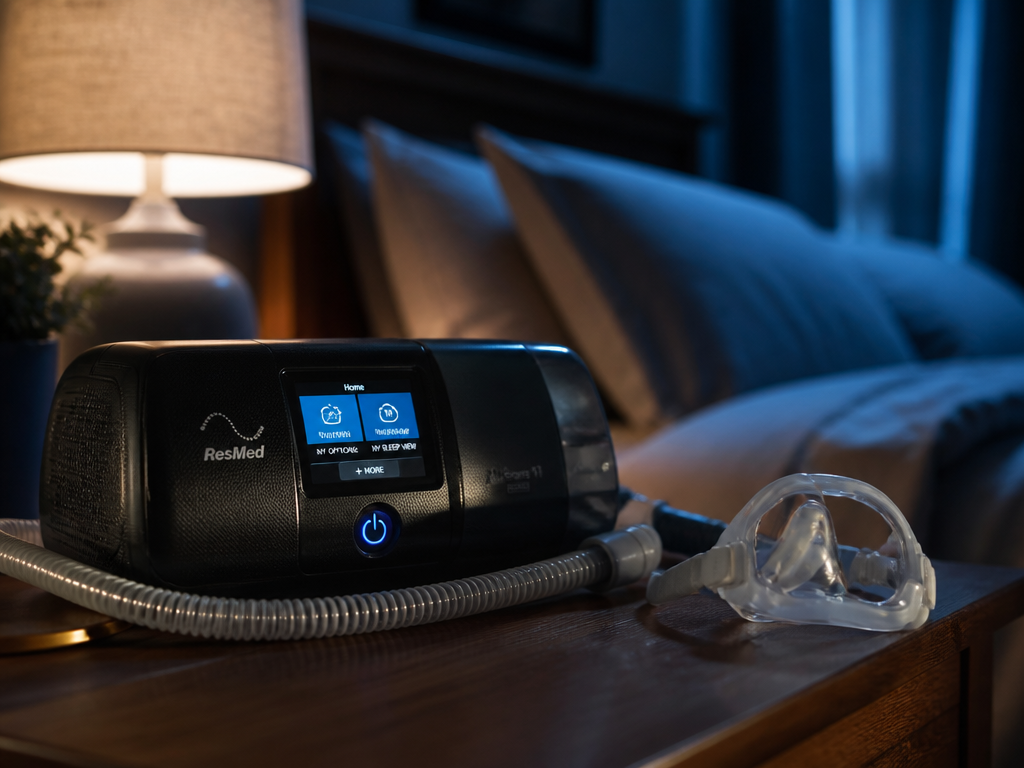
I keep the mask on the nightstand now, hose already clipped to the headboard, the way some people keep a glass of water — within reach without thinking. That's the only change I made after the ninety days, and it's a small mechanical one, not a resolution.
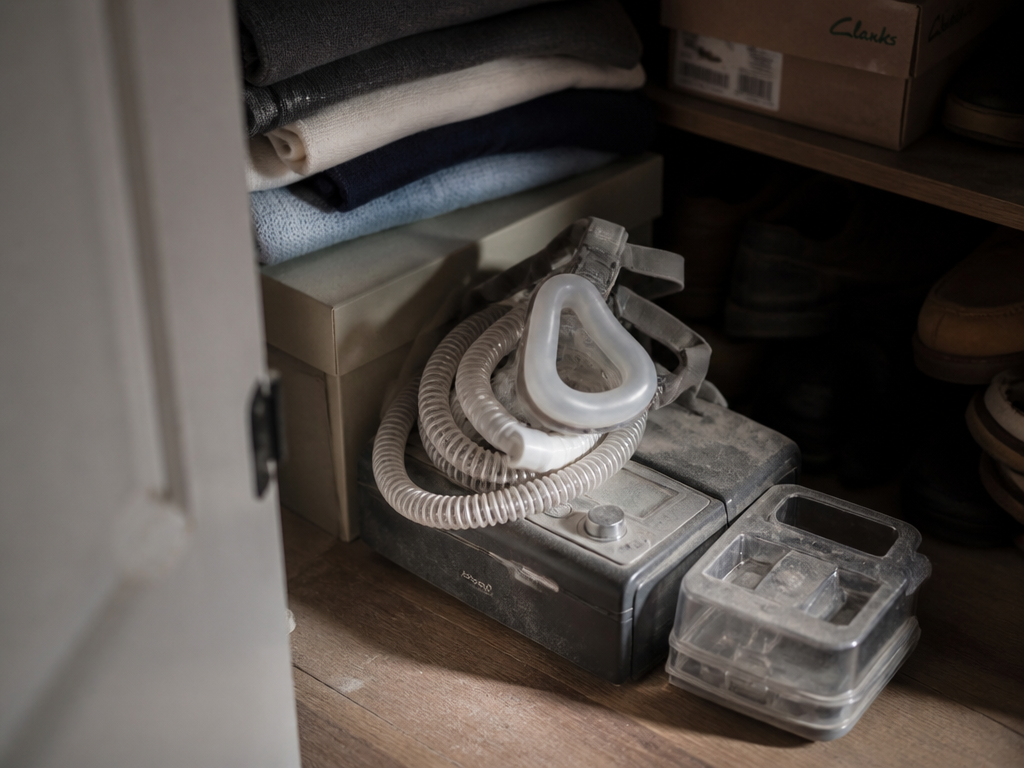
Before the experiment the mask lived in its case in a drawer, and the act of retrieving it at 11 p.m. was just friction enough that on tired nights I'd skip it and tell myself one night wouldn't matter. The data is what convinced me that on a bad-trauma night — exactly the night I least want to wrestle with equipment — skipping is the most expensive choice I can make. So the friction is gone. The hose is clipped. The decision is already made before I'm too tired to make it well. That, and not any number in the table, is what the article's logic looks like once it stops being an argument and becomes a Tuesday.