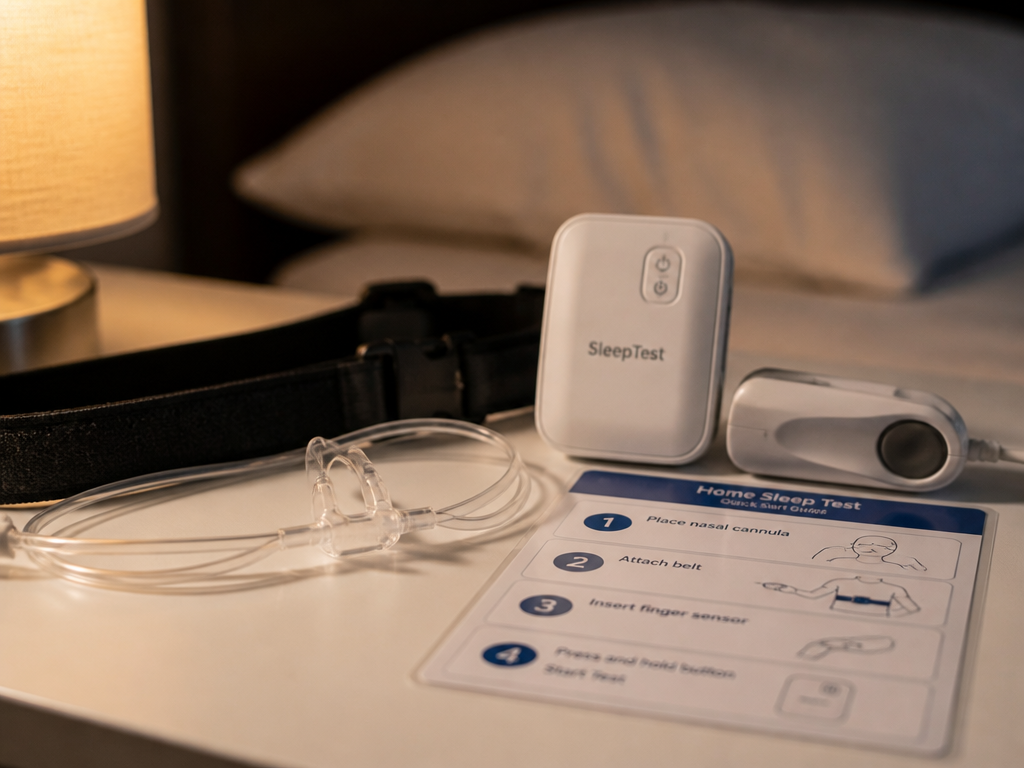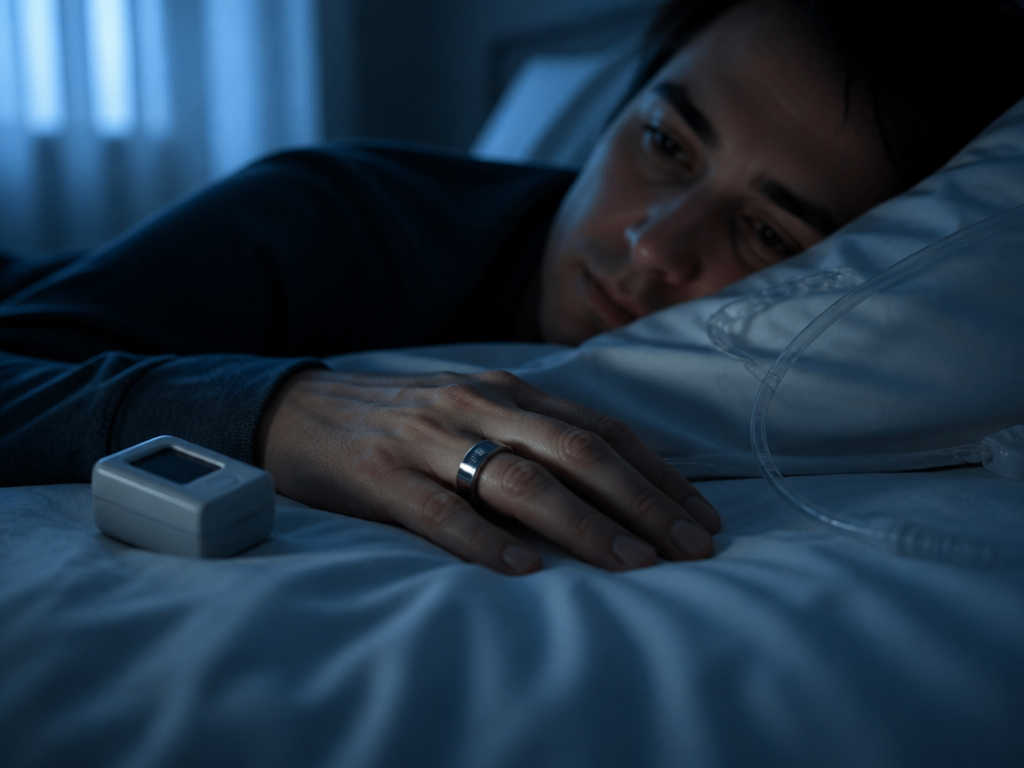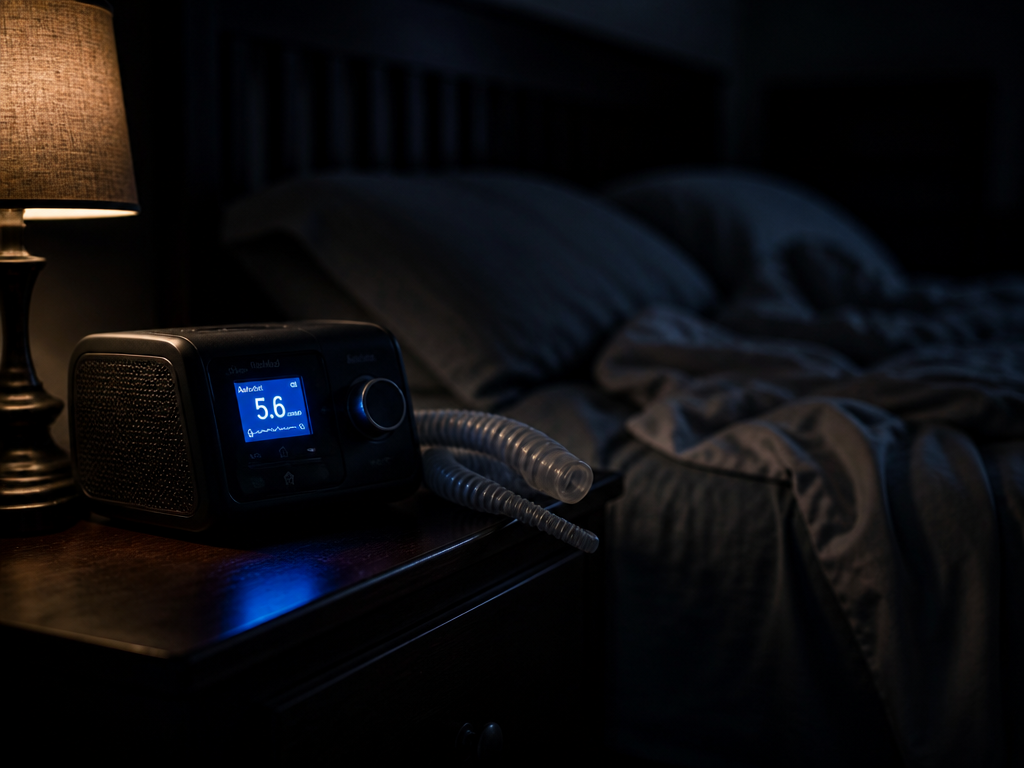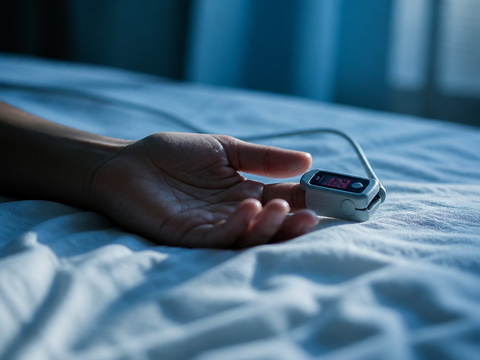
The first device was the size of a matchbox and clipped to my finger like a tiny blood-pressure cuff that had wandered to the wrong limb. A second sensor sat under my nose. A band went around my chest. I went to sleep at 11:40, woke twice that I remember, and mailed the recorder back in a prepaid envelope two days later. Ten days after that, a number arrived: AHI 6.
That number is the center of a sleep apnea diagnosis. It stands for apnea-hypopnea index — the average count of breathing interruptions per hour of sleep. Six is technically "mild." Six is also the number that made me distrust the whole process, because I snore loudly enough to be exiled to the couch and I fall asleep at 2 p.m. meetings like a man who has been drugged. Mild did not match my life.
The one-sentence verdict
For most adults with symptoms, the at-home test is the correct first step and will give you a usable answer — but if your number comes back low and your symptoms stay loud, the in-lab study is not optional, it's the appeal.
That gap between the two tests is the whole story, so let me take it apart.
What a diagnosis is actually counting
Sleep-disordered breathing isn't only the dramatic full stop of an apnea, where airflow halts for ten seconds or more. It also includes hypopneas — partial collapses where airflow drops and your blood oxygen dips, but you don't fully stop. The AHI lumps both together. An index under 5 is considered normal; 5 to 15 is mild; 15 to 30 moderate; above 30, severe.
The trouble is that the index is a rate: events divided by hours of sleep. And here is the quiet flaw in the home version — the home kit doesn't measure sleep. It measures time in bed. If you lie awake for two hours, the device counts those two hours as denominator, diluting your real rate. A lab test counts only actual sleep, scored from brain waves. Same events, smaller denominator, higher number. That alone can move a person across a diagnostic line.
Home test vs. lab test, side by side
I paid for both inside three weeks, which is not what most people do, so treat this as a controlled splurge rather than a recommendation.
| Criterion | Home sleep apnea test | In-lab polysomnography |
|---|---|---|
| Typical cost (US, insured) | $150–$400 | $1,000–$3,000 |
| What it measures | Airflow, oxygen, chest effort, pulse | All of that plus brain waves, leg movement, sleep stage, position |
| Measures actual sleep? | No (time in bed) | Yes |
| Where you sleep | Your own bed | A monitored room with a technologist |
| Turnaround for results | 7–14 days in my case | 10–21 days in my case |
| Best at catching | Moderate-to-severe obstructive apnea | Mild apnea, central apnea, mixed disorders |
The table flatters the lab on completeness, and it should. But completeness is not the same as appropriateness. The home test exists because dragging every snorer into a wired room is slow, expensive, and unnecessary for the people whose airways are obviously and severely obstructing. If your AHI comes back at 38 from your own bed, no lab is going to overturn that. The home test is decisive when it says yes and loudly.
It's the no you have to be careful with.
What the kit missed in my case
My home AHI of 6 had two problems baked in.
The first was the denominator I already described — I'm a restless, frequent-waker, and the recorder generously credited my staring-at-the-ceiling hours as sleep.
The second was position. The home unit logged position crudely and didn't tie events to it. The lab did. It turned out my apneas weren't spread evenly across the night — they clustered hard when I rolled onto my back, and during REM, when the muscles of the airway go slack. In the lab, my back-and-REM AHI ran above 20. Averaged across a full night that included a lot of side-sleeping, the whole-night number was softer. The home test handed me the average and called it a day.
So the lab number came back: AHI 17, moderate, positional and REM-predominant. Not the 6 I'd been told. Same body, same breathing, different instrument — and a different clinical conversation entirely.
I want to be fair to the home kit. It was comfortable, it cost a tenth as much, and it correctly told me I had apnea. It was not wrong that I had a problem. It was wrong about the size of the problem, and size is what determines whether you treat it.
Who this is for, and who it isn't
Start with the home test if: you snore, you're tired, you've been told you stop breathing, you have a healthy heart and lungs otherwise, and you want the fastest, cheapest first answer. For you, the home kit is genuinely the right tool, and a clear positive result will move you straight toward treatment without a night in a strange room.
Push for the lab if: your home result is mild or normal but your symptoms aren't; you have heart failure, COPD, or a history of stroke (these raise the odds of central apnea, which home kits read poorly); you have severe insomnia that wrecks the home test's denominator; or you suspect something beyond obstruction — limb movements, narcolepsy, parasomnias. The lab sees all of it. The home kit sees a slice.
The line you can screenshot: the at-home test is the best place to begin a sleep apnea diagnosis, but a low home number plus loud symptoms is a reason to escalate, not to relax.
Back to the matchbox
The thing I keep returning to is how close I came to filing this away. A "mild" result is easy to shrug off. You feel almost vindicated — it's not that bad, you tell yourself, and you go on falling asleep in meetings. The single number is persuasive precisely because it's a number, and numbers feel like the end of an argument rather than the start of one.
What neither test answered is the part I'm in now, and it's the harder part. A diagnosis tells you what is happening to your breathing. It does not tell you which treatment you'll actually tolerate — whether you're a CPAP person, a mandibular-advancement-device person, a positional-therapy person who just needs to stop sleeping on your back, or someone whose case warrants surgery. The numbers got me to the door. They did not walk me through it.
That's the next thing to look at, and it deserves its own night of testing: a titration study, where they fit the mask and tune the pressure while you sleep. I haven't done it yet. When I do, I'll report the second number — the one that says whether any of this actually let me breathe.