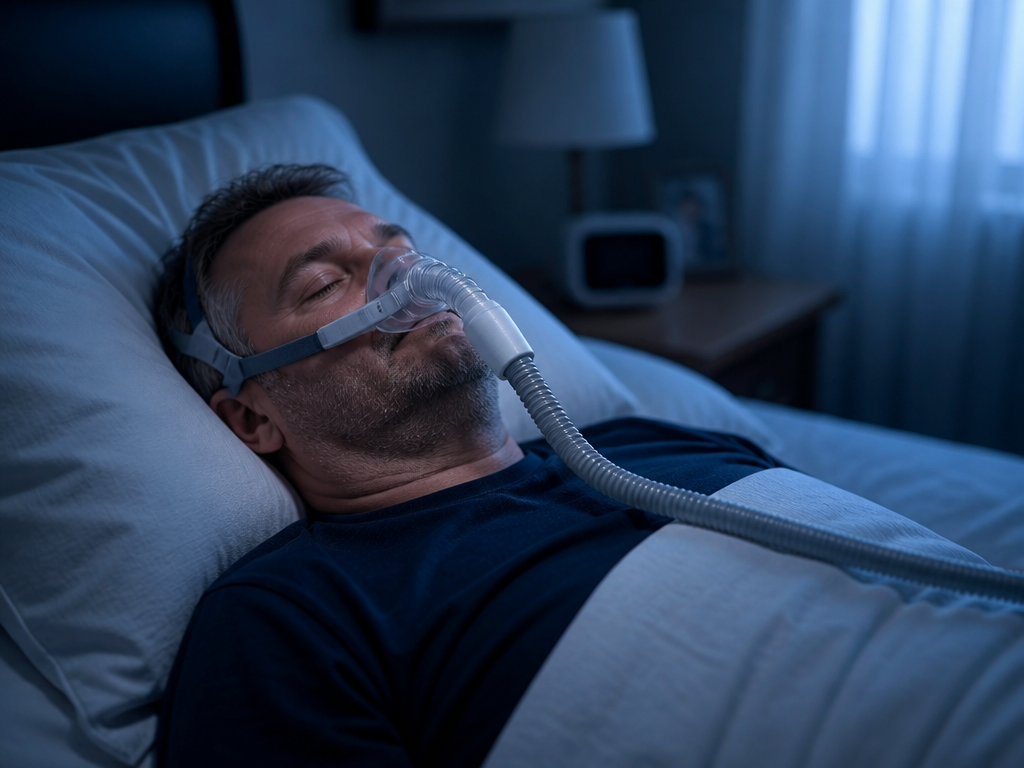
There is a claim floating around the apnea corners of the internet that you can shrink your breathing pauses by doing exercises with your tongue. It sounds like the kind of thing a wellness account would sell you. It is also, with some important qualifications, true.
The discipline is called myofunctional therapy — a set of repeated movements for the tongue, soft palate, cheeks, and throat. People reach for it because the standard treatments for obstructive sleep apnea are imperfect in their own ways. CPAP works beautifully when you wear it, and a large minority of people don't. Surgery is permanent and uneven. Into that gap walks a low-cost option with a number attached: somewhere around a 50% drop in apnea severity in adults. The number is real. The story behind it is more interesting, and a little more demanding, than the number alone.
What actually collapses when you stop breathing
Start with the anatomy, in the order events happen. You fall asleep. Muscle tone drops everywhere, including in the roughly twenty muscles that hold your upper airway open. The airway behind your tongue and soft palate has no rigid scaffolding — no bone, no cartilage — so it depends on those muscles staying just taut enough. The genioglossus, the big fan-shaped muscle that forms most of the tongue, is the main one. During wakefulness it fires constantly to keep the tongue forward and the airway patent. During sleep, its drive falls.
In most people that's fine. In someone with a narrow or crowded airway, the relaxed tongue and floppy palate get pulled toward the back wall on each inhale, the way a paper straw caves when you suck too hard on a thick shake. The airway narrows (a hypopnea) or seals shut (an apnea). Oxygen dips, carbon dioxide climbs, and the brain triggers a brief arousal to restore tone. You gasp, the airway reopens, you don't remember it, and it repeats — sometimes dozens of times an hour. That count, events per hour, is the apnea-hypopnea index, or AHI.
The premise of myofunctional therapy is straightforward: if collapse is partly a problem of muscle tone, and muscle responds to training, then targeted exercise might leave the airway better defended at the moment tone drops. Plausible. The question is how much, and against what.
Three things worth comparing
It helps to line myofunctional therapy up against the realistic alternatives rather than judging it in isolation. Four criteria matter: how much it lowers AHI, whether the effect lasts, what it costs you in effort, and how it interacts with adherence.
| Doing nothing | CPAP alone | Myofunctional therapy (adjunct or standalone) | |
|---|---|---|---|
| AHI reduction | None | 60–90% when worn all night | ~50% in pooled trials for adults |
| Durability | — | Only on nights you wear it | Effect persisted at follow-up in small studies |
| Effort cost | Zero | Mask, machine, habit | 10–30 min daily, for months |
| Adherence trap | — | ~30–50% abandon it | Tedium; easy to quit early |
The table makes the honest tension visible. CPAP is the heavyweight: when it's on your face, it essentially eliminates events, because it splints the airway open with air pressure rather than asking your muscles to do anything. That is also its weakness. A device that only works while worn is hostage to whether you wear it, and the long-tail abandonment rate is the central unsolved problem of apnea care.
Myofunctional therapy is the opposite shape of intervention. It does less per night than a well-fitted mask. But what it changes, it changes about you — the tone of the tissue — so the benefit isn't switched off the moment you stop. That's the trade the rest of this piece is really about.
What the research actually measured
The headline number comes from a meta-analysis by Camacho and colleagues (2015), published in Sleep, which pooled nine adult studies covering 120 patients. Across them, myofunctional therapy lowered AHI by roughly 50% in adults — from an average of about 24 events per hour down to about 12. It also reduced the lowest overnight oxygen dip and cut snoring and daytime sleepiness scores. Two caveats sit on top of that: 120 is a small total, and the individual studies used different exercise protocols, so "myofunctional therapy" isn't a single standardized thing.
The cleanest single trial inside that literature is Guimarães et al. (2009), also in an American Thoracic Society journal, a randomized controlled trial of 31 adults with moderate OSA. The exercise group did about 30 minutes of daily oropharyngeal exercises for three months; the controls did sham breathing and nasal rinsing. AHI fell from roughly 23 to 14 in the treatment group and barely moved in the controls. Neck circumference shrank slightly. Snoring dropped.
So the effect is real and reproducible, but read the magnitude carefully. Cutting AHI in half is meaningful if you start at 20. If you start at 60 — severe disease — halving still leaves you at 30, which is still severe. This is why the consensus places myofunctional therapy in mild-to-moderate disease, and as an adjunct in worse cases, not a replacement for primary treatment. The data thin out quickly past that boundary, and the confidence with which it's sometimes pitched outruns the evidence.
Where it fits, and the adherence angle
There's a second-order benefit that doesn't show up in AHI tables. People who do a small daily practice aimed at their airway tend to engage more with the rest of their treatment. The mechanism here is behavioral, not muscular, and the evidence is more "plausible" than "established" — but it lines up with what's known about CPAP habit formation, where the strongest predictor of long-term use is what happens in the first weeks. A daytime ritual that keeps the problem salient, without the friction of a mask, may help that habit set. Treat that as a reasonable bet, not a proven outcome.
There's also pediatrics, where the picture is encouraging and outside our scope here: in children, myofunctional therapy after adenotonsillectomy appears to reduce relapse, which is part of why the mechanism is taken seriously at all.
For adults, the practical reading is this. If your AHI is in the single digits to low twenties, myofunctional therapy is one of the few non-pharmaceutical, non-surgical things with randomized evidence behind it. If you're on CPAP and tolerating it poorly, it's a low-risk addition that might lower the pressure you need or simply keep you invested. If your apnea is severe, it is a supporting actor, not the lead.
An honest rule of thumb
Give it twelve weeks before you judge it. Muscle adaptation is slow, the trials that worked ran for three months, and most people who quit do so in the first fortnight — before anything could have changed. Aim for short and daily over long and occasional; consistency is doing the work here, not intensity. And do it under a clinician's eye if you can, because the protocols vary and a myofunctional therapist or sleep dentist can correct form that a YouTube video can't.
Something to try this week
Pick one exercise and do it for five minutes a day, every day, before you brush your teeth at night. The standard starter is the tongue press: place the entire tongue flat against the roof of your mouth, press firmly, and hold for a slow count of ten, then release — twenty repetitions. It's tedious. That's the point; tedium is the dose. If you can keep that one habit alive for a week, you've cleared the hurdle that defeats most people, and you've learned something real about your own discipline before you build anything larger on top of it.
Train the muscle that holds the door open, and the door is a little less likely to swing shut without you.