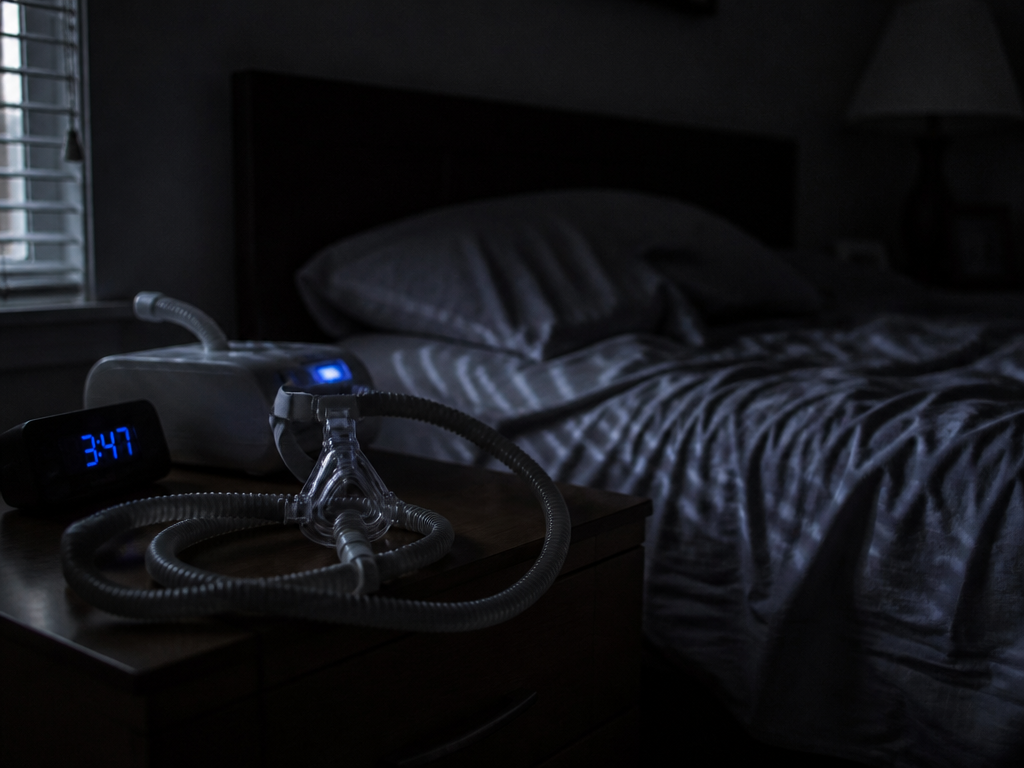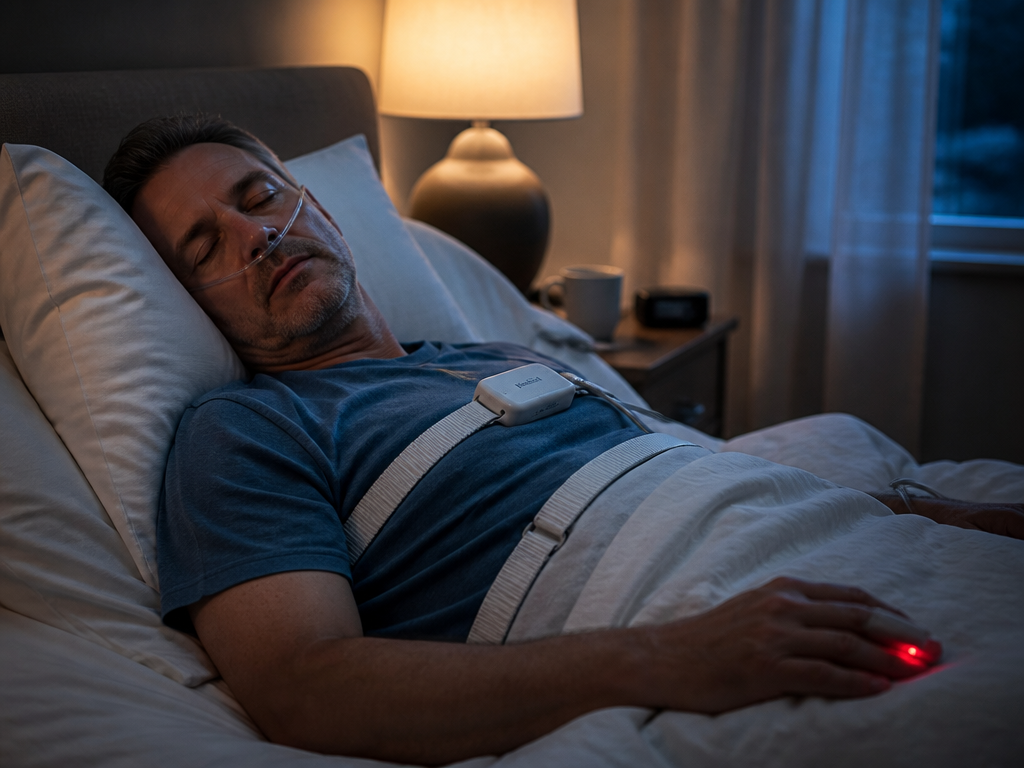
For three months my partner kept sending me phone recordings: a low saw of a snore, then a gap, then a gasp that sounded like surfacing from deep water. I was sleeping eight hours and waking up as if I hadn't. So I did the unglamorous thing — a referral, a take-home sleep study, then a daytime drug-induced sleep endoscopy where a camera watches your airway collapse in real time. This piece is what I learned, organized the way air actually travels: in through the lips, past the tongue, down to the place where things close.
The verdict first, because that's what you came for: in obstructive sleep apnea, the tongue is rarely the sole villain, but for a specific anatomical profile it acts as the closing valve — and you can often guess which profile you have before a lab confirms it.
Where air enters: the lips and the front of the mouth
The mouth is supposed to be a backup. Resting, healthy breathing runs through the nose, which warms and filters air and — crucially — keeps the lower jaw and tongue forward. The moment you default to mouth-breathing, that scaffolding loosens. The jaw drops, the tongue follows it back, and the airway behind starts the night already narrowed.
I am a chronic mouth-breather; my nose runs congested most evenings. On the endoscopy the technician noted my mouth fell open under sedation within seconds. This is the cheap, visible clue most people miss. Before any talk of tongue fat or jaw geometry, ask the simpler question: does the reader breathe through their nose at night, or their mouth? Mine was answered before the camera reached the tongue.
The tongue body: more muscle, more fat, more problem
The tongue is mostly genioglossus, a fan-shaped muscle anchored to the inside of the lower jaw. Awake, it holds tone and stays put. Asleep, that tone drops, and gravity has its say.
Two things change how much that matters. The first is macroglossia — a tongue that's simply large for the mouth holding it. A reliable sign: scalloped, wavy edges where the tongue presses against the teeth all night. Mine has them. The second is less visible and more interesting: tongue fat. Imaging studies of OSA patients have found measurably higher fat volume in the tongue compared with matched controls, concentrated at the base. That's the part that falls backward. A tongue can look normal in a mirror and still be heavy enough at the root to occlude an airway under sedation.
My tongue measured large but not pathologically so. The fat distribution I couldn't see; the clinic doesn't do volumetric MRI as routine. So I'll be honest about the limit of my own data here — I know my tongue is big, I do not know precisely how heavy its base is.
The collapse zone: base of tongue meets soft palate
This is where the apnea happens. At the back of the throat, the base of the tongue sits just in front of the soft palate and the posterior pharyngeal wall. Three soft structures, one narrow space.
The Mallampati score is the quick clinical proxy: open wide, and a clinician grades how much of your throat the tongue hides. Class I, you can see the whole soft palate; Class IV, the tongue blocks almost everything. Higher classes correlate with higher apnea risk because they describe, in a single glance, how crowded the back of the mouth already is while you're awake and upright. Lying down and asleep only makes it worse.
On the endoscopy I watched my own collapse on the monitor. As sedation deepened, the base of my tongue rocked backward and met the soft palate descending toward it — a two-structure pinch the literature calls retroglossal and retropalatal collapse happening together. The airway didn't narrow so much as it closed, like two halves of a curtain.
Three ways an airway closes
Not every airway closes the same way, which is why one-size treatment fails so often. Drug-induced sleep endoscopy sorts patients into rough profiles. Here are the three I saw described, with the criteria that distinguish them.
| Profile | Primary closing structure | Tell-tale signs | Responds well to |
|---|---|---|---|
| Tongue-dominant | Base of tongue falling back | Scalloped edges, high Mallampati, large/heavy tongue | Mandibular device, positional therapy, sometimes hypoglossal nerve stimulation |
| Palate-dominant | Soft palate and uvula | Loud palatal snore, long soft palate, lower Mallampati | CPAP, palatal surgery in selected cases |
| Jaw-dominant | Recessed lower jaw crowding everything forward | Small or set-back chin, normal-size tongue in a too-small space | Mandibular advancement, orthognathic surgery |
Most real airways, including mine, are blends. I came out tongue-dominant with a jaw contribution: a large tongue in a slightly small mouth, the worst geometry for the back of the throat.
What my numbers actually said
For the reader who wants specifics rather than adjectives, here is my chart:
- Apnea-hypopnea index (AHI): 22 events per hour — moderate OSA (15–30 is the moderate band).
- Mallampati: Class III.
- Neck circumference: 42 cm, just over the 43 cm threshold often flagged for men but close enough to count against me.
- Lowest oxygen saturation: 84% during the worst event.
- Endoscopy finding: concentric collapse at the tongue base and soft palate, mouth open.
Twenty-two events an hour means my airway closed, on average, roughly every three minutes. The gasps my partner recorded were the reopenings.
Who this is for, and who it isn't
This applies to you if: you snore with witnessed pauses, wake unrefreshed, have scalloped tongue edges or a crowded-looking throat in the mirror, default to mouth-breathing, or carry weight at the neck. The anatomical clues above are worth checking yourself, then bringing to a clinician.
This probably isn't your story if: your fatigue has no breathing component — no snoring, no witnessed pauses, normal nighttime breathing per a partner or a recording app. Daytime exhaustion has many causes, and a too-large tongue is a poor scapegoat for all of them. Sorting that out needs an actual sleep study; self-mapping in a mirror identifies risk, not diagnosis.
If you remember one line: a scalloped, oversized tongue in a high-Mallampati throat is the single most screenshot-worthy clue that your apnea is tongue-driven — and tongue-driven apnea is the kind that often shrugs off CPAP and responds to something else.
The question I left the clinic with
Here is where the science stops being clean. The tongue-fat findings are real and replicated — heavier tongue bases collapse more readily. And there's early evidence that weight loss reduces tongue fat specifically, not just body fat broadly, with airways measurably opening up afterward.
But I can't get a straight answer to the obvious follow-up: in a mouth that is simply too small for its tongue, does removing fat change anything? Or is the limiting factor pure geometry — a fixed volume of muscle in a fixed bony box, where no amount of fat reduction moves the base of the tongue far enough forward to matter? The studies measuring fat and the studies measuring jaw size rarely cross-reference each other in the same patient. I am, by build, the patient where the two explanations collide. Nobody at the clinic could tell me which one governs my own airway. I'm not sure the data exists yet to say.