The advice you'll hear, from a doctor or a friend who's been through it, is compact: get diagnosed, get a CPAP machine, wear it every night, and you'll feel like a person again. It is, as far as it goes, correct. But it packs three separate claims into one sentence, and only two of them survive contact with real patients.
If you've recently been diagnosed — or you're waiting on a home sleep test and reading ahead — the useful thing to understand about sleep apnea treatment options is not which one is "best." It's where the standard recommendation is genuinely well-supported, and where it quietly assumes something about you that may not be true. That gap is where most people either recover or give up.
What is actually happening while you sleep
Obstructive sleep apnea is a mechanical problem before it's anything else, and it helps to walk through it in the order your body experiences it.
You fall asleep. The muscles of your throat — the genioglossus at the base of the tongue, the muscles of the soft palate — relax, as all muscles do in sleep. In an unobstructed airway this is fine. In a narrow or crowded one, the soft tissue collapses inward and the airway closes. You keep trying to breathe. The chest and diaphragm pull against a sealed pipe, generating pressure but no airflow.
Oxygen in the blood begins to fall. Carbon dioxide climbs. Chemoreceptors in the brainstem register this and, after several seconds to a minute, trigger a brief cortical arousal — not always a full waking, but enough to restore muscle tone and reopen the airway. You gasp, the oxygen recovers, you slide back down into sleep, and the cycle restarts. Someone with moderate apnea does this fifteen to thirty times an hour. Severe, more than thirty.
The daytime symptoms — the fog, the irritability, the falling asleep at red lights — come from that fragmentation, not from the low oxygen alone. You are being pulled out of deep sleep hundreds of times a night without ever knowing it. This is the thing every treatment is trying to interrupt.
Where the advice holds up: CPAP works
Continuous positive airway pressure does exactly what its name says. It splints the airway open with a steady stream of pressurized air, so the tissue can't collapse when the muscles relax. It doesn't sedate you or retrain anything. It's a pneumatic solution to a mechanical problem, and on that narrow question it is close to definitive.
When it's worn, it works. In properly titrated patients, CPAP drives the apnea-hypopnea index — the count of breathing interruptions per hour — from the double digits down toward the normal range of under five. Blood-oxygen dips flatten out. The evidence that it reduces daytime sleepiness and blood pressure is well-established; the evidence on long-term cardiovascular events is real but noisier, complicated by the fact that the people who use CPAP consistently differ from the people who don't.
So the first claim in the standard advice — CPAP is effective — is about as solid as sleep medicine gets. It's the second claim, the "wear it every night" part, that carries all the weight.
Where it breaks: the machine only works if you use it
Here is the number that reframes the whole conversation. Adherence to CPAP — usually defined, somewhat generously, as four or more hours a night on 70 percent of nights — sits in the range of 30 to 60 percent depending on the population studied and how you count. A frequently cited review, Weaver and Grunstein (2008) in the Proceedings of the American Thoracic Society, put non-adherence around a quarter to a half of patients, and that figure has proven durable.
Think about what that means. The single most effective treatment we have fails, in practice, for something like a third to a half of the people prescribed it — not because it doesn't clear the airway, but because they stop putting it on. The mask leaks, or dries out the nose, or the strap marks the face, or the hose tugs when they roll over, or the partner finds the whir intolerable, or it simply feels like sleeping inside a small appliance.
None of that shows up in an efficacy trial, because trials measure the device against the airway, not the device against a human being's tolerance over years. This is the crucial distinction: CPAP is the most effective treatment on paper, and the most effective treatment you'll actually use may be a different thing entirely. The best therapy is the one that clears your airway and stays on your face.
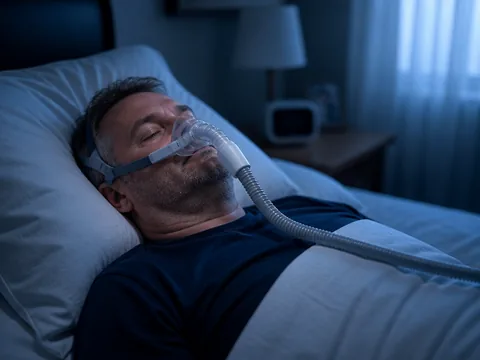
Modern machines have narrowed the gap. Auto-adjusting pressure, heated humidification, quieter motors, and a menu of mask styles — full-face for mouth breathers, nasal masks, and minimal nasal-pillow designs that seal at the nostrils — solve a lot of the early complaints. If your first mask is miserable, that is a fitting problem, not a verdict. Fixing it is a conversation with your sleep clinic, not a reason to quit.
The other real options, ranked honestly
Oral appliances are the most important alternative, and they're often undersold. A mandibular advancement device — fitted by a dentist, it holds the lower jaw slightly forward to keep the airway open — is less effective than CPAP at lowering the AHI in head-to-head trials. But people wear them. Because adherence is higher and the mouthpiece is smaller than a machine, the real-world benefit for mild-to-moderate apnea can come out roughly even. For that group, a lower-efficacy device used every night can beat a higher-efficacy device used three nights a week.
Weight loss matters and is worth stating without moralizing: fat deposition around the airway is one of the strongest modifiable risk factors, and meaningful weight reduction can lower the AHI substantially, sometimes resolving mild cases. It is slow, it is hard, and it is not a reason to defer treatment while you attempt it. Positional therapy helps the subset of people whose apnea is much worse on their back — worth testing, limited in scope.
Surgery sits at the intensive end, and here the honesty is important: for soft-tissue procedures like uvulopalatopharyngoplasty, published success rates are modest and inconsistent, commonly cited around 40 to 60 percent, with few large controlled trials to anchor the number. Hypoglossal nerve stimulation — an implanted device that gently activates the tongue muscle in time with your breathing — has better data in carefully selected patients (the STAR trial, Strollo et al., 2014, New England Journal of Medicine, followed 126 patients and showed durable AHI reduction), but the selection criteria are narrow and it's an implant.
A rule of thumb you can use tonight
| If your apnea is... | Reasonable first move |
|---|---|
| Moderate to severe | CPAP, with a serious mask-fitting effort before judging it |
| Mild to moderate | CPAP or an oral appliance — ask which you're likelier to actually use |
| Clearly worse on your back | Add positional therapy; don't rely on it alone |
| Tied to recent weight gain | Treat now; pursue weight loss in parallel, not instead |
The honest rule of thumb: judge any device by whether it will still be on your face in six months, not by its score in a trial. If you're two weeks into CPAP and hating it, that's a fitting appointment, not a failure. If you're two months in and still hating it, an oral appliance consult is a legitimate next step, not a defeat.
The standard advice, revised: get diagnosed, then find the treatment that clears your airway and survives your actual nights — and expect that to take a little tuning.
I'll say what that looks like for me. I use a nasal-pillow mask, not because it's more effective — it isn't, quite — but because the full-face mask I started with made me claustrophobic and I'd wake up having torn it off in the dark. The smaller one stays on. That's the whole argument, lived out: the best machine is the one I don't take off.