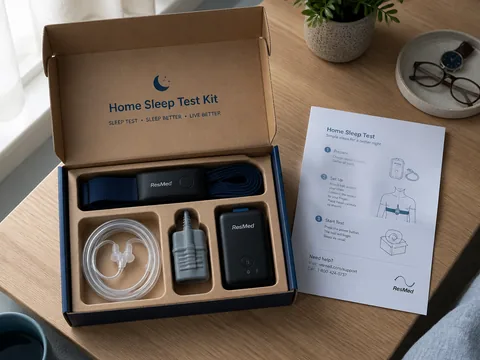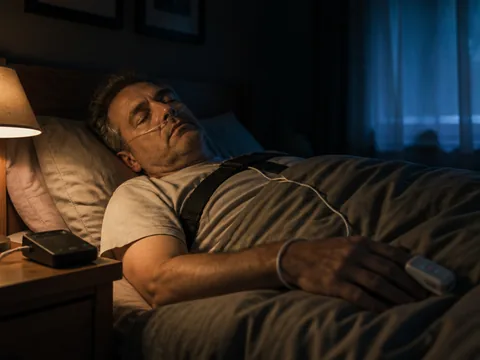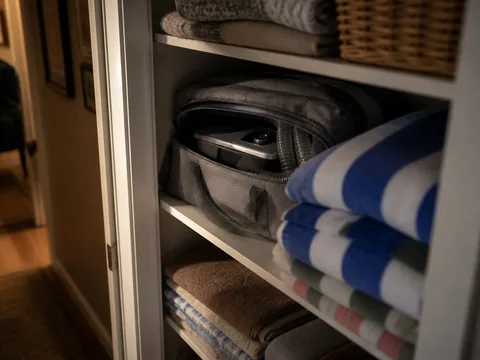
The machine is usually in a closet. Second shelf, behind the beach towels, still in the tote bag the equipment company handed over at the fitting. Eleven nights of use. Maybe thirty. Then the mask started leaking air into one eye, and the humidifier gurgled, and the whole apparatus went back in the bag.
If that's your closet, you're not unusual, and the search you've been running at 2 a.m. — sleep apnea treatment alternatives, sleep apnea dentist near me — is a reasonable search. What almost nobody tells you first is where the standard you failed came from. It has a source. The source is thinner than the belief built on top of it.
The default started with five people
Obstructive sleep apnea is a young diagnosis. The commonly cited first description is Gastaut, Tassinari, and Duron, working in Marseille in 1965–66, who put polygraph leads on obese "Pickwickian" patients and discovered that the daytime sleepiness everyone had blamed on body weight was actually the residue of hundreds of nightly breathing stoppages. For the next fifteen years, the only reliable fix was a tracheostomy — Kuhlo and colleagues reported it in 1969. You bypassed the collapsing throat by cutting a hole below it. It worked. It also meant a permanent stoma in your neck, closed with a plug during the day.
Then, in 1981, Colin Sullivan's group at Royal Prince Alfred Hospital in Sydney published a short paper in The Lancet: continuous positive airway pressure delivered through the nose. The apparatus was improvised — a blower motor of the sort found in a vacuum cleaner, tubing, and masks molded to each patient's nose with silicone. Five patients. In all five, the apneas stopped on the first night.
That result is genuinely one of the great moments in sleep medicine. It's also worth noticing what happened next: a five-person physiology demonstration became, within a decade, the gold standard against which every other treatment would be measured — before the large trials on hard outcomes existed. The pressure obviously splinted the airway open. The polysomnograms were dramatic. The mechanism was so satisfying that the question of long-term benefit felt already answered.
What happens in your throat, in the order it happens
Here's the sequence a mandibular advancement device is trying to interrupt.
You fall asleep, and motor tone drops across your skeletal muscles — including the genioglossus, the fan-shaped muscle that anchors at the inside of your chin and forms the bulk of your tongue. Awake, it fires with every breath to hold the tongue base forward. Asleep, it relaxes. Now you inhale, and your diaphragm generates negative pressure inside a tube whose walls are soft tissue and no cartilage. The pharynx narrows — most often behind the soft palate, sometimes behind the tongue. Airflow stops while your chest keeps heaving. Oxygen saturation falls; carbon dioxide climbs; chemoreceptors in the carotid body and brainstem register both. The brain responds with a cortical arousal — brief, usually not remembered — muscle tone snaps back, the airway pops open, and you take a gasping breath. Along the way, a sympathetic surge spikes your blood pressure. Then you fall back asleep, and it starts again. Thirty times an hour is moderate disease.
A custom oral appliance holds the lower jaw forward, typically at 50–75% of your maximum voluntary protrusion. Because the genioglossus originates on the mandible, moving the mandible forward pulls the tongue base with it. Less obviously — and this is the part that matters more — advancement puts tension on the palatoglossal and palatopharyngeal folds, which stiffens the lateral walls of the pharynx and widens the space behind the soft palate. It doesn't add pressure. It changes the geometry.
Does an oral appliance work as well as CPAP?
Not on the sleep study. Often, in real life, close to it. The cleanest comparison is Phillips et al. (2013) in the American Journal of Respiratory and Critical Care Medicine: 108 patients with moderate-to-severe apnea used CPAP and a custom titratable appliance for a month each, in randomized order. CPAP was clearly the better machine — it dropped the apnea-hypopnea index from about 26 events per hour to roughly 4, while the appliance reached about 11. But patients wore the appliance about an hour longer per night, and on the outcomes people actually care about — 24-hour blood pressure, daytime sleepiness, quality of life — the two treatments came out largely indistinguishable.

That gap has a name. Efficacy is how well a treatment works when used. Effectiveness is efficacy multiplied by the hours you actually use it — the concept usually credited to Grote and colleagues (2000) as "mean disease alleviation." A device that fixes 85% of your events for seven hours can beat one that fixes 95% for three. Vanderveken et al. (2013), Thorax, embedded microsensor chips in appliances to measure wear objectively rather than trusting self-report, and found compliance in the range of six-plus hours a night.
What the appliance costs you
This is where the marketing usually goes quiet. Roughly six in ten patients get at least a 50% reduction in their AHI from a mandibular device; something like a third to a half get all the way down to near-normal. Which means a substantial minority get very little — and here is the honest part: we still cannot reliably predict who. Smaller neck, lower BMI, milder disease, younger age, and supine-dominant apnea all tilt the odds, but no clinical model performs well enough to skip the confirmatory sleep test.
Side effects are real and mostly minor: morning jaw soreness, excess saliva or dry mouth, transient bite changes that resolve within an hour. The long-term one is not minor. Pliska et al. (2014), Journal of Clinical Sleep Medicine, followed patients across roughly a decade of nightly wear and documented overbite and overjet shrinking progressively — the teeth move, slowly, and the change did not plateau. That is a trade you can accept knowingly. It should not be sprung on you in year seven.
The rest of the menu
| Option | What it does | Best evidence |
|---|---|---|
| Positional therapy | Keeps you off your back | Helps only supine-dominant apnea; cheap to test |
| Weight loss | Reduces parapharyngeal fat load | Foster et al. (2009); AHI falls, rarely to zero |
| GLP-1 / tirzepatide | Same pathway, pharmacologically | Malhotra et al. (2024), NEJM, 469 patients — large AHI drops, new data |
| Hypoglossal nerve stimulation | Implant paces the genioglossus | Strollo et al. (2014), NEJM, 126 patients; strict eligibility |
| Airway surgery | Removes or repositions tissue | Highly variable; MMA is the most effective and most invasive |
An honest rule of thumb
If you've abandoned CPAP, do this in order, starting tonight. Get the diagnosis from a physician, not a dentist — a dental practice in Woodland Hills can order a home sleep test and fabricate the device, but a board-certified sleep physician interprets it and makes the diagnosis. Then insist on three things from whoever makes your appliance: that it's custom and titratable (adjustable in small increments over weeks, not a boil-and-bite from a website), that the dentist holds American Board of Dental Sleep Medicine credentialing rather than a weekend certificate, and that you get a repeat sleep test after the device is fully titrated. An untested appliance is a mouthguard you feel good about. Whether it's treating you is an empirical question with an available answer.1
The question underneath all of it
In 2016, McEvoy and colleagues published the SAVE trial in the New England Journal of Medicine: 2,717 patients with moderate-to-severe apnea and existing cardiovascular disease, randomized to CPAP or usual care. CPAP improved snoring, sleepiness, and mood. It did not significantly reduce heart attacks, strokes, or cardiovascular death. Average nightly use was 3.3 hours, which may be the whole explanation — or may not be.
No trial of that size has ever been run on oral appliances. So the thing we are all optimizing — a number on a sleep report — has never been convincingly shown, by any treatment, to be the thing that protects the heart. Twenty years from now, will we find that the number was the point, or that the number was only ever the part we knew how to count?
-
Oral appliances for apnea are typically billed to medical insurance as durable medical equipment (code E0486), not to dental benefits — a distinction that surprises most patients and some front desks. ↩