Whether you keep using a CPAP machine is mostly decided in the first ten days, and it depends less on your character than on whether someone from the clinic contacts you on day four.
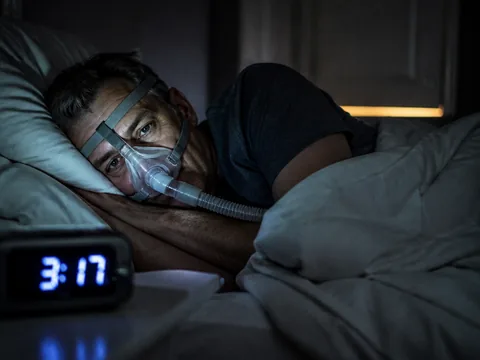
That sentence is unfashionable, so the rest of this piece is an attempt to earn it. The literature on sleep apnea prevalence and epidemiology is large, careful, and genuinely useful — and it is not the reason most people quit. People quit because at 3 a.m. on a Tuesday the mask leaks into their left eye, and there is no one to tell.
Everyone quotes the prevalence numbers. Almost nobody quotes the adherence ones.
The figure you've probably seen: Benjafield et al. (2019), in The Lancet Respiratory Medicine, estimated that 936 million adults aged 30–69 worldwide have obstructive sleep apnea at an apnea-hypopnea index of 5 or more, and 425 million have it at moderate-to-severe levels. That is a real, careful paper, and it is also a model — the authors built it by extrapolating from a limited set of population studies using age and BMI distributions, and they say so plainly. It is an estimate of how many people would meet criteria if you tested everyone. Nobody tested everyone.
The measured numbers are smaller in scope and firmer in ground. Peppard et al. (2013), in the American Journal of Epidemiology, re-analyzed the Wisconsin Sleep Cohort with modern scoring rules and found moderate-to-severe sleep-disordered breathing in about 13% of men and 6% of women aged 30 to 70. Those are actual overnight recordings. They are also one American state, mostly employed, mostly white, from a cohort that began in 1988. The commonly cited claim that the large majority of cases go undiagnosed is directionally well-supported and precisely quantified less often than it's repeated.
So: the epidemiology of sleep apnea gives you a prior. If you're a 54-year-old man with a 17-inch neck who snores and wakes at 4 a.m. to urinate, your prior is high. Useful. What the prevalence literature cannot tell you is anything about the part that actually decides your outcome, which is what happens between the day the machine arrives and the day two weeks later when you either sleep with it or don't.
One obstructive event, start to finish
It helps to know what the machine is for, in the order the body does it.
You fall into non-REM sleep. Tone drops in the genioglossus and the other pharyngeal dilator muscles — the ones that hold your throat open, which, unlike your windpipe, has no cartilage ring to keep it from collapsing. You inhale. Inhalation generates negative pressure inside a floppy tube. The tube closes.
Now the interesting part: you keep trying. The diaphragm pulls harder, the chest and abdomen move, and no air enters. Over the next 20 to 40 seconds, oxygen saturation slides — 96%, 93%, 88%, sometimes lower. Carbon dioxide climbs. Carotid and central chemoreceptors register both and fire. Sympathetic outflow surges: catecholamines up, heart rate up, blood pressure spiking to levels that would alarm anyone who saw them on a daytime cuff. Then a cortical arousal, three seconds long, not remembered. Muscle tone returns, the airway snaps open, and you gasp.
Then you go back to sleep and do it again. Thirty times an hour is 240 times a night. The next morning you say you slept fine.
CPAP is a pneumatic splint against exactly this. It is not oxygen and it is not breathing for you. It is a column of air, typically 4 to 20 cm H₂O, holding the tube open from the inside. Mechanically it is almost stupidly simple, and that is the whole problem — nothing about the therapy is medically hard, and everything about it is behaviorally hard.
Why "compliance" is the wrong word
Kribbs et al. (1993), in the American Review of Respiratory Disease, put covert monitors on 35 patients' machines and compared measured use against what patients reported. Reported use exceeded actual use by roughly an hour a night. This was not lying so much as it was the ordinary human inability to audit one's own unconscious hours — and it was the moment the field learned it had to measure.
What measurement showed: in Weaver and Grunstein's 2008 review in Proceedings of the American Thoracic Society, nonadherence rates across studies ranged from about 29% to 83%, depending on how you defined it. A range that wide usually means the variable being measured isn't really a property of patients.
And here is the finding that reframes everything. Budhiraja et al. (2007), in the Journal of Clinical Sleep Medicine, tracked early use patterns and found that how much a patient used the machine in the first week strongly predicted use at 30 days. The trajectory was set almost immediately. Not by motivation assessed at intake, not by disease severity — by the first few nights.
Which means the follow-up schedule most systems use, where you get the machine and a phone number and are seen again in three months, is structured to miss the entire event. The Cochrane review by Askland et al. (2020) pooled trials of educational, supportive, and behavioral interventions and found they meaningfully increase usage — for behavioral therapy, on the order of an extra hour a night, though the trials were heterogeneous enough that the pooled figure should be read as "this works" rather than "this works by exactly this much." An hour a night is a large effect for something that costs a phone call.

Adherence, in other words, is an output of the care system, not a trait of the patient. If your clinician talks about it as something you either have or lack, that's a tell.
How many hours a night do you actually have to use it?
There is no single number, and anyone who gives you one is quoting insurance rather than physiology. The common requirement — four hours a night on 70% of nights over a 30-day window — is an administrative threshold, not a biological one.¹ The real relationship is a dose-response curve, and different symptoms sit at different points on it.
Weaver et al. (2007), in Sleep, followed 149 patients and found that outcomes normalized at different doses: subjective sleepiness on the Epworth scale improved by about four hours of nightly use, objective alertness on the multiple sleep latency test closer to six, and daily functional outcomes closer to seven and a half. More is better, essentially all the way to a full night.
This matters for reading the cardiovascular literature honestly. McEvoy et al. (2016), in the New England Journal of Medicine, randomized 2,717 patients with sleep apnea and existing cardiovascular disease to CPAP or usual care and found no reduction in cardiovascular events. Mean nightly use was 3.3 hours. Two readings are available: CPAP doesn't prevent heart attacks, or the largest trial to test it never delivered a therapeutic dose. Both are live. What's well-established is that CPAP abolishes the events and improves sleepiness and blood pressure; that it prevents cardiac events is plausible but not demonstrated, and the trial design is a fair reason why.
Where the coffee comes in
Most people arrive at a sleep clinic already treating themselves — with caffeine, at a dose they'd be startled to see written on a prescription. This creates a quiet trap. Caffeine blocks adenosine receptors, suppressing the sleepiness signal that would otherwise be the most reliable feedback that the machine is working. Patients on a heavy afternoon load often report no daytime improvement in week three, because the symptom they'd have noticed improving was already chemically masked.
It also cuts the other way. Drake et al. (2013), in the Journal of Clinical Sleep Medicine, gave 12 subjects 400 mg of caffeine at 0, 3, and 6 hours before bedtime; even the dose six hours out cost more than an hour of measured sleep. If you are trying to learn to sleep in a new mask, a 4 p.m. coffee is competing directly with that project.
The clinical observation that people successfully treated for apnea drift down in caffeine intake without deciding to is common and, as far as I can find, essentially unstudied. Treat it as a thing worth watching in yourself, not as evidence.
An honest rule of thumb
Wear it while you're awake first. Twenty minutes on the couch with the machine running — reading, watching something — for three or four evenings before you ask yourself to fall asleep in it. You are asking your nervous system to accept a novel sensation on your face during the one state in which it cannot evaluate threats. Do that negotiation with the lights on.
And when something goes wrong in week one, it is almost always fixable equipment, not failed therapy:
| What week one feels like | Usual cause | What to ask for |
|---|---|---|
| Air blasting into your eye | Mask too tight, seal folded | A refit — often a smaller cushion, not a bigger one |
| Dry mouth, sore throat | Mouth leak, low humidity | Humidifier setting up; ask about a chinstrap |
| Can't exhale against it | Pressure feels wrong at sleep onset | Ramp feature, or expiratory pressure relief |
| Off by 3 a.m., every night | Almost always mask, rarely pressure | Download your data before changing anything² |
One thing to do this week
Set a calendar alarm for seven days from the night you start — or, if you're already three months in and quietly losing the habit, seven days from tonight. When it goes off, write down the single worst thing about using the machine in one sentence, and send that sentence to the clinic before you decide anything else. Not a complaint. A data point they can act on: air leaks onto my left cheek around 2 a.m. Most clinics can fix that in one appointment, and most never hear it, because by the time anyone asks, the machine is in the closet and the patient has decided the failure was theirs.
The machine is the easy part. The part that needs a person is the person. ¹ The four-hour figure entered American practice through Medicare coverage criteria and spread to private insurers; it was chosen to define coverage, not to define benefit.
² Every current machine reports nightly hours, mask leak, and a residual event index to a phone app or SD card. The residual index is a useful trend and a poor absolute — the algorithms differ by manufacturer and are not scored the way a sleep lab scores a study.