By ten in the morning you've had three cups, and you'd like to believe that's a preference. Some of it is. But caffeine works by blocking adenosine at its receptors — it doesn't replace sleep, it defers the bill, with a half-life near five hours in most adults. If you're drinking that much to survive a Ventura Boulevard commute, something in the night isn't working. A spouse usually says the word first. Then a physician. Then you start reading about Oral Appliance Therapy (OAT) — a custom mouthpiece, worn at night, marketed across the San Fernando Valley as the thing you do instead of the mask.
And at some point, probably around 3 a.m. with the machine humming beside you, you've asked yourself the sharper version of the question:
Would a mouthpiece actually work for me — or am I just looking for permission to quit my CPAP?
Both can be true at once. That's the honest place to start. The good news is that the first half of the question has a real answer, and there is a way to find it that doesn't require guessing.
What actually closes, and in what order
Sleep apnea is a mechanical failure, and the mechanics happen in sequence. The order matters, because it's what makes a mouthpiece a plausible fix rather than a wellness gadget.
You drift toward sleep. Tonic drive to the pharyngeal dilator muscles — chiefly the genioglossus, the muscle that holds your tongue forward — falls off. Between the back of your nose and your larynx there is no bone; that stretch of airway is a soft tube held open by muscle tone alone. You inhale, which generates negative pressure inside the tube. The tongue base and soft palate get drawn toward the back wall of the throat. Narrow it a little and the tissue flutters: that's snoring, which is vibration, not obstruction. Narrow it further and the tube seals. Your diaphragm keeps pulling against a closed door. Oxygen saturation slides, carbon dioxide climbs, and an arousal fires from the brainstem — dilator tone snaps back, the airway pops open, and you take the gasp you won't remember.
Then it repeats. Five events an hour is the diagnostic floor. Thirty-plus is severe, and some people run past sixty. Every arousal costs you deep and REM sleep and delivers a sympathetic surge to heart rate and blood pressure. Which is the real reason the coffee isn't working. The coffee is fine. The sleep underneath it is being shredded.
How the jaw changes the geometry
A mandibular advancement device — the workhorse of oral appliance therapy — holds the lower jaw forward, typically 50 to 75 percent of your maximum comfortable protrusion. Because the genioglossus and the hyoid muscles anchor to the mandible, moving the jaw forward puts tension on the tongue and the tissue slung around it. Chan and colleagues (2010), in Thorax, imaged patients' upper airways with and without a device in place and found the biggest gains were lateral — the side walls of the velopharynx — rather than front-to-back. Most people picture the jaw shoving the tongue off the back wall. The imaging suggests something closer to a tent: the walls get pulled taut.
Is an oral appliance as good as a CPAP?
On the number your doctor tracks, no. On the outcome you feel, often yes — and the reason is that those two things multiply rather than compete. Any therapy's real benefit is its efficacy times the hours you actually use it. CPAP wins efficacy by a wide margin and loses hours.
The trial usually cited is Phillips et al. (2013), in the American Journal of Respiratory and Critical Care Medicine: 126 patients with moderate-to-severe obstructive sleep apnea, randomized to a month of CPAP and a month of a titratable mandibular device, each person serving as their own control. CPAP cut the apnea-hypopnea index far more thoroughly — into the low single digits, versus roughly eleven on the appliance, from a baseline in the mid-twenties. But reported nightly use ran about an hour longer with the device, and on the endpoints patients actually experience — daytime sleepiness, quality of life, 24-hour blood pressure — the two arms landed in much the same place.
Adherence here isn't only self-report, which is worth something. Vanderveken et al. (2013), also in Thorax, embedded microsensor thermometers inside the appliances of 51 patients and measured real wear: about 6.4 hours a night across three months, with most patients using them regularly. That is an unusually honest number in a field that otherwise runs on what people say they did.
Who it works for, and who it doesn't
This is where the answer becomes it depends, and where the marketing tends to go quiet.
Prediction is imperfect. The frequently repeated summary is that roughly a third of patients get near-complete resolution, a third get meaningful partial improvement, and a third get little. The underlying literature is messier than that tidy split implies, but the shape is right. The features that tilt toward success are well established: milder disease, lower body mass index, younger age, female sex, a supine-predominant pattern where events cluster when you sleep on your back, and a naturally set-back lower jaw. Very severe apnea in a heavier body is where a device becomes, at best, part of the answer.
Then there's the requirement nobody advertises: you need teeth. Enough sound teeth in both arches to anchor the appliance, and periodontal health to tolerate nightly force. Advanced gum disease, failing restorations, or full dentures change the conversation — sometimes toward implants first.
And the limitation the brochures skip. This is not side-effect-free. Morning jaw soreness and a bite that feels off for half an hour are common early and usually settle. A minority develop persistent temporomandibular symptoms. Over years, long-term follow-ups — Marklund's Swedish cohorts are the standard citation — show small, cumulative bite changes, with overjet and overbite tending to decrease. Mostly modest, well documented, and not zero. You should hear it out loud before you start, not discover it in year four.
The part that's really keeping you out of the chair
If the reason you haven't pursued this is that you'd rather sleep badly than sit in a dental chair, that's not an unreasonable trade. It's just an outdated one.
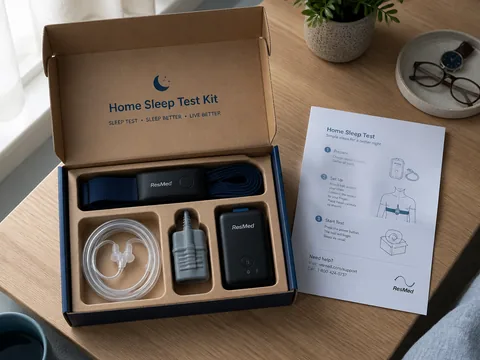
The sequence is shorter than you think. A physician diagnoses the apnea — a dentist cannot, and any Valley office willing to skip that step is one to walk out of. Diagnosis is usually a home sleep test now: a chest strap and a fingertip sensor, in your own bed in Woodland Hills, rather than a wired night in a lab across the hill. The dental part is a scan of your teeth, a bite record taken with the jaw protruded, and a visit to seat the device. The alginate trays that gave a whole generation a gag reflex have largely given way to an intraoral scanner — a wand, a few minutes, nothing setting in your mouth. Nitrous oxide is available if you want it, and practices built around anxious patients will happily split the work across shorter visits.
Then titration, which gets skipped and shouldn't. The jaw is advanced incrementally, often a quarter-millimeter at a time over several weeks, until the snoring and the events resolve without punishing your joints. In Los Angeles, a custom titratable device generally runs somewhere between $1,800 and $3,500 before insurance, and it usually bills to medical rather than dental coverage. Over-the-counter boil-and-bite versions exist. They are not what was studied.
Four questions to ask before you pay
| Ask this | A good answer sounds like |
|---|---|
| Do I need a diagnosis first? | "Yes — a physician-interpreted sleep study before we make anything." |
| Custom or over-the-counter? | "Custom and titratable, from a scan and a protrusive bite record." |
| How will we know it worked? | "A repeat sleep test with the device in, usually a few months out." |
| What happens to my bite? | "We take baseline records and recheck them, and we'll show you any change." |
A practice that answers all four without flinching is doing dental sleep medicine. A practice that answers none of them is selling a mouthguard.
An honest rule of thumb
Count nights, not intentions. If you've used your CPAP fewer than four of the last seven nights, or you wear it three hours and pull it off, then its real-world efficacy for you is not the number printed on the compliance report — and that's a clinical fact to hand your physician, not a personal failing to hide.
So do this tonight: write down the hour you actually took the mask off, and bring that number — not your best intentions — to the person who can order the sleep test, because a device you'll wear every night beats a machine you won't.