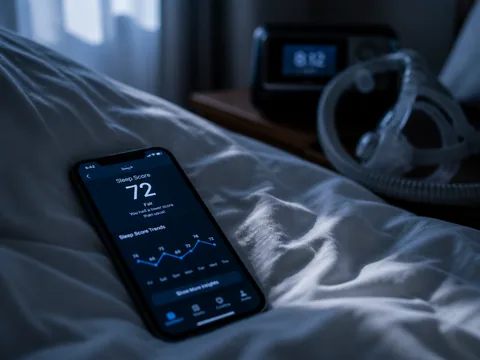
Back the founder who lived the problem. In sleep tech that advice has a specific shape: the resident who woke up on a hospital floor, the engineer whose father died at 61 in his own bed, the marathoner who spent six years being told she was anxious. I counted, because the pattern had started to feel like a template. Of the 31 sleep-tech pitch decks that founders or their investors have sent me since early 2024, 19 open on a personal medical crisis, and 12 of those crises are apnea that nobody caught. The premise underneath is that sleep apnea detection built by someone the system missed will be better at not missing you.
I spent 21 nights finding out whether that premise survives contact with the hardware it justifies.
Verdict: the origin story is a strong predictor of what a company will refuse to claim, and a weak predictor of whether its detection works on a body that isn't the founder's.
Where the advice is roughly right
The founder-diagnosed companies under-claim, consistently, and that is worth more than it sounds. Their copy says "elevated breathing disturbances" where a marketing-led competitor says "apnea detected." Their apps route you to a physician read instead of a supplement. When I asked two of them for device-versus-polysomnography agreement numbers, both declined to share anything pre-clearance, which is annoying to write around and exactly the right answer.
The decks with the medical crisis on slide two are also the decks with a regulatory pathway on slide nine and reimbursement mechanics on slide eleven. That is not a coincidence. A founder who was personally missed has usually also personally discovered that an alarming graph on a phone does not get you a titration appointment. They know the diagnostic pipeline is the product, and they budget years for the boring middle — validation cohorts, physician networks, the difference between an oxygen desaturation index and an apnea-hypopnea index — that a market-size founder abandons by month eight.
They also tend to know what the missed patient actually looks like, which is not the snoring 55-year-old man in the stock photo. It is the 32-year-old woman whose events are positional and cluster in REM, who scores fine on every screening questionnaire because the questionnaires were built on the man in the photo.
Where it breaks down
The founder's body is n=1, and it leaks into the algorithm. Tuning happens where the disease the team knows best lives. If the founding case was severe and obstructive, the thresholds get good there and stay mediocre at the border.
Urgency is not signal-to-noise. A photoplethysmography sensor pressed against a finger does not resolve a hypopnea more cleanly because the CEO nearly died. Motivation buys persistence, not sensor physics.
There is survivorship bias inside the origin story itself. The founders who got diagnosed after seven years were sick enough to eventually be caught. Nobody founds a company off an AHI of 9. But the AHI of 9 is where the entire consumer category is actually operating, and it is the hardest number to get right.
In coverage, the story crowds out the statistic. The stroke gets four hundred words. The agreement data gets a subordinate clause, if it appears at all. I have contributed to this.
The test I ran
I am 41, six foot one, 178 pounds, BMI around 23 — not the textbook patient, which is the point. My partner reports snoring and occasional pauses. I ordered a mail-order home sleep apnea test with a physician read: $189 out of pocket, two nights of recording. Night one came back at an AHI of 9.4. Night two, 11.2. Oxygen desaturation index 7.8. That straddles the mild/moderate line, and the border is where detection claims deserve to be judged, because every device on the market catches an AHI of 42.
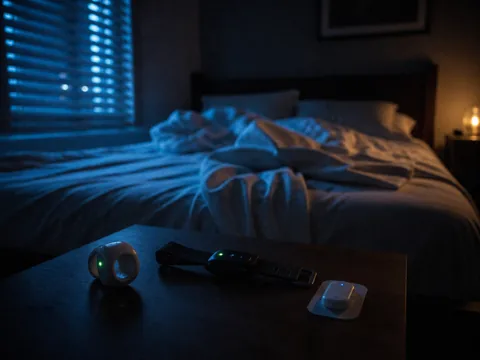
Then 21 consecutive nights wearing three consumer devices at once: a ring on the left index finger, a band on the right wrist, a sensor mat under the mattress. I am not naming them. One sleeper, one unit of each, three weeks — that is not a brand verdict, and publishing it as one would be the sort of review I don't trust when other people write it.

| Device | Price | What it claims | Nights flagged (of 21) | Against my home test |
|---|---|---|---|---|
| Ring A | $349 + $5.99/mo | "Breathing regularity" index | 3 | Called both reference nights normal |
| Band B | $199 | Apnea notification over a 30-night window | 0 in-window; 11 marked "elevated" nightly | Directionally closest, nothing actionable |
| Mat C | $279 | Estimated respiratory events per hour | 19 | Mean 21.4/hr vs my measured 9.4 and 11.2 |
| Home test | $189, two nights | AHI and ODI, physician read | — | Reference |
The split is the finding. Ring A almost never flagged anything; Mat C almost always did. They cannot both be describing the same three weeks. Ring A returned "breathing regularity: normal" on precisely the two nights a scored recording found 9.4 and 11.2 events per hour — the only two nights where I could check it, and it missed both. Mat C ran a little over double the reference: right that something is happening, wrong by a factor that would move me across a treatment threshold. Band B tracked the shape of my worse nights better than either, then declined to conclude anything inside my window, which is the correct behavior from a device with a 30-night model and, if you are a worried person who just spent $199, an infuriating one.
The caffeine variable
On 7 of the 21 nights I took 200 mg of caffeine at 12:30 p.m. — a large drip coffee, alternating blocks, nothing after 9 a.m. on the other 14. Onset latency was self-logged by phone timestamp, so treat it as soft: median 14 minutes on control nights, 26 on caffeine nights.
Mat C's estimated respiratory events climbed from a mean of 19.1 per hour on control nights to 26.8 on caffeine nights. That is a 40% swing attributed to breathing, on nights when the more parsimonious explanation is arousals and lighter sleep. Ring A's regularity index did not move at all. Band B's nightly "elevated" marks clustered on caffeine nights, six of seven.
I had no reference recording on any caffeine night, so this is device-versus-device, not device-versus-truth. But a detector whose respiratory number rises 40% because of an afternoon coffee is partly reporting on the coffee.
What I couldn't test
No lab polysomnography — the home test is itself a floor, since it divides events by time in bed rather than time asleep and tends to read low. Two reference nights against 21 test nights is a thin denominator. One body, one phenotype, no controlled sleep position, no alcohol arm. Band B pushed firmware on day 12 and I did not restart the count. And I never tested the thing these companies actually stake their differentiation on: whether a flag turns into a diagnosis and a treated patient. That takes months, a payer, and a physician network. It cannot be reviewed from a bedroom.
Who this is for, and who it isn't
For: people at the border. Thin, young, female, or otherwise not the screening-questionnaire patient, with a partner who has noticed something. Also for anyone reading a deck this quarter — the origin story is a real signal about scope and staying power, just not about sensitivity.
Not for: anyone with witnessed pauses and daytime sleepiness right now. You are not gathering evidence, you are delaying. And not for people who want a device to decide whether to see a doctor they have already decided to see.
If you want a number, buy the $189 home test. If you want a nudge toward the $189 home test, the ring is fine. Nothing on my nightstand replaced the read. The winner of this comparison is the cheapest thing in it, which is not a satisfying outcome for a hardware review and is the outcome I got.
A more honest version of the rule
Back the founder who lived the problem — for scope, not for sensitivity. The origin story tells you what a company will refuse to claim, how long it will tolerate the unglamorous middle, and whether it understands that detecting sleep apnea is worthless without the appointment on the other side. It tells you nothing about whether the sensor agrees with a scored recording on a body unlike the founder's. So take the crisis on slide two at full value, then turn to the slide with agreement statistics on patients who are not the founder, and read that one twice.
Nineteen of thirty-one decks open on a medical crisis. I would still read all nineteen first. I would just stop treating the founder's body as the evidence and start treating it as the reason someone bothered to go looking for some.