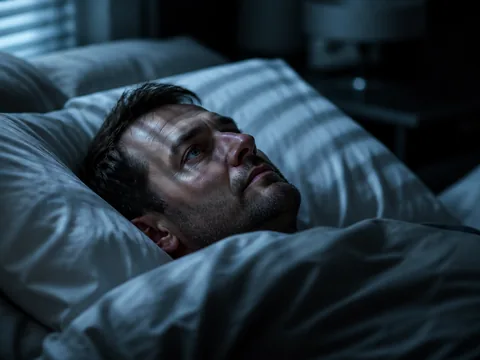
The number on my sleep study was 8.4 events an hour. Mild, technically. "We usually just watch that," the physician said, and that is how most conversations about sleep apnea treatment alternatives begin — with a shrug, a CPAP brochure for later, and the clear implication that everything between watching and a machine is a rounding error.
I eventually spent $1,650 to test that implication. What follows is what I found, including the parts that annoyed me.
The myth is "CPAP or nothing," and it's half right
You have heard this one, probably from a clinician you liked. CPAP is the gold standard; the rest is mouthguards and marketing. Half of that is true and worth respecting: positive airway pressure is a pneumatic splint, and it works on physics, not hope. Applied at the right pressure it can take an AHI of 30 to under 5 on the first night. Nothing else in this field does that.
The half that gets hidden is adherence. The standard clinical threshold — four hours a night on 70% of nights — is a definition of "using it" that would embarrass most other medications, and a substantial minority of patients don't clear even that. A treatment with a 90% effect and a 50% uptake is not obviously better than one with a 45% effect you actually use. That arithmetic is why the alternatives exist, and why dismissing all of them as snake oil is lazy.
What the research on eXciteOSA actually measured
eXciteOSA is a removable mouthpiece that delivers neuromuscular electrical stimulation to the tongue. It received FDA De Novo clearance in February 2021 for snoring and mild obstructive sleep apnea — AHI under 15, adults 18 and up. It is prescription-only, and you use it awake, for 20 minutes a day, for six weeks, then twice weekly indefinitely.
The pivotal citation is Baptista et al. (2021), Journal of Clinical Medicine: 115 participants with primary snoring or mild OSA, six weeks of daily 20-minute sessions, snoring measured objectively as time spent above 40 decibels rather than by asking a spouse. Objective snoring time dropped roughly 41%. In the mild-OSA subgroup, mean AHI fell from about 10.2 to about 5.3 — a 48% reduction, which is a real number and roughly what a decent oral appliance delivers. Smaller earlier work from Kotecha and colleagues pointed the same direction; I'd treat the specifics there as supporting rather than load-bearing.
Here is the part the marketing does not lead with: these were open-label studies without a sham arm. Nobody was stimulated with a device that tingled convincingly and did nothing. Snoring outcomes are exquisitely sensitive to expectation, alcohol, weight, and sleep position, all of which people modify when they are enrolled in a study about their snoring. Well-established is the wrong label here. Plausible, with a coherent mechanism and one decent uncontrolled trial is the right one.
Does eXciteOSA actually work for sleep apnea?
For mild sleep apnea and snoring, the honest answer is: probably somewhat, for some people, and less than it sounds. The published data show roughly a 40–50% reduction in snoring time and in AHI within the mild range, which can move a person from a diagnosis to below the diagnostic threshold. It does not treat moderate or severe apnea, it is not cleared for it, and the trials capped body mass index around 32 — so if your apnea is substantially driven by neck and upper-airway fat, this device was not tested on you.
What actually happens in your throat at 2 a.m.
It helps to walk the failure through in order, because the order is where the device's logic lives.
You lie down. The tongue and soft palate shift back a few millimeters, and lung volume drops, which reduces the downward tension that helps hold the pharynx open. Then you fall asleep, and within a couple of breaths the wakefulness drive to the genioglossus — the big fan-shaped muscle that pulls the tongue forward — falls away. Awake, you were compensating constantly without noticing. Asleep, you stop.
Then you inhale. The diaphragm drops and pressure inside the pharynx goes negative, because the upper airway is a collapsible tube being sucked inward. If dilator tone doesn't rise fast enough, the walls approach each other. Airflow narrows, or stops. Snoring is the tissue fluttering in the moment before. Carbon dioxide climbs, oxygen falls, respiratory effort escalates, and an arousal — usually one you'll never remember — restores muscle tone and reopens the airway. Then it happens again.

The device is switched off during all of that. Its claim is not nighttime tone but daytime training: that chronic low-frequency stimulation shifts tongue muscle toward more fatigue-resistant, slow-twitch fiber, so that when the wakefulness drive vanishes, the residual muscle holds. Fiber-type conversion under chronic stimulation is well documented in animal muscle. That six weeks of 20-minute sessions does it to the human genioglossus is inference, not measurement. The data on this is thinner than the confidence with which it's usually stated.
Six weeks at the kitchen counter
The sensation is a metallic flicker under the tongue that ramps in intensity across four settings, and the first week produces a genuinely startling amount of saliva. I did my sessions standing at the counter, reading email, spitting into the sink like an idiot. By week three the salivation had mostly stopped and the session had become as interesting as brushing my teeth.
My partner said the snoring got quieter around week four. I felt sharper in the mornings. And I want to be precise about how little that last sentence is worth, because I made the classic error first: I was drinking about 350 mg of caffeine a day, most of it before noon, and the outcome I was using to judge the device — daytime alertness — is exactly the thing caffeine is engineered to counterfeit. Caffeine's half-life runs around five hours in a typical adult, with genuine spread depending on CYP1A2 activity and hormonal status. You cannot evaluate an apnea treatment through a stimulant. I got a repeat home sleep test in month three, which I should have scheduled before I opened the box.
An honest rule of thumb
Before you spend $1,650, spend nothing for two weeks. Sleep on your side, deliberately — the common estimate is that more than half of mild OSA is supine-predominant, and positional apnea is the cheapest win in this entire field. Move your last caffeine to eight hours before lights out. Then, whatever you try next, get a home sleep test before it and after it. One measured number twice beats six weeks of feeling.
| Approach | Typical AHI effect | Evidence strength | The catch |
|---|---|---|---|
| CPAP | Near-normalization | Well-established | Adherence, not efficacy, is the failure mode |
| Mandibular advancement device | ~50% reduction | Strong; AASM-recommended for CPAP intolerance (Ramar et al., 2015) | Jaw pain, bite change over years |
| Positional therapy | Large, if supine-predominant | Good for the right phenotype | Only works if your apnea is positional |
| Myofunctional therapy | AHI ~24.5 → 12.3 in adults (Camacho et al., 2015, Sleep, meta-analysis, 120 patients) | Moderate; small studies | Requires daily effort with no device to blame |
| eXciteOSA | ~10.2 → 5.3 in mild OSA (Baptista et al., 2021) | Plausible but unblinded | $1,650, no sham control, BMI-limited |
| Hypoglossal nerve stimulation | 29.3 → 9.0 at 12 months (Strollo et al., 2014, NEJM, 126 patients) | Strong, for selected patients | Surgical implant; strict eligibility |
What this piece didn't answer
Three things, and they're the three that matter. Nobody has run eXciteOSA against a convincing sham, so we cannot separate the muscle from the ritual. Nobody has shown that a mild-range AHI reduction changes any hard endpoint — blood pressure, arrhythmia, daytime crash risk — because those trials are long and expensive and have barely been attempted at this severity. And nobody knows what happens when you stop the twice-weekly maintenance, because the follow-up windows are short.
If you want to watch this properly: search ClinicalTrials.gov for sham-controlled intraoral neuromuscular stimulation trials, read the AASM's position statements as they update, and — most usefully — ask your clinician for a repeat home sleep test rather than an opinion.
A treatment you'll actually use, measured honestly, beats a better treatment you abandon in March. Footnote: "AHI" counts apneas and hypopneas per hour of sleep — 5 to 15 is mild, 15 to 30 moderate, above 30 severe. It is a crude index. It weights a 10-second event and a 60-second event identically, and says nothing about how far your oxygen fell, which is one reason two people with the same number can feel completely different.