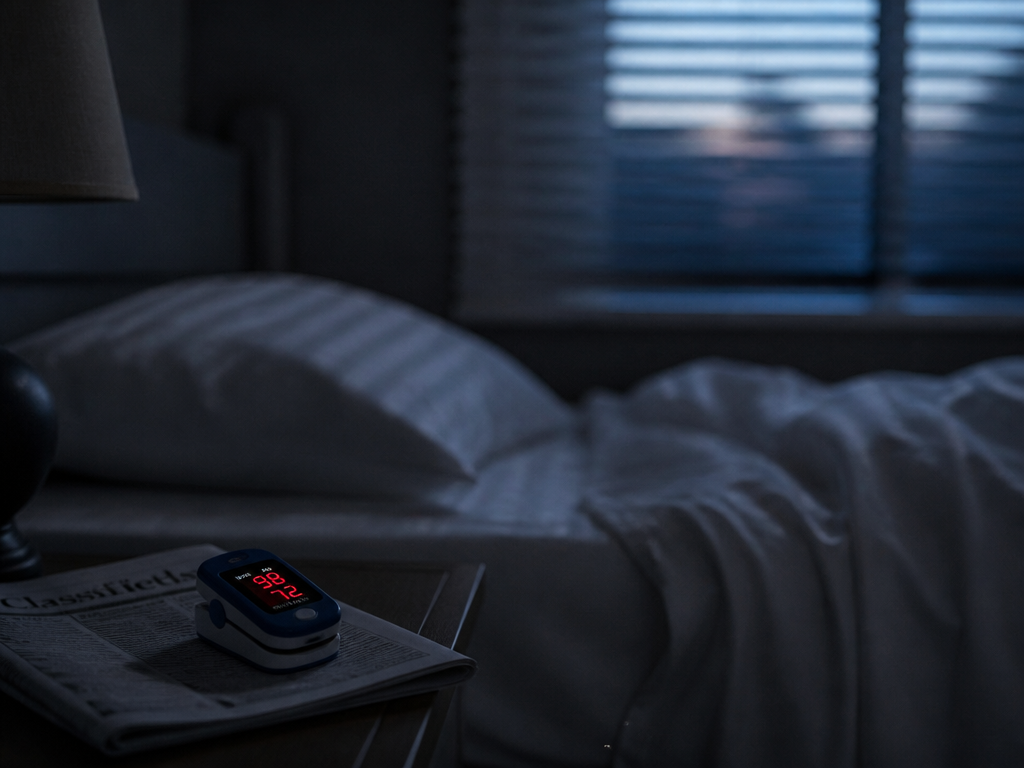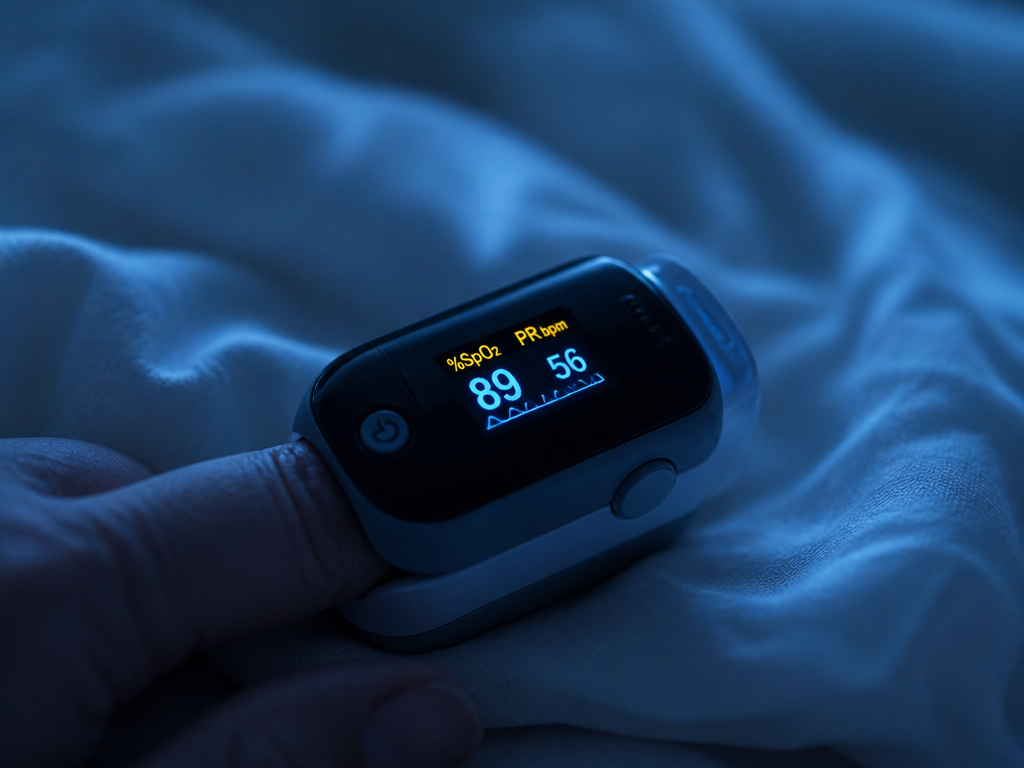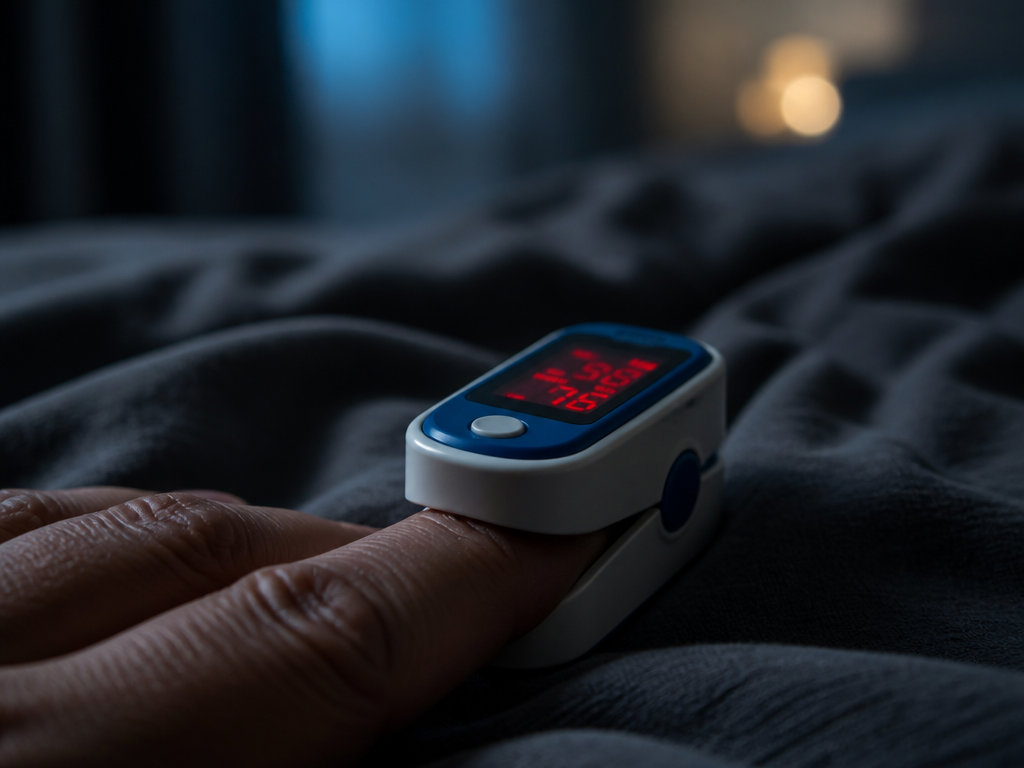
I borrowed a fingertip pulse oximeter from a friend who climbs mountains, clipped it on before bed, and taped the little screen to the back of my hand so it faced the ceiling. I wanted to watch my own oxygen. The reason was a string of mornings that started with a headache pressing behind my eyes and a fog that coffee solved too well, too fast — the kind of relief that tells you the coffee was patching something, not fixing it.
By 3 a.m., the recording later showed, my oxygen saturation had dipped into the high 80s more than once. I had read enough to suspect obstructive sleep apnea: the throat collapsing during sleep, the breath stalling, the brain hauling me halfway awake to reopen the airway. What I had not considered was the more complicated possibility — that apnea might be one of two things happening at once, and that the second thing might be why the first one hit so hard.
Apnea rarely arrives alone
Here is the part that gets undersold in the pamphlets. A diagnosis of sleep apnea is often a diagnosis of one condition in a room that contains several. The airway closing in your throat is the headline. The lungs, the heart, the metabolism, and the esophagus are frequently in the room too, and they talk to each other.
This matters for a practical reason. If you treat the apnea and feel only half-better, the temptation is to conclude the treatment failed. Sometimes it did. More often, the treatment worked on the problem it was built for, and a second problem — quieter, slower, harder to feel at 3 a.m. — kept its hand on the dial.
The clearest example, and the one with the most research behind it, is what happens when obstructive sleep apnea shares a body with chronic obstructive pulmonary disease.
The lungs next door
COPD is an umbrella for chronic bronchitis and emphysema — diseases that narrow the airways and destroy the elastic architecture of the lungs, usually after years of smoking, sometimes from genetics or long exposure to dust and fumes. It is a daytime, awake-and-breathing disease. Sleep apnea is, almost by definition, a sleeping disease. You might assume two such different conditions would simply coexist, each minding its own clock.
They don't. They compound. And the compounding has a mechanism you can follow, breath by breath, through the night.
What happens to a shared body at 2 a.m.
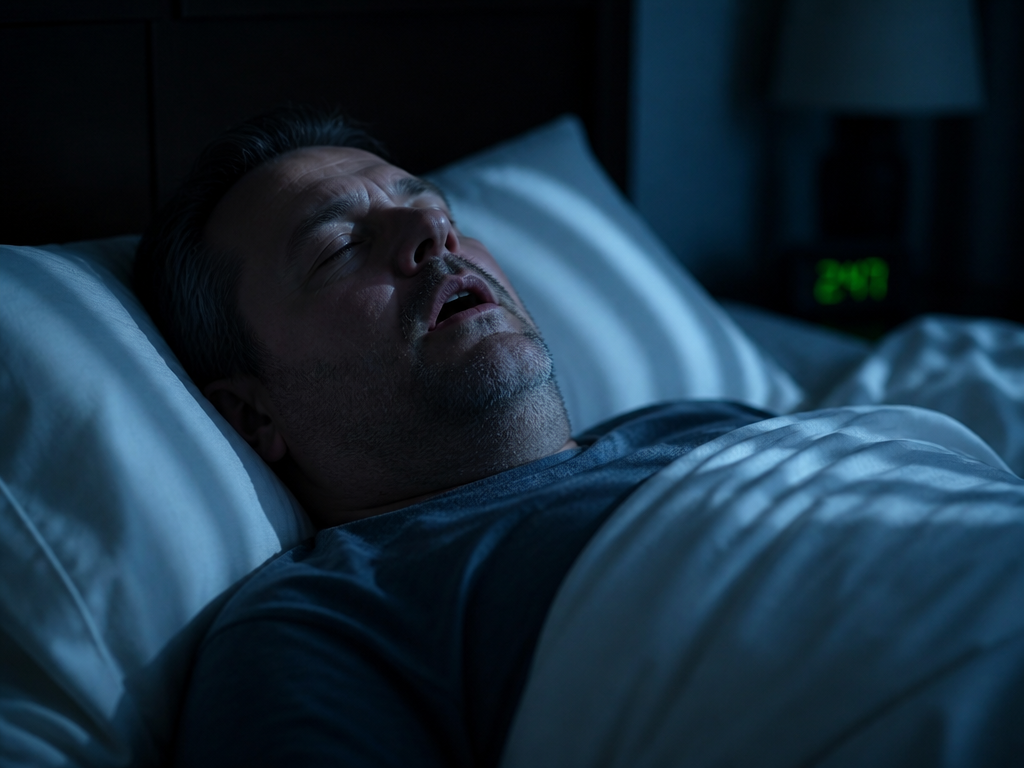
Walk it through in order. When you fall asleep, the muscles that hold your upper airway open relax. In someone with obstructive sleep apnea, that relaxation lets the throat narrow or close. Airflow drops or stops. Oxygen falls, carbon dioxide climbs, and the brain triggers a brief arousal to restore the airway. This cycle can repeat dozens of times an hour.
Now add lungs that already move air poorly. In COPD, the alveoli — the tiny sacs where oxygen crosses into blood — are damaged, and air gets trapped behind narrowed airways. So the person starts the night with less oxygen reserve than a healthy sleeper. There's less margin to spend.
Then layer on the architecture of sleep itself. During REM sleep, the muscles between your ribs and the accessory breathing muscles go slack, leaving the diaphragm to do most of the work. In a healthy person that's fine. In someone with diseased lungs and a collapsing airway, REM becomes the most dangerous neighborhood of the night: the airway is more likely to close, the diaphragm is working alone, and the starting oxygen was already low. The dips go deeper and last longer.
The result is a pattern of nighttime hypoxia — low blood oxygen — that is worse than either condition would produce by itself. Chronic low oxygen at night drives up pressure in the pulmonary arteries. Over years, that strains the right side of the heart. This is the line that connects a snore to a swollen ankle, and it is not hypothetical.
What the research actually measured
The term for OSA and COPD occurring together was coined by the physician David Flenley in 1985, who noticed that patients with both did worse than the arithmetic of their separate diagnoses suggested. That observation has held up, though the numbers around it are softer than the confidence with which they're often quoted.
Prevalence first. Estimates of how often the two conditions co-occur range widely — somewhere between roughly 1 and 4 percent of the general adult population in most surveys — because the answer depends entirely on whom you sample and how you define each disease. The Sleep Heart Health Study (Sanders et al., 2003, American Journal of Respiratory and Critical Care Medicine), which screened more than 5,000 participants, found that airflow obstruction and sleep-disordered breathing were each common but not strongly correlated with each other — meaning the overlap is largely two common conditions landing in the same person by probability, not one causing the other.1

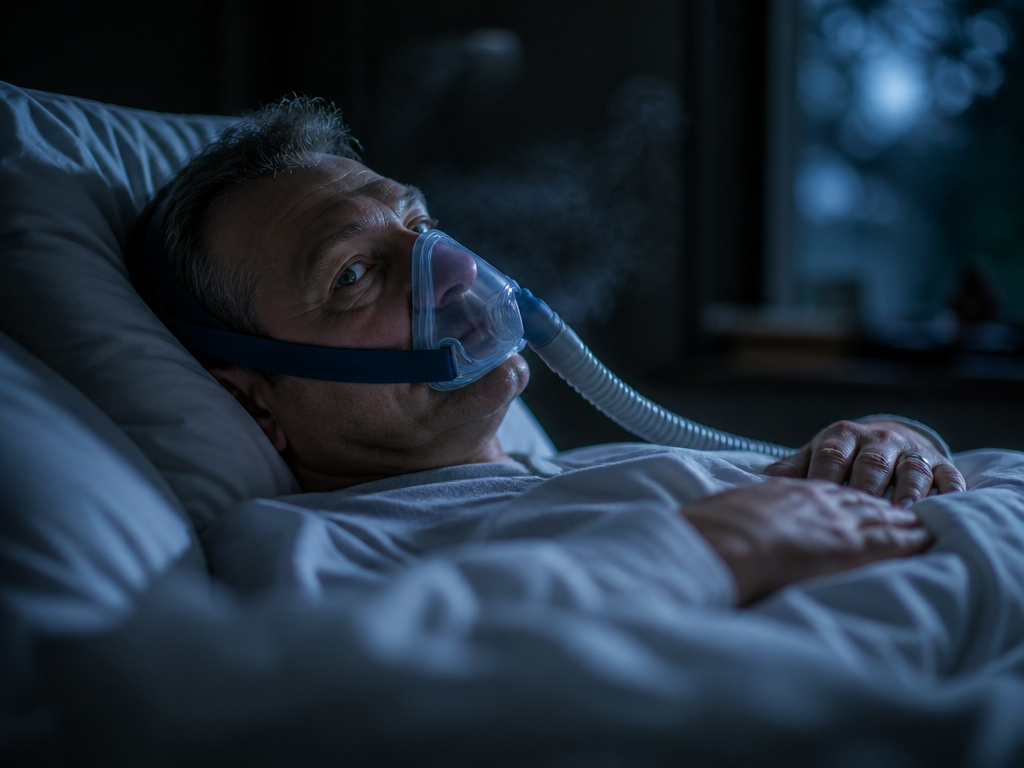
The mortality signal is sturdier. Marin et al. (2010), published in the American Journal of Respiratory and Critical Care Medicine, followed 228 patients who had both conditions alongside comparison groups, for an average of about nine years. Patients with untreated overlap died at higher rates and were hospitalized for COPD flare-ups more often than patients with COPD alone. Crucially, the patients who used CPAP — continuous positive airway pressure, the mask that splints the airway open at night — had survival curves that looked much more like the COPD-only group. The treatment appeared to erase a substantial part of the extra risk.
That study is observational, not a randomized trial, so it can't fully rule out that healthier or more motivated patients were the ones who stuck with CPAP. But the size of the effect, and the biological plausibility of the mechanism, have made it one of the more trusted findings in this corner of medicine. Call it well-established that treating the apnea helps; call it plausible-but-thinner exactly how much.
The other companions
COPD is the best-studied roommate, but it isn't the only one. A few others worth knowing, with honest labels on how solid each connection is.
Asthma. Sleep apnea and asthma appear to worsen each other, and the relationship may run both ways. The repeated pressure changes and inflammation of apnea can aggravate twitchy airways; poorly controlled asthma and the steroids used to treat it may promote weight gain and airway changes that feed apnea. The bidirectional link is plausible and increasingly supported, but the size of the effect varies a lot between studies.
Obesity hypoventilation syndrome. This one is often confused with sleep apnea and sometimes hidden inside it. In OHS, excess weight on the chest and abdomen, combined with a blunted drive to breathe, leaves carbon dioxide elevated even during the day. A person can have both apnea and hypoventilation, and the second won't show up on a standard overnight oxygen tracing the way the first does — you need a daytime blood gas or a careful CO2 measurement to catch it. Missing it means undertreating.
Heart failure. The relationship here is genuinely tangled. Obstructive sleep apnea strains the heart, but heart failure can also produce a different breathing disorder during sleep — central sleep apnea, where the brain briefly stops sending the signal to breathe, often in a waxing-waning pattern called Cheyne-Stokes respiration. The two can coexist in the same patient and even shift into each other over the course of treatment. This is well-established and one of the better reasons that a cardiologist and a sleep physician should be reading the same chart.
Reflux. Gastroesophageal reflux is more common in people with sleep apnea, and the leading explanation is mechanical: the effort of trying to breathe against a closed airway generates negative pressure in the chest that can pull stomach acid upward. Treating the apnea sometimes quiets the reflux. This is plausible and supported by association studies, though causation in any individual is hard to prove.
How do I know if my apnea isn't the whole story?
If you've been diagnosed or are about to be, the most useful question to bring to your appointment is: is anything else going on with my breathing? The honest answer is that a single overnight sleep study, especially a home test, is built to detect apnea and not much else — so a second condition can hide in plain sight.
A few patterns should prompt you to push for more. If you cough most mornings or bring up phlegm, if you get short of breath climbing a flight of stairs, if you've smoked for years, or if your oxygen on a sleep study stays low for long stretches rather than only dipping at the apnea events — these point toward a lung problem riding underneath. If you wake with headaches that fade through the morning, that can signal carbon dioxide building overnight, which is more about how well you're ventilating than how often your airway closes. None of these confirms a second diagnosis. All of them are reasons to ask for a daytime lung function test (spirometry) or a blood gas before assuming the mask alone will fix everything.
A signal-spotting table

| What you notice | What apnea explains | What might point past it |
|---|---|---|
| Loud snoring, witnessed pauses | Classic OSA | — |
| Morning headache that fades | Some OSA cases | Daytime CO2 retention (hypoventilation, COPD) |
| Shortness of breath on stairs | Rarely | Lung disease — get spirometry |
| Chronic morning cough/phlegm | Rarely | Chronic bronchitis / COPD |
| Oxygen low all night, not just in dips | Unusual for pure OSA | COPD, hypoventilation, heart issue |
| Ankle swelling, weight gain at the belt | Late, severe OSA | Right-heart strain, fluid — see a doctor soon |
The point of the table isn't to diagnose yourself. It's to give you specific words for the appointment, so "I just feel tired" becomes "I'm short of breath on the stairs and my oxygen stayed in the 80s for half the night." Specific complaints get specific tests.
What treatment looks like when there are two problems
The reassuring part — and it is genuinely reassuring — is that treating the apnea usually helps even when a second condition is present, and sometimes it helps the second condition too. CPAP keeps the airway open through the night, which flattens out the oxygen dips and, in the overlap with COPD, appears to reduce flare-ups and hospitalizations. For people whose lungs can't move enough air on their own even with the airway propped open, there are machines that do more than CPAP — bilevel devices (BiPAP) that push harder on the inhale than the exhale, and in hypoventilation, settings that guarantee a minimum number of breaths.
The catch is that a second condition often needs its own treatment in parallel. CPAP does not fix COPD; inhalers and pulmonary rehabilitation do that work. It does not cure heart failure. The mask is a powerful tool aimed at one specific failure — the airway closing — and it is honest to say it is necessary but not always sufficient. The patients in Marin's data who did best were the ones whose whole picture was managed, not just the loudest part of it.
A word on supplemental oxygen, because it's a common assumption: giving someone oxygen at night does not splint the airway open. It can raise the floor on how low the saturation falls, but it leaves the apnea events themselves untreated and, in people who retain carbon dioxide, oxygen alone can occasionally make ventilation worse. Oxygen and pressure therapy answer different questions. Sometimes you need both, and the order and combination are a physician's call, not a guess.
Back to the oximeter
My own recording, it turned out, was a textbook of one thing and a question mark on another. The dips were sharp and brief — saturation falling fast, then snapping back — which is the signature of an airway opening and closing, not lungs failing to keep up. That pattern pointed at obstructive apnea and away from a lung problem. I am not a lifelong smoker; I don't cough in the mornings. The probability that a second condition was hiding under mine was low, and the shape of the curve agreed.
But here is what the oximeter could not tell me, and what I want you to take more than any single number from this piece: a consumer device that measures one variable cannot rule out a condition it doesn't measure. It saw my oxygen. It did not see my carbon dioxide, my airway pressure, my heart's response, or how much air my lungs could move when I blew hard into a tube. The clip on my finger answered the question it was built to answer and stayed silent on the rest — which is exactly the trap that catches people who feel "mostly better" on treatment and stop asking.
I took the recording to a sleep physician, got a real study, and started treatment for the thing I actually had. The morning headaches went. The fog lifted, and the coffee went back to being coffee instead of a patch. If they hadn't — if I'd treated the apnea and still woke up gray and breathless — that would have been the signal to look at the room behind the headline, at the lungs and the heart and the slow chemistry of carbon dioxide that a finger clip never sees.
If you're starting treatment for sleep apnea and you still feel short of breath, foggy, or headachy after a few good weeks on the mask, don't assume the mask failed — write down exactly what's still wrong and ask your doctor what else in your body might be breathing badly while you sleep.
-
This is the counterintuitive part worth sitting with: for the most part the two conditions aren't causally linked at the population level. They overlap because each is common on its own. The danger isn't that one breeds the other — it's that when chance puts them in the same chest, their effects multiply. ↩