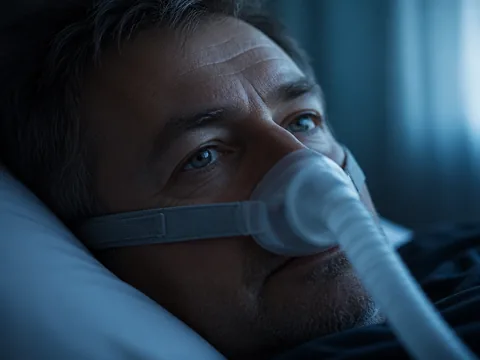
I have used a CPAP machine every night for four years. In that time, three cardiologists and one primary-care doctor have talked to me about my heart. Not one has mentioned my eyes. When I learned that sleep apnea is associated with glaucoma — a disease that steals vision silently and permanently — I wanted to know whether I'd been ignoring a real risk or chasing a scary headline.
The short version: the link between obstructive sleep apnea and glaucoma is real enough that eye clinics take it seriously, but the research has not proven that one causes the other. Given that a glaucoma screening costs less than a tank of gas and the disease is symptomless until it isn't, the sensible move is to get screened and stop losing sleep over the uncertainty.
Here's how I sorted it out, organized the way I think about most of my own health decisions.
What most people do
Most people with a sleep apnea diagnosis treat it as a two-organ problem: the airway and the heart. That's not wrong. The cardiovascular case is the strongest one in the literature — untreated apnea is repeatedly linked to hypertension, atrial fibrillation, and stroke, and those associations are backed by large, long-running studies. When a newly diagnosed patient reads about "long-term risks," those are the risks they read about.
The eyes fall off the list. In practice, the pattern I see — in myself and in the online forums where apnea patients trade notes — looks like this:
- Get the sleep study, get the diagnosis.
- Fight with the CPAP mask for a few weeks.
- Watch the cardiovascular numbers, because the doctor watches them.
- Never once tell an optometrist about the apnea, and never once tell the sleep doctor about a family history of glaucoma.
The two specialists never talk to each other, and the patient becomes the only person holding both facts. That's the gap. Not that people are careless — it's that the referral pathway doesn't exist. My CPAP compliance report gets faxed to my cardiologist automatically. It has never once reached an eye doctor.
What the evidence suggests
Here I have to be honest about what the research does and does not say, because overstating it would be its own kind of harm.
What's reasonably established: multiple observational studies and several meta-analyses report that people with obstructive sleep apnea show a higher prevalence of glaucoma — particularly open-angle glaucoma and a related condition called normal-tension glaucoma — than people without apnea. The effect sizes vary a lot between studies, and some well-designed cohorts have found weaker or no association. So the association is repeated often enough to take seriously, and inconsistent enough that no honest source calls it settled.
What's plausible but unproven — the mechanisms: researchers propose two main pathways, and I find both convincing without being able to prove either.
- Oxygen and blood flow. Apnea causes repeated drops in blood oxygen through the night. The optic nerve is metabolically demanding tissue with a delicate blood supply. The theory is that repeated nightly hypoxia stresses the nerve head, and that this can contribute to the kind of nerve damage glaucoma produces — independent of eye pressure.
- Pressure swings. The struggle to breathe against a closed airway changes pressures throughout the body, and some work suggests intraocular pressure fluctuates during apnea events too. Fluctuation, not just the average, may matter for the nerve.
Neither of these has been demonstrated to cause glaucoma in humans in the way we'd want before making strong claims. They are mechanisms that would explain the association if the association is real. That is a weaker statement than most headlines make, and it's the accurate one.
There's one more finding worth naming without alarm: floppy eyelid syndrome, an eyelid laxity condition, shows a genuinely strong and repeated association with sleep apnea — stronger than the glaucoma link. It's not vision-threatening in the way glaucoma is, but it's the eye-apnea connection with the most solid footing.
Here's how I'd rank the eye risk against the comorbidities that already get attention:
| Comorbidity | Strength of evidence | Reversible with treatment? | Silent until advanced? |
|---|---|---|---|
| Hypertension | Strong | Often improves | Somewhat |
| Atrial fibrillation | Strong | Sometimes improves | No — has symptoms |
| Open-angle glaucoma | Moderate / mixed | No — damage is permanent | Yes — fully silent |
| Floppy eyelid syndrome | Strong for association | Treatable | No — visible |
The row that changed my behavior is glaucoma's, and it's not because the evidence is the strongest. It's because it's the only one where the damage can't be undone and you feel nothing until vision is already gone. A moderate risk of a silent, permanent loss is worth more of my attention than a strong risk of something reversible that announces itself.
What I actually do
I am one person with one set of eyes, so treat this as a protocol I settled on, not a recommendation I can defend for you.
I told my optometrist about the apnea. This was the single highest-value thing, and it cost me one sentence. It moved me from the "check every two years, you're young" schedule to an annual dilated exam with a specific note in my chart to watch the optic nerve. The exam takes twenty minutes and, on my insurance, ran about $40 out of pocket beyond the covered visit.
I keep my CPAP adherence honest, and I have the numbers. My machine reports usage, and over the last twelve months I averaged 6.8 hours a night with an AHI (apnea-hypopnea index) under 3, down from an untreated 28. I can't prove that treating the apnea protects my eyes — no one can, yet. But if the hypoxia mechanism is real, adherence is the lever I actually control, and mine is in good shape. That's the part of this I can measure.
What I couldn't test: everything that matters most. I have no baseline optic-nerve imaging from before my diagnosis, so I can't see whether treatment changed my trajectory. I'm a single case with no control. And I can't tell you whether my normal eye pressure means I'm safe, because normal-tension glaucoma exists precisely to ruin that assumption. So I'm monitoring, not concluding.
What I stopped doing: worrying about it daily. Once the annual exam was on the calendar, the anxiety had a job to do and a place to live. That's the real payoff of screening — not certainty, but a container for the uncertainty.
Who this is for, and who it isn't
This is worth acting on if you:
- Have a sleep apnea diagnosis and a family history of glaucoma — that's a double flag, and it's the group I'd push hardest toward a dilated exam.
- Are over 50, of African or Hispanic descent, or have high eye pressure — glaucoma risk factors that stack on top of the apnea question.
- Have never mentioned your apnea to your eye doctor. Fix that regardless of anything else here.
This is probably not worth losing sleep over if you:
- Have well-controlled apnea, no family history of glaucoma, and a recent clean eye exam. Keep the annual check; don't spiral.
- Are looking for a reason to distrust your CPAP. The eye evidence, such as it is, cuts the other way — toward treating the apnea, not toward alarm.
The clear winner here isn't a device or a supplement. It's a conversation and a calendar entry. The science may firm up in either direction over the next decade. Until it does, the asymmetry is what matters: the test is cheap and the loss is permanent.
Screen the eyes you can't grow back.