The most consequential development in sleep apnea in the last decade was not a therapy. It was a notification.
Somewhere around 2022, wrist-worn devices started getting FDA clearance to tell people something a doctor had never told them: your breathing looks disturbed at night. Apple's sleep apnea notification feature cleared in September 2024. Samsung's cleared in February 2024 — the first of its kind through the FDA's De Novo pathway. Neither one diagnoses anything. Both of them, collectively, have done more to drive sleep apnea treatment expansion than any single new device, because they took a condition that was overwhelmingly undiagnosed and handed millions of people a reason to ask.
That's the claim. The rest of this is me earning it.
The number everyone treats as the disease
Sleep apnea gets scored with the apnea-hypopnea index — events per hour of sleep where airflow stops (apnea) or drops substantially with a desaturation or arousal (hypopnea). Five to fifteen is mild. Fifteen to thirty, moderate. Above thirty, severe. It is a clean number, and clinicians have organized four decades of care around it.
It is also a strange number. It counts events without regard to how long they last, how far oxygen falls, or why the airway closed in the first place. Two people can both score an AHI of 28 and have almost nothing in common physiologically. One has a crowded oropharynx and a thick neck. One has a jaw set back a centimeter from where the textbook would like it. One's airway is structurally fine but the muscles that hold it open lose tone too readily. One wakes at the faintest respiratory stimulus — a low arousal threshold — and fragments their own sleep chasing a breath they didn't need.
Those are distinguishable phenotypes. The best-known framework for them, sometimes abbreviated PALM, comes out of work by Eckert and colleagues at Brigham and Women's, published in 2013 in the American Journal of Respiratory and Critical Care Medicine. They measured the four traits in 75 subjects and found that a non-anatomical trait was a significant contributor in roughly 56 percent of apnea patients. Anatomy still mattered most. But anatomy alone did not explain the majority of cases.
Here is the problem that creates. If the diagnosis is a single number and the phenotypes underneath it are plural, then a single default therapy is going to fit some people beautifully and other people badly — and the clinical system will have no vocabulary for the difference except noncompliance.
What actually happens in the airway
Walk through one obstructive event in the order the body experiences it.
You fall asleep. Muscle tone drops across the body, including in the genioglossus — the big extrinsic tongue muscle that, when active, pulls the tongue forward and holds the pharynx open. The pharynx has no rigid skeleton. It's a collapsible tube held patent by muscle and by the pressure gradient across its walls.
You inhale. The diaphragm drops, generating negative pressure inside that tube. If the tissue around it is crowded, or the muscle holding it isn't firing hard enough, the walls come together. Airflow stops while the effort to breathe continues — the chest keeps moving against a closed door.
Carbon dioxide rises. Oxygen falls, sometimes 4 percent, sometimes 15. Chemoreceptors in the carotid body register both and escalate the drive to breathe. Sympathetic outflow spikes; blood pressure climbs inside the event. Eventually the respiratory drive overwhelms the sleep state and the brain issues a brief cortical arousal — usually three to fifteen seconds, usually not remembered. Muscle tone returns, the airway snaps open, and there's a gasp.
Then you fall back asleep, tone drops again, and it happens again. Thirty times an hour, six hours a night, five thousand-odd times a month.
Notice how many separate points in that sequence could be the weak link. Crowded anatomy. Insufficient genioglossus activation. An oversensitive arousal threshold that ends the event before it needed to. That's not a rhetorical flourish — those points map onto different therapies.
The adherence problem, stated plainly
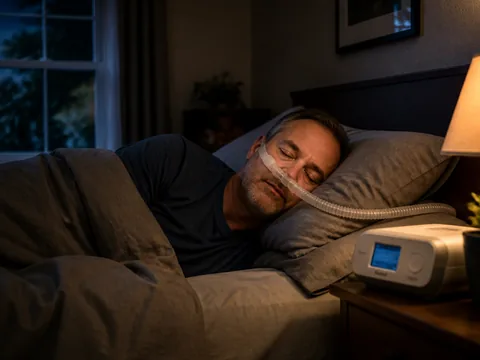
CPAP works. This needs saying clearly before anything else, because the alternative-therapy conversation gets used as a cudgel against a device that, when worn, essentially abolishes obstructive events. Positive airway pressure is a pneumatic splint. It doesn't strengthen anything or reposition anything; it raises the pressure inside the collapsible tube above the pressure trying to close it. Mechanically, it's close to elegant.
The trouble is the when worn part. The frequently cited figure is that 30 to 50 percent of patients are no longer using CPAP meaningfully at one year, with the range depending heavily on how a given study defined adherence — Medicare's threshold of four hours a night on 70 percent of nights is common but arbitrary. Weaver and Grunstein's 2008 review in Proceedings of the American Thoracic Society is the standard citation. It's an old paper, and modern masks, heated humidification, and auto-titrating machines have improved things at the margins. Nobody has made the problem go away.
What's worth saying about this: the four-hour threshold isn't a biological constant. It's a reimbursement rule that hardened into a clinical definition. If you sleep seven hours and use CPAP for four, you're "adherent" while spending three hours a night untreated. The number describes billing better than it describes physiology.

Can a smartwatch diagnose sleep apnea?
No. A smartwatch can flag a pattern consistent with sleep apnea and tell you to get tested — that's the entire scope of what the FDA cleared, and it's what the label says. Apple's clearance was based on data indicating the feature identified a substantial share of participants with moderate-to-severe apnea over a 30-day window; it was not designed to catch mild disease and it produces both misses and false alarms.
The clearance pathway matters here, and it's where the phrase "FDA-cleared wellness device" earns some scrutiny. Clearance is not approval. Most of these features come through 510(k) or De Novo routes, meaning the FDA agreed the device is substantially equivalent to something already on the market, or that a new low-to-moderate-risk category was reasonable. That's a real regulatory bar — considerably more than the zero bar applied to the general "wellness" category — but it is not a claim of diagnostic accuracy against polysomnography in your particular body.
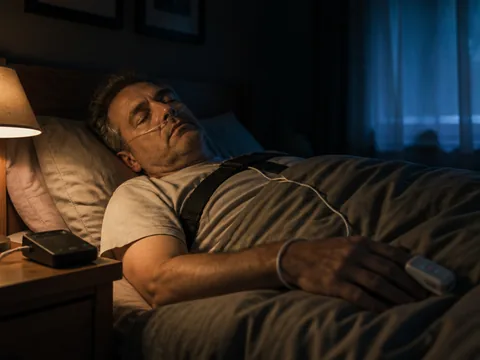
What these devices are unambiguously good at is generating a reason to act. A person who has snored for fifteen years and been told to roll over now has a screen telling them something measurable is happening. Home sleep apnea tests, which are now the majority of diagnostic pathways for uncomplicated adult cases, are what turn that into a diagnosis.
What the toolkit actually contains now
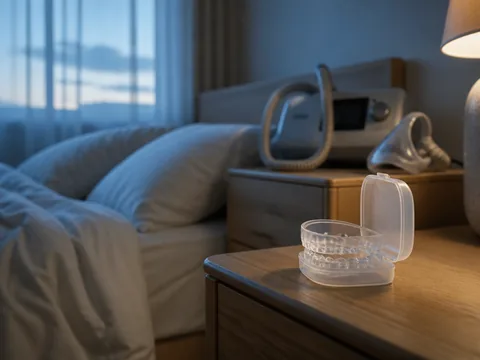
Oral appliances. Mandibular advancement devices hold the lower jaw forward, which drags the tongue base with it and enlarges the retroglossal space. They are less effective than CPAP at reducing AHI and better tolerated — and in several trials the health outcomes land in similar territory, precisely because people wear them more hours. The trade-off is real: some patients get durable bite changes over years.
Hypoglossal nerve stimulation. An implanted device stimulates the hypoglossal nerve in time with inspiration, activating the genioglossus so the tongue moves forward before the airway can collapse. The STAR trial — Strollo et al., 2014, New England Journal of Medicine, 126 patients — reported a median AHI drop from 29.3 to 9.0 at 12 months. It's a single-arm cohort, not a randomized comparison against CPAP, and the entry criteria excluded high BMI and complete concentric collapse at the palate. Within those constraints, it's the clearest example of therapy aimed at a specific mechanism rather than at the number.
Pharmacotherapy. Tirzepatide received FDA approval in December 2024 for moderate-to-severe obstructive sleep apnea in adults with obesity, on the strength of the SURMOUNT-OSA trials (Malhotra et al., 2024, NEJM), which reported AHI reductions on the order of 25 to 30 events per hour versus roughly 5 on placebo across two trials with 469 participants total. That's a genuine first: a drug indication for apnea. It also treats the upstream driver in one population, not the airway in everyone.
An honest rule of thumb
If a wearable flags disturbed breathing, get a home sleep test before you buy anything. Then ask the question the AHI can't answer on its own: what is closing my airway? A drug-induced sleep endoscopy or a careful craniofacial exam answers it better than another titration.
| If the driver is | The therapy aimed at it |
|---|---|
| Pressure — airway collapses under any negative pressure | CPAP |
| Jaw position, retroglossal crowding | Mandibular advancement device |
| Tongue-base collapse, adequate BMI | Hypoglossal nerve stimulation |
| Obesity-driven airway loading | Weight-directed therapy, including tirzepatide |
The table is a starting vocabulary, not an algorithm. Most people are a blend.
The gap nobody planned
The clinician most likely to hear about your snoring first is your primary care physician, and the commonly reported figure is that undergraduate medical curricula devote somewhere under two hours total to sleep across four years. The estimate traces to survey work by Rosen and colleagues in the 1990s and has been re-reported often enough that it should be treated as directionally right rather than precisely current. Sleep medicine fellowship exists; the pipeline is small relative to a condition affecting tens of millions.
So the wearables arrived into a system where demand for answers is now rising faster than the supply of people trained to give them. That is not a failure of the technology. It is what happens when a screening tool gets ahead of a specialty.
What's still unsettled
Here is what nobody has cleanly resolved. The SAVE trial — McEvoy et al., 2016, NEJM, 2,717 patients with moderate-to-severe apnea and existing cardiovascular disease — randomized participants to CPAP plus usual care or usual care alone and found no significant reduction in cardiovascular events over 3.7 years. Mean adherence was 3.3 hours a night. The field has spent a decade arguing about whether that's a null result about apnea treatment or a null result about undertreatment, and both readings are defensible.
Which leaves the question the entire expansion rests on: if a therapy someone will actually wear all night beats a better therapy they abandon by month four, we should be able to show that in hard outcomes — and so far, we can't.