Every sleep clinic says a version of the same sentence: there is a mask out there for everyone, and if yours hurts, you just haven't found yours yet. It is the founding folk wisdom of consumer CPAP technology, repeated by respiratory therapists, durable-medical-equipment reps, and the 2 a.m. forums where strangers trade cushion sizes like baseball cards. It is also, for most people, true. I spent six weeks testing the edge of it — forty-two nights, four interfaces, one of them anchored to my molars instead of my skull.
The verdict: swapping masks reliably fixes fit problems and does almost nothing for contact problems, and the maskless category is only worth your money if you can say which one you have.
The advice earns its authority
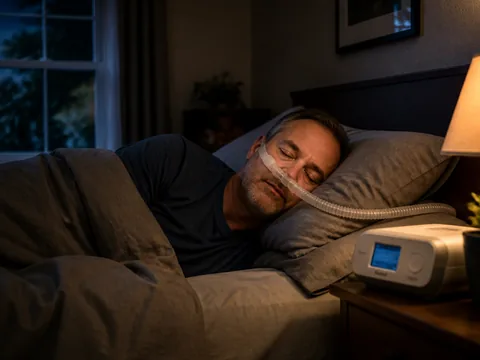
Interface intolerance is the reason most people abandon therapy, and the standard escalation ladder exists because it works. Full face mask leaking and clamping? Move to a nasal mask. Nasal mask bruising the bridge? Move to nasal pillows. Pillows still pulling? Move to a tube-up frame, where the hose exits above the crown and the headgear is a fabric strap rather than a harness.
Most of what people call "the mask hurts" is a pressure-distribution problem, and pressure distribution is exactly what a different mask changes. My own first swap made the case better than any argument. On a full face mask I averaged 3.1 hours of use a night and a 95th-percentile leak of 31 L/min. On nasal pillows, same machine, same settings, I went to 6.2 hours and 8 L/min inside a week. That is not a subtle effect. If you are one swap away from the interface that fits your face, nothing in this article should talk you out of making it.
The benchmark worth knowing: the American compliance standard most insurers still enforce is four hours a night on 70% of nights across a 30-day window. It is a low bar, and it is a bar an enormous number of people never clear. That gap — between prescribed therapy and used therapy — is the whole reason a maskless market exists.
What I tested, and what I couldn't
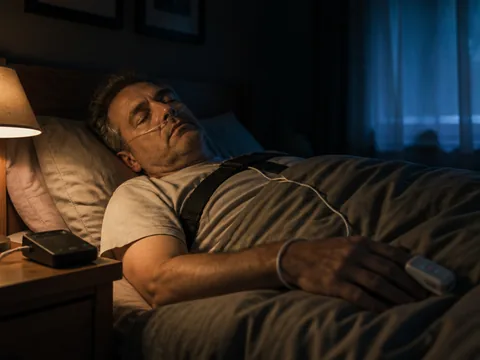
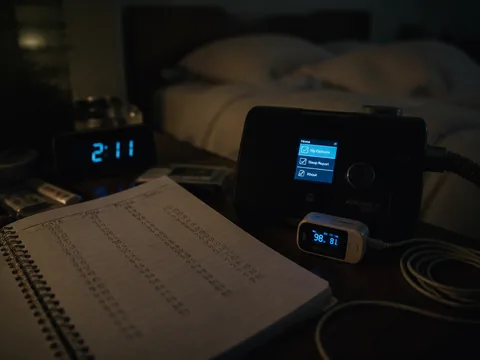
My diagnostic study, three years old, put me at an AHI of 26.4 — moderate, edging into severe. I run an auto-adjusting machine with a 7–13 cmH2O range; my 95th-percentile pressure sits at 9.4. I pulled nightly data into OSCAR and cross-checked with a wrist pulse oximeter recording oxygen desaturation index, because one of the things I tested doesn't produce machine data at all.
Four interfaces, eight nights each, with two washout nights back on my baseline nasal pillows between each. I logged four things every morning: machine-scored AHI, 95th-percentile leak, hours of use, and a crude 1–5 note on how long it took me to stop noticing the thing on my face.
What this setup cannot tell you, stated plainly:
- n = 1. One nose, one jaw, one sleeping position (side, mostly left). I have a full set of natural teeth, no beard, and no septal deviation. Any of those changes the answer.
- Machine-scored AHI is not lab-scored AHI. Flow-based event detection is a decent proxy and not a polysomnogram. I did not repeat a sleep study for each interface, which is what a real comparison would require and what almost nobody can afford.
- The order wasn't randomized. I got better at falling asleep with hardware on my face over six weeks, which flatters whatever came last.
- Eight nights is short. The problems that end relationships with an interface — a sore spot that compounds, a jaw that stops liking you in month three — mostly live past night eight.
Side by side
| Interface | Median AHI | 95th-pct leak | Nights ≥4 hrs (of 8) | Cost as tested |
|---|---|---|---|---|
| Nasal pillows, standard headgear (baseline) | 3.4 | 8 L/min | 8 | $95 |
| Tube-up nasal cushion | 3.1 | 11 L/min | 8 | $129 |
| Dental-anchored nasal pillows | 2.9 | 5 L/min | 7 | $186 + fitting |
| Nasal EPAP valves (no machine) | — | — | 8 | $118 / ~90 nights |
| Mandibular advancement device | — | — | 8 | quoted $2,100 |
The two blank rows are the honest part of the table. Nasal EPAP and an oral appliance produce no flow data because there is no blower, no circuit, and no software. For those I have only oximetry: my ODI on the baseline mask ran 4.1 events per hour. On the EPAP valves it was 11.8. Untreated, on the two nights I recorded without anything, it was 24.3.

That is the sentence the maskless marketing category will not write for you. The valves cut my events by roughly half and left more than twice as many as the machine did.
The tube-up cushion
The most conservative step off a conventional mask, and the one most people should take first. Moving the hose to the crown does two real things: it kills the tug that wakes side sleepers when they roll, and it takes the frame off your cheeks. My numbers barely moved — AHI 3.1 versus 3.4, leak slightly worse — but the morning face check changed completely. No bridge mark, no cheek creases, just a soft line where the crown strap sat.
If your complaint is "I wake up looking like I was interrogated," this $129 part is the entire fix, and everything else in this article is unnecessary.
The dental-anchored pillows
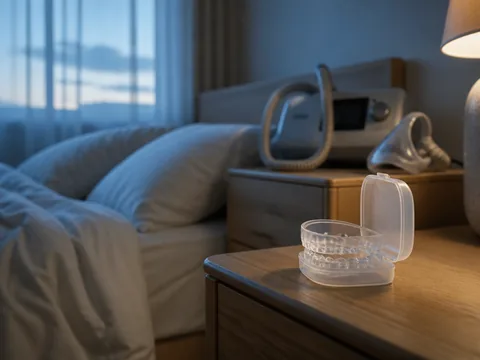
This is the design the press releases mean when they say maskless. A retainer-style tray — either a boil-and-bite you form yourself or a custom tray from a dentist — clamps to your upper teeth and carries a small arm that holds nasal pillows under your nose. No headgear. Nothing behind your head, nothing across your cheeks, nothing in your hair.
It posted the best numbers of anything I tested: median AHI 2.9 and a 95th-percentile leak of 5 L/min, the lowest of the six weeks. That result makes mechanical sense. Conventional headgear holds a seal by tensioning against a soft, mobile, sweaty surface. Teeth do not move, do not perspire, and do not change shape when you roll onto them.
It also produced the only failure night of the study. On night five I pulled it at 2:40 a.m. with an ache along the hinge of my jaw that took most of the next morning to fade. It came back on nights six through eight without recurring, and I do not know whether that was adaptation or luck. Eight nights cannot answer that question.
Where the standard advice breaks down
Failure mode one: contact intolerance is not a fit problem
The escalation ladder assumes your problem is where the pressure lands. For a meaningful minority, the problem is that anything lands at all. Claustrophobic response to an enclosed face is not a sizing error, and telling someone in that state to try a fourth cushion is prescribing more of the thing they cannot tolerate.
This is the one real insight buried in the maskless sales pitch, and it is worth separating from the pitch. If a nasal pillow interface — the least enclosing conventional option there is — still produces the panic, then more mask-shopping is a treadmill. That is the point at which dental anchoring, oral appliance therapy, or a conversation about hypoglossal nerve stimulation stops being exotic and starts being the sensible next question.
The test is cheap and takes one evening: sit up, awake, wearing nasal pillows with the machine running, and watch television for twenty minutes. If that is fine and sleep is not, you have a habituation problem and time will probably solve it. If twenty minutes awake is unbearable, no cushion in the catalog is your answer.
Failure mode two: the pressure ceiling
Minimal-contact interfaces win their argument at low and moderate pressure and lose it as pressure climbs. I ran two nights with the floor of my auto range raised to 12 cmH2O to see where the dental-anchored setup broke. Leak went from 5 to 19 L/min, and I woke twice with the pillows blown partly out of my nostrils.
This is not a defect anyone is hiding; it is physics. Less contact area means less retention force, and retention force is what a seal is. Nasal pillows in general get unpleasant at high pressure — the sensation stops being air and starts being a jet — and the surface area of two silicone nubs is a poor place to resist 15 cmH2O. If your titrated pressure lives in the mid-teens, the entire minimal-contact category is a harder sell, and the honest recommendation is a well-fitted conventional nasal mask with a tube-up frame.
Failure mode three: the bill moves to your dentist
Every maskless option I tested relocates the load rather than eliminating it. Dental-anchored interfaces and mandibular advancement devices both transfer nightly force to your teeth and jaw, and long-term occlusal change — bite drift, tooth movement, jaw discomfort — is the known trade-off of oral appliance therapy. Sleep dentists monitor for it precisely because it happens.
So the maskless promise is real but conditional: you are not escaping pressure, you are choosing which tissue absorbs it. Skin recovers from a strap mark by lunchtime. A migrated bite does not, and correcting one costs more than a decade of mask cushions.
The genuinely maskless one

Nasal EPAP valves are the only thing I tested with no machine attached. Two adhesive-backed valves sit in the nostrils; they open freely on inhale and resist on exhale, using your own breath to hold a little back-pressure in the airway. They are prescription devices, they cost about as much as a mask, and they last roughly ninety nights before the adhesive gives up.
They are also, on my numbers, clearly inferior therapy: ODI 11.8 against 4.1 on the machine. I would not trade a working CPAP setup for them and neither should you.
What they are excellent at is the gap. A four-day trip where hauling the machine is the difference between packing a carry-on and checking a bag. A night in a place with no outlet near the bed. The choice on those nights is not valves versus machine — it is valves versus nothing, and on my data valves versus nothing is a difference of twelve events an hour.
What it actually costs
Prices are what I paid in early 2026 and they move. The tube-up cushion was $129 with cushions at about $28 each on a quarterly schedule. The dental-anchored kit was $186 plus a fitting appointment my dental insurance treated as elective. The EPAP valves work out to roughly $40 a month if you use them nightly, which nobody should.
The mandibular advancement device is the outlier: $2,100 quoted, custom-fabricated by a dentist, with titration visits after. Medical insurance covers oral appliance therapy for diagnosed OSA in many plans — dental insurance usually does not, and the two will each explain that it belongs to the other. Budget for the phone calls.
One piece of insurance mechanics worth knowing: interfaces bought outside the DME channel generally do not count against your supply allowance, and they also generally do not generate the compliance data your insurer wants. If your coverage is contingent on machine-reported hours, a device with no machine attached can quietly break your paperwork even while it improves your sleep.
Who this is for, and who it isn't
Worth your time if: your 95th-percentile pressure sits below roughly 11 cmH2O; you have a full set of natural teeth and no TMJ history; you sleep on your side or stomach and keep waking from hose tug; your specific complaint is facial marks, cheek pressure, or hair flattened by headgear; you breathe through your nose reliably; or you travel enough that a machine-free fallback has real value.
Not worth your time if: your prescribed pressure is in the mid-teens or higher; you are a mouth breather who needs a chin strap or a full face seal; you have partial dentures, extensive dental work, implants, or an existing bite problem; your untreated AHI was severe and you are currently well-controlled on a conventional mask; or your actual problem is nasal congestion or dry throat — that is a humidifier and heated-tubing question, and no interface change will fix it.
And if you have not yet tried nasal pillows with a tube-up frame, start there. It is the cheapest thing on this list and it resolves the majority of the complaints that send people looking for something exotic.
The clear winner, for the narrow group it fits: if your pressure is under about 11 cmH2O and you still have your molars, the dental-anchored nasal pillow gave me the lowest leak and the lowest AHI of anything I tested — and it is still a mask, just one that clamps to a different bone.
One caveat that applies to all of it. Every device here is prescription-gated for a reason, and changing your interface changes your effective pressure delivery. Bring the swap to whoever manages your therapy and look at thirty nights of data afterward, not eight. My six weeks are a starting point for a conversation, not a substitute for one.
The honest version of the rule
Six weeks in, I sleep on the dental-anchored pillows about four nights a week and the tube-up cushion the rest, because my jaw votes on the matter and I have learned to listen. Neither is a cure and neither is a scandal. What changed is the question I ask when a night goes badly — not which mask should I try next, but what is my face actually objecting to.
The myth is that there is a mask out there for everyone, and finding it is a matter of trying enough of them. The truer version is that there is a contact point out there for most people — face, skull, teeth, or nothing at all — and the search only starts working when you stop shopping for a better mask and start deciding where you can afford to put the pressure.