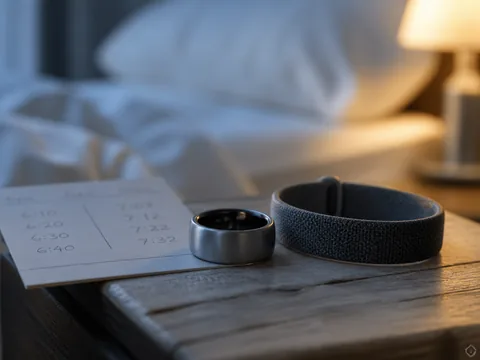
Your ring says you slept 6 hours 41 minutes and gives the night a 58. It flags elevated resting heart rate and a late-arriving temperature minimum. You scroll back through the day looking for a culprit and land on the 3:40 p.m. cortado, which is the obvious suspect, and you close the app feeling vaguely convicted.
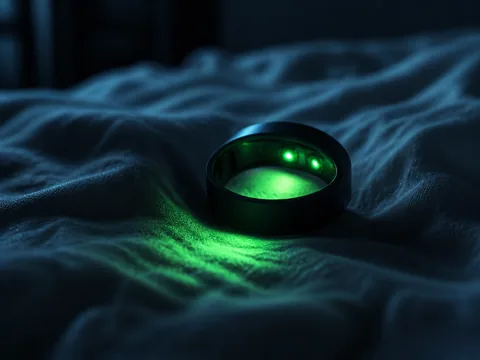
But notice what just happened. The device did not detect caffeine. Nothing in that ring, watch, or armband has any chemical contact with your bloodstream. It saw a green LED bouncing off capillaries, an accelerometer that stayed quiet, and a thermistor reading skin. You supplied the coffee. The wearable technology on your finger supplied a correlation, and your brain, which loves a story, welded the two together.
So here's a question worth taking seriously, because a lot of engineering money is currently pointed at it: could a wearable ever actually see the caffeine in you — not infer it, not accept it as manual log entry, but measure the molecule? And if it could, would that tell you anything your bedtime already doesn't?
The answer is more interesting than yes or no. It's partly, in a lab, on a small number of people, and probably not on the part of your body you'd expect.
What your wearable is actually measuring
Four signals do nearly all the work in consumer sleep tracking. A photoplethysmogram — an LED shining into skin, a photodiode counting how much light comes back as blood volume pulses — gives heart rate and, with enough beat-to-beat resolution, heart rate variability. A three-axis accelerometer gives movement. A thermistor gives distal skin temperature. Some devices add electrodermal activity, which is a proxy for sympathetic tone.
Everything else is inference. Sleep stages, "recovery," "readiness" — these are model outputs, not observations. And the models are decent at some things and genuinely mediocre at others. Chinoy et al. (2021), publishing in Sleep, ran seven consumer devices against in-lab polysomnography in 34 healthy adults. The pattern was consistent and instructive: sensitivity for detecting sleep was high, in the 0.93–0.97 range for most devices, while specificity for detecting wake was poor — some devices scored below 0.4. Translated: your tracker is very good at knowing you're asleep and quite bad at noticing when you're not. Four-stage classification landed well short of what the marketing implies.
This matters for the caffeine question. If you want to catch the specific damage caffeine does to sleep, staging accuracy is exactly the capability you need — and it's the weakest one you have. Landolt, Werth, Borbély, and Dijk showed in 1995 (Brain Research) that 200 mg of caffeine taken in the morning, roughly three hours after waking, still measurably altered the sleep EEG that night: reduced sleep efficiency, suppressed power in the delta range, raised it in the beta range. That's a spectral change inside non-REM sleep. No photoplethysmogram is going to find it.
Can a wearable measure caffeine directly?
In a research setting, yes — the chemistry works, and it has been demonstrated on human skin. In a product you can buy, no, and not imminently. The gap isn't the sensor. It's everything around the sensor.
The landmark result is Tai et al. (2018), published in Advanced Materials out of Ali Javey's lab at Berkeley. The device is a flexible patch that induces sweat locally, pulls it into a microfluidic channel, and runs differential pulse voltammetry across a carbon electrode. Caffeine is electroactive: hold the electrode at the right potential and the molecule oxidizes, producing a current peak whose height scales with concentration. Subjects took caffeine, and the patch tracked the rise in sweat caffeine over the following hours, with the curve broadly shadowing what you'd expect from plasma. The human data are proof-of-concept scale — a handful of volunteers, not a cohort — which is normal for this stage and also the reason you should hold the result loosely.
That lab has form here. Gao et al. (2016), in Nature, put a fully integrated multiplexed sweat array on a flexible board — glucose, lactate, sodium, potassium, plus skin temperature for calibration. The caffeine work is that platform pointed at a methylxanthine instead of an electrolyte.
How a sweat sensor gets from your cup to a number
Worth walking the whole path, in the order your body does it, because the failure points are distributed along it.
You swallow. Caffeine absorbs from the gastrointestinal tract essentially completely — the usual figure is 99% within about 45 minutes — and plasma concentration peaks somewhere between 30 and 120 minutes depending on what else is in your stomach. It crosses membranes freely; it's small, and lipid-soluble enough to go almost everywhere, including into the brain and across the placenta.
Then the liver starts working. Roughly 95% of caffeine clearance runs through a single enzyme, CYP1A2, which demethylates it into paraxanthine (the bulk of it), theobromine, and theophylline. That single-enzyme bottleneck is why caffeine pharmacokinetics vary so wildly between people, and we'll come back to it.

Meanwhile, some fraction of circulating caffeine partitions into eccrine sweat glands. This is the part the sensor depends on, and it's the part that's least under anyone's control. The concentration in sweat is low — micromolar, orders of magnitude below what you'd find in a blood draw — and it arrives late relative to plasma, because the molecule has to diffuse out of capillaries, into the gland, and up the duct.
Finally the electrode reads it. The patch applies a sweeping voltage; at caffeine's oxidation potential, electrons transfer; the resulting current peak gets integrated and converted into a concentration. That last step is the mature, well-established part. Voltammetry is old, reliable electrochemistry. Everything upstream of it is the problem.
The parts nobody has solved yet
Start with sweat rate. Analyte concentration in sweat is not independent of how fast you're sweating — dilution effects are real and vary with temperature, exertion, hydration, and gland density at the sampling site. Two people with identical plasma caffeine can produce different sweat readings, and so can one person on two different afternoons. Correcting for this is an active research problem, not a settled one.
Then there's the fact that at rest — which is to say, when you're sitting at a desk deciding whether to have another coffee — you barely sweat at all. The available volume is measured in nanoliters per gland per minute. That's why these patches induce sweat chemically, usually with iontophoresis: a small current drives a cholinergic agonist into the skin to switch the glands on locally. It works. It also costs power, requires a hydrogel that depletes, and is not something you can run continuously for sixteen hours on a ring-sized battery.
And then the lag. Even if you nailed the calibration, sweat tells you where your plasma was some time ago. For a decision like should I drink this at 4 p.m., a delayed readout of a curve you could have predicted from a timestamp and a body weight is not obviously worth wearing a patch for.
Which is why the likelier path may not be sweat at all. Interstitial fluid — the stuff between cells, sampled by microneedles that penetrate a few hundred microns and don't reach nerve endings — sits much closer to plasma in both concentration and timing. This is the route continuous glucose monitors already took, and CGMs are the existence proof that a needle-bearing biosensor can become an unremarkable consumer object. Groups working on microneedle electrochemical sensing have published detection of other small molecules through this route — the common citation is Joseph Wang's lab at UC San Diego, which has demonstrated microneedle sensing of levodopa and alcohol. Caffeine is chemically no harder. The obstacle is that nobody has a commercial reason to build it yet, because caffeine, unlike insulin dosing, is not a condition anyone treats.
The molecule that makes you sleepy isn't on the menu
Here's the deeper problem, and it's the one that makes me skeptical of the whole premise even as I find the engineering delightful.
Caffeine doesn't make you alert. It makes you less sleepy, which is a different operation. Adenosine accumulates in the extracellular space of the basal forebrain and elsewhere across your waking hours as a byproduct of neural metabolism, and binding at A1 and A2A receptors is a large part of what sleep pressure physically is. Caffeine is a competitive antagonist at both. It occupies the seat without triggering the signal. Lazarus et al. (2011), in the Journal of Neuroscience, narrowed this considerably in mice: knocking out A2A receptors specifically in the shell of the nucleus accumbens abolished caffeine's arousal effect, while the same animals still slept normally otherwise. That's an unusually clean localization for a drug this widely used.
So the number you'd actually want on your wrist is not caffeine concentration. It's adenosine tone at the receptor — how much pressure you've built, and how much of it is currently blocked. There is no non-invasive way to measure that in a human. There isn't a plausible one on the horizon. Your caffeine level is a stand-in for a stand-in.
And the conversion between them is deeply personal. Two axes of variation, both well documented:
On the pharmacokinetic side, CYP1A2 activity spreads the half-life across a wide range — commonly cited as 4 to 6 hours as a central figure, with real people falling anywhere from about 2 to 10. Regular smoking induces the enzyme and can roughly halve the half-life. Combined oral contraceptives inhibit it and can roughly double it. Late pregnancy pushes it dramatically longer, into the range of 15 hours.
On the pharmacodynamic side, Rétey et al. (2007), in Clinical Pharmacology & Therapeutics, tied a common variant in ADORA2A — the gene for the A2A receptor itself — to how much caffeine disrupts a given person's sleep, with certain genotypes showing markedly more caffeine-induced disturbance in sleep EEG at the same dose. Same milligrams, same blood level, different night.
A sensor that reported 12 micromolar in your sweat would still not tell you which of those people you are. It would tell you the concentration and leave the interpretation to a model that has never seen your receptors.
Where this technology probably lands first: the night shift

If continuous caffeine monitoring arrives as a real product, it will almost certainly show up in occupational safety before it shows up in the consumer aisle — long-haul freight, aviation, offshore work, hospital rotations. Fatigue risk management already has budgets, regulators, and a body count to justify itself, which is a set of conditions consumer sleep tech has never had.
What's striking is that the software half of that system already exists and works without any biosensor at all. Researchers at the Walter Reed Army Institute of Research built a family of tools around a two-process fatigue model that predicts psychomotor vigilance performance from sleep-wake history and caffeine intake. Vital-Lopez, Ramakrishnan, Doty, Balkin, and Reifman published caffeine-optimization work along these lines in the Journal of Sleep Research in 2018: given a sleep-deprivation schedule and a total caffeine budget, the algorithm computes when to take it to maximize alertness at the moments that matter. In their analyses, optimized timing beat conventional dosing patterns substantially — sometimes achieving equivalent alertness on less total caffeine.
Read that twice. The hard problem in this domain was never measuring the drug. It was scheduling it. A model with two inputs you can supply from a calendar already outperforms folk practice, and adding a chemical readout to it would be a refinement, not a revolution.
One honest flag, stated once and then dropped: a patch that reports a worker's stimulant levels to a dispatcher is a different object than one that reports to the worker. The occupational case is where wearable technology of this kind is most useful and also where the consent architecture needs to be settled before deployment, not after. The haptics people have the better instinct here — a device that buzzes you on your own wrist, and tells no one else, solves the actual problem without creating a second one.
An honest rule of thumb, and the arithmetic behind it
Until something better exists, exponential decay and a clock outperform any consumer sensor you can currently buy. Caffeine clears in first-order kinetics, so the only two numbers you need are your dose and your half-life.
Here's what 200 mg — roughly a 12-ounce drip coffee, though brew variation is enormous — leaves in you eight hours later:
| Your half-life | Who this tends to be | Left after 8 hours |
|---|---|---|
| 4 hours | Fast metabolizers; regular smokers | ~50 mg |
| 6 hours | The broad middle | ~79 mg |
| 9 hours | Combined oral contraceptive users; slow CYP1A2 | ~108 mg |
That bottom row is the one people underestimate. Just over half the dose is still circulating at bedtime, and 100 mg is not a trivial amount — it's a shot of espresso, arriving exactly when adenosine signaling is supposed to be winning.
The evidence that this matters at bedtime-adjacent hours is solid. Drake et al. (2013), in the Journal of Clinical Sleep Medicine, gave 12 subjects 400 mg of caffeine at 0, 3, and 6 hours before bed. The six-hours-before dose still reduced objectively measured total sleep time by more than an hour. The subjects, notably, did not report noticing. Self-perception failed where the polysomnograph didn't — which is a decent argument for tracking something, even something imperfect.
The rule of thumb: count backward eight hours from your target bedtime and make that your last real dose. If you're on an estrogen-containing contraceptive, or you know you're a slow metabolizer, make it ten. If you smoke, six is probably fine, though you have larger problems.
The experiment worth running this week
Don't wait for the sensor. Run the study on yourself, using the one thing your device measures well rather than the thing it merely models.
For the next ten nights, hold your bedtime and wake time fixed within about twenty minutes. Alternate: five days with your last caffeine before 1 p.m., five days with your usual schedule, shuffled rather than blocked if you can manage it. Log exactly one outcome, and make it average heart rate during the first three hours of sleep — a straightforward PPG measurement, not a stage classification, and therefore the number your device is least likely to be wrong about. Note your caffeine total in milligrams, not cups.
Ten nights won't reach significance and isn't meant to. What it will do is tell you whether the effect on you is large enough to see through the noise of a consumer sensor — and if it is, that's more actionable than any concentration readout would be, because it's already expressed in the units of your own life.
The wearable can't see the caffeine in your blood. But it can see what the caffeine did, if you give it a clean enough question to answer. Two side notes the body didn't need. First: paraxanthine, the metabolite that accounts for the majority of caffeine's breakdown, is itself an adenosine antagonist with its own half-life — so "caffeine cleared" and "stimulant cleared" are not the same event, and the simple decay table above is slightly optimistic. Second: decaf is not zero. An 8-ounce cup typically runs 2–15 mg. That's noise for most people and not for everyone.