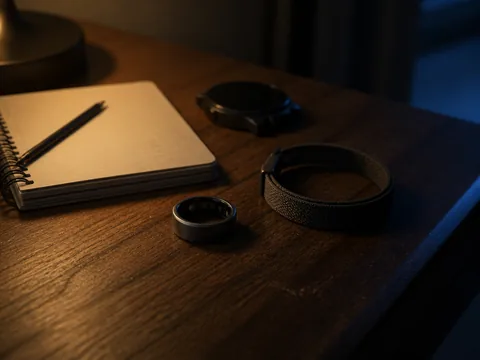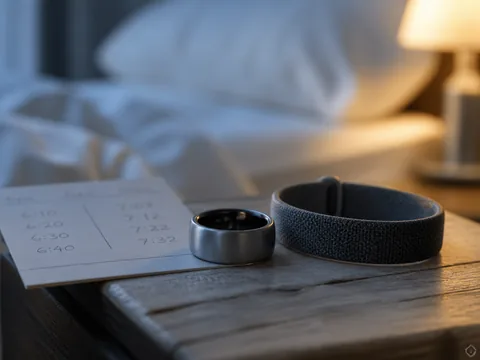
The standard advice on sleep tracking is simple: pick a device, wear it around the clock, and don't take it off. Almost every maker of wearable technology says some version of this, and most reviewers repeat it. The argument is about baselines. A tracker learns what normal looks like for you from continuous data, so every hour it misses makes the baseline a little less true, along with every score built on it. If you deadlift, boulder, knead bread, sand furniture or scrub a cast-iron pan, that advice runs into a plain fact: a ring on your finger is a ring you will take off.
So I spent 28 nights testing the rule. Here is the verdict in one sentence: taking the ring off during the day barely changed my sleep numbers, but the two nights I forgot to put it back on cost me more than every daytime gap combined, and a screenless band worn alongside it fixed that with less fuss than I expected.
Why I bothered
I've worn a smart ring for about 14 months. Over that time I built habits around it that I never really looked at. It came off for heavy pulls, because the knurling on a barbell chews titanium. It came off for climbing, because a ring under a crimp hold is a good way to hurt a finger. It came off at the kitchen sink and at the workbench. I knew the ring was missing those hours. I assumed, the way the advice tells you to, that the missing hours were quietly wearing down everything the ring told me about my nights.
There was a second reason, and it's the one this magazine cares about. For most of the summer I'd been trying to see whether my afternoon coffee showed up in my overnight heart rate. The 3 p.m. cortado is a habit I'd like to keep, and I wanted the data to tell me whether I could. Every time I sat down to look, a few nights were missing. When I traced them back, they were nights I'd taken the ring off after dinner and left it somewhere.
That turned a vague worry into a question I could test: how much do the gaps actually cost, and what do they cost?
How I ran it
The experiment ran for four weeks in September.
- Weeks 1–2: ring only. I kept my normal habits and took it off whenever I normally would.
- Weeks 3–4: ring plus a screenless fabric band on my left wrist, worn day and night. The band has no display and no subscription, and you read its data on your phone after the fact.
- Throughout: a paper index card in my pocket. Every time a device came off, I wrote down the time it came off and the time it went back on. Each morning I logged lights-out, my best guess at when I fell asleep, any wakings I remembered, and my wake time. I also logged every caffeinated drink with the time and a rough dose. My home double shot comes to roughly 60–80 mg depending on the beans, and I treated café drinks as about 100 mg.
Three limits matter for everything below. First, this is one person. Second, I had no access to a sleep lab, so when I say a device "agreed" with my log, I'm comparing it to a log that is itself unreliable. Nobody knows exactly when they fell asleep, and my guesses were probably off by ten minutes either way. Third, I'm not naming the specific ring and band. I tested one unit of each, and I don't want a single month on my wrist to read like a product verdict. What I can report is how the two form factors held up in a life that keeps taking rings off.
Where the advice is roughly right
The ring came off far more than I thought
In the two ring-only weeks, the index card recorded 41 removals, about 2.9 a day. Total time off came to 29.5 hours, an average of 2 hours 6 minutes a day. The median removal lasted 38 minutes. The longest was 3 hours 40 minutes, on a Saturday spent helping a friend move a workshop: table saw, drill press, a lot of steel shelving.
If you'd asked me before the experiment, I'd have guessed one removal a day and maybe an hour of missing time. I was off by a factor of two on both. The removals I'd forgotten about were the small ones: washing a roasting pan, re-potting a plant, ten minutes oiling a bike chain. None of them felt like taking the ring off. All of them were.
Missing workouts distort the next morning
This is where the advice holds up best, and athletes should take it seriously. My ring folds daytime activity into a morning recovery score. On days when it came off for lifting, it didn't see the lifting. The clearest example was a Tuesday with 75 minutes of heavy squats and pulls, with the ring sitting in my gym bag the whole time. As far as the ring knew, that was one of my least active days of the week. The next morning it told me I was well recovered and had room to push. I could barely get down the stairs.
The ring wasn't wrong about my sleep that night. My resting heart rate and sleep duration were ordinary. It was wrong about what the sleep was recovering from. If you use a tracker to decide whether to train hard or back off, missing workout hours are not cosmetic. They make the device optimistic on exactly the days it shouldn't be.
The forgotten nights
Twice in fourteen nights, the ring didn't make it back onto my finger. Once it sat on the windowsill above the sink after I washed dinner dishes. Once it stayed in my jacket pocket after an evening climbing session. Both nights are simply gone. There's no estimate and no partial record, just a blank in the weekly average.

By bad luck, both were late-coffee days, which took out two of the nights I most wanted for the caffeine question. The weekly sleep average for that stretch was built on twelve nights instead of fourteen, and the ring said nothing about it. It reported the average with the same confidence either way.
Here the advice is right, but for a narrower reason than it gives. Taking the ring off didn't cost me two nights. Not putting it back did.
Where the advice breaks down
Daytime gaps barely touched the sleep data
The advice implies that every missing hour degrades the whole picture. For sleep specifically, my data says otherwise.
I split the ring-only weeks into high-gap days (more than 2.5 hours off) and low-gap days (under 1.5 hours off). There were five high-gap days and six low-gap days. The rest sat in between or were the forgotten nights. On the nights that followed, the differences were within what I'd call ordinary night-to-night noise:
- Lowest overnight heart rate: 52 bpm after high-gap days, 51 after low-gap days.
- Total sleep estimate: 7 h 02 m vs 7 h 09 m.
- Overnight heart rate variability: a 2 ms difference, smaller than the swing between two ordinary Wednesdays.
That makes sense once you think about how sleep is measured. A ring reads sleep from what happens while you're asleep: heart rate, movement and skin temperature at night. Whether it saw you scrub a pan at 6 p.m. doesn't change much about what it records at 2 a.m. Daytime data feeds the scores wrapped around sleep, like recovery, readiness and activity balance, more than the sleep estimate itself.
So if your only question is "how did I sleep?", daytime ring removal is close to harmless. The baseline argument is real, but its main victim is the morning advice, not the nightly record.
The fix it offers is discipline, and discipline lost
The implied fix in "never take it off" is to stop taking it off. I tried. For three days at the start of week two, I left the ring on through everything.
On day one I put a visible scratch in the ring on a barbell. On day two I pinched the skin under it on a pull-up bar badly enough to leave a blood blister. By day three I was gripping differently on every pull to protect the finger, which is a bad trade for a sleep metric. I took the ring off for the next lifting session and went back to my old habits.
I don't think that's a willpower failure. The removals were reasonable decisions about my hands. Advice that only works if you stop making reasonable decisions isn't good advice. The useful question isn't how to wear the ring more. It's what you can wear that never needs to come off.
Two devices don't give you twice the truth
In weeks three and four I wore the band all the time and kept wearing the ring as I had before. The band had almost no gaps. It came off for about nine minutes a day on average, mostly while charging during a shower. And because it lives on the wrist, there was no ring sitting on a windowsill at bedtime. I lost zero nights to it in fourteen. The ring, still coming on and off, lost one more.
What I hadn't expected was how often the two devices disagreed with each other.
- Sleep onset: they differed by an average of 14 minutes. Compared with my log, the ring was off by 11 minutes on average and the band by 19.
- Total sleep: within 20 minutes of each other on ten of fourteen nights. One restless night they were 52 minutes apart.
- Night wakings: on one night I was clearly awake from about 3:10 to 3:35. I remember checking the clock twice. The ring caught it. The band logged it as light sleep.
- Overnight heart rate: the lowest-HR figures tracked each other closely, usually within 1–2 bpm. The two devices agreed most on the numbers least affected by sensor position.
The ring's sleep timing matched my log a little better, as you'd expect from a sensor on a finger, where the pulse signal tends to be cleaner than at the wrist. But the band's real advantage had nothing to do with accuracy. It was always there. A slightly less precise number for every night beat a slightly more precise number for most nights, especially when the missing nights weren't random.
Ring vs band: the comparison
These are my own measurements over two weeks per configuration, on one wrist and one finger, not a lab test.
| Smart ring (my habits) | Screenless band | |
|---|---|---|
| Average daily data missing | 2 h 06 m | about 9 min |
| Nights lost (per 14) | 2 in weeks 1–2, 1 in weeks 3–4 | 0 |
| Sleep onset vs my log (average gap) | 11 min | 19 min |
| Under a barbell or on a climbing wall | Came off every time | Stayed on; slid down the wrist on hangs |
| Ongoing fee | Monthly membership for the full sleep analysis | None |
| Charging interval in my use | Every 5–6 days | Every 4–5 days |
The band had real costs. It's another strap on your body. It sat awkwardly under a watch on the days I wore one. And the fabric stayed damp for about an hour after a sweaty session, which I noticed every time. The ring is the better object: smaller, more discreet, a little more precise at night. It just isn't the better object for someone who keeps taking it off.

If you want the line to screenshot, it's this: if your ring comes off more than twice a day, the ring isn't your problem. The night you forget to put it back on is.
The caffeine question I came in with
Here's what four weeks did and didn't tell me about the afternoon cortado.
Across the whole experiment I had seven days with caffeine after 2 p.m. and nineteen without. The other two days are the forgotten-ring nights, which fell on late-coffee days and are missing from the ring's record entirely. On the band, which only covered weeks three and four, I had five late-coffee nights and nine others.
- Ring: lowest overnight heart rate averaged about 3 bpm higher on late-coffee nights.
- Band: the same direction, about 2 bpm higher.
- Total sleep: no difference I'd trust. Late-coffee nights averaged 6 minutes shorter on the ring and 4 minutes longer on the band.
A 2–3 bpm rise in overnight heart rate after a late coffee is the kind of thing I'd expect, but I can't separate it from what else was going on. My late-coffee days were also my long days: the workshop move, a deadline week, two evening climbing sessions. Each of those is enough on its own to raise an overnight heart rate. Five to seven nights is not a sample. It's an anecdote with a spreadsheet attached.
This is also where the gaps did their real damage. The nights the ring lost weren't a random sample of my life. They were busy, late, caffeinated days, the ones when I was too scattered to put the ring back on. That's a quiet bias in any ring-only dataset. The days you most want to study are the days you're most likely to lose. A device that never comes off doesn't fix that by being more accurate. It fixes it by not having an opinion about which days are worth recording.
Who this is for, and who it isn't
This is for you if:
- You lift, climb, do martial arts, play racquet sports, or work with tools, and your ring comes off as a matter of routine.
- You cook, garden or clean in ways that put your hands in water or grit for long stretches.
- You want overnight data without a screen lighting up on your wrist at 2 a.m.
- You're tired of paying monthly for analysis of data you collected yourself, and you'd trade some precision to get rid of the fee.
- You're running your own experiment on caffeine timing, alcohol or training load, where missing a non-random set of nights would quietly bias the answer.
This isn't for you if:
- You already wear a ring around the clock without trouble. If it never comes off, nothing here argues for changing, and the ring was the more precise of the two at night.
- You want pacing, GPS or live heart-rate zones during a workout. A screenless band won't do that; you want a watch.
- You're trying to work out whether something is medically wrong with your sleep. Neither device is a diagnostic tool, and neither tried to be one. That question belongs with a doctor and, if it comes to it, a proper sleep study.
A more honest version of the rule
"Never take it off" gets the priorities slightly wrong. My month suggests a different order:
- Every night matters more than every hour. A missing night is a hole you can't fill. A missing afternoon mostly isn't, at least for the sleep numbers.
- If you train hard, daytime gaps matter for recovery advice, not for sleep data. Discount the morning recovery score on days the device didn't see your workout, or log the workout by hand.
- Pick the form factor your days won't defeat. If your hands are part of your training or your work, choose something that can stay on through them rather than a better sensor that spends two hours a day in a gym bag.
- Make putting it back automatic. After the experiment I moved the ring's charger next to my toothbrush. In the two weeks since, the ring hasn't missed a night. That one change did more than three days of trying to never take it off.
Or, in one sentence: wear something every night without exception, wear it during the day when your hands allow it, and if they don't, change the device rather than your hands.
What this didn't answer
A few things are still open, and I'd rather name them than paper over them.
How accurate either device is. My comparison was against my own morning guesses, which aren't a reference standard. The real test is laboratory polysomnography. The place to look is independent validation work from academic sleep labs that test consumer trackers against it. Check whether the specific model and firmware you're considering has been tested. Results for one generation don't automatically carry over to the next.
Whether wrist placement holds up for everyone. The band slid on my wrist during hangs and tracked well at night, but I have one pair of wrists. People with very slim wrists, tattoos or darker skin tones can get different optical readings. That's a known issue across wearable technology in general and one I couldn't test.
The caffeine dose and timing question. I ended the month with a plausible direction and no real answer. A real answer needs more nights: something like alternating caffeine-free weeks with late-coffee weeks over two or three months, with a device that never comes off, so the busy days are counted along with the calm ones. Before running that, read the published research on how long caffeine stays in the body and how much that varies between people. Then export your raw overnight data rather than trusting the app's summary scores. The scores are where your daytime gaps, and the device maker's assumptions, get folded in where you can't see them.
I'm keeping the band on, and I'm keeping the cortado for now. Ask me again in December.