A friend who reads sleep studies for a living told me last winter that consumer sleep data is "astrology with a heart rate sensor," and that if I was going to buy into it anyway, I should at least buy the expensive version. That second half is the belief I want to poke at, because it's everywhere: the idea that accuracy in fitness trackers scales with price, that a $100 band is a toy and a $400 watch is an instrument. So I spent sixty nights on the cheap end of that claim, wearing a Fitbit Inspire 3 against a deliberately boring caffeine schedule.
The verdict: for the one question most coffee drinkers actually want answered — is my late cup costing me anything — the Inspire 3 is enough tracker, because the two signals it measures most reliably, movement and overnight heart rate, are exactly where caffeine leaves a mark. Nearly everything else it reports, including the number it prints in the largest font, is softer than it looks.
The myth: that truth about your sleep scales with price
The myth is worth taking seriously because it's half right, and the half that's right is loud. Premium watches genuinely have more hardware. An Apple Watch or a Pixel Watch will give you an ECG, multi-band GPS, an electrodermal sensor in some models, a much faster processor, a much better screen. Those are real components, and you can feel where the money went the moment you put one on.
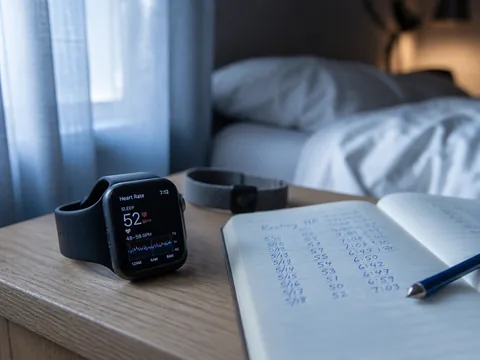
But walk down the list and ask which of those sensors is doing anything at two in the morning. The ECG is a spot check you run deliberately while sitting still; it isn't running overnight. GPS is asleep. The payments chip, the speaker, the always-on display — irrelevant. What's actually collecting your sleep data on a $400 watch is an accelerometer and an optical heart rate sensor: the same two things doing the job on a $79 band. The expensive device is not listening harder. It's listening with roughly the same ears, then running the numbers through a model that is proprietary on both devices and validated in public on neither.
That's the myth in a sentence: people assume they're buying a better microphone when what they're mostly buying is a better dashboard. I wanted to find out whether the cheap microphone was good enough to hear one specific thing.
What I actually did
I bought an Inspire 3 in black for $79.95. List is $99.95, and in the eight months I've been half-watching it, the street price has bounced between about $69 and $99 without ever staying anywhere long — if you're buying, the number on the box is not the number to plan around. It ships with six months of Fitbit Premium for new accounts, which matters more than I expected and not in a good way; more on that below.
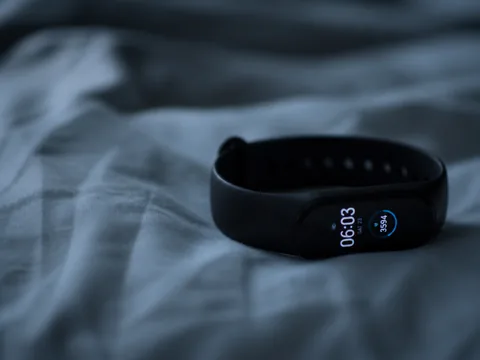
The hardware, briefly. It's 17.7 grams on the wrist with the small silicone band, small enough that I stopped noticing it on night three, which is the only comfort metric that counts for a sleep device. Color touchscreen. Rated 5ATM, so showers and pools are fine. No built-in GPS — it borrows your phone's. No altimeter, so no floor counts. No payments, no music, no speaker. Overnight it records heart rate continuously, an estimate of blood oxygen variation, and relative skin temperature once it's built a three-night baseline.
Battery: Fitbit claims ten days. With continuous heart rate on, SpO2 tracking on, and the always-on display off, I averaged seven days and nine hours across five full charge cycles, with a worst cycle of six days two hours during a week I used the timer a lot. Turning off SpO2 got me to roughly nine days. Turning the always-on display on collapsed it to just under three. None of this is a scandal — seven days still means I charge it on Sunday morning in the shower and never think about it — but ten days is a laboratory number, not a wrist number.
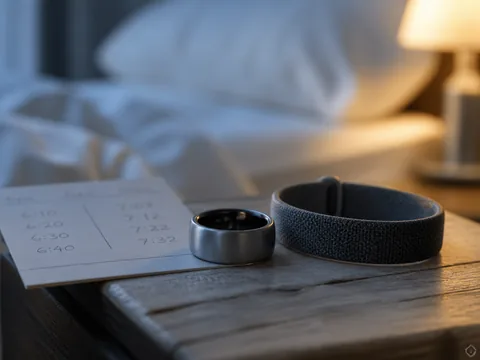
The protocol was designed to hold the dose constant and move only the timing. Every day for sixty days I drank the same total: two double espressos before 9 a.m. (roughly 130 mg each by the roaster's published figure) plus one 8 oz filter coffee (call it 120 mg) whose timing was the only variable. Twenty nights with that last cup at noon, twenty at 4 p.m., twenty at 7 p.m. Same bedroom, same 11:00–11:30 p.m. target lights-out, blackout curtains, no alcohol on tracking nights, no evening screens past 10:30 that I could avoid. Alongside the Fitbit I kept a paper diary: what time I got in bed, my honest guess at how long falling asleep took, and a one-to-five morning rating.
What I couldn't control: everything else. I knew which block I was in — you cannot blind yourself to drinking coffee at 7 p.m. — so expectation is baked into both the diary and, arguably, into my sleep. The blocks ran consecutively rather than interleaved, so seasonal drift, work stress, and one head cold are all confounded with timing. Sixty nights of one middle-aged man is not a study. It's a well-kept notebook, and I'd ask you to read it as one.
The numbers
Medians across each twenty-night block, with the night-to-night spread in brackets where it's large enough to matter.
| Metric | Last cup at noon | Last cup at 4 p.m. | Last cup at 7 p.m. |
|---|---|---|---|
| Fitbit sleep score | 82 | 81 | 77 |
| Lowest overnight heart rate | 51 bpm | 52 bpm | 56 bpm |
| Minutes awake after falling asleep | 41 | 44 | 58 |
| Deep sleep, minutes | 68 [±22] | 64 [±19] | 61 [±25] |
| Diary: minutes to fall asleep | 14 | 17 | 31 |

The first thing to say about that table is that two of its rows are noise wearing a suit.
The sleep score moved five points across a shift that took me from finishing coffee at lunch to finishing it two and a half hours before bed. Five points, on a scale where my ordinary night-to-night variation was ±7 even inside a single block. If I'd run this experiment by opening the app each morning and reading the big number, I would have concluded that a 7 p.m. coffee costs me approximately nothing, and I'd have been wrong.
The deep sleep row is worse. The medians descend in the direction you'd expect, which is exactly the kind of tidy little slope that invites you to believe it. But look at the spread: ±22 minutes inside a block whose medians are seven minutes apart. I had a 91-minute deep sleep night in the 7 p.m. block and a 39-minute night in the noon block. Anyone reporting "late caffeine cut my deep sleep by 10%" from data this loose is reporting their prior, not their wrist.
The one number that actually moved
The row I trust is the heart rate.
My lowest overnight heart rate sat at 51 or 52 bpm through the noon and 4 p.m. blocks and jumped to 56 in the 7 p.m. block — a five-beat shift that showed up on 17 of 20 nights, not as an average pulled around by outliers. The three exceptions were the three nights I'd done a hard morning run, which raises the floor anyway. That's the cleanest finding I got, and it's clean in the way that matters: it's a per-night effect you can see with your naked eye by flipping through the overnight heart rate graphs, not a difference you have to compute.
The minutes-awake row backs it up, more roughly. Fifty-eight versus forty-one is a real gap, and it lines up with the diary, where the 7 p.m. block is full of entries like took ages, kept surfacing. My subjective time-to-sleep roughly doubled. I want to be careful here — that's the metric most contaminated by knowing which block I was in — but the wake-count and the heart rate floor don't care what I believed, and they agree with it.
What I did not find: any convincing evidence that a 4 p.m. coffee costs me anything at all. On every metric, the 4 p.m. block is within noise of the noon block. Sixty nights of the tidiest protocol I could manage, and the honest summary of two-thirds of it is no detectable difference. I went in half-expecting a graded dose-response — earlier is better, always — and got a cliff instead of a slope. That may be entirely specific to my metabolism. It may be an artifact of block order. But it's what the notebook says.
Why the cheap sensor is well matched to this particular question
Here's the mechanism, and it's the reason the myth fails on this specific job.
The Inspire 3 has two ways of knowing anything about your night. The accelerometer tells it when your wrist moves. The green LEDs on the underside shine light into your skin and measure how much bounces back, which changes with each pulse of blood — that's photoplethysmography, and it yields heart rate plus the timing gaps between beats.
Sleep-versus-wake is the easy problem. A body that hasn't moved in eleven minutes and whose heart rate has dropped fifteen beats below its daytime floor is asleep, and you don't need a $400 watch to work that out. The general finding in the published validation literature on wrist wearables — across brands, not just this one — is that they're decent at that binary and considerably shakier at the next step.
That next step, sleep staging, is the hard problem. Nothing on your wrist can see a brain wave. What the device does instead is feed movement, heart rate, and beat-to-beat variability into a model that infers which stage you were probably in. Sometimes it's right. When it's wrong, it's wrong invisibly, and the app renders the guess in the same confident colored bands as everything else. That's the part my study-reading friend was calling astrology, and on that narrow point she's closer to right than the marketing is.
Now put caffeine into it. Caffeine works by blocking adenosine receptors — adenosine being the molecule that accumulates all day and makes you feel the weight of being awake. Block it and you don't remove the tiredness, you just stop reading the gauge. One downstream consequence is a nudge toward sympathetic tone: heart rate a little higher, heart rate variability a little lower, arousal threshold a little lower. Which means the fingerprint caffeine leaves overnight lands squarely on heart rate and restlessness — the two things this cheap sensor measures most directly — rather than on sleep architecture, which is the part it's guessing at.
That's the whole argument. The Inspire 3 isn't a good sleep lab. It's a decent thermometer pointed at the one axis where late coffee shows up. Spending three hundred more dollars would have bought me a nicer graph of the same two signals.
What the extra money does buy
To be fair to the expensive end, here is what you actually get for it. Prices are US list as of this summer; all four of these get discounted.
| Inspire 3 ($99.95) | Charge 6 ($159.95) | Apple Watch SE ($249) | Phone app only ($0) | |
|---|---|---|---|---|
| Battery on my wrist | 7d 9h | ~5 days | Overnight charge needed | n/a |
| Overnight sensors | Accelerometer + PPG | Same, plus better PPG | Same, plus temp | Microphone / bed motion |
| Costs money to see stages? | No | No | No (third-party apps vary) | Usually yes |
| Built-in GPS | No | Yes | Yes | Phone |
| Best for | Sleep + steps, forget-about-it | Runners who want maps | Everything, if you charge daily | Trying before buying |

The Apple Watch column is where the argument gets decided for most people, and not on accuracy. It's a better computer in every measurable way. It also needs charging every day, which means you will develop a charging habit, and the natural slot for that habit is bedtime — the exact hours you bought it to measure. I've watched three separate friends buy premium watches for sleep tracking and quietly stop wearing them to bed within two months. A tracker you charge weekly, in the shower, on a Sunday, is a tracker that's actually on your wrist at 3 a.m. Seven days of mediocre data beats two days of excellent data, every time.
Where it annoyed me
This is not a five-star device and I'd distrust anyone who says it is.
The screen is poor in daylight. Bright noon sun outdoors, at a glance, mid-stride: unreadable often enough that I stopped bothering. Raise-to-wake missed maybe one time in five, and the miss rate got worse when my wrist was at an angle — reaching for something, holding a mug. You end up doing the little double-flick thing that everyone with a cheap band does.
The clasp is the classic Fitbit peg-and-hole design and it caught on jacket cuffs twice hard enough to pop open. Neither time did it actually fall off, but I've read enough accounts of the band going missing that I'd budget for a third-party strap with a real buckle.
Premium is the real friction. Sleep stages and the nightly score are free, which is more generous than I expected, and it's genuinely all I needed for this experiment. But the Sleep Profile — the monthly analysis that assigns you an animal — and the Daily Readiness Score both sit behind the subscription, and the app is architected to keep reminding you of that. Six free months means the paywall lands right when you've built the habit, which is the point. At around $10 a month, ask yourself honestly whether you'll act on a readiness score. I didn't, and I let it lapse.
The score's precision is a lie of presentation. An 84 is not meaningfully better than a 79. Displaying two significant figures on an estimate this noisy trains people to react to nothing, and reacting to nothing is how you end up anxious about sleep — which, as it happens, degrades sleep.
And getting your data out is a chore. Bulk export runs through a Google account data export rather than anything resembling a download button, and the shape of what arrives is not what you'd design if you wanted people to analyze their own nights. New setups now route through a Google account too, which some people will care about and some won't.
Who this is for, and who should skip it
Buy it if you've never worn a tracker and want to find out whether you're the kind of person who uses one — this is the cheapest honest way to answer that. Buy it if you have one specific question about a habit (coffee timing, alcohol, late meals, bedtime drift) and you want an instrument pointed at it for a month. Buy it if you want step counts and sleep and would resent charging a gadget every night. Buy it if you're on a wrist small enough that a 44mm watch looks silly on you; this thing is tiny.
Skip it if you're a runner who wants pace and route without carrying a phone — that's the Charge 6's job and the $60 is well spent. Skip it if you want notifications you can actually reply to, or payments, or music control. Skip it if you already own any recent smartwatch, because you own the same two overnight sensors already. And skip it if you're chasing sleep architecture — if you want to know something real about your deep sleep, no wrist device at this price or four times it is going to settle it, and a conversation with a doctor about a real sleep study is the honest next step.
The hardest case: skip it if you suspect you'll get anxious about the number. Some people get a useful nudge from a nightly score. Some people get a new thing to fail at. You probably already know which one you are.
The line you can screenshot
The expensive watch doesn't see your sleep better — it just draws it prettier. If your question is "is my late coffee costing me," a $79 Inspire 3 and its overnight heart rate graph will answer it, and the $400 watch will answer it identically, on a screen you have to charge every night.
Try this, this week
Don't run my sixty-night protocol. Run five nights, and only look at one number.
For the next five nights, keep everything about your day the same — same total coffee, same bedtime, same everything — except move your last caffeinated drink three hours earlier than usual. Each morning, open whatever tracker you have and find the lowest overnight heart rate, the floor of the graph. Not the sleep score. Write those five numbers on a sticky note next to the five from the week before.
If the floor drops by three beats or more, you've got your answer, and it's the same answer I got at a cost of one week instead of two months. If it doesn't move, that's an answer too — the late cup isn't your problem, and you can stop wondering and go looking at something else.
Five numbers on a sticky note is a smaller experiment than the app wants you to run. It's also the only part of mine I'd defend.