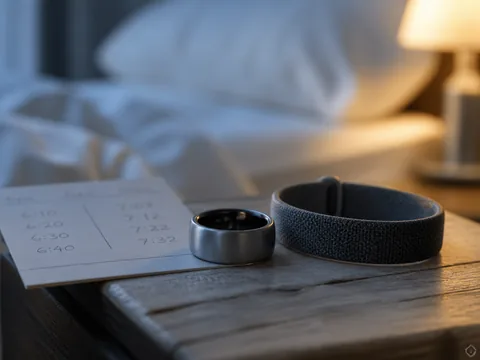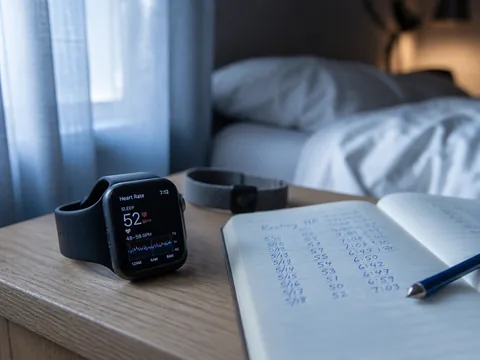
The question I kept asking before I bought one is probably the one you're asking now: will a $349 watch change anything I actually do, or will it just show me, in nicer graphics, that I sleep badly and sit too much? This smartwatch review is my attempt to answer that honestly after six weeks of wearing one day and night. For comparison I wore a $55 fitness band on the other wrist and kept a paper notebook.
The short version: the watch changed three of my habits, and the band would have caught two of them. The one only the watch caught, which was what my afternoon coffee was doing to my nights, is the reason I kept it.
How I tested it
I am not an athlete. I run three times a week, slowly, and I walk the dog. I drink two to three cups of coffee a day, and before this started the last one usually landed around 3 p.m.
For six weeks I wore a mid-range flagship smartwatch ($349 when I bought it, no cellular) on my left wrist and the $55 band on my right. Every night I wrote down my lights-out time, the time of my last caffeine, and a rough milligram estimate. I counted a 12 oz drip coffee as about 180 mg and a double espresso as about 130, which is approximate at best. Every morning, before I looked at either device, I rated how rested I felt on a 1–5 scale.
Here is what I couldn't test. I don't have a sleep lab, so I had nothing to check sleep stages against. I wore a chest strap on only six runs. And one person over 42 nights is a diary, not a study. Every number below is mine and nobody else's.
The metrics that earned their place
Overnight heart rate and the 3 p.m. coffee
This is where the watch paid for itself. Fifteen of the 42 nights followed a coffee after 2 p.m. On those nights my average overnight heart rate was 58 bpm. On the other 27 it was 54. Heart rate variability, which the watch reports as a nightly average, was 36 ms after late coffee and 46 ms without it. Estimated sleep was 6 h 38 min against 7 h 09 min.
None of those numbers means much on its own. HRV in particular moves with alcohol, a hard run or a stressful day. But the split held across all six weeks, and my notebook agreed: I averaged 2.6 out of 5 on mornings after a late coffee and 3.5 on the rest. I moved my last cup to 1 p.m. in week three. I never felt any different at bedtime. The watch showed the difference the next morning, nearly every time.
That is what I mean by an actionable metric: a number that tells you something you can't feel, attached to a choice you control.
The band reports resting heart rate too, but as a single daily figure that blends day and night. In that figure the late-coffee gap shrank to 1–2 bpm, which disappears in normal day-to-day variation. It doesn't measure HRV at all, and HRV was where the effect was largest and most consistent.
Resting heart rate as an early warning
In week four the watch flagged my resting heart rate 6 bpm above baseline on two mornings in a row. The next day I had a sore throat. I skipped a run I would otherwise have done and was back to normal in four days. That happened once, so it's an anecdote. The band showed the same rise if you went looking for it, which is one of the two habits the cheaper device could have changed.
The idle nudge
The hourly buzz telling me to stand up is the least interesting feature on the watch, and it worked. My average daily steps went from about 6,800 in week one to 8,900 by week six. The band buzzes in exactly the same way. That's the second habit both devices would have caught.
The metrics that didn't
The readiness score
Every morning the watch gives a readiness score from 1 to 100. It tracked my own ratings poorly. After a broken night up with a sick dog, which I rated 2, it gave me 82, apparently because the previous day had been light on activity. The morning after a long, easy run that left me feeling great, it gave me 61. Across 42 mornings the score and my rating moved in the same direction about half the time, which is no better than guessing. I stopped opening it in week three.

Calories
On the same 45-minute walk, the watch claimed 310 calories and the band claimed 240. I can't check either at home, but a 70-calorie gap on one walk is wide enough that I wouldn't base a food decision on either number.
Sleep stages
The watch credited me with anywhere from 40 minutes to 1 h 20 min of deep sleep a night, and the figure didn't line up with anything I logged: caffeine, exercise, alcohol or bedtime. I had no way to verify it, and I ignored it after week two.
Heart rate on the run
On the six runs with a chest strap, the watch read within 2–3 bpm at a steady pace. During intervals it lagged 10–15 seconds behind the strap and undershot my peaks by up to 12 bpm. That's fine for an easy runner and not good enough for someone training by heart-rate zones.
Watch vs band: what each one changed
| Metric | $349 watch | $55 band | Changed what I did? |
|---|---|---|---|
| Overnight HR and HRV | Both, nightly, with a clear trend view | Daily resting HR only | Yes: last coffee moved to 1 p.m. |
| Resting HR spike | Flagged automatically | Visible if you look | Yes, once |
| Idle reminders | Yes | Yes | Yes: about 2,000 more steps a day |
| Readiness score | Yes | No | No |
| Calories (same walk) | 310 | 240 | No |
| Battery | About 2 days | About 9 days | — |
The battery row matters more than it looks. I charged the watch every other morning while I showered, and I still lost three nights of data to forgetting. The band I charged twice in six weeks.
Where the answer is 'it depends'
Most smartwatch reviews skip the part where the device's value depends on you rather than on the hardware. These are the conditions that decided it for me.
- Is there a gap between how you feel and what's happening? My late coffee didn't feel like a problem at 10 p.m. If your habits already show up in how you feel, the watch will mostly confirm what you know.
- Will you wear it to bed? Almost everything that made it worth $349 happened overnight. The watch is noticeably thicker than the band, and I took it off on two nights in the first week. If you won't sleep in it, buy the band.
- Does it fully support your phone? Many flagship watches keep features back unless they're paired with the same brand's phone. Check before you buy, not after.
- Are the trends behind a paywall? My watch showed the nightly HRV history for free. Some brands charge a monthly fee for exactly that view, and that changes the math.
Who this is for, and who it isn't
It's for people who sleep worse than they think they should and suspect caffeine, alcohol or late meals. It's for people willing to wear it every night and keep a few weeks of honest notes alongside it. And it suits people who would use the notifications and payments anyway, so the health features ride along.
It isn't for anyone who wants a calorie number to diet by, or who will let a readiness score tell them how they feel. And it isn't for people who just want to move more: the band does that for less than a sixth of the price, with four times the battery life.
If you only want to move more, buy the $55 band. If you want to know what your evenings are doing to your nights, the watch is the one that will tell you.
Back to $349
I started by asking whether $349 would change anything I do. It changed three things, and a $55 band would have caught two. So the extra $294 bought exactly one habit: my last coffee now comes at 1 p.m. instead of 3.
Measured as a gadget, that's a steep price for one behavior. Measured as sleep, it bought me about half an hour on every night that used to follow a late cup, which makes it the cheapest sleep I've paid for. That only holds because I had a habit worth finding. Someone without one would pay the same $294 and learn that they were already doing fine.