I drink two cups of coffee a day, and for years I've told myself the second one, the 4 p.m. one, doesn't matter. This Apple Watch Series 12 review started as a way to prove that. It ended with me awake at 6:40 a.m., searching what a sleeping heart rate six beats above normal means, so you can guess how the proving went.
The short version: the Series 12 can see caffeine. It shows up in your heart rate within about half an hour and in your overnight numbers that night. What it can't do is tell you which cup did the damage, and one odd overnight reading taught me to stop asking it to.
The setup, and its limits
Ten days. One 12-ounce pour-over per cup, made the same way each time, which I put at roughly 150 mg of caffeine. That's an estimate from brew ratio and published averages, not a lab number. On days one to five my last cup was at 11 a.m. On days six to ten it was at 4 p.m. Lights out at 11 p.m. every night, give or take a dog.
This is one person, one wrist, ten nights. I'm also someone who checks the oven is off by touching the knobs in order, so treat my emotional reactions as part of the data, not as calibration.
I'll go in the order the coffee does: into the gut, into the blood, into the brain, through the night, and out the other side as a number on my wrist the next morning.
Minute 0 to 45: the cup goes in
Caffeine is absorbed almost completely in the small intestine, and blood levels usually peak somewhere between 30 and 60 minutes after you drink it. Until now, wearables mostly guessed at this window, because a watch on a seated wrist took a heart-rate sample every few minutes and filled in the gaps.
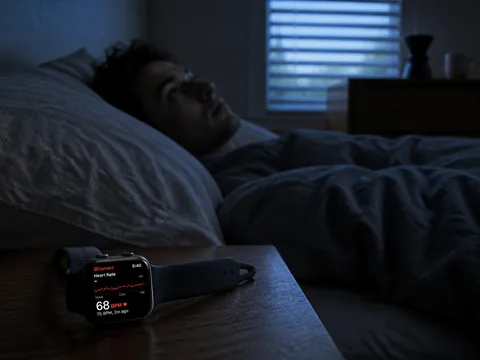
The headline hardware change on the Series 12 is a new heart sensor that takes a reading every five seconds, even when you're doing nothing. Apple says that's 60 times more often than the Series 11. On my old Series 9 a morning at the desk looked like a flat line with a few dots on it. On the Series 12 it looks like weather.
On a typical noon-cutoff morning, my seated heart rate sat around 61 bpm before the first sip. By minute 25 it was drifting through 68 to 70. It peaked near 72 at about minute 40, then settled back to the mid-60s over the next hour. I saw the same rough shape on eight of ten days. The two exceptions were the days I walked the dog right after brewing, which wrecked the comparison.
I'll admit some of that rise may have been me. It is hard to sit still and calm while watching a graph of whether you're sitting still and calm. (On day three I caught myself refreshing the Heart Rate app instead of drinking the coffee, which kind of defeats the purpose.)
Hours 1 to 6: the long tail nobody wears on their wrist
This is where the watch hits a wall, and it's worth being clear about why.
Caffeine's main job happens in the brain. It blocks adenosine receptors. Adenosine is the molecule that builds up while you're awake and makes you feel sleepy. Caffeine's half-life averages around five hours in healthy adults, but it varies a lot from person to person. If I finish a cup at 4 p.m., something like half of it is plausibly still around at 9 p.m., and a meaningful share at bedtime.
No wrist sensor measures adenosine. What the Series 12 sees are downstream shadows: heart rate, heart rate variability, skin temperature. On 4 p.m. days, my afternoon and evening heart rate looked almost the same as on noon days. Daytime HRV readings were a few milliseconds lower, but the spread was wide enough that I wouldn't put money on it.
The new Readiness score updates through the day instead of locking in each morning. It didn't move after the afternoon cup either. That isn't a flaw so much as an honest picture of the physiology: a habitual coffee drinker's body barely registers the second cup at the wrist. The cost shows up later.
Lights out: sleep onset
Apple doesn't hand you a sleep onset latency figure, but you can work one out. Take the gap between when the watch thinks you got into bed and its first logged sleep stage. I also kept a paper log of the last time I remember seeing the clock, which is crude but at least independent of the watch.
Noon-cutoff nights averaged 14 minutes to fall asleep by the watch's count. 4 p.m. nights averaged 27. My paper log agreed on direction and roughly on size. On two nights the watch had me asleep about ten minutes before I believe I was. Lying very still with your eyes closed, thinking about an email, looks a lot like sleep to an accelerometer.
Thirteen extra minutes doesn't sound like much. On those nights it felt like an hour.
2 a.m.: the reading
Night seven was a 4 p.m. night. In the morning, the Vitals app had flagged my overnight heart rate as above my usual range, about six beats higher than my baseline. Wrist temperature was also slightly elevated. Two outliers at once is how the app gets your attention, and it got mine.
What followed was not a proud twenty minutes. I read about overnight tachycardia. I read about early infection. I asked my partner whether I seemed feverish, and they said I seemed like someone who had been reading about tachycardia.
Then I did what I should have done first, which was look at the rest of the evening. It had been a 4 p.m. coffee day. I'd also eaten dinner at 9:15, and the bedroom was warm because I'd forgotten to open the window. Any one of those can push up sleeping heart rate. The watch can't tell them apart, and to its credit it doesn't claim to. Night eight was completely normal, and so were nights nine and ten.
One flagged night, three likely causes, no repeat: that's not something to act on. It is, though, a good example of what five-second sampling and overnight vitals can do to a person who wasn't looking for anything.
Morning: the Readiness number
Readiness runs from 0 to 10 and folds together sleep, overnight vitals, training load, HRV, and recent activity. My noon-cutoff mornings averaged 7.4. My 4 p.m. mornings averaged 6.6. That gap held up, and it lined up with how I actually felt at 8 a.m.
But Readiness never says the word coffee. It bundles everything, so a 6.6 could mean caffeine, a late dinner, a warm room, or Thursday. Over a week it's a useful trend. On any single morning it can't tell you why.
Noon cutoff vs 4 p.m. cutoff: what the Series 12 recorded
| Measure (5-night average) | Last cup 11 a.m. | Last cup 4 p.m. |
|---|---|---|
| Time to fall asleep (watch) | 14 min | 27 min |
| Deep sleep | 58 min | 44 min |
| Overnight HRV | 48 ms | 41 ms |
| Sleep Score | 84 | 76 |
| Morning Readiness | 7.4 | 6.6 |
| Flagged overnight vitals | 0 nights | 1 night |
Five nights per column is a small sample, and the two blocks ran back to back, not interleaved. If something else changed between week one and week two, it's baked into these numbers. Still, every row moved in the same direction, and that's more than I expected.
What I couldn't test
- Hypertension notifications. These work from patterns over about 30 days. Ten days isn't enough, so I have nothing to report.
- Sleep apnea detection. It never flagged anything, but that tells you about my breathing, not about how well it detects apnea.
- Accuracy against a sleep lab. I compared the watch to my own notes, not to polysomnography. My notes are worse than polysomnography.
- Exact caffeine doses. Mine were estimated. If you want to repeat this properly, weigh your beans and use the same ones throughout.
Who this is for, and who it isn't
It's for people who already suspect a habit, like the afternoon coffee, the late workout, or the 9 p.m. dinner, and want a week or two of their own evidence. Five-second heart rate makes the first hour after a cup visible in a way older watches couldn't. Sleep Score and Readiness are good at showing a trend across several nights.
It's for Series 9 owners or earlier who care about the health side of the watch. If you're coming from a Series 11, the sensor upgrade is real, but whether it's worth $399 depends on how much you'll actually look at the data.
It isn't for anyone who will turn one flagged night into a week of worry. I came close, and I knew what I was looking at. The Series 12 records far more than it explains, and the gap between those two is where anxious people end up spending their nights.
It isn't for anyone hoping it will tell you why. It shows you what happened. Working out the cause is still up to you.
If there's one line from this Apple Watch Series 12 review worth screenshotting, it's this: the Series 12 is the first Apple Watch that showed me what my afternoon coffee costs at night clearly enough to change the habit, and the change is free.
As for me, my last cup is at noon now. I wish the watch had told me something else.
Here's the rule I'm keeping: count back eight hours from your bedtime and make that your last coffee tonight, because your wrist will only confirm what the half-life already predicts.